
The ASQ Quality Auditor CQA Secret No One Tells You

The ASQ Certified Quality Auditor (CQA) credential signifies a professional’s expertise in auditing quality management systems. This advanced guide delves into the nuances of achieving the CQA certification, offering expert insights into the exam structure, comprehensive syllabus domains, effective preparation strategies, and the profound career advantages it confers. Professionals aiming to validate their skills in evaluating, analyzing, and improving quality systems will find this certification invaluable. This article aims to clarify the often-underestimated depth required for the CQA exam and provide a strategic roadmap for aspiring quality auditors.
Defining the ASQ Certified Quality Auditor Role and Value
The ASQ Quality Auditor CQA certification is a globally recognized benchmark for professionals who understand the standards and principles of auditing quality systems. It validates an individual's proficiency in conducting audits, preparing audit reports, and implementing corrective actions to ensure organizational quality objectives are met. This credential is designed for those deeply involved in quality assurance, compliance, and process improvement across various industries, from manufacturing to healthcare. Achieving the CQA signifies a commitment to excellence and positions auditors as trusted experts in their field.
The value of the CQA extends beyond individual recognition. It assures employers that a certified auditor possesses the critical thinking, ethical conduct, and technical knowledge necessary to perform effective audits. This enhances organizational credibility, aids in risk management, and contributes directly to improved product and service quality. For a deeper understanding of the ASQ organization and its mission, explore the ASQ organization website. The CQA is a testament to an auditor's ability to drive continuous improvement and uphold rigorous quality standards.
Unpacking the CQA Exam Structure and Logistics
Preparing for the ASQ CQA examination requires a clear understanding of its format and administrative details. The ASQ Quality Auditor CQA exam is a rigorous assessment designed to thoroughly test a candidate's comprehensive knowledge and application skills in quality auditing. Knowing these specifics upfront allows for more strategic and targeted preparation, maximizing efficiency and confidence on exam day.
The ASQ CQA examination is structured as follows:
-
Exam Name: ASQ Certified Quality Auditor
-
Exam Code: CQA
-
Duration: 318 Minutes (5 hours and 18 minutes)
-
Number of Questions: 165 multiple-choice questions. Out of these, 150 questions are scored, and 15 are unscored pretest questions used for future exam development.
-
Passing Score: Candidates must achieve a scaled score of 550 out of 750 points to pass the examination.
-
Exam Price: The cost varies based on ASQ membership status:
-
ASQ Members: USD $450
-
Non-Members: USD $550
-
Retakes: USD $350
Understanding these logistical elements is the first step in formulating an effective study plan. Candidates should factor in the exam duration when practicing, ensuring they can manage time effectively for each section. The multiple-choice format demands not only knowledge recall but also the ability to apply concepts to real-world auditing scenarios, making practice an indispensable component of preparation. Visit the official ASQ site for further details regarding exam registration and policies specific to your region.
Mastering Auditing Fundamentals: The CQA Core
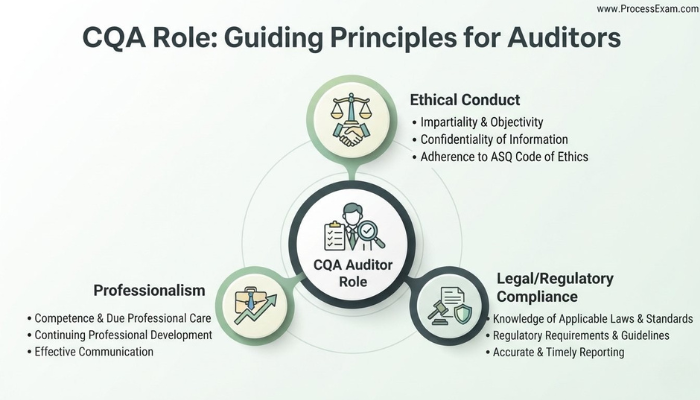
The Auditing Fundamentals section forms the bedrock of the ASQ Quality Auditor CQA exam, establishing the essential concepts and ethical principles that underpin all quality auditing activities. This domain covers the foundational knowledge required to understand the purpose, scope, and types of audits, ensuring auditors operate with integrity and a clear understanding of their role. A strong grasp here is crucial for interpreting audit standards and conducting effective assessments.
Key aspects of Auditing Fundamentals include:
-
Basic Concepts: Delving into the definitions of quality, audit, auditee, client, and auditor. This also encompasses understanding audit objectives, scope, and criteria.
-
Ethical Conduct and Professionalism: Emphasizing the auditor's responsibility to maintain impartiality, independence, and confidentiality. It covers the ASQ Code of Ethics and professional behavior during all audit phases.
-
Legal and Regulatory Requirements: Familiarity with relevant laws, regulations, and industry standards that govern quality management and auditing practices. This ensures compliance and mitigates legal risks.
-
Types of Audits: Distinguishing between first-party (internal), second-party (supplier), and third-party (certification/registration) audits, along with their respective objectives and methodologies.
-
Audit Principles: Understanding principles such as integrity, fair presentation, due professional care, confidentiality, and independence, which guide auditor conduct.
These fundamentals are not merely theoretical; they dictate the auditor's approach in real-world situations, influencing everything from planning to reporting. Candidates must not only memorize definitions but also understand the practical implications of these principles in diverse auditing contexts.
Navigating the Audit Process: A CQA Requirement
The Audit Process domain is central to the ASQ CQA certification, detailing the systematic steps involved in conducting an audit from initiation to follow-up. This section focuses on the practical application of auditing principles, ensuring candidates can manage each phase effectively to achieve audit objectives. Proficiency in these procedural elements is vital for any successful quality auditor.
The audit process involves several critical stages:
-
Audit Initiation: Defining the audit objectives, scope, and criteria, along with establishing the audit team and initial contact with the auditee.
-
Preparing for Audit Activities: This involves developing the audit plan, selecting the audit team, assigning responsibilities, and preparing working documents such as checklists and forms.
-
Performing the Audit: Executing on-site activities, including opening meetings, collecting and verifying information through interviews, observation, and document review, and identifying nonconformities.
-
Preparing and Distributing the Audit Report: Documenting audit findings clearly, objectively, and concisely. This includes nonconformity reports, summary findings, and conclusions.
-
Completing the Audit: Conducting the closing meeting, formal report distribution, and ensuring all audit objectives have been addressed.
-
Audit Follow-Up: Verifying the implementation and effectiveness of corrective actions taken by the auditee to address nonconformities. This ensures continuous improvement and resolution of identified issues.
Each step requires meticulous attention to detail and strong communication skills. Auditors must be able to adapt their approach based on the specific audit context while adhering to established protocols. The successful navigation of this process ensures a thorough and impactful audit outcome.
Cultivating Essential Auditor Competencies for Success
Beyond technical knowledge, the ASQ CQA credential emphasizes the critical competencies an auditor must possess to perform their duties effectively and professionally. This domain focuses on the personal attributes, skills, and behaviors that enable an auditor to lead, communicate, and resolve conflicts during the audit process. Developing these competencies is as crucial as understanding the theoretical aspects of quality auditing.
Key auditor competencies include:
-
Personal Attributes: Qualities such as ethical conduct, open-mindedness, diplomatic approach, perseverance, and decisiveness are paramount for maintaining integrity and effectiveness throughout the audit.
-
Communication Skills: The ability to listen actively, ask pertinent questions, articulate findings clearly, and facilitate productive discussions with auditees and clients. This involves both verbal and written communication.
-
Interpersonal Skills: Building rapport, managing group dynamics, handling difficult situations with tact, and fostering a collaborative environment, even when delivering critical findings.
-
Leadership and Teamwork: For audit team leaders, this involves planning and organizing audit activities, motivating team members, and ensuring consistent application of audit methodology. For team members, it’s about contributing effectively to the team's objectives.
-
Conflict Resolution: Skillfully addressing disagreements or resistance during an audit, mediating disputes, and maintaining focus on audit objectives without compromising impartiality.
-
Problem-Solving and Critical Thinking: Analyzing complex information, identifying root causes of nonconformities, and evaluating the effectiveness of proposed corrective actions.
These skills are refined through experience but can be actively developed through training and self-assessment. A well-rounded auditor combines deep technical knowledge with strong soft skills to navigate the intricate human elements of an audit. Many resources for developing these professional skills are available through quality training programs offered by ASQ.
Strategic Audit Program Management and Business Integration
The Audit Program Management and Business Applications section of the ASQ CQA syllabus shifts focus to the broader strategic context of auditing. This domain explores how audit programs are developed, implemented, and maintained within an organizational framework, emphasizing their alignment with business objectives and continuous improvement initiatives. Understanding this strategic dimension is crucial for auditors aiming to contribute at a higher level within their organizations.
Key elements of this domain include:
-
Establishing and Managing an Audit Program: Designing an audit program that defines objectives, scope, responsibilities, resources, and procedures for planning, conducting, reporting, and following up on audits.
-
Risk-Based Auditing: Incorporating risk assessment into audit planning to prioritize areas of highest risk, ensuring that audit resources are allocated effectively and focus on critical processes.
-
Strategic Planning and Objectives: Aligning audit activities with the organization's strategic goals, ensuring that audits support overall business objectives and contribute to enterprise-wide risk management.
-
Performance Measurement and Improvement: Monitoring the effectiveness of the audit program itself, evaluating auditor performance, and implementing improvements to the audit process.
-
Integration with Other Management Systems: Understanding how quality audits integrate with environmental, safety, information security, and other management systems (e.g., ISO 9001, ISO 14001).
-
Business Process Auditing: Applying audit principles to specific business processes (e.g., product design, manufacturing, customer service) to identify inefficiencies and areas for improvement.
This section highlights the auditor's role not just as a compliance checker but as a strategic partner in organizational performance and resilience. Effective audit program management ensures that auditing is a value-adding activity, rather than merely a cost center.
Leveraging Quality Tools and Techniques in CQA Practice
The final syllabus domain, Quality Tools and Techniques, equips ASQ CQA candidates with the analytical and problem-solving methodologies essential for effective auditing. This section focuses on the practical application of various tools to collect, analyze, and interpret data, allowing auditors to draw robust conclusions and support findings with objective evidence. Proficiency in these techniques enhances the depth and credibility of any audit report.
Critical quality tools and techniques covered include:
-
Data Collection and Analysis Tools:
-
Check Sheets: For systematic data collection.
-
Pareto Charts: To identify the most significant factors or nonconformities.
-
Histograms: To visualize data distribution and variation.
-
Scatter Diagrams: To explore relationships between two variables.
-
Control Charts: To monitor process stability and identify special causes of variation.
-
-
Process Analysis Tools:
-
Flowcharts: To map out process steps and identify potential bottlenecks or areas for noncompliance.
-
Cause and Effect (Fishbone) Diagrams: To systematically identify potential causes of a problem or nonconformity.
-
5 Whys Analysis: A technique to explore the root cause of a problem by repeatedly asking "why."
-
-
Sampling Techniques: Understanding different sampling methods (e.g., random, stratified, systematic) and their appropriate application in auditing to gather representative evidence.
-
Measurement System Analysis (MSA) Basics: An introduction to evaluating the precision and accuracy of measurement systems used in an organization.
These tools are not just for quality engineers; they are indispensable for auditors to substantiate their observations with quantifiable data. Using these techniques allows auditors to move beyond subjective judgment, providing a more objective and impactful assessment of a quality system. Further information on quality tools is available through quality assurance resources provided by ASQ.
Benefits of CQA Certification: Advancing Your Quality Career
Obtaining the ASQ CQA certification offers substantial benefits that can significantly accelerate a professional's career trajectory within the quality assurance landscape. This credential serves as a powerful differentiator, signaling advanced expertise and a commitment to maintaining the highest standards in auditing practices. The advantages span professional credibility, earning potential, and expanded career opportunities.
The core benefits of earning the CQA include:
-
Enhanced Professional Credibility: The ASQ CQA is internationally recognized, signifying that you meet a rigorous standard of knowledge and competence. This builds trust with employers, colleagues, and clients, making you a preferred choice for critical auditing roles.
-
Increased Earning Potential: Certified quality auditors often command higher salaries compared to their non-certified counterparts. The specialized skills validated by the CQA are in high demand, leading to better compensation and career growth prospects.
-
Expanded Career Opportunities: The certification opens doors to a broader range of roles, including Lead Auditor, Quality Manager, Compliance Officer, and roles within supplier quality or regulatory affairs. It can facilitate transitions into new industries or advancement within current organizations.
-
Demonstrated Expertise: The CQA proves your in-depth understanding of auditing principles, processes, and techniques across various quality management systems. This confidence translates into more effective audits and strategic contributions.
-
Networking Advantages: Becoming an ASQ Certified Quality Auditor connects you to a global network of quality professionals. This access to peers, mentors, and industry leaders provides invaluable opportunities for knowledge sharing and professional development.
-
Commitment to Continuous Improvement: The recertification requirement for CQA holders encourages ongoing learning and staying current with evolving quality standards and best practices, reinforcing a lifelong commitment to excellence.
These benefits collectively make the ASQ CQA a strategic investment for any quality professional serious about elevating their career and making a tangible impact on organizational quality.
Developing an Expert CQA Exam Preparation Plan
Achieving the ASQ CQA certification demands a structured and disciplined preparation approach. Given the breadth and depth of the syllabus, a well-thought-out study plan is essential for efficiently covering all domains and building the necessary confidence for the exam. This section outlines key strategies for developing an effective preparation regimen, moving beyond rote memorization to true understanding and application.
An expert CQA exam preparation plan should encompass:
-
Thorough Syllabus Review: Begin by meticulously reviewing each topic area outlined in the ASQ CQA Body of Knowledge. Understand the weighting of each domain to prioritize your study efforts.
-
Resource Identification: Gather official ASQ handbooks, reference materials, and recommended texts. Supplement these with high-quality third-party study guides and online courses that align with the ASQ syllabus.
-
Structured Study Schedule: Create a realistic study timetable, allocating dedicated time slots for each domain. Break down complex topics into manageable segments and schedule regular review sessions.
-
Conceptual Understanding: Focus on understanding the "why" behind concepts, not just the "what." The exam often tests the application of knowledge in scenarios, requiring a deep conceptual grasp.
-
Practice Question Integration: Incorporate solving practice questions regularly throughout your study. This helps identify weak areas, familiarizes you with the exam's question style, and improves time management.
-
Mock Exams: Simulate the actual exam experience by taking full-length practice tests under timed conditions. This is crucial for building stamina, managing pressure, and assessing your readiness.
-
Review and Refine: After each practice session or mock exam, thoroughly review incorrect answers. Understand why you made mistakes and revisit the relevant material to solidify your knowledge.
-
Form Study Groups: Collaborating with peers can provide different perspectives, clarify difficult concepts, and offer motivation. Discussing topics aloud can reinforce learning.
Effective preparation is not about cramming; it's about systematic learning, consistent practice, and strategic self-assessment. A comprehensive plan minimizes surprises on exam day and maximizes your chances of success.
Choosing the Best CQA Study Materials and Practice Resources
Selecting appropriate study materials is a cornerstone of effective ASQ CQA exam preparation. With numerous resources available, identifying those that accurately cover the ASQ Body of Knowledge and provide relevant practice is crucial. This section guides candidates through choosing high-quality study materials and leveraging practice resources to ensure thorough and efficient preparation.
Consider the following for your CQA study materials:
-
ASQ Official Resources: Start with the official ASQ Certified Quality Auditor Handbook. This is often the most authoritative resource, providing detailed explanations aligned with the exam's structure and content.
-
Reference Texts: Consult general quality management and auditing textbooks recommended by ASQ or reputable academic sources. These can offer broader context and deeper dives into specific topics.
-
Online Courses and Training: Enroll in ASQ-approved training courses or high-quality online prep courses. These often provide structured learning paths, expert instructors, and interactive content, which can be invaluable for complex topics.
-
Practice Exam Questions: Engaging with a variety of practice questions is non-negotiable. Look for practice exams that mimic the format, difficulty, and question style of the actual CQA exam. Platforms like ProcessExam offer extensive CQA practice questions that can help cement your understanding and test your readiness.
-
Flashcards and Summaries: Create your own flashcards for key definitions, formulas, and concepts. Summarizing complex topics in your own words helps with retention and recall.
-
Study Guides from Reputable Publishers: While the ASQ handbook is primary, well-regarded third-party study guides can offer alternative explanations and additional practice problems. Ensure they are current with the latest ASQ Body of Knowledge.
The goal is to build a diverse library of resources that caters to different learning styles and reinforces understanding through multiple approaches. Avoid relying on outdated materials or unverified sources, as this can lead to misconceptions and inadequate preparation.
Sustaining Your CQA Credential: Recertification Insights
Achieving the ASQ CQA certification is a significant milestone, but maintaining its validity requires ongoing commitment through a recertification process. This ensures that certified quality auditors remain current with evolving industry standards, best practices, and the latest advancements in quality management and auditing. Understanding the recertification requirements from the outset helps in strategic career planning and continuous professional development.
The ASQ CQA recertification process typically involves earning continuing education units (CEUs) or recertification units (RUs) over a three-year period. These units are accumulated through various professional activities, including:
-
Work Experience: Active engagement in quality-related work contributes significantly to recertification.
-
Continuing Education: Attending courses, workshops, seminars, and conferences related to quality auditing or quality management. These can be formal ASQ training programs or external, accredited educational opportunities.
-
Professional Activities: Participating in ASQ section activities, serving on committees, delivering presentations, or publishing articles in relevant quality journals.
-
Further Education: Earning additional degrees or certifications, especially those related to quality, can also contribute units.
-
Self-Study: Documented self-study hours, such as reading industry publications or relevant books, may also be eligible for units.
Detailed information on the specific number of units required and eligible activities can be found on the official ASQ certification website. Proactive tracking of professional development activities is key to a smooth recertification process, ensuring your ASQ CQA credential remains active and valuable throughout your career.
The Strategic Value of ASQ CQA in Modern Quality Assurance
In an increasingly complex and regulated business environment, the ASQ Quality Auditor CQA certification holds immense strategic value for organizations striving for excellence and compliance. Modern quality assurance transcends mere defect detection, encompassing risk management, continuous improvement, and robust system performance. A CQA-certified professional is uniquely positioned to drive these critical initiatives, making them indispensable assets to any organization.
The strategic contributions of ASQ CQA certified professionals include:
-
Elevating Organizational Trust: CQA auditors bring a high level of credibility to internal and external audit processes, fostering trust among stakeholders, customers, and regulatory bodies. This reduces business risk and enhances reputation.
-
Driving Systemic Improvement: Beyond identifying nonconformities, CQA auditors are trained to pinpoint root causes and recommend systemic improvements that enhance overall quality management systems, leading to sustainable operational excellence.
-
Ensuring Regulatory Compliance: With a deep understanding of legal and regulatory requirements, CQA professionals help organizations navigate complex compliance landscapes, minimizing penalties and ensuring adherence to industry standards.
-
Optimizing Supplier Performance: In global supply chains, CQA auditors play a critical role in evaluating and developing supplier quality, ensuring that external partners meet the same rigorous standards, thereby safeguarding product quality and brand integrity.
-
Facilitating Informed Decision-Making: Through objective audit reports and data-driven analysis, CQA auditors provide management with critical insights necessary for strategic decision-making, resource allocation, and risk mitigation.
-
Cultivating a Culture of Quality: The presence of CQA professionals within an organization often fosters a stronger culture of quality awareness, accountability, and continuous improvement, embedding quality into every aspect of operations.
By investing in CQA certification, individuals are not just advancing their careers; they are equipping themselves to be pivotal figures in an organization's journey towards operational excellence and competitive advantage. The ASQ CQA is a testament to expertise that directly impacts an organization's bottom line and long-term success.
The ASQ Quality Auditor CQA certification is far more than a resume enhancer; it is a profound investment in a quality professional’s expertise, credibility, and career longevity. The secret to mastering the CQA lies not just in studying hard, but in understanding the holistic demands of the role and the strategic value it brings to any organization. By meticulously preparing for the comprehensive exam, professionals solidify their grasp of auditing fundamentals, process mastery, essential competencies, and the application of powerful quality tools.
The journey to becoming an ASQ Certified Quality Auditor transforms individuals into strategic assets, capable of driving continuous improvement, ensuring compliance, and fostering a culture of excellence. Embrace this challenge, leverage the insights provided, and commit to the rigorous preparation required to unlock the full potential of your quality auditing career. Your commitment will distinguish you as a leading authority in the field.
To further enhance your preparation and validate your knowledge, explore comprehensive resources and practice exams designed to simulate the real test environment. Visit the ASQ certifications section on ProcessExam to access study materials and practice tests tailored for the ASQ CQA and other quality assurance credentials. Begin your strategic preparation today and secure your place among the elite in quality auditing.
FAQs
1. What does ASQ CQA certification validate?
The ASQ CQA certification validates a professional's expertise in auditing quality management systems, ensuring they understand audit principles, lead audit teams, evaluate quality systems, and ensure compliance with standards and regulations.
2. Who should pursue the ASQ Quality Auditor CQA certification?
The ASQ CQA certification is ideal for quality professionals, auditors, quality managers, and individuals responsible for conducting internal or external audits of quality systems within any industry. It suits those seeking to enhance their credibility and career prospects in quality assurance.
3. How long is the ASQ CQA exam and what is the passing score?
The ASQ CQA exam has a duration of 318 minutes (approximately 5 hours and 18 minutes). Candidates must achieve a scaled score of 550 out of 750 points to pass the examination.
4. Are there any prerequisites for taking the ASQ CQA exam?
ASQ typically requires candidates to have eight years of on-the-job experience in a quality assurance environment, with at least three years in a decision-making role. Educational degrees can waive some of the experience requirement. It's best to check the official ASQ website for the most current requirements.
5. How do ASQ CQA certified professionals maintain their certification?
ASQ CQA certified professionals maintain their certification through a recertification process, typically every three years. This involves accumulating recertification units (RUs) through continuing education, work experience, professional activities, and self-study to demonstrate ongoing professional development and currency in the field.
- ASQ Quality Auditor Sample Questions |
- CQA Exam Questions Download |
- CQA Test Questions |
- Quality Auditor PDF |
- ASQ Quality Auditor Book |
- ASQ CQA BOK PDF |
- Quality Auditor Certification Cost |
- Quality Auditor Certification Requirements |
- ASQ Quality Auditor Test Questions |
- CQA Question Bank |
- CQA Body of Knowledge (BOK) |
- Auditing |
- CQA Handbook


