
Difference Between ITIL and PRINCE2: Which to Take First
Take ITIL if your working day is about keeping live IT services healthy: tickets, changes, outages, suppliers. Take PRINCE2 if your day is about delivering something with a start, an end and a budget. They answer different questions, so they rarely compete. Both foundation exams come from PeopleCert and both run 60 minutes, closed book. ITIL 4 Foundation has 40 questions; PRINCE2 7 Foundation has 60.

Do you run services or deliver projects?
Most "ITIL or PRINCE2" arguments disappear once you stop comparing the certificates and look at your calendar. Ask yourself three plain questions.
- Does the work you own have an end date? A migration, a new system, an office move: PRINCE2 was built for work like this. A help desk, a monitoring rota or a supplier contract that renews every year has no end date, and that is ITIL territory.
- Who judges you, and on what? If a sponsor asks "is it on time, on budget and still worth doing?", you are in a project. If a business unit asks "why did the system go down twice this month?", you are running a service.
- What do you hand over? Project people hand over a finished product and move on. Service people receive that product and live with it for years.
Both frameworks came out of the same place. Wikipedia's ITIL entry traces ITIL to work done for the British government in the 1980s, and PRINCE2 grew up in the same public-sector setting. That shared background explains why they sound alike in meetings (business case, value, governance) while pointing at different halves of the same IT lifecycle.
If you are a service person
ITIL 4 starts from the idea that a service exists to help someone get value without carrying the cost and risk of producing it themselves. PeopleCert's ITIL 4 Foundation page lists the topics: service management concepts, the service value system, the four dimensions, the guiding principles, the practices, continual improvement, service level agreements and the metrics used to track them. Everything is about the running state of a service.
If you are a project person
PRINCE2 7 starts from the idea that a project is a temporary organisation set up to deliver a business case, and that someone senior must be able to stop it if the case falls apart. PeopleCert's page for the Foundation exam lists principles, practices, processes, roles, people management, project performance (including sustainability), digital and data management, communication and tailoring. Everything is about steering change from approval to closure.
If you are honestly both
Many people in small IT teams are the service owner on Monday and the project lead on Tuesday. If that is you, choose by the pain you feel most: recurring outages and unclear ownership point to ITIL; slipping dates and vague scope point to PRINCE2. The section on taking both exams, further down, covers the order.
How do the ITIL 4 and PRINCE2 7 Foundation exams compare side by side?
The figures below are the ones listed for each Foundation exam, with the fee as quoted for the exam itself. PeopleCert also sells bundles that add learning materials and eLearning, so the cart price you see may be higher than the bare fee.
| Detail | ITIL 4 Foundation | PRINCE2 7 Foundation |
|---|---|---|
| Exam code | ITIL 4 Foundation | PRINCE2 Foundation |
| Vendor | PeopleCert | PeopleCert |
| Exam fee | USD 463 | USD 338 |
| Duration | 60 minutes | 60 minutes |
| Questions | 40 | 60 |
| Passing score | 65% | 60% |
| Format | Multiple choice, closed book | Multiple choice, closed book |
| Exam languages listed | 12 | 14 |
| Renewal | Every 3 years, 60 CPD points | Every 3 years, 60 CPD points |
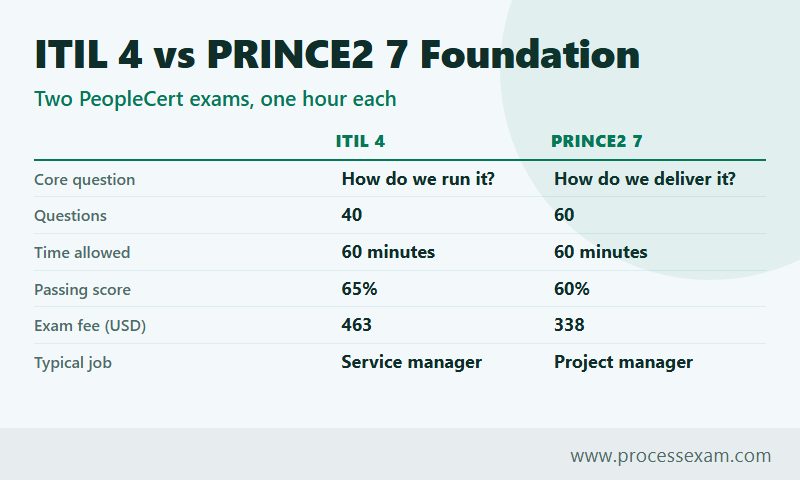
Put the percentages next to the question counts and the exams feel different. ITIL 4 Foundation needs 26 correct answers out of 40, which leaves 14 you can miss. PRINCE2 7 Foundation needs 36 out of 60, which leaves 24. The ITIL paper gives you 90 seconds a question; the PRINCE2 paper gives you 60. ITIL therefore rewards slower, careful reading of definitions, while PRINCE2 rewards quick recall of terms, roles and who decides what.
The fee gap is USD 125 in favour of PRINCE2. Sitting both exams costs USD 801 in fees alone, before any training, which is worth knowing if an employer is paying for only one.
What the fee does not tell you
Neither Foundation exam asks for prior experience, and PeopleCert describes both as suitable for any career stage. The difference shows up later. Foundation is the entry point for each framework, and the deeper qualifications assume you can already speak the vocabulary. Passing the cheaper exam does not make it the lighter credential; it only means the paper has more, shorter questions.
Where does a project end and a service begin?
The clearest way to see the difference is to follow one piece of IT work from idea to daily use. Take a hospital that wants to replace paper prescriptions with an electronic system.
Before approval
Someone has to explain why the hospital should spend money on this at all. That is project territory: a business case, a sponsor, an agreed budget and a decision on whether to go ahead. ITIL contributes the existing picture, such as which clinical services already run, how often they fail and what staff complain about.
During delivery
A project manager breaks the work into stages and gives the board a point at each stage boundary to continue, change course or stop. The service team has a seat here too, even though they are not building anything. They need to say what support the new system must have: who is on call, how outages are reported, what response time the wards expect and how the system will be monitored. A project that ignores these questions delivers something that works on test day and fails in month two.
The hand-over
This is the moment the two frameworks meet. PRINCE2 treats closure as a deliberate step: products are handed over, follow-on actions are recorded and the question of whether the promised benefits arrived is passed to people who will measure them later. ITIL picks up from there. The new system becomes a live service with a service desk, incident handling, a controlled way to make changes and agreed service levels.
Six months later
Nurses report that the system is slow at shift change. Nobody opens a project for that. It goes through incident and problem handling, and if it needs a configuration change, through change enablement. If the fix turns out to be large, say a new database server, it becomes a small project again, and the cycle restarts. Seen this way, PRINCE2 and ITIL are not alternatives; they take turns.
Which job titles lean on ITIL, which on PRINCE2, and which on both?
PeopleCert lists career roles on each certification page. Laying the two lists side by side shows where the pull of each framework sits. The table groups them; it does not claim a job posting will name only one.
| Role | Leans toward | Why |
|---|---|---|
| IT service manager, service operations manager | ITIL | Owns the agreed quality of live services and the people who deliver them |
| IT operations specialist, IT team leader | ITIL | Works inside incident, change and request handling every day |
| Project manager, project coordinator | PRINCE2 | Plans, controls and reports on work with a defined end |
| PMO manager, project support | PRINCE2 | Keeps plans, reports and controls consistent across projects |
| Business analyst, risk manager | PRINCE2 | Feeds the business case and the risk picture of a project |
| IT project manager | Both | Delivers change into an environment that someone else has to run |
| Product manager | Both | Appears on both lists; owns what is built and how it lives afterwards |
| Transformation or change manager | Both | Moves people from the old way to the new, then checks it stuck |
Two points stand out. First, the roles that sit between building and running (IT project manager, product manager, change manager) appear on lists for both frameworks, so those are the jobs where holding both certificates pays most visibly. Second, neither list promises a particular salary and neither does this article; if pay matters to your decision, check a salary survey for your own country and job title rather than relying on any certificate's marketing.
What hiring managers usually mean
When a job advert says "ITIL preferred", it normally means the team already uses incident, change and request records and wants a new joiner who will not need those words explained. When it says "PRINCE2 preferred", it normally means a project board, stage reports and a project manager who knows what a project brief is. Reading the advert's responsibilities, not the preferred-certificate line, tells you which framework the employer actually lives in.
Should you sit both exams, and which one goes first?
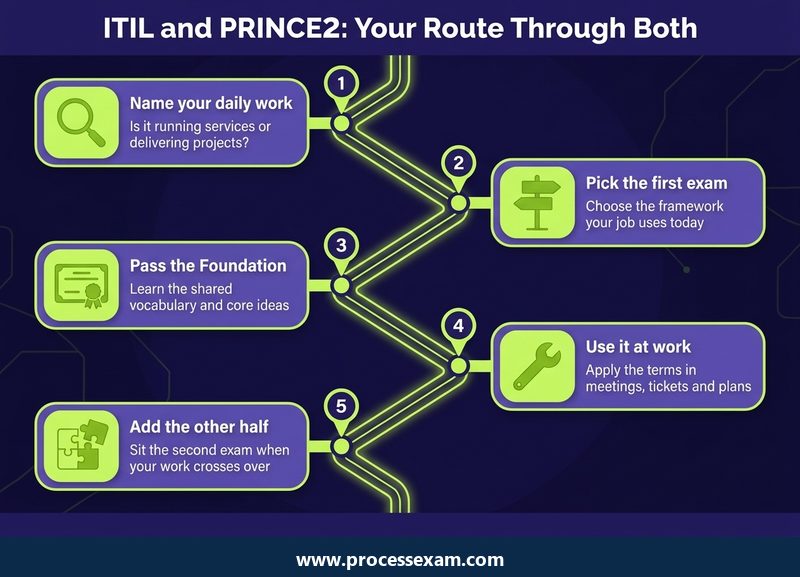
Yes, eventually, if your career crosses the boundary between building and running. The only real decision is the order, and it follows your current job.
- Start with ITIL 4 Foundation if you are on a service desk, in operations, in a support team or in a vendor-management role, and you expect a move into project work later. You will already know how things behave in production, so PRINCE2 will feel like adding structure to instincts you have.
- Start with PRINCE2 7 Foundation if you coordinate projects, work in a PMO or run change programmes. You will know how to get something approved and delivered, and ITIL will show you what happens to it afterwards.
- Start with the one your employer will fund if budget decides it. Fees and bundles change, so check PeopleCert's current page for your exam before you commit.
If ITIL is your first stop, a timed run through the ITIL 4 Foundation practice exam is a quick way to find out whether 90 seconds per question suits you before you book the real paper.
A gap of a few months between the two exams works better than back-to-back sittings. The two vocabularies overlap on purpose, and studying them in the same fortnight is how candidates end up mixing up what "change" or "risk" means in each. The next section shows where that happens.
Three paths people actually follow
The service desk analyst who wants out of the queue. ITIL 4 Foundation first, because it gives a name to everything already happening around you. After a year of helping with change reviews and release weekends, PRINCE2 7 Foundation shows how those weekends were planned and who approved them.
The project coordinator who keeps inheriting live systems. PRINCE2 7 Foundation first, since it matches the job today. When the projects keep ending with "and now you own it", ITIL 4 Foundation explains how to receive a system properly: service levels, ownership and a way to improve it.
The product manager who sits between the two. Either order works. Read PeopleCert's role lists, check which one your employer names in adverts, and take that exam first. The second then becomes a way of seeing your own job from the other side of the hand-over.
A note on ITIL versions
The figures in this article are for ITIL 4 Foundation, the version PeopleCert still lists on its ITIL 4 Foundation page. In October 2026, PeopleCert's ITIL page lists both ITIL 4 Foundation and a newer ITIL Foundation (Version 5), plus a Foundation Bridge route aimed at people already holding an ITIL 4 certificate. If you are choosing today, open the PeopleCert ITIL page, decide which version your employer expects, and read the exam details for that version before you pay.
Why do the same words mean different things in the two exams?
Candidates who study both frameworks in a hurry often trip on shared vocabulary. The words look the same on the page, but the question behind them differs. The table shows the five that cause the most confusion.
| Word | In an ITIL context | In a PRINCE2 context |
|---|---|---|
| Change | A modification to a live service, controlled so the risk of breaking it stays acceptable | A request to alter what the project agreed to deliver, handled through the issues routine |
| Product | A set of resources an organisation configures to offer value to a consumer | Any input or output of the project, tangible or not, that can be described and tested |
| Quality | How well a service meets the levels agreed with those who use it | Whether a delivered product meets the criteria agreed before it was built |
| Risk | Uncertainty that could reduce the value a service gives over time | Uncertainty that could affect the project's objectives, recorded and owned |
| Success | Users getting the outcomes they want, consistently | The business case staying justified while delivery stays inside agreed tolerances |
Read the rows as pairs of correct answers, not right and wrong. On the ITIL paper, "change" is about controlled movement in production. On the PRINCE2 paper, the same word is about scope and authority: who may approve a departure from the plan. Keeping the two meanings separate is the most useful habit if you take both exams within a year.
What genuinely overlaps
Both frameworks open with a set of seven principles, both push you to tailor the method to the situation rather than follow it by rote, and both treat governance as a reason for clear ownership, not paperwork. A question about "adapt the approach to the size of the work" can show up on either paper and the sensible answer is similar.
How to study the second exam faster
If one exam is behind you, spend your first study session on a one-page list of the terms in the table above, written from memory, then compare it with the syllabus. For the project side, the PRINCE2 Foundation syllabus shows how the content is organised. For the service side, PeopleCert's own ITIL 4 Foundation page is the reference. Then take a timed set of questions in the new style: closer to 60-second recall for PRINCE2, slower reading for ITIL.
What does neither exam cover, and what fills the gap?
A Foundation certificate shows that you know a framework's language and core ideas. It does not show that you have run a service desk for a year or steered a project through a cancelled stage. Here is what each leaves out and the usual next step.
What ITIL does not teach you
ITIL does not teach you how to plan, schedule and control a time-boxed piece of work. It describes how value is created and kept in services, not how a one-off delivery gets approved or cancelled. If you find yourself running a migration with only ITIL behind you, borrow the project side from PRINCE2 or another project method.
What PRINCE2 does not teach you
PRINCE2 does not teach you how to run a service after the project closes, how to measure service levels, or how to handle the daily flow of incidents and requests. Its closing step hands things over, but what happens next belongs to service management.
What about PMP and Agile?
Many searchers compare these two with PMP as well. PMP comes from a different body, the Project Management Institute, and sits in the project-management family, so it overlaps with PRINCE2 rather than with ITIL. If you already hold PRINCE2 and wonder about PMP, you are asking a project question; if you hold ITIL and wonder about PMP, you are adding a project skill the framework never offered. Neither credential removes the need for the other. PRINCE2 also has an Agile edition listed alongside its main exams, so teams working in short iterations have a route that is not PRINCE2 alone.
The practical next step
For ITIL holders, the next step is either a deeper ITIL module or the Version 5 bridge on PeopleCert's ITIL certification page, depending on your employer's direction. For PRINCE2 holders, the next step is the Practitioner level, which tests application rather than recall and is covered elsewhere on this blog. For people who hold both Foundations, the strongest move is often not a third certificate but showing that you can run a hand-over: write down one project of yours and trace it through to the first incident ticket.
To read the exam-level detail straight from the source, PeopleCert's pages for ITIL 4 Foundation and PRINCE2 7 Foundation list the syllabus topics, languages, purchase options and renewal rules. Wikipedia's ITIL article gives the history if you want the background.
Frequently Asked Questions
What is the difference between ITIL and PRINCE2?
ITIL is a framework for running IT services after they go live: incidents, changes, service levels and continual improvement. PRINCE2 is a method for managing projects with a start, an end and a business case. ITIL covers ongoing operations, PRINCE2 covers delivery, and many IT teams use both.
Should I take ITIL or PRINCE2 first?
Take the one that matches your current job. Service desk, operations and support staff usually start with ITIL 4 Foundation. Project coordinators, PMO staff and project managers usually start with PRINCE2 7 Foundation. If your employer funds only one, choose that and add the other when your work crosses over.
Which is harder, ITIL 4 Foundation or PRINCE2 7 Foundation?
Neither is hard for prepared candidates, but they test differently. ITIL 4 Foundation has 40 questions and needs 65%, so 26 correct, at about 90 seconds each. PRINCE2 7 Foundation has 60 questions and needs 60%, so 36 correct, at about one minute each. Both are closed book.
How much do the ITIL 4 Foundation and PRINCE2 7 Foundation exams cost?
The ITIL 4 Foundation exam fee is USD 463 and the PRINCE2 7 Foundation exam fee is USD 338, so both together come to USD 801. PeopleCert also sells bundles with learning materials and eLearning, and shows prices in your local currency, so check the cart before you buy.
Can I hold both ITIL and PRINCE2 certifications?
Yes. They are separate PeopleCert certifications with no rule that stops you holding both, and they suit the roles that sit between building and running IT, such as IT project manager, product manager and change manager. A gap of a few months between the two exams helps you keep their vocabularies apart.
- ITIL 4 Foundation Question Bank |
- ITIL 4 Foundation Test Questions |
- ITIL 4 Foundation Body of Knowledge (BOK) |
- ITIL 4 Foundation Certification Cost |
- ITIL 4 Foundation Certification Requirements |
- ITIL 4 Foundation PDF |
- PeopleCert ITIL 4 Foundation Test Questions |
- ITIL 4 Foundation Simulator |
- ITIL 4 Foundation Mock Exam |
- PeopleCert ITIL 4 Foundation Book |
- PeopleCert ITIL 4 Foundation BOK PDF |
- PeopleCert ITIL 4 Foundation Sample Questions |
- ITIL 4 Foundation Exam Questions Download


