
The Untold Levels of OMG-OCSMP-MBF200 Progression
The OMG-OCSMP-MBF200 certification, known formally as the OMG-Certified Systems Modeling Professional - Fundamental, stands as a pivotal credential for professionals aiming to validate their foundational understanding and practical skills in systems modeling. Offered by the OMG (Object Management Group), this examination is designed for individuals who work with or aspire to work with systems modeling languages and methodologies, particularly SysML. This article delves into the various facets of this certification, from its core objectives and exam structure to the strategic preparation required, career benefits, and pathways for advanced professional development within the realm of systems modeling.
Navigating the OMG-OCSMP-MBF200 Credential Landscape
The OMG-OCSMP-MBF200 certification serves as a baseline for demonstrating proficiency in SysML (Systems Modeling Language) concepts and application. It is specifically targeted at systems engineers, software engineers, architects, business analysts, and anyone involved in the design, analysis, and implementation of complex systems using model-based approaches. Earning this fundamental credential signifies a candidate's ability to understand, interpret, and effectively contribute to modeling efforts, laying a crucial groundwork for more advanced roles and responsibilities in the field. This credential ensures that professionals can accurately communicate system designs and behaviors, fostering clarity and efficiency across development teams.
Defining the Foundational Professional
The OMG-Certified Systems Modeling Professional - Fundamental certification confirms that an individual possesses the basic knowledge and skills necessary to build and interpret systems models. It covers essential modeling concepts, including structural and behavioral aspects, requirements modeling, and understanding the core capabilities of SysML. Professionals who achieve this certification are recognized for their commitment to industry best practices in systems engineering. This foundational level is critical for ensuring that all participants in a modeling project share a common understanding and can collaborate effectively using a standardized language.
Recognizing the Certification's Core Purpose
At its heart, the OMG-OCSMP-MBF200 certification validates a professional’s comprehension of fundamental SysML constructs and their application in real-world scenarios. It ensures that certified individuals can correctly utilize SysML diagrams and elements to represent various aspects of a system, from its components and interactions to its requirements and behaviors. This validation extends beyond mere theoretical knowledge, emphasizing the practical ability to engage with and contribute to model-based systems engineering (MBSE) initiatives. This foundational understanding is invaluable in industries where complex systems necessitate precise and unambiguous communication.
Decoding the OMG-OCSMP-MBF200 Exam Framework
Understanding the structure of the OMG-OCSMP-MBF200 exam is paramount for effective preparation. The examination is meticulously designed to assess a candidate's grasp of fundamental systems modeling principles as defined by the OMG. Knowing the format, duration, and scoring criteria provides candidates with a clear roadmap for what to expect on exam day, reducing anxiety and allowing them to tailor their study approach strategically. The clear cut structure helps candidates focus their efforts on the most critical areas.
Key Examination Specifications
The OMG-OCSMP-MBF200 exam adheres to a standardized set of specifications to ensure fairness and consistency for all candidates. These details offer a comprehensive overview of the testing environment and requirements:
-
Exam Name: OMG-Certified Systems Modeling Professional - Fundamental
-
Exam Code: OMG-OCSMP-MBF200
-
Exam Price: USD $350
-
Number of Questions: 90 multiple-choice questions designed to test both conceptual understanding and application.
-
Passing Score: Candidates must achieve a score of 60 out of 90 to pass the examination.
-
Duration: The allocated time varies based on residency. Residents of English-speaking countries receive 105 minutes, while all others are granted 135 minutes to complete the exam.
These specifications highlight the importance of not only knowing the material but also managing time effectively during the exam.
Maximizing Time and Performance on Test Day
Given the exam's duration and number of questions, candidates must develop strong time management skills. For those in English-speaking countries facing a 105-minute limit for 90 questions, each question allows approximately 1 minute and 10 seconds. Non-English speaking residents benefit from an additional 30 minutes, allowing approximately 1 minute and 30 seconds per question. Effective practice under timed conditions, using resources like practice exam questions, is crucial to perform optimally and comfortably within these constraints. Consistent review helps solidify concepts and speed up recall, making the best use of the allocated time.
Core Syllabus Domains for Systems Modeling Professional Fundamental
The OMG-OCSMP-MBF200 exam covers a comprehensive syllabus designed to ensure candidates have a solid understanding of systems modeling fundamentals. Each domain contributes a specific percentage to the overall exam, indicating its relative importance. A balanced study approach, giving due attention to each section based on its weight, is essential for thorough preparation.
Key Subject Areas and Their Emphasis
The OMG-OCSMP-MBF200 syllabus is structured into four main domains:
-
MODELING STRUCTURE AND BEHAVIOR - 57%: This is the largest section, focusing on the core aspects of SysML diagrams related to system structure (e.g., Block Definition Diagrams, Internal Block Diagrams, Package Diagrams) and behavior (e.g., Activity Diagrams, Sequence Diagrams, State Machine Diagrams, Use Case Diagrams). Candidates need to understand how to represent system components, their properties, relationships, and how systems interact and change states over time. This heavy weighting underscores the practical application of SysML constructs in detailing system design and function.
-
THE MODEL - 19%: This section addresses fundamental concepts related to the overall model, its organization, and general principles of modeling. It includes understanding model elements, views, and viewpoints, and how to manage and structure models effectively. It also covers the basic philosophy behind model-based systems engineering (MBSE) and how models serve as central artifacts in system development.
-
MODELING REQUIREMENTS - 16%: This domain focuses on using SysML for capturing, analyzing, and managing system requirements. It covers Requirement Diagrams, understanding the relationship between requirements and other model elements, and traceability. Effective requirements modeling is critical for ensuring that systems meet stakeholder needs and for verifying system designs against those requirements.
-
CAPABILITIES AND FEATURES - 8%: This smaller but important section delves into specific features and advanced capabilities within SysML that enhance modeling expressiveness and utility. It may include topics such as allocations, constraints, and custom stereotypes, demonstrating a deeper understanding of the language's power and flexibility.
A strong grasp of these domains, particularly Modeling Structure and Behavior, is vital for success in the certification exam.
Prioritizing Study Efforts Across Domains
Given the percentage breakdown, candidates should allocate their study time proportionally. While a foundational understanding of "Capabilities and Features" is necessary, the majority of effort should be directed towards "Modeling Structure and Behavior." Creating a study plan that revisits and reinforces concepts from the higher-weighted sections multiple times will be more effective than uniform distribution. This targeted approach ensures that the most impactful areas of the syllabus are thoroughly mastered.
Strategic Preparation for OMG-OCSMP-MBF200 Success
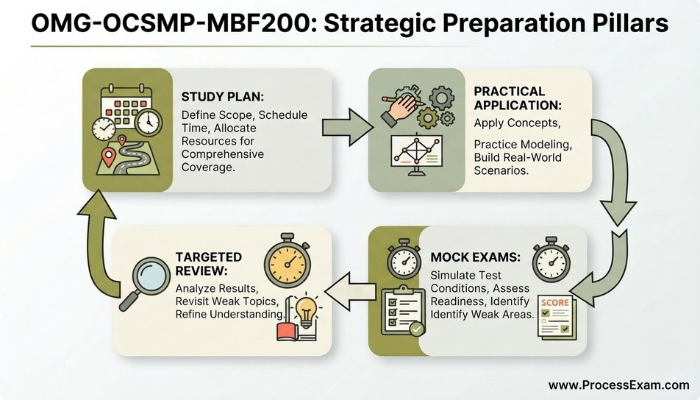
Embarking on the OMG-OCSMP-MBF200 certification journey requires a well-structured and disciplined preparation strategy. Simply reviewing concepts is often not enough; candidates must actively engage with the material, practice their modeling skills, and simulate the exam environment. A comprehensive approach ensures both theoretical understanding and practical readiness.
Developing a Robust Study Plan
Successful candidates typically begin by crafting a detailed study plan. This involves:
-
Syllabus Review: Go through the entire OMG-Certified Systems Modeling Professional - Fundamental syllabus to understand all topics and their weightages.
-
Resource Gathering: Collect official OMG documentation, recommended textbooks on SysML, online tutorials, and reputable OMG-OCSMP-MBF200 study guide materials.
-
Scheduled Learning: Allocate dedicated time slots for studying each domain, prioritizing heavier weighted sections. Consistency is more important than cramming.
-
Conceptual Understanding: Focus on truly understanding the "why" behind SysML constructs, not just memorizing syntax.
This foundational planning sets the stage for efficient and effective learning.
Leveraging Practical Application and Mock Exams
Theoretical knowledge must be complemented by practical application. Actively drawing diagrams, interpreting existing models, and working through case studies are invaluable. Furthermore, incorporating practice tests into your routine is essential. OMG-OCSMP-MBF200 practice test resources are critical for:
-
Familiarizing yourself with the exam format and question types.
-
Identifying areas of weakness that require further study.
-
Improving time management skills under exam conditions.
-
Building confidence and reducing exam-day anxiety.
Always review incorrect answers thoroughly to understand the underlying concepts and avoid repeating mistakes.
Unlocking Career Potential with OMG-Certified Systems Modeling Professional - Fundamental
The OMG-OCSMP-MBF200 certification is more than just a piece of paper; it's a strategic investment in a professional's career trajectory within the rapidly evolving landscape of systems engineering. In an era where complex systems demand precise design and clear communication, this credential significantly enhances marketability and opens doors to advanced opportunities.
Enhanced Professional Credibility
Earning the OMG-Certified Systems Modeling Professional - Fundamental designation immediately elevates a professional's standing. It signals to employers and peers a verified commitment to excellence and a standardized understanding of SysML. This enhanced credibility can be a differentiator in competitive job markets, showcasing a dedication to foundational knowledge in model-based systems engineering. Organizations increasingly seek certified professionals who can contribute to robust and well-defined system architectures from the outset. Further information can be found at the OMG certification portal.
Broadening Career Horizons
The skills validated by the OMG-OCSMP-MBF200 are highly transferable and applicable across numerous industries, including aerospace, automotive, defense, healthcare, and software development. Professionals with this certification are well-suited for roles such as:
-
Systems Analyst
-
Junior Systems Engineer
-
Requirements Engineer
-
Model-Based Systems Engineer (MBSE) Practitioner
-
Software Architect (with a systems perspective)
The certification can serve as a strong OMG-Certified Systems Modeling Professional - Fundamental career path accelerator, enabling individuals to take on more complex projects and leadership responsibilities as their experience grows. It also provides a solid foundation for pursuing more specialized or advanced certifications within the OMG framework.
Deepening Your Systems Modeling Expertise Beyond the Fundamental
While the OMG-OCSMP-MBF200 certification establishes a robust foundation, it also serves as a springboard for continuous learning and specialization in systems modeling. The field is dynamic, and staying current with evolving standards and advanced techniques is crucial for long-term career success. This fundamental certification opens pathways to more intricate domains.
Pathways for Advanced Certification
For professionals seeking to advance their expertise, the OMG offers higher-level certifications within the OCSMP program, such as Intermediate and Advanced levels. These build upon the fundamental concepts, delving into more complex modeling scenarios, advanced SysML constructs, and sophisticated application patterns. Pursuing these higher credentials demonstrates a sustained commitment to mastery and positions professionals for expert roles. Staying informed about the latest industry insights from OMG can guide these advanced pathways.
Cultivating Specialized Skill Sets
Beyond formal certifications, professionals can deepen their expertise by focusing on specialized areas within systems modeling. This might include:
-
Model-Based Systems Engineering (MBSE) Tool Proficiency: Gaining expert-level skills in specific MBSE tools (e.g., Enterprise Architect, Rhapsody, Cameo Systems Modeler).
-
Domain-Specific Modeling: Applying SysML and MBSE principles to a particular industry or problem domain, such as embedded systems, safety-critical systems, or enterprise architecture.
-
Simulation and Analysis: Developing skills in simulating system behaviors from models and performing various analyses to validate designs.
-
Metamodeling and Language Customization: Understanding how to extend SysML or create domain-specific languages (DSLs) based on metamodeling principles.
These specializations further enhance a professional's value and adaptability in diverse engineering environments.
Essential Tools and Techniques for OMG-OCSMP-MBF200 Candidates
Preparing for the OMG-OCSMP-MBF200 exam extends beyond theoretical knowledge; it involves understanding and, ideally, gaining some exposure to the practical tools and techniques used in systems modeling. While the exam doesn't test tool-specific proficiency directly, familiarity with common practices enhances comprehension of the underlying principles.
Navigating SysML Modeling Tools
SysML is a graphical language, and its practical application almost always involves specialized modeling tools. While candidates aren't expected to be experts in any single tool for the fundamental exam, understanding how these tools facilitate model creation, validation, and collaboration is beneficial. Exposure to user interfaces and basic functionalities of popular MBSE tools can reinforce the theoretical concepts learned from the syllabus. This hands-on perspective helps bridge the gap between abstract concepts and their real-world implementation.
Applying Effective Learning Methodologies
Beyond tools, the choice of learning methodologies significantly impacts exam readiness. Key approaches include:
-
Active Recall: Instead of passively rereading, actively retrieve information from memory. This could involve flashcards, self-quizzing, or explaining concepts to others.
-
Spaced Repetition: Reviewing material at increasing intervals over time to strengthen long-term memory retention.
-
Diagram Interpretation and Creation: Regularly practice drawing different SysML diagrams from scratch based on given scenarios, and conversely, interpret existing complex diagrams. This is crucial for the heavily weighted "MODELING STRUCTURE AND BEHAVIOR" section.
-
Concept Mapping: Create visual maps to connect different SysML concepts, showing their relationships and hierarchies. This aids in understanding the interconnectedness of the modeling language.
These techniques, when combined, create a powerful learning ecosystem for mastering the OMG-OCSMP-MBF200 exam topics.
Estimating the Financial Commitment: OMG-OCSMP-MBF200 Certification Cost
Understanding the financial investment associated with the OMG-OCSMP-MBF200 certification is a practical aspect of planning. Beyond the direct exam fee, candidates should also account for potential costs related to study materials, training, and practice resources. A clear financial overview helps candidates budget effectively for their certification journey.
Direct Exam Fees and Related Expenditures
The primary financial outlay for the OMG-OCSMP-MBF200 certification cost is the exam fee itself. At USD $350, this fee covers the cost of taking the official examination. However, candidates should also consider other potential expenses:
-
Study Guides and Textbooks: While some resources are free, high-quality, in-depth study guides or recommended textbooks may incur additional costs.
-
Training Courses: Optional OMG-OCSMP-MBF200 training course options, whether online or in-person, can significantly aid preparation but come with varying price tags.
-
Practice Tests: Access to premium practice exams might be an additional, but often worthwhile, investment to ensure readiness.
-
Retake Fees: In the event that a candidate does not pass on the first attempt, a retake fee would apply, making thorough initial preparation a cost-saving measure.
Factoring in these potential costs provides a realistic budget for the entire certification process.
Assessing the Return on Investment
While there is an upfront financial commitment, it is important to view the OMG-OCSMP-MBF200 as an investment in professional development. The enhanced career prospects, potential for higher earning capacity, and increased professional credibility often outweigh the initial costs over the long term. This certification can accelerate a career path, leading to more specialized roles and greater responsibilities within organizations that value model-based systems engineering expertise. The value proposition of the certification extends far beyond the monetary expense.
Maximizing Your Readiness: Effective OMG-OCSMP-MBF200 Practice and Review
True mastery of the OMG-OCSMP-MBF200 material comes through consistent practice and thorough review. This phase of preparation moves beyond passive learning into active engagement, solidifying understanding and sharpening exam-taking skills. Effective strategies here directly translate to improved performance on the actual exam.
Integrating Practice Tests into Your Schedule
Regularly taking OMG-OCSMP-MBF200 practice test sessions is non-negotiable for success. These simulations serve multiple purposes:
-
They expose you to the types of questions and scenarios presented in the actual exam.
-
They help you gauge your understanding of specific OMG-Certified Systems Modeling Professional - Fundamental exam topics.
-
They train you to manage your time effectively, answering questions accurately under pressure.
After each practice test, dedicate time to review every question, especially those answered incorrectly. Understand why the correct answer is correct and why your chosen answer was wrong. This iterative process of test-review-learn is highly effective. Additional OMG certification resources can supplement this practice.
Refining Your Knowledge with Targeted Review
Beyond practice tests, targeted review sessions are crucial for reinforcing weaker areas. Utilize your study notes, official documentation (like the official SysML Model Builder Fundamental guide), and any challenging topics identified during practice. Focus on:
-
Revisiting Core Concepts: Ensure a deep understanding of fundamental SysML principles and systems modeling professional fundamental concepts.
-
Diagrammatic Mastery: Practice interpreting and creating complex SysML diagrams without aids, paying attention to syntax and semantics.
-
Scenario-Based Questions: Work through problems that require applying SysML concepts to real-world engineering scenarios, which mimics the practical nature of some exam questions.
-
Flashcards: Create flashcards for key terms, definitions, and diagrammatic elements to aid rapid recall.
This meticulous review ensures that no stone is left unturned in your pursuit of certification.
The Tangible Value of OMG-OCSMP-MBF200 in Modern Engineering
The OMG-OCSMP-MBF200 certification holds significant tangible value in today's complex engineering landscape. It addresses a growing industry demand for professionals capable of applying model-based approaches to design, analyze, and manage systems. This credential directly translates to practical advantages in various professional capacities.
Driving Efficiency and Communication in Projects
Certified professionals are equipped to contribute to projects with improved efficiency and clearer communication. By leveraging a standardized language like SysML, ambiguity in system specifications is reduced, leading to fewer errors, less rework, and faster development cycles. The ability to create and interpret precise models facilitates better understanding among multidisciplinary teams, stakeholders, and clients. This enhanced clarity directly impacts project success rates and reduces overall costs, making the certification highly valuable to organizations. Learn more about the full certification program details.
Validating Essential Systems Modeling Professional Fundamental Concepts
The certification validates a strong grasp of essential systems modeling professional fundamental concepts. These include the ability to:
-
Represent system architecture using various structural diagrams.
-
Illustrate system behavior through activity, sequence, and state machine diagrams.
-
Capture and trace requirements effectively using SysML.
-
Understand the role of models in the overall system development lifecycle.
These skills are critical for any organization adopting or scaling MBSE practices. The OMG-OCSMP-MBF200 assures employers that a candidate possesses these core competencies, enabling them to hit the ground running and make meaningful contributions. This makes the question "is OMG-OCSMP-MBF200 worth it?" an easy one to answer, given the clear benefits.
Engaging with the Systems Modeling Professional Community
Beyond individual study and certification, connecting with the broader systems modeling professional community offers invaluable benefits. Engagement provides opportunities for networking, continuous learning, and staying abreast of industry trends and best practices. It transforms the solitary study process into a collaborative professional journey.
Benefits of Community Involvement
Participating in professional communities and forums dedicated to systems modeling can significantly enhance a candidate's preparation and ongoing career development. These benefits include:
-
Access to Expert Insights: Engage with seasoned professionals who can offer practical advice, share experiences, and clarify complex concepts related to OMG-OCSMP-MBF200 exam preparation tips.
-
Networking Opportunities: Build connections with peers and industry leaders, potentially leading to career opportunities, mentorships, or collaborative projects.
-
Shared Resources: Discover additional study materials, tutorials, and practical examples that complement official resources.
-
Problem-Solving Collaboration: Discuss challenging modeling scenarios or exam questions with others, gaining different perspectives and strengthening understanding.
-
Staying Current: Keep informed about updates to SysML, new tools, and emerging trends in model-based systems engineering.
The OMG professional communities themselves are excellent starting points for this engagement.
Utilizing Online Forums and Study Groups
Numerous online platforms host discussions and study groups for systems modeling professionals. These can be particularly helpful for preparing for OMG-OCSMP-MBF200 certification. Joining a study group, even virtually, can provide:
-
Structured accountability for your study plan.
-
Opportunities to teach concepts to others, which reinforces your own understanding.
-
A supportive environment to ask questions without hesitation.
Active participation in these communities transforms the learning experience, making it more dynamic and engaging. It provides a platform to validate understanding and discuss various OMG-OCSMP-MBF200 exam sample questions.
Conclusion
The OMG-OCSMP-MBF200 certification represents a critical step for any professional dedicated to the discipline of systems modeling. It validates a foundational understanding of SysML, equipping individuals with the skills to contribute effectively to complex system design and development. The progression through this fundamental level not only enhances individual credibility but also significantly broadens career opportunities in diverse industries. Embracing a strategic preparation approach, leveraging available resources, and engaging with the professional community are key to unlocking the full potential of this valuable credential. The journey through the OMG-OCSMP-MBF200 is indeed a pathway to mastering essential model-based systems engineering principles, fostering clear communication and robust system development.
For those ready to solidify their expertise in systems modeling, taking the next step towards OMG-OCSMP-MBF200 certification is highly recommended. Explore comprehensive resources and start your focused preparation to achieve this foundational credential. Further information on related certifications and training can be found at OMG certification resources.
FAQs
1. What does the OMG-OCSMP-MBF200 certification validate?
The OMG-OCSMP-MBF200 certification validates a professional's foundational understanding of SysML (Systems Modeling Language) and its application in model-based systems engineering. It confirms the ability to interpret and contribute to system models, focusing on structural, behavioral, and requirements modeling concepts.
2. Who should consider taking the OMG-OCSMP-MBF200 exam?
This exam is ideal for systems engineers, software architects, business analysts, and other technical professionals involved in designing, developing, or analyzing complex systems. Anyone looking to formalize their basic SysML knowledge and enhance their career in model-based engineering will benefit.
3. How long is the OMG-OCSMP-MBF200 certification valid?
OMG certifications typically do not have an expiration date, meaning once earned, the certification remains valid indefinitely. However, staying current with evolving standards and practices through continuous learning and advanced certifications is highly recommended to maintain relevance.
4. What kind of preparation is recommended for the OMG-OCSMP-MBF200 exam?
Effective preparation includes reviewing the official syllabus, studying OMG-recommended SysML specifications, utilizing comprehensive study guides, and practicing with sample questions and practice tests. Hands-on experience with SysML modeling tools, though not directly tested, can also greatly enhance understanding.
5. Is the OMG-OCSMP-MBF200 certification recognized globally?
Yes, as an Object Management Group (OMG) certification, the OMG-OCSMP-MBF200 is internationally recognized. The OMG is a respected global standards body, ensuring that its certifications carry weight and are valued by organizations worldwide that adopt SysML and MBSE practices.
- SysML Certifications |
- OMG OCSMP Fundamental Test Questions |
- OMG-OCSMP-MBF200 Question Bank |
- SysML MBF Simulator |
- SysML MBF Mock Exam |
- OMG OCSMP Fundamental Book |
- OCSMP Fundamental Certification Cost |
- OCSMP Fundamental Certification Requirements |
- OMG SysML MBF Question Bank |
- OMG SysML MBF Book |
- OMG SysML MBF Study Guide |
- SysML MBF Certification |
- SysML MBF Certification Cost |
- SysML MBF Certification Requirements |
- OMG OCSMP Fundamental Sample Questions |
- OMG-OCSMP-MBF200 Exam Questions Download |
- OMG-OCSMP-MBF200 Test Questions |
- OCSMP Fundamental PDF |
- OMG SysML MBF Exam Questions |
- OMG SysML MBF Sample Questions |
- SysML MBF |
- SysML MBF PDF


