
SPC vs RTE vs SAFe Agilist: Which SAFe Certification to Hold
Updated on 30 October 2026. What’s new: now covers the AI-Empowered SPC, RTE and Agilist exams, replacing the older SPC domain list and weightings
Hold the Agilist if you sponsor the change, the Release Train Engineer if you run a train, and the Practice Consultant if you are the person teaching and coaching it. The three exams are close in shape, with 45 to 60 questions and 80% to 83% to pass, but the SPC is the only one that lets you train and certify others, and its retake costs $250 against $50 for the other two.
That one-line verdict hides plenty of detail: who needs which certificate, what the courses expect from you, and what order makes sense when you want more than one. This guide works through the choice using Scaled Agile's current AI-Empowered exam details, read in October 2026, and leaves the full SPC exam walkthrough to its own article.
Which SAFe certification matches the job you actually do?
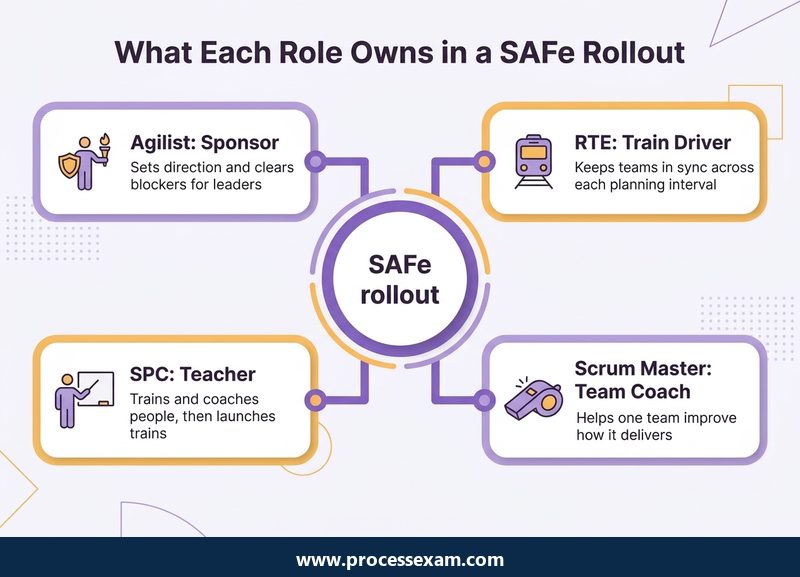
Scaled Agile sells certifications by role, not by seniority, and the quickest way to choose is to ask what you will be doing on a Monday morning during a rollout. A rollout has three recurring jobs: someone with authority has to steer and sponsor the change, someone has to keep each Agile Release Train moving, and someone has to teach and coach everybody else. Those three jobs line up with the Agilist, the RTE and the SPC.
The Agilist sponsors and steers
The SAFe Agilist (SA) is written for people who lead or want to lead change in a large organisation, and the page names executives, directors, product managers and agile coaches. You come out able to talk about value streams, Lean Portfolio Management and the leader's part in change with the people actually doing the work. You do not come out able to run a planning event for a hundred people or to teach a class, and the certification does not pretend otherwise.
The RTE keeps one train in sync
The SAFe Release Train Engineer (RTE) is for people who already oversee several teams. Scaled Agile describes the role as a servant leader and coach for the Agile Release Train: facilitating PI Planning, clearing impediments, managing risk, and keeping teams and stakeholders aligned. The certification page targets program managers and agile coaches who want to move into the role, and it also lists Solution Train Engineers and project managers. The scope is one train, or a handful, and it is hands-on and calendar-driven.
The SPC builds and teaches the whole thing
The SAFe Practice Consultant (SPC) sits one level up in breadth. The certification page says it gives you the ability to teach a set of SAFe courses to others, which neither of the other two does, and the course behind it covers implementation: identifying value streams, launching trains, coaching them, and connecting portfolio decisions to strategy. An SPC is expected to design the rollout that Agilists sponsor and RTEs then operate.
One way to hold the three apart is by the question each one answers. The Agilist answers "what should leadership do differently?", the RTE answers "how does this train deliver together?", and the SPC answers "how do we get the whole organisation there, and who teaches it?". When you read a job advert, the verbs tell you which certificate the employer means: sponsor and lead point to SA, facilitate and coordinate point to RTE, and implement, coach and train point to SPC.
What do the three exams look like side by side?
All three share the same delivery rules: web-based, closed book, multiple choice with a single correct answer, with an unlimited practice test bundled in. The differences are in length, pass mark and what a failed attempt costs. The figures below come from the exam details Scaled Agile publishes for each exam, with the SPC study guide dated 8 April 2026, the RTE exam details dated 9 June 2026 and the study guide for the Agilist, all read in October 2026.
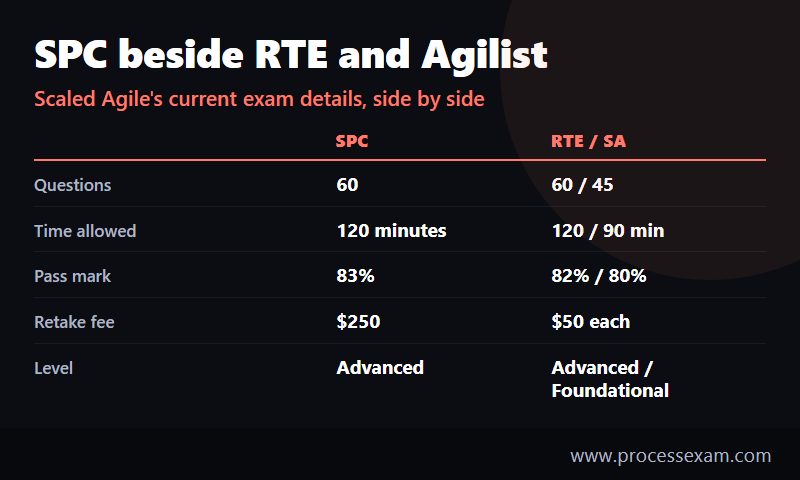
| Detail | SPC | RTE | SA |
|---|---|---|---|
| Certification | Certified SAFe Practice Consultant | Certified SAFe Release Train Engineer | Certified SAFe Agilist |
| Exam code | SPC | RTE | SA |
| Level on Scaled Agile's page | Advanced | Advanced | Foundational |
| Questions | 60 | 60 | 45 |
| Duration | 120 minutes | 120 minutes | 90 minutes |
| Passing score | 83% | 82% | 80% |
| Question format | Multiple choice, single select | Multiple choice, single select | Multiple choice, single select |
| Attempts included | One, within 60 days of the course | One, within 60 days of the course | Two, within 60 days of the course or the exam purchase |
| Fee per retake | $250 | $50 | $50 unproctored, $495 proctored |
| Keeping it current | Renewed yearly | Renewed yearly | At least 12 continuing education units a year |
Do the arithmetic and the passing scores say something about how much room for error you have. At 83% on 60 questions you need roughly 50 correct, so about ten misses end the attempt; at 82% on the RTE the margin is nearly the same; at 80% on 45 questions the Agilist allows nine misses. The SPC and RTE are therefore the same exam length with a slightly harsher pass line than the Agilist's shorter paper, which matters if you were hoping the advanced exams would feel like a bigger Agilist.
The fee line is where the SPC stands apart. A retake costs $250 after a failed first attempt, five times the RTE's fee. Scaled Agile also spaces the attempts: the first retake can follow straight away, the next needs a ten-day wait, and later ones a thirty-day wait. For an SPC candidate who has just paid for a four-day course, that price is a good reason to arrive prepared rather than treat the first sitting as a trial run.
Older web pages, including earlier versions of this one, quote a 30-day window for the included first attempt, and some quote an SPC pass mark that no longer applies. Scaled Agile's current SPC study guide says 60 days, 83% and $250, and its RTE details give 82% and $50. If a source names SAFe 5 or SAFe 6.0 as the exam version, it describes a paper that has since been replaced by the AI-Empowered editions.
How do the courses and prerequisites differ before you ever sit the exam?
The SPC is the only one of the three with a stated course length on Scaled Agile's pages: its framework guidance calls Implementing SAFe a four-day program. The certification pages for Leading SAFe (the SA course) and the RTE course do not give a day count, and training partners set their own schedules, so check the dates in the class finder rather than relying on a figure from a blog. What the pages do say is more useful for choosing.
Agilist: no prerequisites, and the course is optional
The Agilist page lists no prerequisites and carries a note that the training course is not required for the exam. That sets it apart: you can buy a proctored exam without attending Leading SAFe, which suits a manager who has already worked with SAFe for years and wants the credential. The trade-off is the fee structure above, since the proctored retake is far dearer than the unproctored one. Taking the course gets you the two included attempts.
RTE: recognise the other roles first
For the RTE, Scaled Agile asks that you be familiar with the Agilist and Scrum Master roles, an expectation rather than a hurdle. In practice that means you should be able to describe how a team, a Scrum Master and leadership interact before the course starts, because the RTE course spends its time on facilitation and flow, not on introducing the vocabulary. People who walk in without any train experience tend to find the PI Planning material abstract.
SPC: the heaviest ask, with a fixed four days
For the SPC, the certification page recommends SAFe for Teams (SP) and Leading SAFe (SA) as prerequisites, labelled recommended rather than required. Scaled Agile's support answer on the question is blunt that you must attend all four days of Implementing SAFe to earn the certification, whether or not you already hold an Agilist certificate. Holding the SA shortens nothing, so do not plan an SA as a way of buying yourself a lighter SPC course.
The SPC course is also where the AI-Empowered material is most visible. The SPC page promises role-specific prompting for generating coaching material and facilitator guides, and use of the SAFe CoPilot assistant to reference framework guidance. The RTE page applies the same ideas to dependency mapping, flow analysis and risk prediction, and the Agilist page applies them to portfolio transparency and backlog refinement. All three exams carry AI content, so none of them is the older version you can dodge.
Who can skip the ladder and go straight to the SPC?
Scaled Agile's own description of a successful SPC is a person with a firm grasp of Lean-Agile principles and a professional background in consulting, project management, product leadership or portfolio management. It adds that prior experience in a specific SAFe role, such as RTE or product manager, can help. The page's audience list names agile coaches, project managers, product managers and Release Train Engineers.
That description gives a workable test. You can go straight to the SPC if you already coach teams or run change programmes and the next step in your job is leading a SAFe adoption, not sitting inside one. Typical cases are an internal agile coach whose company has just chosen SAFe, a transformation manager who will be asked to train hundreds of people, or an independent consultant who needs the authority to certify clients' staff. For each of them, the SA course would repeat what they already do, and the SPC course is where the new material lives.
You should not go straight to the SPC in three cases. If you only plan to run one train, the RTE gives you the facilitation depth for a fraction of the retake risk. If you are an executive who needs to understand and sponsor the change but will never teach it, the Agilist is the better match and costs less to hold. And if you have never worked in or around a SAFe organisation at all, the four-day pace will punish you; read through the SPC sample questions first and see whether the scenario wording makes sense, as an inexpensive check before you commit to the course fee.
| Your situation | Best first certification | Why |
|---|---|---|
| Executive or director sponsoring a SAFe adoption | SA | Built for leaders who steer the change; no teaching authority needed |
| Program manager moving to a train | RTE | Covers the facilitation and flow work of one train directly |
| Agile coach asked to lead the company rollout | SPC | Implementation, coaching and teaching in one course |
| Consultant who needs to train and certify client staff | SPC | The page says it gives the ability to teach SAFe courses |
| Manager new to SAFe, unsure of the framework | SA | Foundational level, no prerequisites, exam can be bought alone |
| Experienced RTE wanting to design adoptions | SPC | Scaled Agile names prior RTE experience as a help |
What is the sensible order if you want more than one?
Most people will end up holding at least two, and the order matters mostly for money and for how much each course builds on the last. Here are the three routes that make sense on Scaled Agile's own prerequisite wording.
- Agilist, then SPC. The classic route. You learn the leadership view first, test whether SAFe fits your employer, then take the four-day implementation course. It costs an extra course and exam, and nothing is credited towards the SPC, but you arrive with the vocabulary the recommended prerequisites assume.
- RTE, then SPC. The operational route. Running a train for a year or two gives you scenarios no classroom can, and Scaled Agile lists RTE experience as a help to SPC candidates. It suits program managers who discover they like designing the system more than running one train.
- SPC directly, then the Agilist or RTE if the job needs them. The consultant's route. It works because the SPC course reuses leadership material, but it leaves you without hands-on train time, so expect the RTE material to feel theoretical unless you have run a PI Planning event.
After the SPC, the next rung is the Advanced SAFe Practice Consultant (ASPC), a separate credential covered in its own article. Do not treat it as part of this decision: it is for working SPCs and says nothing about which of the three here you need first.
Whatever the order, work back from the 60-day window. The attempt included with each course is only free inside it, so book the course for a time when you can protect the weeks that follow, rather than stacking an SA course and an SPC course in the same month and sitting both exams under time pressure. For the SA, which includes two attempts, the second attempt is a genuine safety net; for the SPC and RTE you have one included try, and the $250 or $50 retake behind it.
How differently do the three exams reward preparation?
The three papers share vocabulary, so a candidate can drift into studying them the same way. Their weighting tells you not to. The Agilist's study guide spreads its marks across six domains, with Product Development Flow carrying 25-28% and the mindset, values and principles domain 21-23%. The RTE paper has eight domains and puts 16-18% each on understanding the role and on fostering relentless improvement, with 14-16% on applying AI to the role. The SPC paper has thirteen domains, the largest being Product Development Flow at 12-14%, and no domain tops 14%.
The consequence is that the SPC cannot be passed by mastering a couple of big topics. With thirteen domains each worth between 2% and 14%, a gap in any one costs a few questions, and a shaky grasp of three or four adds up to a failed attempt. The RTE rewards depth in the facilitation scenarios, and the Agilist rewards breadth at leader level, where PI Planning and portfolio questions come up repeatedly.
Preparing for the SPC
Treat the thirteen domains as a checklist and tick them off against the study guide, not against your instincts. The course lessons map to them one to one, and the final days of the class are the implementation lessons: the tipping point, designing the implementation, launching and coaching a train, large solutions, enhancing the portfolio and accelerating business agility. Leave time after the course to redo the early leadership lessons, because the exam samples them as heavily as the late ones.
When the lessons feel familiar, rehearse the format. The SPC practice exam gives you full-length single-select scenarios to answer against the clock, which is a different skill from recognising a term in your workbook. Pair it with the practice test Scaled Agile bundles with the course, which mirrors the number of questions and domains of the real paper.
Preparing for the RTE or the Agilist
For the RTE, rebuild a Planning Interval from memory and know who attends each event, what goes in and what comes out; then spend time on the AI domain, since at 14-16% it is no side topic. For the Agilist, concentrate on flow and portfolio, which together carry roughly half the paper, and learn the AI-for-leaders material in the principles and change domains. Both are better served by scenario practice than by rereading the framework.
What does each one cost to keep, and which should you hold?
Keeping a SAFe credential is an annual affair. Scaled Agile's SPC and RTE pages both say the certification is renewed yearly, and the Agilist page asks for at least 12 continuing education units each year. The vendor lists the same benefits on all three pages: a digital badge, PMI PDUs and Scrum CEUs, access to the SAFe community and the Skills Library, and the CoPilot AI assistant. Renewal fees depend on your account, so read the current terms in your SAFe Studio profile before budgeting.
That recurring cost is a good reason not to collect all three by default. Holding a certification you never use means paying to keep it, and employers screening for an SPC rarely care how many other badges sit beside it. A better rule is to hold the one that matches your current job, add the next only when a role or client requires it, and let the others lapse if they stop earning their keep.
Here is how the verdict looks if you hold only one:
- Sponsor, leader or newcomer to SAFe: the Agilist. Lowest bar, optional course, two included attempts.
- Running one or more trains: the RTE. The deepest facilitation content and a $50 retake.
- Leading or selling the rollout itself: the SPC. The only one that includes teaching others, and the one with the most to prepare.
If a decision still feels open, ask which of three sentences you would be comfortable saying in an interview: "I lead the change," "I run the train," or "I teach the organisation." Whichever you would say without hedging is the certification to hold.
Frequently Asked Questions
Should I take the SAFe Agilist before the SPC?
You do not have to. Scaled Agile recommends SAFe for Teams and Leading SAFe before the Practice Consultant course, but lists them as recommended, and you must attend all four days of Implementing SAFe either way. The Agilist is worth taking first if SAFe is new to you or you want a lighter check that it fits your employer.
Which is harder, the SPC or the RTE exam?
On paper they match: both have 60 questions in 120 minutes, with pass marks of 83% for the SPC and 82% for the RTE. The SPC spreads those questions over 13 domains and costs $250 to retake, while the RTE has 8 domains and a $50 retake, so the SPC leaves less room to recover.
Can an RTE become an SPC without starting over?
There is no credit between them, so you take the full four-day Implementing SAFe course and the SPC exam. Scaled Agile does say prior experience in a role such as RTE can help position you for success as an SPC, so the time on a train is an advantage in the scenarios rather than a shortcut.
Does the Agilist exam require attending Leading SAFe?
No. The Agilist certification page states that the training course is not required and offers a proctored exam purchase. Taking the course adds two included attempts inside 60 days; unproctored retakes cost $50, and proctored ones $495 according to the current study guide. Check the page before buying, since terms can change.
Who is allowed to teach SAFe courses?
Scaled Agile says earning the SPC certification gives you the ability to teach a broad set of SAFe courses, once you meet its other requirements. The Agilist and the RTE are not teaching credentials. They prepare you to lead change or run a train, and each is renewed or maintained on its own terms.
- Scaled Agile |
- SPC Question Bank |
- SPC Exam Questions Download |
- SPC Test Questions |
- SAFe Practice Consultant Test Questions |
- SAFe Practice Consultant Book |
- Practice Consultant Certification Cost |
- Practice Consultant Certification Requirements |
- SAFe Practice Consultant Sample Questions |
- Practice Consultant PDF |
- Implementing Simulator |
- Implementing Mock Exam |
- SAFe Implementing Question Bank |
- SAFe Implementing Book |
- SAFe Implementing Study Guide |
- Implementing Certification |
- Implementing Certification Cost |
- Implementing Certification Requirements |
- SAFe Implementing Exam Questions |
- SAFe Implementing Sample Questions |
- Implementing |
- Implementing PDF


