
OG0-061 IT4IT Part 1: Syllabus, Pass Mark and How to Pass
Updated on 12 October 2026. What’s new: the OG0-061 exam fee is corrected to $375 USD; the 40-question format and 65% pass mark are as the vendor's data sheet states
Priya runs a service desk and has been told to hold an IT4IT certificate before the training budget closes. Her question is simple: how hard is a short paper on a framework she has never used? The OG0-061 exam is 40 multiple-choice questions in 60 minutes, closed book, with a 65% pass mark (26 correct), and it costs $375 USD. It tests IT4IT Version 2.1, and the rest of this guide shows where the questions sit.

The exam is the Open Group IT4IT Part 1 paper, and passing it earns the IT4IT Foundation certification. That is a knowledge-and-comprehension credential: it checks that you know the terminology, the structure and the basic concepts of the IT4IT Reference Architecture and the IT Value Chain, not that you can configure a tool. It suits service managers, IT professionals who deliver services, and enterprise architects working on IT change, which is the audience the vendor names in its own fact sheet.
Which version of IT4IT does OG0-061 test, and where does OGIT-101 fit?
OG0-061 tests IT4IT Standard, Version 2.1. The Open Group's IT4IT certification program page describes two bodies of knowledge side by side: IT4IT Foundation, based on Version 2.1, and IT4IT 3 Foundation, based on Version 3.0. Its IT4IT examinations data sheet lists the matching papers: the IT4IT Part 1 exam (OG0-061 in English, OG0-C61 in Simplified Chinese) and the IT4IT 3 Foundation exam (OGIT-101). We read both pages in October 2026, and OG0-061 was still listed.
The two papers share a format, so the code is the only reliable way to tell them apart. If a job advert, an employer's training list or a course outline names IT4IT Foundation or Part 1, it means this exam. If it names IT4IT 3, it means OGIT-101, which is a separate syllabus. Pick one before you buy any book or video, because the version 2.1 material is organised around four value streams and a newer title may teach a different frame.
| Detail | OG0-061 |
|---|---|
| Exam name | The Open Group IT4IT Part 1 Foundation |
| Certification earned | The Open Group Certified IT4IT Part 1 Foundation |
| Exam code | OG0-061 |
| Number of questions | 40 |
| Duration | 60 minutes |
| Passing score | 65% (26 of 40) |
| Exam fee | $375 USD |
| Standard tested | IT4IT Standard, Version 2.1 |
| Format | Multiple choice, supervised, closed book |
How are the 40 OG0-061 questions split across the nine syllabus units?
The data sheet gives the number of questions drawn from each of the nine units, and the split is more useful than the syllabus headings alone. Two units contribute nothing to the paper, and the four value-stream units together supply exactly half of it.
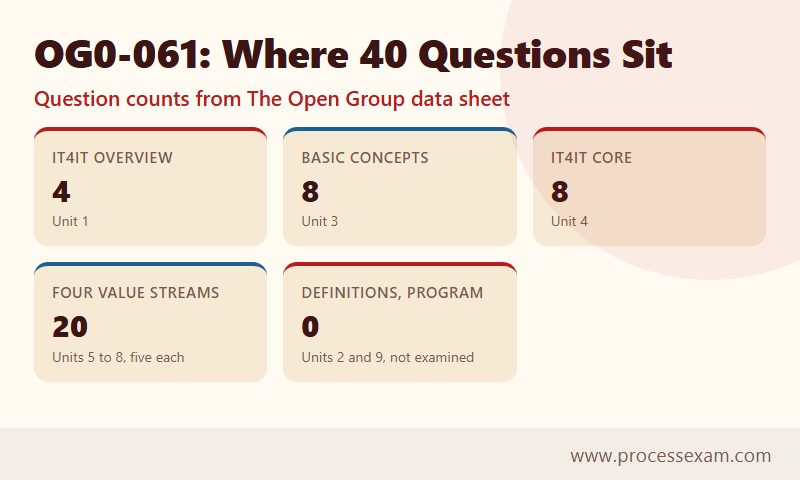
| Unit | Name | Learning outcomes | Questions |
|---|---|---|---|
| 1 | IT4IT Overview | 11 | 4 |
| 2 | Definitions | 9 | 0 |
| 3 | Basic Concepts | 29 | 8 |
| 4 | IT4IT Core | 19 | 8 |
| 5 | Strategy to Portfolio Value Stream | 15 | 5 |
| 6 | Requirement to Deploy Value Stream | 21 | 5 |
| 7 | Request to Fulfill Value Stream | 23 | 5 |
| 8 | Detect to Correct Value Stream | 21 | 5 |
| 9 | IT4IT Certification Program | 1 | 0 |
Three readings of this table change how you spend your hours. First, Unit 9 is marked non-examinable by the vendor, and Unit 2 contributes no questions of its own, so the definitions are not tested as a list. Expect the terms to be used inside questions from the other units, where a question simply assumes you know what a data object or a functional component is.
Second, count outcomes per question. The four value streams carry 80 learning outcomes between them for 20 questions, which is about four outcomes behind every question you might meet. Basic Concepts carries 29 outcomes for 8 questions. IT4IT Core has 19 outcomes for 8 questions, the lightest load per question on the paper. A unit with few outcomes and many questions is the cheapest place to bank marks.
Third, no unit can be skipped. With 5 questions per stream, ignoring one value stream puts up to 5 of your 40 at risk, and you can only afford to miss 14 in total. The full unit-by-unit outcomes are laid out on the OG0-061 syllabus page, which is a good checklist to tick against as you revise.
What does each value stream ask, and how do you tell neighbouring streams apart?
The IT Value Chain in Version 2.1 has four value streams, and each one answers a different question about a service. The vendor's fact sheet names all four, and the sections below take them in order. A useful shortcut is to attach a lifecycle word to each: plan, build, deliver and run.
Strategy to Portfolio: which services deserve investment?
This is the plan stream. It connects business strategy and demand to the portfolio of services IT will offer, and it is where the decision to fund, change or retire a service is made. A question that mentions weighing demand, balancing investment or deciding what belongs in the portfolio is pointing here. It does not build anything.
Requirement to Deploy: how is the service built and released?
This is the build stream. It takes an approved need and carries it through design, development, testing and release until a deployable service exists. The tell-tale words are requirement, build, test and release. It stops where the service is ready to be offered; running it belongs to the other two streams.
Request to Fulfill: how does a consumer get the service?
This is the deliver stream, the storefront of IT. It deals with offering services, letting people choose and subscribe, and fulfilling what they ask for. If the scenario starts with a user browsing a catalogue or requesting access, the answer lives here, not in the build stream that created the service.
Detect to Correct: how does the service stay healthy?
This is the run stream. It covers noticing events, handling incidents and correcting faults, and it feeds what it learns back into the earlier streams: a recurring defect goes back to the build stream, and a service that keeps failing may prompt a portfolio decision. Do not read it as bug-fixing alone. Monitoring and feedback are half of its purpose.
When two streams look equally plausible in an answer set, ask who is acting and what is being handed over. A planner handing an approved scope to a builder is the first hand-off. A builder handing a released service to the people who offer it is the second. A consumer's request meeting a fulfilment action is the third. An operator's finding flowing back upstream is the fourth.
Which records belong to which stream?
Questions often name a record and ask where it lives. A requirement belongs with the build stream, because it is what the builders work from. An offer and a subscription belong with the deliver stream, since they describe what consumers can choose and what they have chosen. An event and an incident belong with the run stream. A proposal or a portfolio entry belongs with the plan stream. Treat this list as a starting point only: the standard names each data object precisely, and your revision should use its wording, not a paraphrase.
A second habit helps with look-alike answers. When two options name the right stream but different objects, ask which object would exist first in the life of the service. An incident cannot exist before a service is running, and a subscription cannot exist before an offer. Putting events in time order removes many of the wrong choices without any memorised rule.
Can you follow one service through all four value streams?
Memorised lists break down the moment a question describes a situation. A faster test is to follow a single service from idea to retirement and say aloud which stream owns each step. Take a staff travel-booking app as the example.
The finance director asks for a cheaper way to book travel, and the proposal competes with other demands for funding. That decision belongs to Strategy to Portfolio. Once the business case is approved, the team captures what the app must do, builds it, tests it and releases it, which is Requirement to Deploy. The service is then listed so that employees can find and request it, and each new user's access is delivered. That is Request to Fulfill. Finally, a monitoring alert shows booking failures on Monday mornings, an incident is raised and fixed, and the defect goes back to the build team. That is Detect to Correct, feeding the loop.
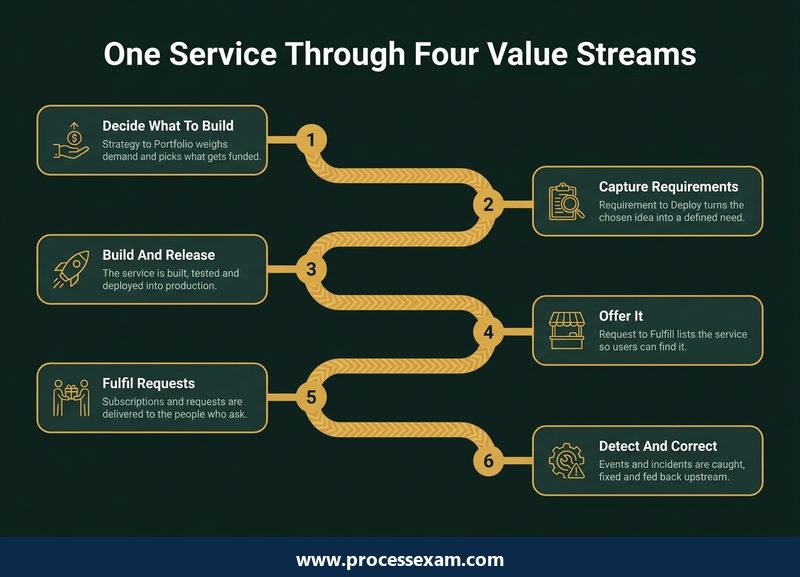
Practise this walk with three or four services you already know at work: a password reset, a laptop refresh, a new reporting tool. For each, write the six steps, name the stream, then write one data record that moves between the steps, such as an incident or a subscription. The exam rewards candidates who can place a record in a stream, and the walk builds exactly that habit. The vendor's own data sheet is also worth keeping open while you do it, since the stream names must match its wording.
Why are Basic Concepts and IT4IT Core worth two-fifths of the paper?
Basic Concepts and IT4IT Core carry 8 questions each, so 16 of the 40 come from the ideas that sit underneath the streams. Candidates who treat these units as warm-up reading and rush to the value streams tend to feel the gap later, because stream questions quietly assume the concepts.
What Basic Concepts expects
This unit is the largest by learning outcomes, with 29. It introduces the pieces the architecture is built from: value streams, functional components that do the work, and data objects that carry the information between them. It also covers how the IT Value Chain borrows from the idea of a value chain in general business, and why IT4IT looks at the flow of information rather than at process steps alone. That last point is what separates it from process-based frameworks such as ITIL: the question is not only what activity happens, but which data object is created or updated and who may read it.
What IT4IT Core expects
The core gathers the central ideas that connect the four streams, notably the service model that every stream reads from and writes to. Expect questions on how information stays consistent across streams, and why a shared service model matters when separate tools handle planning, build, request and operations. A good self-test is to sketch the four streams in a row and draw the service model underneath, with arrows showing what each stream adds. If you can do it from a blank page, you can answer most of this unit.
What the overview adds
The overview supplies four questions about what the architecture is for and how the value chain is arranged. It is the lightest unit to learn and an easy place to avoid dropping marks. Learn the four stream names exactly as the vendor prints them, in order.
What do the fee, booking options and exam-day rules look like?
The exam fee is $375 USD when you book directly, and a retail voucher costs $400 USD, according to The Open Group's examination fee schedule, which applies from 1 February 2026 (checked October 2026). Local taxes can be added at checkout. Accredited training courses include the exam in the course fee and supply a voucher code, so if your employer is paying for a course, you may not need to pay separately.
The rules on the day are plain. There are no prerequisites. The exam is supervised and closed book, multiple choice, 40 questions in 60 minutes. You can sit it at an authorised test centre or remotely under online proctoring; the Open Group describes the remote route on its online proctored exams page, and it is worth reading before you book a slot, because a remote sitting needs a webcam, a microphone and photos of your testing room, and the vendor advises against work computers or restricted corporate networks. Candidates taking the English paper whose first language is not English may be given extra time, and the vendor notes that the total appointment, including registration, a tutorial and a survey, runs about 15 minutes longer than the 60 minutes of testing.
Sixty minutes for 40 questions is 90 seconds each. Recall items will take far less than that and a long scenario more, so the pace to aim for is about 45 minutes on a first pass and 15 in reserve for flagged items. You need 26 right, which means you can miss 14 and still pass.
Why do people hunt for OG0-061 dumps, and what works better?
Search data shows that candidates type the code next to the words dumps, questions and practice test, which tells you what most of them are afraid of: not knowing what the questions look like. That fear is reasonable. The remedy is not a copied list.
A dump is a collection of questions claimed to come from the real paper. It tends to fail in three ways. It may be out of date, because exams change. It may be wrong, because nobody checks the answers or the explanations. And it teaches recognition of one wording rather than the reasoning, which does not help when the live paper describes the same idea differently. Using real exam content may also break the rules you agree to when you book; read your candidate agreement before you go anywhere near it.
Better material has three parts: the vendor's own data sheet for the weighting, a course or reading of the IT4IT standard for the substance, and practice questions written to the syllabus, with an explanation for every option. After you have the units clear, sit one full OG0-061 practice exam against the 60-minute limit: your score by unit shows which streams need another pass, which is exactly what a dump cannot tell you.
One last point on materials. The data sheet's unit table is the closest thing to a blueprint the vendor publishes, so build your notes in the same nine headings and tick off every learning outcome rather than reading the standard straight through. Notes that follow the exam's own structure are quicker to review in the final days, and they make gaps obvious: an empty page for a unit is a warning you can act on while there is still time.
How many weeks of preparation suit a service manager, an architect or a newcomer?
The vendor does not publish a recommended study time, so what follows is a sensible plan, not a rule. Most people with an IT service background can prepare in about four weeks at a few hours a week. People who work in enterprise architecture often cover the concepts quickly but must learn the stream vocabulary. Newcomers to IT management should allow six weeks, spending the extra time on Basic Concepts.
| Background | Suggested length | Where the extra effort goes |
|---|---|---|
| Service desk or service manager | About four weeks | Architecture vocabulary: functional components and data objects |
| Enterprise architect | About four weeks | Request to Fulfill and Detect to Correct, which are operational |
| New to IT management | About six weeks | Basic Concepts and IT4IT Core, read twice |
A four-week shape you can adjust
- Week 1: overview and basic concepts. Learn the four stream names, what a functional component is and what a data object is.
- Week 2: IT4IT Core and Strategy to Portfolio. Draw the service model from memory.
- Week 3: Requirement to Deploy, Request to Fulfill and Detect to Correct. Follow one service through them.
- Week 4: timed mixed practice. Keep a log of every miss and which unit it came from, and go back to that unit rather than doing another full paper.
The fact sheet notes that an accredited course is one route but not the only one, so a self-study plan is acceptable, and the vendor's IT4IT Foundation fact sheet lists the target audience and the exam's knowledge-and-comprehension level. Readiness looks like this: you hit about 80% on mixed timed sets for two sittings in a row, and you can explain why each wrong option is wrong. Anything above the 65% pass mark gives you a buffer for nerves.
As for what the credential does for you, it gives you a vendor-neutral vocabulary for talking to architects, tool owners and managers about how IT creates and delivers services. It is evidence of foundation knowledge, not of tool skills, so pair it with real examples from your own work when you talk about it in an interview.
Frequently Asked Questions
How many questions are on the OG0-061 exam?
The OG0-061 exam has 40 multiple-choice questions and a 60-minute time limit, which works out at about 90 seconds a question. It is supervised and closed book. Twenty of the questions come from the four value-stream units, and the rest come from the overview, basic concepts and IT4IT Core units.
What is the passing score for OG0-061?
The pass mark is 65%, which means 26 correct answers out of 40. You can miss 14 questions and still pass. Because every value stream contributes five questions, a candidate who skips one stream entirely puts several of those 26 marks at risk, so revise all four.
Are OG0-061 dumps safe to use?
Dumps are collections of questions claimed to come from the real paper. They can be outdated or wrong, they teach one wording instead of the reasoning, and using real exam content may breach the rules you accept when booking. Syllabus-based practice with explanations and the vendor's data sheet are safer ways to prepare.
Which IT4IT version does OG0-061 cover?
OG0-061 is based on the IT4IT Standard, Version 2.1, and leads to the IT4IT Foundation certification. The Open Group runs a separate IT4IT 3 Foundation exam, OGIT-101, based on Version 3.0. Check which code your employer or course names before you choose study material, because the two syllabuses are organised differently.
Does OG0-061 have prerequisites, and can you sit it from home?
There are no prerequisites for OG0-061. The exam can be taken at an authorised test centre or remotely with online proctoring, and in both cases it is supervised and closed book. Read the vendor's online proctoring page before booking a remote slot, as it lists the webcam, microphone and room-photo requirements.
- IT4IT |
- Open Group IT4IT Part 1 Test Questions |
- OG0-061 Question Bank |
- IT4IT Part 1 Simulator |
- IT4IT Part 1 Mock Exam |
- Open Group IT4IT Part 1 Book |
- Open Group OG0-061 BOK PDF |
- IT4IT Part 1 Certification Cost |
- IT4IT Part 1 Certification Requirements |
- Open Group IT4IT Part 1 Sample Questions |
- OG0-061 Exam Questions Download |
- OG0-061 Test Questions |
- IT4IT Part 1 PDF


