
The Pega CPSA Hack: One Strategy That Changes Everything

The Certified Pega System Architect (CPSA) certification validates a professional's ability to apply Pega's leading low-code platform to design and build robust applications. This credential signifies expertise in crucial areas such as case management, data integration, security, and user experience, enabling system architects to drive digital transformation initiatives effectively. Ideal candidates for the Pega CPSA exam are experienced professionals seeking to enhance their proficiency in Pega platform development and prove their capability to deliver high-quality Pega solutions. This comprehensive guide outlines a powerful, integrated preparation strategy, the "Pega CPSA Hack," designed to streamline your study process and fundamentally change your approach to certification success, covering everything from exam structure to advanced study tactics.
Establishing the Pega System Architect Role and Its Impact
A Pega System Architect is a crucial figure in organizations leveraging the Pega platform for business process automation and customer engagement. These professionals are responsible for translating business requirements into technical solutions, designing the architecture of Pega applications, and ensuring their optimal performance and scalability. The role demands a blend of technical acumen, problem-solving skills, and a deep understanding of Pega's capabilities to create efficient and effective systems.
The Core Responsibilities of a Pega SA
Pega System Architects undertake a variety of tasks essential to the success of Pega projects. Their responsibilities extend beyond mere coding, encompassing a holistic view of application development and deployment.
- Application Design: Conceptualizing and designing Pega applications that align with business goals and technical best practices.
- Solution Development: Building and configuring Pega components, including case types, data models, and UI elements.
- System Integration: Connecting Pega applications with external systems and databases to facilitate seamless data flow.
- Performance Optimization: Identifying and resolving performance bottlenecks to ensure applications run efficiently.
- Security Implementation: Designing and implementing robust security measures within Pega applications to protect sensitive data.
By mastering these responsibilities, a Pega SA directly contributes to improved operational efficiency, enhanced customer experiences, and faster time-to-market for digital solutions. The Certified Pega System Architect credential directly validates these critical capabilities.
Deciphering the Crucial Pega CPSA Exam Blueprint
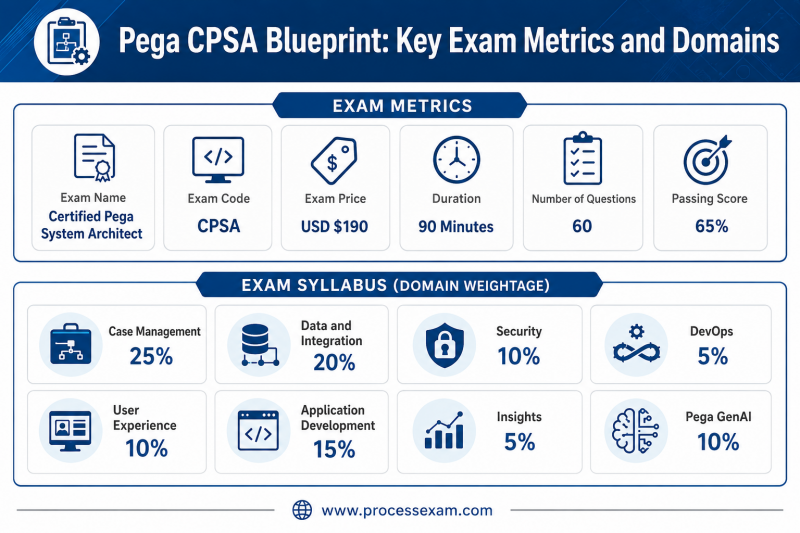
Understanding the structure and format of the Pega CPSA exam is the foundational step in developing an effective preparation strategy. This clarity allows candidates to allocate their study time wisely and anticipate the testing environment, reducing anxiety and increasing confidence. The Pega Certified System Architect examination assesses a candidate's practical skills in application design and development using the Pega platform.
Pega CPSA Exam Essentials
The Certified Pega System Architect exam is structured to rigorously test a candidate's understanding and application of core Pega concepts. Familiarity with these details is vital for strategic planning.
-
Exam Name: Certified Pega System Architect
-
Exam Code: CPSA
-
Exam Price: USD $190
-
Duration: 90 Minutes
-
Number of Questions: 60
-
Passing Score: 65%
This structured format means candidates must be efficient in their problem-solving and decision-making during the exam. Each question counts, emphasizing the need for both accuracy and speed. Given the time constraints, practicing under timed conditions becomes a crucial element of the preparation strategy.
Scoring and Structure for Pega CPSA
The Pega CPSA exam employs a scoring methodology that requires candidates to achieve at least 65% accuracy across all sections. The questions are typically multiple-choice or scenario-based, designed to test not just theoretical knowledge but also practical application skills. Candidates should focus on understanding the underlying principles rather than rote memorization, as scenarios often require logical deduction based on Pega best practices. The total time allotted means each question should ideally be answered in approximately 1.5 minutes, highlighting the need for quick recall and efficient problem interpretation.
Mastering Core Competencies: Pega CPSA Syllabus Topics
The Pega CPSA syllabus serves as the definitive guide to the knowledge and skills required for certification. A deep dive into each topic, understanding its weightage, allows for a targeted study approach. The "Pega CPSA Hack" emphasizes not just covering these topics, but understanding their interconnections and practical implications in real-world Pega projects. This certification covers a broad range of capabilities essential for designing and building Pega applications effectively.
Domain 1: Case Management Proficiency (25%)
Case Management is the cornerstone of Pega applications, and a significant portion of the exam focuses on this area. Candidates must demonstrate an ability to design and implement efficient case lifecycles.
-
Case Management: Understanding stages, steps, processes, and service level agreements (SLAs). This includes designing robust case types, managing case relationships, and implementing automation within the case lifecycle.
-
Data Propagation: How data flows within and between cases, ensuring consistency and accuracy across different stages and associated cases.
-
Process Flows: Designing and configuring complex business processes, including parallel processing, approvals, and conditional routing.
-
Work Assignment: Defining how work is routed to the appropriate operators or workbaskets, leveraging skills and roles.
Mastery of these concepts is vital for building scalable and adaptable business solutions. Practical exercises involving designing various case types and their associated processes will reinforce learning in this high-weightage domain.
Domain 2: Data & Integration Expertise (20%)
Effective Pega applications rely heavily on robust data management and seamless integration with external systems. This domain assesses your capability to handle data and connect systems.
-
Data Modeling: Creating and managing data objects, properties, and relationships to support application requirements. This includes understanding internal and external data sources.
-
Declaratives: Utilizing declarative rules like declare expressions and declareOnChange to automate computations and data changes without explicit programming.
-
Integrations: Configuring connectors (e.g., REST, SOAP) and services to exchange data with external systems. Understanding data mapping and error handling in integration scenarios is crucial.
A strong grasp of how to define, manage, and integrate data is critical for developing comprehensive Pega solutions. Practical labs focusing on integrating with mock services or databases can significantly improve understanding.
Domain 3: Security & Application Lifecycle (10% & 5% - DevOps)
Security and efficient development operations are integral to enterprise applications. This section covers protecting applications and managing their deployment.
-
Security: Implementing access control mechanisms, authentication, and authorization using Pega's security features. This involves understanding roles, access groups, and privileges to secure data and functionality.
-
DevOps: Grasping the principles of continuous integration and continuous delivery (CI/CD) within the Pega ecosystem. Understanding deployment pipelines and managing application changes effectively.
While these sections have lower weightage, they are fundamental to building production-ready applications. Ensuring security from the ground up and understanding how Pega supports modern DevOps practices are essential for any system architect.
Domain 4: User Experience & Application Development (10% & 15%)
Designing intuitive and responsive user interfaces, along with strong application development practices, enhances user adoption and overall solution quality. These areas focus on the end-user interaction and the build process.
-
User Experience: Creating intuitive and responsive user interfaces using Pega's UI capabilities. This includes understanding layouts, controls, and dynamic UI behavior to enhance user interaction.
-
Application Development: Core development principles, including rule management, versioning, and debugging techniques. This encompasses the effective use of Pega's development tools and best practices for creating maintainable applications.
A well-designed UX ensures the application is not only functional but also user-friendly. Combining this with solid application development practices leads to robust and maintainable solutions.
Domain 5: Insights & Pega GenAI (5% & 10%)
Leveraging analytics and understanding Pega's emerging AI capabilities are becoming increasingly important for modern applications. This domain explores how to extract value from data and incorporate AI.
-
Insights: Generating reports, dashboards, and analytical insights from Pega data to support business decisions. This involves understanding report definitions and data visualization tools.
-
Pega GenAI: An introduction to Pega's generative AI capabilities, including how AI can enhance automation, decision-making, and user interactions within Pega applications. Understanding the basic principles and potential applications of GenAI in the Pega context.
These forward-looking topics highlight the evolving nature of the Pega platform. Familiarity with these areas prepares candidates for future trends and more intelligent application design.
Developing an Effective Pega CPSA Study Plan
A structured and consistent study plan is the backbone of the "Pega CPSA Hack." It moves beyond sporadic learning to a strategic approach that maximizes retention and understanding. This plan must be dynamic, adapting to your progress and areas requiring more focus, ensuring comprehensive coverage of all exam topics for the Certified Pega System Architect credential.
Strategic Learning Path
Your learning journey should be systematic, starting with a foundational understanding and progressively moving to complex topics. Begin by reviewing the official Pega curriculum, focusing on the core concepts before diving into the specifics of each domain. Prioritize areas with higher weightage, but do not neglect the others, as questions often bridge multiple topics. Integrate hands-on practice sessions regularly to apply theoretical knowledge, reinforcing your learning through practical application. Regular self-assessment through quizzes or flashcards can help track progress and identify weak points. Consider exploring comprehensive certification insights to enhance your study plan.
Leveraging Official Pega Resources
The Pega Academy provides a wealth of official resources specifically designed for CPSA aspirants. These include detailed course materials, exercises, and official documentation which are indispensable for accurate and up-to-date information. Enroll in the recommended Pega System Architect course available on Pega Academy's official page. These courses often include labs and quizzes that mirror exam questions, providing invaluable practical exposure. Don't overlook the Pega Community forums, where you can find answers to specific queries and learn from the experiences of other Pega professionals.
Importance of Practice Questions
Practice questions are a critical component of the "Pega CPSA Hack," allowing you to test your knowledge, understand the exam's question style, and improve time management. Engage with sample questions for Pega CPSA to familiarize yourself with the format and complexity. Focus not just on getting the correct answer, but on understanding why an answer is right or wrong. This deep analysis builds a stronger conceptual understanding. Repeated practice helps you identify patterns in questions and common pitfalls, enabling you to refine your approach and build confidence for the actual exam. It is vital to use only high-quality, reliable practice materials.
Essential Preparation Tactics for Pega CPSA Success
Beyond theoretical knowledge, the Pega CPSA exam demands practical application and quick problem-solving. This section outlines the key tactics that form the core of the "One Strategy That Changes Everything" for Pega CPSA, ensuring you're not just prepared, but truly proficient.
Gaining Practical Experience
Hands-on experience with the Pega platform is non-negotiable for the CPSA certification. Theoretical knowledge alone is often insufficient to tackle the scenario-based questions that dominate the exam. Actively participate in Pega projects, volunteer for tasks that challenge your skills, and leverage Pega's personal edition or trial environments to build sample applications. Focus on creating case types, defining data models, configuring integrations, and designing user interfaces. This practical exposure solidifies your understanding of how Pega concepts translate into functional solutions, which is what the Pega CPSA certification ultimately validates.
Simulating the Exam Environment
The pressure of a timed, proctored exam can significantly impact performance. Simulating the exam environment during your preparation helps build resilience and improves your ability to manage stress. Use practice tests under strict time limits, replicating the 90-minute duration for 60 questions. This practice helps you pace yourself, identify questions that consume too much time, and develop strategies for efficient navigation. Pay attention to the types of questions that challenge you most and review those topics thoroughly afterwards. Regular simulation minimizes surprises on exam day, making the actual test feel more familiar.
Mastering Time Management for the Exam
With only 90 minutes for 60 questions, effective time management is paramount. This means allocating approximately 1.5 minutes per question. During practice, if you find yourself spending too long on a single question, mark it for review and move on. The goal is to answer all questions to the best of your ability rather than getting stuck on a difficult one. Develop a strategy for reviewing marked questions if time permits at the end. Mastering this pacing ensures you complete the exam and have a chance to revisit challenging items, significantly boosting your potential passing score for the Certified Pega System Architect exam.
Navigating Pega CPSA Certification Costs and Benefits
Investing in a Pega CPSA certification involves both financial commitment and time, but the potential returns in career growth and earning potential can be substantial. Understanding this value proposition is part of the strategic decision-making process for any aspiring Pega professional.
Financial Investment and Value
The upfront cost for the Pega CPSA exam is USD $190. This figure does not include potential expenses for training courses, study guides, or practice exams, which can vary widely depending on the resources chosen. However, this investment is typically recouped through enhanced career opportunities and higher earning potential. Pega Certified System Architects are often in high demand, and the certification acts as a powerful differentiator in a competitive job market. Consider it an investment in your professional future that yields significant long-term benefits.
Career Advancement and Opportunities
Holding the Certified Pega System Architect credential opens doors to advanced roles and projects within the Pega ecosystem. It signals to employers that you possess the verified skills to design and implement complex Pega solutions. This can lead to increased responsibilities, leadership positions, and eligibility for more challenging and rewarding projects. Furthermore, Pega CPSA certification often correlates with higher salary potential compared to non-certified peers. It's a clear indicator of your commitment to the platform and your expertise, making you a valuable asset to any organization leveraging Pega technology.
Registration and Post-Exam Procedures for Pega CPSA
Beyond the preparation and the exam itself, understanding the logistical steps for registration and managing your certification post-exam is crucial for a smooth journey towards becoming a Pega Certified System Architect. This ensures that your efforts are properly recognized and maintained.
Streamlining the Registration Process
The registration process for the Pega CPSA exam is typically managed through the Pega Academy portal, which integrates with Pearson VUE for exam scheduling. You will need to create an account on the Pega Academy, locate the Certified Pega System Architect exam, and follow the prompts to schedule your test. It is advisable to register well in advance to secure your preferred date and time. Ensure all personal details match your identification documents, as any discrepancy can cause issues on exam day. Familiarize yourself with the Pearson VUE policies regarding rescheduling or cancellation to avoid additional fees.
Maintaining Your Certification
Pega certifications, including the CPSA, are subject to renewal requirements to ensure that certified professionals stay current with the latest platform versions and features. While specific policies can vary, Pega typically requires professionals to re-certify on newer versions of the platform or pass an upgrade exam within a certain timeframe. Regularly check the Pega Academy website for the most up-to-date re-certification policies. Proactive engagement with Pega's new features and continuous learning will make the re-certification process much smoother, ensuring your Certified Pega System Architect status remains current and valuable.
Achieving Pega CPSA Certification: A Strategic Roadmap
The "Pega CPSA Hack: One Strategy That Changes Everything" culminates in not just passing the exam, but fostering a mindset of continuous improvement and strategic professional development. This roadmap extends beyond the test day, outlining how to leverage your certification for sustained career growth.
Beyond the Exam: Continuous Learning
Passing the Pega CPSA exam is a significant accomplishment, but the learning journey in the rapidly evolving Pega ecosystem never truly ends. Embrace continuous learning by staying updated with new Pega releases, features, and best practices. Participate in Pega community events, webinars, and advanced training courses. Explore specialized Pega certifications that align with your career interests, such as Lead System Architect or Business Architect. This ongoing engagement ensures your skills remain sharp and relevant, allowing you to adapt to new challenges and contribute effectively to future Pega projects.
Professional Networking and Growth
Your Pega CPSA certification not only validates your technical skills but also positions you as a recognized expert within the Pega community. Leverage this status to expand your professional network. Connect with other Pega certified professionals, architects, and industry leaders through online platforms like LinkedIn and Pega Community forums. Attend Pega world events or local user groups to exchange knowledge, share experiences, and discover new opportunities. A robust professional network can provide mentorship, job referrals, and insights into emerging trends, significantly aiding your career growth and ensuring you remain at the forefront of Pega innovation.
Conclusion
Earning the Certified Pega System Architect (CPSA) certification is a transformative step for any professional dedicated to mastering the Pega platform. By adopting the "Pega CPSA Hack" – a strategy rooted in comprehensive understanding, hands-on application, and disciplined preparation – you not only prepare for the exam but fundamentally enhance your capabilities as a Pega System Architect. This holistic approach ensures you are well-versed in case management, data integration, security, user experience, and the latest Pega GenAI advancements, truly validating your expertise.
The journey demands dedication, but the rewards of professional recognition, increased earning potential, and expanded career opportunities are well worth the effort. Equip yourself with the right knowledge, hone your practical skills, and approach the exam with confidence. To further your certification journey and access essential preparation tools, explore effective preparation strategies and embark on your path to Pega CPSA success.
Frequently Asked Questions
1. What does the Pega CPSA certification validate?
The Pega CPSA (Certified Pega System Architect) certification validates a professional's ability to design and build Pega applications, demonstrating proficiency in areas like case management, data integration, security, and user experience.
2. How long is the Pega CPSA exam and how many questions are there?
The Pega CPSA exam duration is 90 minutes, and it consists of 60 multiple-choice or scenario-based questions. Candidates need to manage their time effectively to complete all questions.
3. What is the passing score for the Certified Pega System Architect exam?
To pass the Certified Pega System Architect exam, candidates must achieve a minimum score of 65%. This score indicates a solid understanding of the core Pega platform concepts and application development principles.
4. Is hands-on experience crucial for passing the Pega CPSA exam?
Yes, hands-on experience is highly crucial. The Pega CPSA exam often includes scenario-based questions that test practical application skills, which are best developed through direct experience with the Pega platform.
5. How can I register for the Pega CPSA certification exam?
You can register for the Pega CPSA certification exam through the Pega Academy website, which directs you to Pearson VUE for scheduling. Ensure your personal details match your ID documents for exam day.
- Pega System Architect Book |
- System Architect Certification Cost |
- System Architect Certification Requirements |
- Pega System Architect Sample Questions |
- System Architect PDF |
- Pega System Architect Test Questions |
- CPSA Question Bank |
- CPSA Exam Questions Download |
- CPSA Test Questions |
- PEGACPSA25V1 Mock Exam |
- PEGACPSA25V1 Simulator |
- PEGACPSA25V1 Book |
- PEGACPSA25V1 Certification |
- PEGACPSA25V1 Certification Cost |
- PEGACPSA25V1 Certification Requirements |
- PEGACPSA25V1 Question Bank |
- PEGACPSA25V1 Study Guide |
- PEGACPSA25V1 |
- PEGACPSA25V1 Exam Questions |
- PEGACPSA25V1 PDF |
- PEGACPSA25V1 Sample Questions


