
How to Become a SAFe SPC: Certification Course, Exam and Rollout
Updated on 22 September 2026. What’s new: rewritten for the AI-Empowered SPC exam, with its current domain weights, pass mark and retake terms.
The budget is approved, the steering group wants a first release train planning together within two quarters, and your brief from the CTO is three words long: roll out SAFe. You are the internal agile coach, and nobody in the company is licensed to teach a single SAFe class. The SAFe Practice Consultant (SPC) certification closes that gap. You earn it through Scaled Agile's four-day Implementing SAFe course and a 60-question exam, and it lets you train and certify your own colleagues.

What follows is written for that coach. It explains why a rollout stalls without in-house trainers, what the SPC credential adds to the coaching you already do, what happens across the four days of Implementing SAFe, how the current AI-Empowered exam is built and weighted, how to use the weeks between the class and the exam, and what the certificate changes once it is on your profile.
Why does a SAFe rollout stall when nobody inside the company can teach it?
Picture the budget line for the rollout. An organisation of six or seven hundred people who will work in Agile Release Trains needs Leading SAFe for its managers, SAFe for Teams for every developer and tester, and role courses for Scrum Masters and Product Owners. Buying every one of those classes from outside trainers is expensive, and it is slow: outside trainers have their own calendars, and the rollout ends up waiting on them.
Scaled Agile saw this problem early and built its answer into the framework. Its article on training Lean-Agile change agents describes a train-the-trainer fan-out model: Scaled Agile licenses SPCs, whether they are partner consultants or the enterprise's own employees, to teach SAFe courses inside the company. The article is explicit that this is an affordable training strategy and that it supplies the trainers a change needs before it can start.
The guiding coalition needs more than a sponsor
The same article borrows John Kotter's idea of a sufficiently powerful guiding coalition and lists four moves to build one. Training change agents as certified SPCs comes first. Forming a Lean-Agile Center of Excellence comes next, then training executives, managers and other leaders, and finally enlisting those leaders to lead the change themselves. A CTO who approves a budget has covered the sponsor part. Nobody has yet covered the knowledge and teaching capacity, and that is the part you are being asked to supply.
Internal plus external works better than either alone
Scaled Agile does not suggest that the internal coach should carry the change alone. It recommends pairing people sourced from inside the company with more experienced external change agents from a Scaled Agile partner. The outsiders bring what they learned in many earlier rollouts; the insiders bring knowledge of the politics, the systems and the people who will still be there after the consultants leave. For you, the practical conclusion is simple. Getting certified does not replace outside help. It turns you into the person who can absorb that help, teach it onward and keep it alive.
What can a certified SPC do that an uncertified agile coach cannot?
Plenty of excellent coaches work with SAFe teams without being SPCs. They facilitate retrospectives, coach Scrum Masters and help trains plan. What they cannot do is deliver the licensed SAFe courses or certify the people who attend them. That single difference is why companies send internal coaches to Implementing SAFe.
The courses an SPC can teach
Scaled Agile's certification benefits sheet for the AI-Empowered SPC lists the courses an SPC is authorised to teach and certify once validated: Leading SAFe, Leading SAFe for Government, SAFe for Teams, SAFe Scrum Master, SAFe Product Owner/Product Manager, SAFe for DevOps, SAFe for Hardware, Agile Software Engineering, SAFe for Architects, SAFe Advanced Scrum Master, Agile HR, Agile Product Management and the current SAFe micro-credentials. For an internal coach, Leading SAFe and SAFe for Teams alone usually cover most of the people in a first release train.
The other half of the job
Teaching is only half of it. The same sheet says the certification prepares you to plan and guide a transformation through coaching, training and hands-on leadership, identify value streams, launch Agile Release Trains, apply Objectives and Key Results to strategic themes and use AI tools responsibly in that work. In practice, an SPC is the person who designs the implementation and then helps the organisation run it.
Who Scaled Agile has in mind
The benefits sheet names the audience as transformation leaders and internal change agents. The SAFe Practice Consultant certification page adds four typical backgrounds: agile coaches, project managers, product managers and Release Train Engineers. It also describes the SPC as an advanced-level certification, and it expects a firm grasp of Lean-Agile principles plus a background in consulting, project, product or portfolio work.
One point causes confusion in searches. The SPC is the base consultant credential. There is also an Advanced SAFe Practice Consultant credential, and it is a different course with a different exam that requires an active SPC before you can even attend. If you are starting from zero, the SPC is where you start; our separate guide covers the step that comes after the SPC for consultants who later lead enterprise-wide change.
What happens during the four days of the Implementing SAFe course?
Implementing SAFe is the course, and SPC is the certification you earn after it. Many people searching for SAFe SPC training are looking for this class, which Scaled Agile's partners run virtually and in person. The certification page lists English, French, German, Japanese, Simplified Chinese, Spanish and Brazilian Portuguese deliveries, and a class finder on the same page shows current dates. An online SPC certification in this sense means a live, instructor-led virtual class: the class finder lets you filter by virtual or in-person delivery.
Days one and two: the leadership view
According to Scaled Agile's framework guidance, the first two days are an intensive version of Leading SAFe. That is deliberate. You will teach Leading SAFe to your own managers, so the course first runs you through it as a participant. Expect the Lean-Agile mindset, the SAFe Core Values and principles, team and technical agility, product development flow including PI Planning, and Lean Portfolio Management. The AI-Empowered release adds material on using AI to support agility in the principles lesson and on AI for leaders in the lesson on leading the change.
Days three and four: the implementation view
The second half follows the SAFe Implementation Roadmap: reaching the tipping point, designing the implementation, launching a release train, coaching its execution, then scaling to large solutions, enhancing the portfolio and accelerating business agility. Scaled Agile says attendees leave with the briefings, artefacts and templates needed to identify value streams, prepare the organisation, launch trains and run the major events. For the coach in our opening, these two days are the reason to attend. They turn a vague instruction into a sequence of concrete steps.
What you keep after the class
The certification page lists what comes with the process: perpetual access to the course workbook and to SAFe Studio, a practice test you can repeat without limit that gives question-level feedback and a coaching report, customer support, and a timed multiple-choice exam that also returns a coaching report. Those resources are your study material for the exam, so do not leave the workbook in a drawer.
How is the AI-Empowered SPC exam structured, and what changed from SAFe 6.0?
Scaled Agile moved its SPC exam to the AI-Empowered version in February 2026. The figures below come from Scaled Agile's current AI-Empowered SPC exam study guide and the certification page, both checked in September 2026.
| Exam detail | SPC |
|---|---|
| Exam name | SAFe Practice Consultant |
| Exam code | SPC |
| Vendor | SAFe (Scaled Agile, Inc.) |
| Certification | Certified SAFe Practice Consultant (SPC) |
| Course | Implementing SAFe (four days) |
| Version | AI-Empowered |
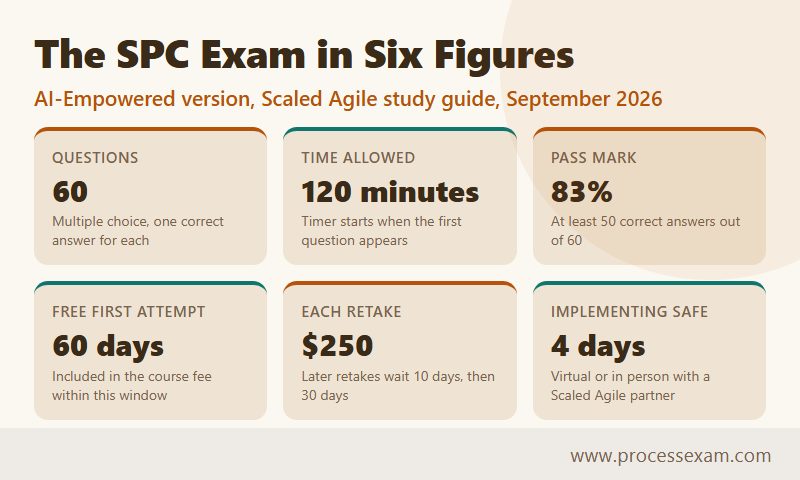
| Number of questions | 60 |
| Duration | 120 minutes |
| Passing score | 83% |
| Question format | Multiple choice, single select |
| Delivery | Web-based, closed book, from your learning plan after the course |
| Exam fee | One attempt is covered by the Implementing SAFe registration if you sit it within 60 days after the course; $250 for every retake |
| Recommended prerequisites | SAFe for Teams (SP) and Leading SAFe (SA) |
| Renewal | Yearly |
Reading the numbers
Sixty questions over 120 minutes averages out at a question every two minutes, which is comfortable for a first pass and leaves room to flag hard items. The 83% pass mark is the demanding part. Eighty-three percent of sixty is 49.8, so you need 50 correct answers and can drop no more than ten. Across thirteen domains that is less than one miss per domain on average, which is why candidates who are strong in team-level SAFe but thin on portfolio topics often fall just short.
The rules on the day are strict and simple. You accept a candidate agreement, the timer appears once the first question does, and the exam submits itself when time runs out. Your score is the count of correct answers, and anything you leave blank is scored as wrong, so an unanswered question never helps you.
What changed from the SAFe 6.0 exam
If you are comparing sources, the differences are these. The AI-Empowered syllabus adds AI topics to the lessons on principles and on leading the change, rewords most domain names, rebalances the weightings and adds facilitating distributed PI Planning to launching a train. The SAFe 6.0 study guide, which Scaled Agile keeps online for people who attended the earlier course, also shows a lower pass mark, so two sets of figures circulate. Pages that quote a 30-day window for the included first attempt are out of date as well; the current guide gives 60 days. Prepare for the version your learning plan shows.
Which of the 13 SPC exam domains carry the most weight?
The study guide gives every domain a weighting band. With 60 questions, a band of 12-14% works out at roughly seven or eight questions, and a band of 2-4% at one or two.
| Domain | Weighting | Course lesson |
|---|---|---|
| Adapt and Thrive with SAFe | 2-4% | Lesson 1 |
| Build a Foundation with Mindset, Value, and Principles | 9-11% | Lesson 2 |
| Establish Team and Technical Agility | 6-8% | Lesson 3 |
| Product Development Flow | 12-14% | Lesson 4 |
| Explore Lean Portfolio Management (LPM) | 11-13% | Lesson 5 |
| Lead the Change | 6-8% | Lesson 6 |
| Reach the SAFe Tipping Point | 4-6% | Lesson 8 |
| Design the Implementation | 6-8% | Lesson 9 |
| Launch an Agile Release Train (ART) | 6-8% | Lesson 10 |
| Coach ART Execution | 6-8% | Lesson 11 |
| Large Solution Integration and Delivery | 7-9% | Lesson 12 |
| Enhance the Portfolio | 7-9% | Lesson 13 |
| Accelerate Business Agility | 6-8% | Lesson 14 |
Two things stand out. The heaviest single domains are Product Development Flow and Lean Portfolio Management, together close to a quarter of the exam. And the two halves of the course carry similar weight: the six leadership-view domains and the seven implementation-view domains each account for roughly half of the questions. You cannot pass on the material you already know from Leading SAFe.
One caution about sources. The exam guidelines table on the certification page prints a different set of bands, and those add up to well over 100%. Treat the study guide as the reference for weighting, because it is the exam-specific document and its bands add up.
Product Development Flow and the portfolio
Product Development Flow covers customer-centricity and Design Thinking, prioritising the ART Backlog, participating in PI Planning and executing the PI. Questions tend to put you inside an event: a team that cannot commit to its objectives, a business owner who scores a feature lower than expected. Lean Portfolio Management adds defining a portfolio, connecting it to enterprise strategy, the portfolio vision, epics, Lean budgets and guardrails, and portfolio flow. Coaches who have only worked at team level lose most of their marks here, so start revision with it.
The implementation domains
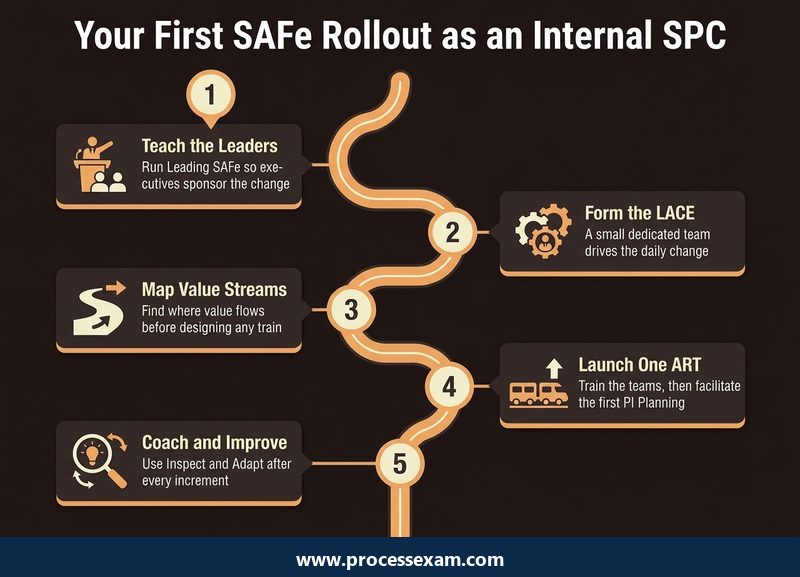
Reach the SAFe Tipping Point, Design the Implementation, Launch an ART and Coach ART Execution follow the roadmap step by step: establishing a vision for change, building a guiding coalition, identifying value streams and trains, writing the implementation plan, preparing the launch, training the teams, facilitating distributed PI Planning, running Inspect and Adapt and a problem-solving workshop. These questions reward knowing the order of the roadmap. An answer that launches a train before the value stream has been identified is almost always the wrong one.
Scaling and acceleration
Large Solution Integration and Delivery covers Solution Trains and launching more trains and value streams. Enhance the Portfolio covers portfolio operations, measuring portfolio performance and strategic agility. Accelerate Business Agility closes with measuring and growing, accelerating flow and customising SAFe. These are the lessons most candidates rush at the end of a long course, and together they are worth more than a fifth of the exam.
How should you use the 60 days between the class and the SPC exam?
The included attempt stays valid for 60 days after the course, and the exam opens in your learning plan once the course is complete. A four-week plan, started the week after class, leaves a buffer for a rescheduled week at work.
Week one: rebuild the roadmap in your own words
Take a sheet of paper and write the implementation steps from memory, in order, with one sentence on what each produces. Then check it against the workbook. Most people get the sequence roughly right and the outputs vague, and vague outputs are exactly what scenario questions test. Do the same for the portfolio: what a portfolio canvas is for, what Lean budgets replace, how an epic moves through the portfolio Kanban.
Week two: use your own company as the case study
This is the advantage an internal coach has over an external consultant. Draft a first-cut value stream for your company, name the train you would launch first and write the three leaders you would put through Leading SAFe before anyone else. The exercise has two payoffs. You rehearse the implementation domains with real names attached, and you finish the week with the first draft of the plan your CTO asked for.
Week three: practise the question style
Start on Scaled Agile's practice test, which matches the real exam's length, difficulty, timebox and domains and can be repeated as often as you like. Its coaching report shows which domains are weak. To check your reasoning on fresh wording, work through the sample SPC questions on ProcessExam, and for each miss write one line on why the correct option comes first in the roadmap or the principles. When you want timed runs with more variety, our SPC practice test draws a new mix of scenario questions for every attempt. Passing any practice set is a signal, not a guarantee.
Week four: full timed runs, then book it
Sit two full runs of 120 minutes in one go, with no notes, since the real exam is closed book. If both are comfortably above the pass mark, book the real attempt that week rather than waiting for a quiet moment that will not come.
Mistakes that cost internal coaches the exam
- Answering as your company does it. Your organisation may run PI Planning over one day or skip the portfolio Kanban. The exam marks Scaled Agile's version.
- Skipping the portfolio lessons. Lean Portfolio Management and Enhance the Portfolio together carry about a fifth of the questions, and they are the least familiar to team-level coaches.
- Treating AI as a side topic. The AI-Empowered syllabus places AI inside the principles and leadership lessons, and Scaled Agile's course description applies it to portfolio work too. Expect questions that ask you to judge AI-generated output rather than accept it.
- Launching before designing. Options that train teams or start a train before value streams are identified are usually traps.
- Letting the window close. Once the 60 days pass, even the first attempt is charged at the retake fee.
If the first attempt fails
A retake costs $250 under the current study guide. You may sit your first retake as soon as you like after a failed attempt. The next one opens ten days after that, a third retake needs a thirty-day wait, and every later attempt also needs thirty days. Read the coaching report before booking; retaking the next morning without fixing the weak domain usually repeats the result.
What changes for you and your company once you are a certified SPC?
For the coach in our opening, the first change is on the budget line. Once Scaled Agile validates you to teach, the Leading SAFe and SAFe for Teams classes for the first train can run in-house, on your company's calendar and in its own context. The second change is credibility. Being the person who teaches the leaders gives you standing in the conversations where the rollout is actually decided.
Resources that come with an active certification
Scaled Agile's benefits sheet describes a large toolkit for active SPCs: 24 toolkits, workshops and guides, including executive and Lean-Agile Center of Excellence workshops, a Value Stream and ART Identification Workshop and a remote ART toolkit; AI-powered SAFe assessments; the SAFe CoPilot assistant; 109 SPC-specific videos; and invitations to role-based SAFe Connect events. You also earn PMI PDUs and Scrum CEUs. The framework article on the Lean-Agile Center of Excellence is worth reading straight after the course, because the LACE is usually the first team an internal SPC helps to form.
Renewal
The certification is renewed yearly. Keep it active: the teaching authorisation and the toolkits come with an active certification, and so does any later move to the advanced consultant credential, which requires an active SPC.
When it is not the right move yet
The SPC makes most sense when an organisation has decided to adopt SAFe, or is close to deciding. If your company is still choosing between scaling approaches, Leading SAFe, a two-day course, is a lighter way to understand the framework first. If your role is centred on a single train rather than the whole change, the Release Train Engineer course may fit better for now. And no certificate substitutes for the rollout itself. The SPC gives you the licence, the materials and the roadmap; the first train you launch is what gives you the experience that the next employer or client will actually ask about.
Frequently Asked Questions
How do I get the SAFe SPC certification?
Attend Scaled Agile's four-day Implementing SAFe course with an authorised partner, then pass the AI-Empowered SPC exam from your learning plan. The course fee includes one attempt if you sit it within 60 days of finishing. Scaled Agile recommends taking SAFe for Teams and Leading SAFe beforehand, though they are not mandatory.
Can I earn the SPC certification online?
Yes. Scaled Agile's partners run Implementing SAFe as live virtual classes as well as in person, in several languages. The exam itself is web-based and taken from your learning plan after the class, closed book and without outside help. Filter the class finder on Scaled Agile's certification page by virtual delivery to see current dates.
How many questions are on the SAFe SPC exam, and what is the passing score?
The current AI-Empowered SPC exam has 60 multiple-choice, single-select questions with a 120-minute time limit. You need 83% to pass, which means at least 50 correct answers. Unanswered questions count as wrong, and the exam submits automatically when the timer reaches zero.
What are the prerequisites for the Implementing SAFe course?
Scaled Agile lists only recommended prerequisites: SAFe for Teams (SP) and Leading SAFe (SA). It also says candidates do best with a firm grasp of Lean-Agile principles and experience in consulting, project, product or portfolio management, or a SAFe role such as Release Train Engineer.
How much does it cost to retake the SPC exam?
Each SPC retake costs $250. The first attempt is covered by the course fee only within 60 days of completing Implementing SAFe; later it is charged at the same rate. The first retake is open at once, the next after ten days, and each one after that needs a thirty-day wait.
- Scaled Agile |
- SPC Question Bank |
- SPC Exam Questions Download |
- SAFe Practice Consultant Test Questions |
- SAFe Practice Consultant Book |
- Practice Consultant Certification Cost |
- Practice Consultant Certification Requirements |
- SAFe Practice Consultant Sample Questions |
- Practice Consultant PDF |
- Implementing Simulator |
- Implementing Mock Exam |
- SAFe Implementing Question Bank |
- SAFe Implementing Book |
- SAFe Implementing Study Guide |
- Implementing Certification |
- Implementing Certification Cost |
- Implementing Certification Requirements |
- SAFe Implementing Exam Questions |
- SAFe Implementing Sample Questions |
- Implementing |
- Implementing PDF


