
Is the aPHR Certification Worth It? Who Gains and Who Should Skip
Yes for some readers, and no for others. The aPHR is worth taking when you have no HR experience and want tested proof of HR basics: HRCI asks for no experience, charges $300 for the exam plus a $100 application fee, and sets 90 questions in 105 minutes, scored on a 100 to 700 scale where 500 passes. It is not worth taking when your years in HR already qualify you for the PHR or SHRM-CP.

The word "worth" hides a different question for each person who asks it. A final-year student is weighing four hundred dollars against a thin CV. An HR coordinator with three years behind them is weighing the same money against a credential that may sit one rung below their experience. A shop manager who has been handed the hiring is weighing it against simply reading a handbook. This guide sorts those readers into profiles, says who gains and who should skip, and describes honestly what the credential changes in an HR job and what it leaves exactly as it was.
Is the aPHR worth it, or only for some readers?
It is worth it for readers who lack a way into HR and cannot yet meet the experience rules of the higher credentials. Every other HRCI credential above it asks for professional-level HR experience before you may apply, so the aPHR is the one place where knowledge alone gets you a recognised HRCI credential. That is its whole value: it replaces "I have never done HR" with "I have been tested on HR fundamentals by the body that runs the exam".
It is not a shortcut past experience, and it does not turn a CV into a senior one. Used for what it is, a proof of foundations, it pays back. Used as a substitute for years of practice, it disappoints. The table gives the short verdict for each common reader before the sections that follow explain the reasoning.
| Reader | Verdict | Main reason |
|---|---|---|
| Student or recent graduate | Worth it | Adds a tested HR credential to a CV with no HR job on it |
| Career changer with no HR work | Worth it | Shows HR knowledge before any HR experience exists |
| HR assistant or clerk, early in the role | Worth it, with a plan to move up | Turns habits learned on the job into tested knowledge |
| Manager or owner who handles HR alone | Worth it if you hire or discipline staff | Gives people decisions a legal and procedural footing |
| Practitioner who already meets a PHR route | Skip it | The PHR or SHRM-CP is open to you now |
What does the aPHR cost, and what exactly does that buy?
HRCI's two fees come to $400 in total. The exam fee is $300 and the application fee is $100, and HRCI states that once an application is approved no refund is made if you withdraw or change your mind. That last rule matters for a worth-it decision: the time to ask whether the credential suits you is before you apply, not after.
The fee buys one sitting of a computer-based exam, delivered at a Pearson VUE test centre or, if you prefer, from home or the office through online proctoring. The figures below are the ones to hold in mind when you set the price against the benefit.
| Item | aPHR |
|---|---|
| Awarding body | HRCI |
| Exam fee | $300 |
| Application fee | $100 |
| Questions | 90 (65 scored plus 25 pretest) |
| Exam time | 105 minutes plus 30 minutes administration time |
| Passing score | 500 on a scale of 100 to 700 |
| Experience required | None |
| Validity | Three years; 45 recertification credits or a retake |
Read the scoring line carefully. HRCI reports results on a scaled range, so 500 is not a percentage and you cannot convert it into "you need to answer this many right". The 25 pretest questions are trial items mixed in with the 65 that count, and you cannot tell which are which, so every question deserves a full attempt.
The fee is only the visible part of the cost. Three years after you pass you must either collect 45 recertification credits or retake the exam, according to HRCI. If you plan to move on to the PHR within a few years, that renewal question may never bite, because many people let the entry credential be overtaken by the next one. If you intend to stay at entry level for the full cycle, put the credit collection into your budget of effort from the start.
The right comparison for the fee is not a salary jump, which HRCI does not promise and which depends on the job you hold. The right comparison is with the next cheapest way of proving the same thing. A university module, a paid course or a year of low-paid HR support work all cost far more in money or time than $400 and a few weeks of study. For someone with no foothold, that gap is the case for the exam.
Who gains most from the aPHR, one reader at a time?
The benefit depends on what is missing from your CV today. The more your profile lacks any HR evidence, the more a tested credential adds. Four typical positions show how that plays out.
A final-year student with no job yet
Your degree may be in business, psychology, law or something unrelated, and your CV shows coursework rather than a workplace. Recruiters reading a stack of graduate applications for an HR assistant post cannot tell who understands hiring, pay and employment law. The aPHR gives you a line that can be checked against HRCI's own page, and it lets you talk in an interview about topics such as job analysis, progressive discipline and benefits administration with the right vocabulary. The gain is real but modest: it improves your odds of an interview, it does not replace an internship.
Someone leaving retail, teaching or operations
You already know how to manage people day to day, but you carry no HR label. The exam helps in two ways. It forces you to learn the formal structure behind things you did by instinct, and it signals to a hiring manager that the move is deliberate rather than a hopeful application. If your current employer has an HR team, you can also use the preparation months to ask for a secondment or shadowing. That pairing of a credential and a few real tasks is stronger than either alone.
An HR coordinator who learned everything on the job
You file records, schedule interviews and answer benefits questions, and nobody has ever tested what you know. The aPHR gives your self-taught practice a formal standard, and filling gaps is often the greater gain than the paper itself: coordinators commonly discover that they handle the daily routine well but have never studied training design or the reasoning behind compensation structures. The warning is the clock. Once your professional-level experience accumulates, the PHR may become reachable, so treat the aPHR as a stepping stone with an expiry date, not a destination.
A manager or owner who inherited HR
Many small businesses have no HR department, so the person who signs the contracts also handles complaints, absences and dismissals. For this reader the exam is less about a CV and more about avoiding avoidable mistakes. Compliance and Risk Management is the largest area of the aPHR outline at 25 percent, followed by Employee Relations at 24 percent, and those two areas are exactly where untrained managers get into trouble. If you never intend to apply for an HR job, ask yourself whether you want the credential or only the learning; the learning can be had without paying for an exam, while the credential matters only if someone else will look for it.
Who should skip the aPHR and go straight to the PHR or SHRM-CP?
Skip it if you can already apply for a higher credential. Paying $400 for an entry credential when you qualify for the next one is the clearest way to misjudge the decision.
Count your professional-level years first
HRCI's PHR page sets three routes, and you need only one: one year of work at professional level plus a master's degree or higher, two years at that level plus a bachelor's degree, or four years at that level with no degree requirement stated. The phrase "professional-level" is the catch. Filing and data entry may not count, while administering programmes, advising managers and handling cases usually do. HRCI publishes guidance on what it treats as professional-level, and it is worth reading before you decide you do not qualify.
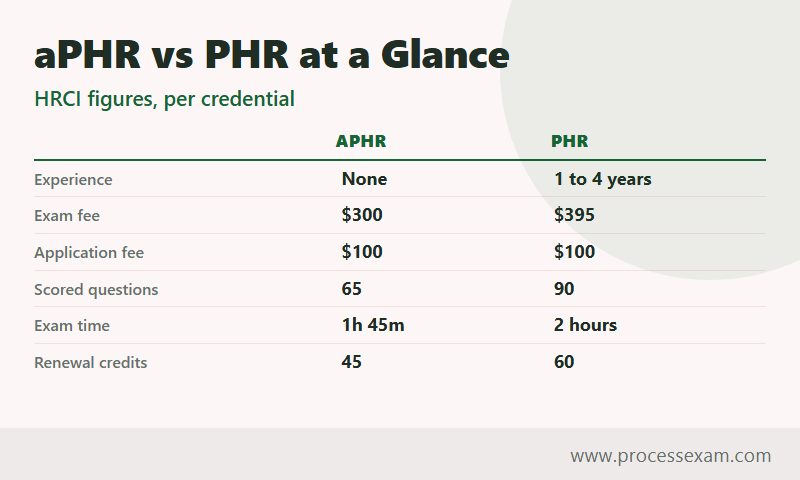
If you meet one of those routes, compare the two exams in terms of effort rather than prestige. The PHR costs $395 for the exam plus the same $100 application fee, runs two hours with 90 scored and 25 pretest questions, and asks for 60 recertification credits over three years instead of 45. It covers seven functional areas rather than five, including Business Management and HR Information Management, which the aPHR outline does not name. The higher exam fee and the extra study are the price of a credential aimed at people who run programmes and day-to-day operations.
SHRM-CP is the other door
SHRM's own certification page describes the SHRM-CP as for people performing HR or HR-related duties, or pursuing a career in HR, with basic working knowledge recommended, and its eligibility note says the candidate's current or recent work is operational in nature. That makes it a fit for an experienced coordinator who does not meet HRCI's professional-level test. Before you pick between SHRM and HRCI, read SHRM's current eligibility criteria and fees on its own site; they are separate from everything quoted here and they change.
A simple rule
If you can name a professional-level HR role and the years to match a PHR route, study for the PHR. If you do HR-related work but cannot satisfy HRCI's experience test, look at SHRM-CP and the aPHR side by side, and choose by which exam style and calendar suits you. If you do neither, the aPHR is the only one of the three you can sit this year. The aPHR also has an international sibling, the aPHRi, for candidates working outside the United States; check which one fits where you work.
What does the credential change at work, and what does it leave alone?
Expectations should be realistic, because most disappointment with entry-level credentials comes from expecting too much of them.
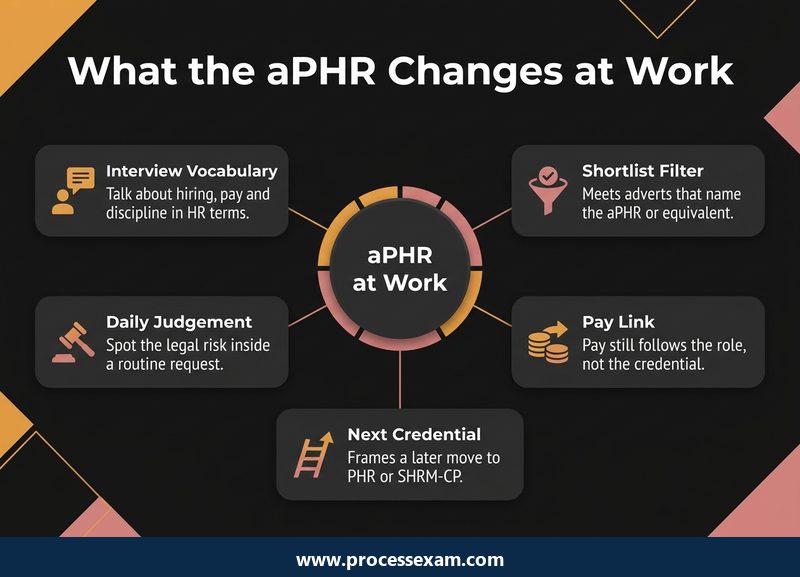
What shifts
- How a hiring manager reads you. A credential with a published exam behind it saves the reader from guessing whether your HR claims are real.
- How you talk. Knowing the difference between a job analysis and a job description, or why an investigation needs a documented process, changes the quality of what you say in meetings.
- How you spot risk. After a study cycle on compliance, an everyday request, such as dismissing someone after a complaint, reads as a possible legal problem rather than a routine one. That habit of pausing is the most useful thing the preparation gives you.
- What you can attempt next. It shows you can finish a formal HR exam, which supports a later move to the PHR or SHRM-CP.
What stays the same
- Your pay band. Employers set pay by role, location and budget. HRCI does not publish an aPHR-specific salary, and no pass mark moves you into a different band on its own.
- Your authority. The credential does not give you decision rights over disciplinary cases or pay reviews. Those follow your job title.
- Your experience record. The aPHR is knowledge-based. HRCI's higher credentials count work experience, not earlier credentials, so passing the aPHR does not shorten the experience you still need for the PHR route.
- The need to keep learning. Employment law and benefits rules shift, and a three-year cycle exists for that reason.
When you want a pay figure to weigh against the fees, look at a published labour-market source for the specific job you would apply for, in your own country, and ignore any number that claims to be "the aPHR salary". Any such number mixes the credential with the role, the employer and the years of experience.
Which parts of the exam will your background make easy or hard?
The aPHR outline has five functional areas with these weights, as HRCI publishes them: Talent Acquisition 19 percent, Learning and Development 15 percent, Compensation and Benefits 17 percent, Employee Relations 24 percent and Compliance and Risk Management 25 percent. Your starting point decides where your study hours go.
- Talent Acquisition (19%). Easier for anyone who has interviewed or been interviewed with care. Harder for people who have never written a job description or measured how long a vacancy stays open. Retail managers and recent graduates tend to find the hiring vocabulary new even when the practice feels natural.
- Learning and Development (15%). Often the smallest worry and the quietest source of lost points, because most readers have been trained but never designed training. Teachers and trainers have a head start; coordinators and owners usually do not.
- Compensation and Benefits (17%). The area where operations managers and owners feel confident about pay but are surprised by the benefit rules and the terms the exam uses. Plan extra time here if your work never touched payroll.
- Employee Relations (24%). The area closest to people management, so managers and team leaders carry an advantage. The catch is that the exam expects the documented, fair process, which differs from what many managers do under pressure.
- Compliance and Risk Management (25%). The largest block and the one most readers underestimate. HRCI describes its PHR as grounded in US laws and regulations, so candidates from other countries should expect statute names and rules that are new to them here too.
A practical way to use this list is to rank the five areas from most familiar to least, then divide your study weeks in proportion to the weight of each area and your unfamiliarity with it. Compliance gets the most time almost every time, simply because it carries the highest weight and the least intuitive content.
One more point on difficulty. The aPHR is a knowledge exam, so scenario answers lean on what HRCI's outline says is correct practice, not on what your last employer happened to do. Readers with real workplace habits sometimes find that the hardest part is setting those habits aside and answering as the textbook would.
How can you test the decision before you pay HRCI anything?
You can answer most of the worth-it question for free in a single evening, and every step below costs nothing until you press the apply button.
- Read the exam outline against your week. HRCI's aPHR page links the full content outline. Mark every task you already do, every one you have seen done and every one that is foreign. If nearly everything is foreign, the preparation will be the main gain. If nearly everything is familiar, you may be ready for a higher exam.
- Do the PHR arithmetic. Write down your professional-level HR years and your degree level, and set them against the three routes on HRCI's PHR page. If one fits, stop and consider the PHR.
- Check five real adverts. Search for the job titles you would apply for in your own area and note whether they name the aPHR, the PHR, SHRM-CP or no credential at all. If none of the five mention any, the aPHR is a supporting item for you, not a gatekeeper.
- Try some questions cold. Work through the free aPHR sample questions without notes. How you score tells you which of the five areas you know and which you do not.
- Take a full-length rehearsal. Sitting the aPHR practice exam under the real clock gives you a number to base the go or no-go call on before the non-refundable fees are paid, and it shows how you hold up over a long exam.
- Set your rule in advance. For example: apply if your sample score shows a realistic path inside the study period you can afford, or if no PHR route is open. Skip or delay if you already qualify for a higher exam.
The decision in one line
Take the aPHR if HR is where you want to go and nothing else on your CV proves you can get there; go straight to the PHR or SHRM-CP if experience has already put them in reach; and treat any promise of a salary jump from the aPHR alone as unproven.
Frequently Asked Questions
Is the aPHR certification worth it?
It is worth it if you have no HR experience and want tested proof of HR basics, because HRCI requires none. It is a poor buy if you already qualify for the PHR or SHRM-CP. Weigh the $300 exam fee and $100 application fee against how much your CV lacks HR evidence.
Does the aPHR raise your salary?
HRCI publishes no salary figure for the aPHR, and the credential alone does not move you into a new pay band. Pay follows the role, employer and location. The aPHR can help you reach entry-level HR jobs you might otherwise miss, which is where any pay benefit would start.
Should you take the aPHR or go straight to the PHR?
Go straight to the PHR if you meet one of HRCI's routes: one year in a professional-level HR role with a master's, two years with a bachelor's, or four years. Take the aPHR if you do not. The PHR exam costs $395 against $300, plus the same $100 application fee.
How long does the aPHR last and what does it cost to keep?
An aPHR is valid for three years. To keep it you must earn 45 recertification credits across that period or retake the exam, according to HRCI. The PHR asks for 60 credits. Many holders move up to a higher credential before the first renewal falls due.
What is the aPHR passing score and exam format?
HRCI scales results from 100 to 700, and 500 is the passing score, so it is not a percentage. The computer-based exam has 90 questions, 65 scored and 25 pretest, with 105 minutes plus 30 minutes for administration. You can sit it at Pearson VUE or online with proctoring.
- HRCI HR Associate Professional Exam Questions |
- HRCI HR Associate Professional Question Bank |
- HRCI HR Associate Professional Questions |
- HRCI HR Associate Professional Study Guide |
- HRCI aPHR Quiz |
- aPHR Certification |
- aPHR Questions |
- aPHR Practice Test |
- aPHR Study Guide Material |
- aPHR Sample Exam |
- HR Associate Professional Certification |
- HRCI HR Associate Professional Book |
- HR Associate Professional Certification Cost |
- HR Associate Professional Certification Requirements |
- HRCI HR Associate Professional Sample Questions |
- aPHR Exam Questions Download |
- aPHR Test Questions |
- HR Associate Professional PDF |
- HRCI Associate Professional in Human Resources


