
AgileDS Foundation Certification: Cost, Syllabus and How to Pass
Picture a delivery manager on a government digital service team. Sprint reviews run on Thursdays, the product owner talks about "discovery findings" and "beta exit", and the manager has run projects for years but never been asked to prove the vocabulary. AgileDS Foundation is APMG International's entry-level exam for that moment: 50 multiple-choice questions in 40 minutes, with 25 correct answers needed to pass. This guide covers cost, syllabus and preparation.
What does a delivery manager actually get from AgileDS Foundation?
The short answer is a shared language and a recognised line on a profile. AgileDS, short for Agile Digital Services, is guidance published in the AgileDS Handbook by the Agile Business Consortium, and APMG International runs the qualification scheme around it. According to APMG's own AgileDS page, the Foundation level is aimed at people who need to work effectively as a member of an AgileDS project team, and the page lists the scheme as suitable for team members in a digital services environment who want to grow into agile project management. Successful candidates can also claim the "Business Agility Professional Level 1 - Explorer" title and a digital badge from the Agile Business Consortium.
That tells you who gets the most from the exam. It suits people who join a service team without having grown up in one: project and programme staff moving from fixed-scope plans, business analysts who now write stories rather than specifications, civil servants and contractors who sit beside developers, designers and user researchers, and operational managers who commission digital work and need to judge whether a team is on track. It is less useful for a developer who already lives in sprints every day and mainly wants a technical credential.
What changes on the team once you hold it?
Nothing magical happens to your authority. What changes is that you can follow a conversation about alpha, beta, timeboxes and prioritisation without translating it into waterfall terms, and you can challenge a plan using the handbook's own principles instead of personal taste. Hiring managers on service teams often screen for a recognised agile qualification before an interview, and a Foundation certificate answers that screen cheaply.
How does a digital service differ from a traditional project?
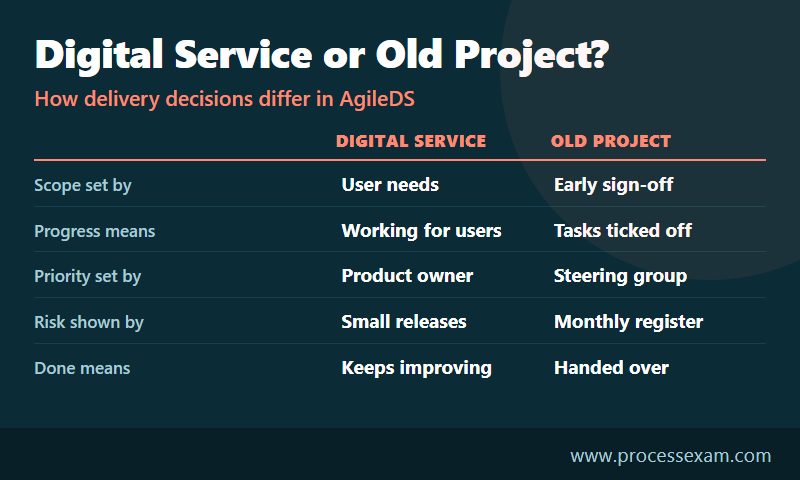
The exam rewards candidates who see the difference in how decisions are made, not only in the words used. A traditional project fixes scope early and measures progress against the plan. A digital service treats the plan as a hypothesis and measures progress by what real users can do. The table below sets out the contrast that the syllabus keeps returning to.
| Question | Traditional project | Agile digital service |
|---|---|---|
| What fixes the scope? | A requirements document signed off early | User needs, re-tested at each stage |
| What counts as progress? | Tasks completed against plan | Something working in front of users |
| Who decides priority? | A steering group, usually at stage gates | The product owner, continuously |
| When is the work "done"? | At hand-over to operations | Never fully; the live service keeps improving |
| How is risk handled? | A register reviewed monthly | Small releases that expose problems early |
If a question offers one answer that protects the plan and another that protects the user's outcome, the handbook-aligned answer is almost always the second.
How tight is a 40-minute, 50-question paper with a 50% pass line?
The format is brief and unforgiving on pacing. The figures below are the exam details we hold for the current listing; the booking page at APMG International remains the place to confirm them before you pay, because APMG states that pass marks and question counts vary from one certification to another.
| Detail | AgileDS Foundation |
|---|---|
| Exam name | APMG International Agile Digital Services Foundation |
| Exam code | AgileDS Foundation |
| Questions | 50 |
| Duration | 40 minutes |
| Passing score | 50 (25 of 50 correct) |
| Exam fee (USD) | 386 |
| Delivery | Booked through APMG International |
Forty minutes for fifty questions is 48 seconds each. That is workable only when you recognise the concept immediately, because there is no time to derive an answer from first principles. The pass line of 25 gives you a margin of 25 misses, which sounds generous until you notice that a candidate who is unsure of two of the five syllabus areas can lose that margin quickly.
Is a course compulsory, and how do you book?
APMG's page says candidates can book an exam directly and self-study, so a course is a choice and not a gate. It also notes that exams are usually bundled into the fee of an accredited training course, while self-study pricing varies by location, which is why the USD figure above is a guide rather than a quote for your country. A booked exam expires after 12 months, according to the same page, so book when you can start studying and not months ahead.
Is the paper open book?
APMG describes most Foundation papers as closed book, and you should assume that here unless your booking confirmation says otherwise. In practice that means the handbook cannot rescue you mid-paper. You need the lifecycle, the roles and the technique names in your head, and you need to understand why each exists so that you can pick the right option in a short scenario.
Read APMG International's AgileDS page for the current booking route, handbook edition and exam conditions. At the time of checking in October 2026 it lists the Foundation exam with a booking link, and the study materials include the handbook, labelled as a beta edition on that page.
How does a service travel from discovery to live, and what does the paper ask about each stage?
The syllabus can be read as five connected areas: the underlying philosophy and principles, the lifecycle, the products or artefacts created, the techniques used, and the roles and responsibilities. Candidates who treat them as five separate lists struggle with scenario questions. Those who treat them as one story do better: who (roles) uses what (artefacts and techniques) at which stage (lifecycle) for what reason (principles). The lifecycle is the spine of that story, so start there.
Discovery: what is the problem, and for whom?
Discovery exists to find out whether a service should be built at all. The team talks to users, maps their current journey, and gathers evidence of the need before anything is designed. A typical exam angle is an option that jumps to choosing a technology or committing to a delivery date at this point. That answer is wrong because nothing is yet known about the user need.
Alpha: can a solution work?
Alpha is for prototypes. The team builds throwaway models to test the riskiest assumptions and shows them to users. The point is cheap learning, so a question about a failed prototype has a positive reading: an alpha that ends with a rejected idea has done its job at low cost.
Beta: can it work for real, at scale?
In beta the service is built properly and put in front of a real, often limited, audience. Expect questions about releasing to a small group first, collecting feedback, and preparing support. The trap is treating beta as a final test before a big launch; the better reading is that beta is where measurement against real use begins.
Live: who looks after it now?
Live is not the end of the team. The service continues to be monitored and improved, the backlog stays active, and decisions are driven by how people actually use it. A "project closes and the team disbands" answer is the classic wrong option.
The phase names above follow the discovery, alpha, beta and live pattern used across digital government delivery. The handbook defines the exact wording the exam uses, so check the terms in your study copy and not in a general article.
What do the principles add to the lifecycle?
The philosophy area is the shortest to read and the easiest to underestimate. It covers delivering value early and often, putting user needs first, working in collaborative multi-disciplinary teams, and judging "done" by whether something reaches real users. Because the scenario questions are built from these ideas, they act as a tie-breaker when two options both sound sensible: choose the one that gets learning from users sooner.
Which roles, artefacts and techniques turn up in scenario questions?
Roles, artefacts and techniques are the vocabulary area, and this is where the closed-book format bites hardest, because a half-remembered term looks like three other terms. The cleanest way to learn them is to tie each to a moment on a real team.
Roles: who owns what?
- Product owner holds the vision and the backlog, and makes the call on priority. When a question asks who decides what to build next, this is the person.
- Delivery manager keeps the team's way of working healthy, removes blockers, and guards the process. In many teams this overlaps with the scrum master role, so expect a question that tests whether you can tell facilitation from decision-making.
- The multi-disciplinary team includes developers, designers, user researchers and others who together can take an idea to a working service without handing it over to another department.
Artefacts: what gets produced, and why so light?
The artefacts are deliberately lean: user personas that describe who the service is for, user stories that capture a need from the user's side, a product backlog that orders the work, and prototypes that let people react to something concrete. The exam is not asking whether you can write heavy documentation. It asks whether you know which lightweight artefact fits which stage. A prototype belongs in alpha; a prioritised backlog drives beta and live.
Techniques: which tool for which job?
Four families recur: timeboxing, prioritisation, workshops and user research. Timeboxing fixes the time and flexes the scope, so a sprint that is running late drops the least important story and does not extend the deadline. Prioritisation is usually shown through MoSCoW, which sorts every item into one of four bands: the Musts without which the service fails, the Shoulds that add clear value, the Coulds that are welcome extras, and the Won'ts parked for this round. Facilitated workshops pull the right people into one room to settle requirements quickly. User research replaces opinion with evidence from the people who will use the service. Wikipedia's explanations of MoSCoW prioritisation are a handy neutral refresher if the term is new.
A worked example: a licence-renewal service
Suppose a team is building an online renewal service for a local licence, with twelve candidate features. The product owner sorts them: renewing and paying online are Must haves, because without them the service fails its purpose; sending a reminder email is a Should have; saving a draft form is a Could have; and a mobile app is a Won't have this time. The team runs two-week timeboxes. When the second timebox falls behind, the delivery manager does not stretch the deadline. The Could have slips to the next timebox, the Musts stay protected, and the user researcher tests the payment screen with real applicants. Every element of that paragraph maps to an exam answer: who prioritises, what a timebox protects, and what a Won't have actually means (not now, rather than never).
What makes a user-centred answer beat a merely plausible one?
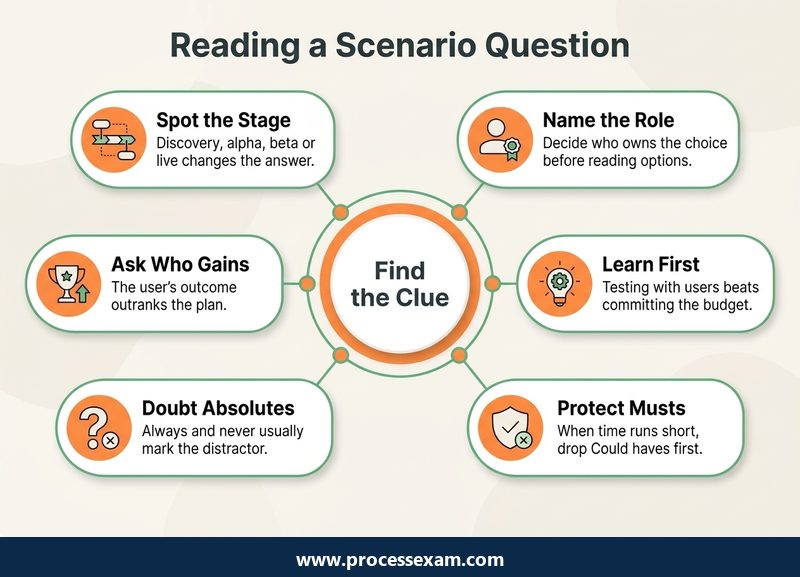
Scenario questions at Foundation level are short, but they are written so that two options look defensible. The skill is to spot the quiet clue that settles it. Four habits help.
- Find the stage first. Is the scenario in discovery, alpha, beta or live? An answer that suits one stage is wrong in another.
- Find the role. If the question asks who should decide, who should facilitate or who should be consulted, name the role in your head before reading the options.
- Prefer learning to commitment. When a choice is between committing the whole budget now and testing with users first, the handbook leans to testing first.
- Distrust absolutes. Words such as always, never and only usually mark the distractor, because the guidance is built on tailoring to context.
What does a typical distractor look like?
Take a team that finishes alpha and finds users reject the main idea. One option says continue to beta to protect the investment already made. Another says stop or change direction because the alpha has produced the learning it was meant to. The first sounds loyal to the plan; the second reflects the purpose of an alpha. Candidates who answer from workplace habit choose the first, and those who answer from the handbook choose the second.
APMG publishes sample papers so that you can see the style before you book. Try the sample papers on APMG's examination site early in your preparation and again in the final days, so you can see the change in your own accuracy.
Can you prepare around a live sprint calendar?
Yes, if you plan around the team's rhythm and keep the sessions short. A delivery manager has predictable pinch points: sprint planning, review and retrospective. Study on the quieter days between them and treat the reading as a backlog of its own.
A three-pass plan that fits sprint weeks
Spend the first pass, around a week of short evening sessions, reading the handbook for the whole story without taking notes. The goal is the lifecycle in one sitting, with the roles and artefacts attached to the stages. In the second pass, build a single page that lists each stage down the side and the roles, artefacts and techniques across the top. Fill it from memory, then correct it from the handbook. The gaps show exactly where to revise. In the third pass, switch to timed questions and review every miss against the page you built.
What should one study session contain?
Thirty to forty minutes is enough. Spend ten recalling last session's material with the book closed, twenty on new material, and the last few minutes writing three questions you could be asked on it. Writing questions forces the contrast thinking the exam tests: not what a prototype is, but when you would choose one.
When do timed questions start?
After the second pass, not before. Timed practice on half-learned material mainly teaches you to panic. Once the one-page map is reliable, do a full 50-question run in 40 minutes, then spend more time reviewing than you spent answering. Our AgileDS Foundation practice exam gives you a way to rehearse that 48-second pace before the real paper, and a missed answer is most useful when you can say which stage, role or technique you confused.
What should the last week look like?
Keep the pace gentle: redo your one-page map from memory, sit one more timed run, and re-read only the questions you got wrong twice. The day before, stop. Confirm your booking details and exam conditions on APMG's page, and sleep. Candidates rarely gain marks from a late-night cram, but they regularly lose them to tiredness in a paper that leaves no time for rereading.
Which digital-service roles and APMG qualifications sit beyond Foundation?
Foundation is the first rung. According to APMG's page, the Practitioner level is the next one up and covers how to apply and tailor the AgileDS guidance to a given scenario. The step is meaningful: Foundation asks whether you know the guidance, Practitioner asks whether you can apply it to a situation. The Practitioner exam is longer than a Foundation paper, so the two levels suit different seasons of a career.
Which jobs ask for this kind of knowledge?
The qualification points at roles in which agile working meets a service context: delivery manager, digital business analyst, product owner in a service team, digital service manager, scrum master or agile coach, and project or programme manager moving into digital delivery. Foundation will not by itself win these roles, because employers weigh experience far above any certificate. What it does is remove a doubt about vocabulary at the screening stage, so your experience is read in the right light.
What about the other APMG agile qualifications?
APMG offers other agile credentials from the same family of guidance, aimed at business analysis and project management in specific contexts. AgileDS is the one tuned to digital service delivery, so choose it when your daily work is about building and running a public-facing or internal service, and choose a different Foundation when your job is dominated by a different discipline.
How should you list it on a profile?
Name the credential in full: APMG International Agile Digital Services Foundation. Add a line that shows the practice behind it, such as the service you helped move from alpha to beta. Recruiters respond to the combination of a recognised qualification and an outcome much more than to the letters alone.
For the topic-by-topic breakdown that backs your revision page, the AgileDS Foundation syllabus lists what the exam covers area by area, and APMG's own page remains the authority for the current handbook edition and booking terms.
Frequently Asked Questions
How many questions are on the AgileDS Foundation exam?
The AgileDS Foundation exam has 50 multiple-choice questions to be answered in 40 minutes, which works out at 48 seconds per question. It tests understanding of the principles, lifecycle, artefacts, techniques and roles in the AgileDS guidance, mostly through short scenarios. Confirm the paper conditions on APMG's booking page.
What is the pass mark for AgileDS Foundation?
The passing score is 50%, which means 25 correct answers out of 50. There is no scoring by section that we know of on the listing, so strength in one area can cover weakness in another, although a gap in the lifecycle or roles will cost several questions at once.
How much does the AgileDS Foundation exam cost?
The exam fee is listed at 386 USD. APMG's page says exams are usually included in accredited course fees and that self-study pricing varies by location, so your local price may differ. Check the booking page for the figure that applies to your country before you pay.
Do you need a course or any prerequisite to sit AgileDS Foundation?
APMG's page says candidates can book an exam directly and self-study, so a course is optional. The page names no prerequisites for Foundation. A booked exam expires after 12 months, so schedule it when you are ready to begin studying, not far in advance.
What comes after AgileDS Foundation?
The next level is AgileDS Practitioner, which APMG describes as applying and tailoring the guidance to a given scenario. Foundation passers can also claim the Business Agility Professional Level 1 - Explorer title and a digital badge from the Agile Business Consortium, according to APMG's AgileDS page.
- APMG International Agile Digital Services Foundation Test Questions |
- AgileDS Foundation Question Bank |
- AgileDS Foundation Body of Knowledge (BOK) |
- Digital Services |
- Agile Digital Services Foundation Simulator |
- Agile Digital Services Foundation Mock Exam |
- APMG International Agile Digital Services Foundation Book |
- APMG International AgileDS Foundation BOK PDF |
- Agile Digital Services Foundation Certification Cost |
- Agile Digital Services Foundation Certification Requirements |
- APMG International Agile Digital Services Foundation Sample Questions |
- AgileDS Foundation Exam Questions Download |
- AgileDS Foundation Test Questions |
- Agile Digital Services Foundation PDF


