admin's blog

Ready for Change? Your PMI-CP Path to New Horizons

An adult woman reviewing a readiness checklist on a laptop, with a notebook and pen on a clean desk, symbolizing thoughtful

The PMI Construction Professional (PMI-CP) certification from PMI is designed for experienced construction project leaders aiming to validate their expertise in managing complex construction projects. This credential confirms a professional's ability to navigate the unique challenges of the construction industry, encompassing advanced skills in contract management, stakeholder engagement, strategy, and project governance. Individuals seeking to solidify their standing in the construction sector, transition into leadership roles, or enhance their project management capabilities will find the PMI-CP invaluable. This article will provide a comprehensive guide to understanding the PMI-CP certification, its benefits, preparation strategies, and how it can propel your career.

Understanding the PMI-CP Credential

The PMI Construction Professional (PMI-CP) credential signifies a high level of proficiency in construction project management, distinguishing certified professionals as experts in the field. It is a globally recognized certification that underscores an individual's capacity to lead and deliver successful construction projects from inception to completion. Holding the PMI-CP demonstrates a commitment to professional excellence and a deep understanding of the specialized processes and knowledge areas critical to construction. This certification is particularly beneficial for those who aspire to lead larger, more intricate construction endeavors and those who seek to broaden their career horizons within the dynamic construction industry.

DSDM Certification Guide: AgilePM Foundation Cost, Syllabus, Pass Mark

If you last looked at DSDM certification a few years ago, one thing has moved: APMG International's AgilePM scheme is now on AgilePM version 3, which gives Scrum a syllabus topic of its own. The entry exam, AgilePM Foundation, is still 50 multiple-choice questions in 40 minutes, costs USD $386 and needs 60% (30 correct answers) to pass, and the certificate never expires. Most candidates are ready for this recall exam after three to four weeks of steady study.

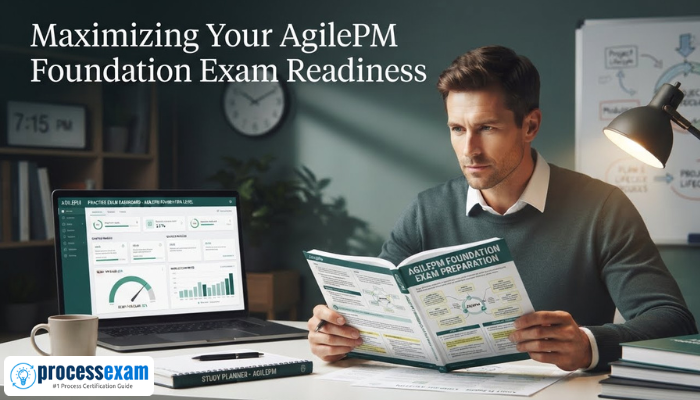
Man studying for the AgilePM Foundation exam at a desk with a study guide and laptop

Version 3 is the current edition on APMG International's AgilePM page, which we checked in September 2026. If a study guide, a course handout or an old forum thread describes an earlier edition, treat the Scrum material in it with caution and rely on the syllabus below instead.

This guide is for project managers, team leaders, business analysts and team members who have been told to "get agile" and want a recognised qualification that goes beyond a two-day workshop. It explains what the exam is, what it covers, how the DSDM ideas turn into questions, how to plan four weeks of study, and where the certificate leads.

OMG OCEB 2 Fundamental: Exam Cost, Format and Syllabus

A wide environmental scene depicting a clear upward trajectory leading towards a bright, symbolic future cityscape

The OMG OCEB 2 Fundamental certification, officially known as OMG Certified Expert in BPM 2 - Fundamental (Exam Code: OMG-OCEB2-FUND100), is designed to validate an individual's foundational understanding of Business Process Management (BPM) concepts, principles, and modeling techniques. This credential from the OMG (Object Management Group) serves as a crucial entry point for professionals aspiring to demonstrate their competence in analyzing, designing, and improving business processes. This article clarifies the essence of the OMG OCEB 2 Fundamental certification, outlining its purpose, benefits, exam structure, syllabus, and effective preparation strategies for aspiring candidates looking to enhance their BPM expertise. It aims to demystify the certification process, offering a clear roadmap for success.

Understanding the OMG OCEB 2 Fundamental Credential

The OMG OCEB 2 Fundamental certification establishes a benchmark for professional competency in Business Process Management. It signifies that an individual possesses a fundamental grasp of BPM terminology, lifecycle phases, and the modeling notations used to represent business processes effectively. This certification is particularly relevant for business analysts, process owners, project managers, and IT professionals who interact with or are involved in process improvement initiatives. Earning this credential confirms a candidate's ability to speak the common language of BPM, fostering better collaboration and understanding within organizations.

Pega CPBA Certification: Version 25 Exam Cost and Syllabus

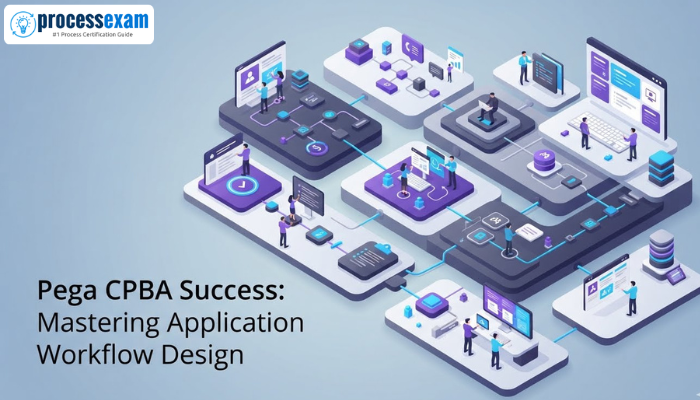
An isometric 3D illustration showing a complex but clearly structured Pega application workflow, with interconnected modules

The Certified Pega Business Architect (CPBA) certification from Pega stands as a critical validation for professionals adept at translating business requirements into Pega solutions. This esteemed credential signifies an individual's expertise in designing and optimizing business processes using the Pega platform, crucial for organizations aiming to streamline operations and enhance customer experiences. Targeting business architects, system analysts, and project managers, the CPBA exam (code CPBA) confirms a candidate's ability to drive successful Pega implementations from a functional perspective. This comprehensive roadmap will guide aspiring CPBA professionals through a strategic 9-step preparation journey, ensuring readiness for Pega success.

Validating the Pega Business Architect Role

The role of a Pega Business Architect is pivotal in bridging the gap between business needs and technical solutions. Obtaining the CPBA certification solidifies your standing as an expert capable of analyzing, designing, and delivering effective Pega applications. This professional validation demonstrates your proficiency in core Pega functionalities, empowering you to contribute significantly to digital transformation initiatives within any enterprise utilizing the platform.

ISTQB CTAL-AT Agile Tester: Syllabus, Scoring and Study Plan

A CTAL-AT paper has 40 questions, yet you cannot score 40: it is marked out of 52 points, because ISTQB weights each question by its difficulty. Thirty-one questions are worth one point, six are worth two and three are worth three. You need 34 points in 90 minutes. Answer every one-point question correctly and you still finish on 31, three points short of a pass.

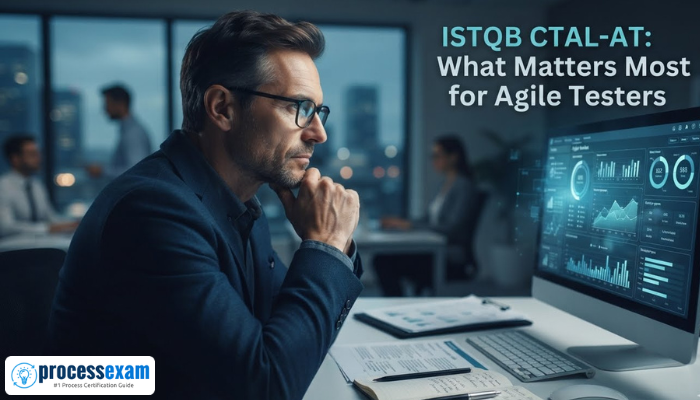
Senior agile tester studying a metrics dashboard while preparing for ISTQB CTAL-AT

That arithmetic shapes everything below: which chapters you study hardest, how you spend the clock and why the Agile Tester syllabus that ISTQB released in April 2026 is not the one your colleague studied in 2018. The details here were checked in October 2026 against ISTQB's own certification page, the v2.0 syllabus and its exam rules.

How does a 40-question paper turn into 52 points?

ISTQB's exam rules give Advanced Level papers a sliding scale. A question that tests understanding (cognitive level K2) is allocated one point. An applying question (K3) is allocated two points in general, and an analysing question (K4) three. For CTAL-AT the published structure sets the mix at 31 K2 questions, 6 K3 and 3 K4, which gives 31 + 12 + 9 = 52 points. The pass line is 65 percent of 52, which is 33.8, and the rules round up to 34 points.

SHRM-SCP Eligibility, Exam Content and How to Apply

Updated on 29 September 2026. What’s new: exam fee corrected to $399 for members and $499 for non-members, and content-area weightings now follow SHRM's published score split

SHRM-SCP stands for SHRM Senior Certified Professional, the credential the Society for Human Resource Management awards to HR practitioners working at a strategic level. To sit the exam you need three years of strategic-level HR work, at least 1,000 hours in each of those calendar years, and no degree or HR job title. The exam is 134 questions in 220 minutes, and the winter 2026-27 window closes to new applications on 24 December 2026.

Senior HR leader reviewing a workforce plan with two colleagues in a bright meeting room before applying for the SHRM-SCP

What does SHRM-SCP stand for, and what does the credential certify?

The letters are SHRM, for the Society for Human Resource Management, and SCP, for Senior Certified Professional. Searchers often type "shrm-scp designation" because that is exactly what it is: a designation you may add after your name once you have passed SHRM's exam and while you keep it current. It sits above the SHRM-CP, the Certified Professional credential, and the difference between the two is a difference of job level rather than of subject.

Mastering ISTQB CTAL-ATT: Essential Prep for Agile Testers

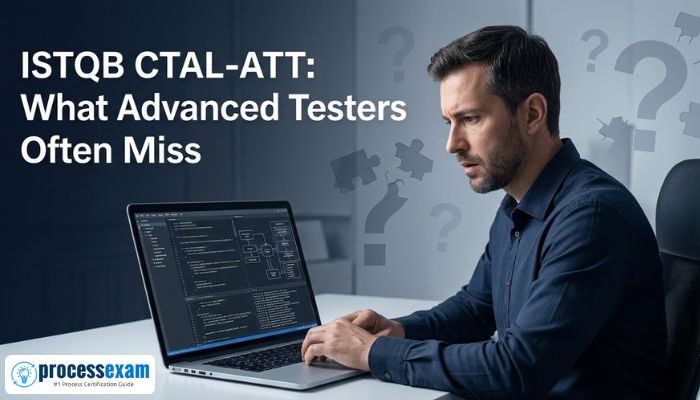
An adult man, a technical tester, looking thoughtfully at a laptop screen with complex code, symbolizing the challenges and

The ISTQB Advanced Level Agile Technical Tester (CTAL-ATT) certification validates a tester's advanced skills in agile software development environments, focusing on technical aspects. This credential is for experienced testing professionals looking to deepen their expertise in test automation, static and dynamic analysis, and the deployment and delivery of agile projects. Many candidates, however, approach the ISTQB CTAL-ATT exam with misconceptions, leading to common pitfalls that hinder their success. This article evaluates the critical areas where most candidates struggle, offers honest insights into effective preparation, and outlines a clear path to readiness. Here, we delve into the exam's structure, critical syllabus topics, and strategies to ensure a thorough understanding of the technical intricacies required for agile testing excellence.

Examining the ISTQB CTAL-ATT Framework

Achieving the ISTQB Advanced Level Agile Technical Tester certification signifies a deep understanding of quality assurance within an agile context, particularly concerning technical testing practices. This involves not only theoretical knowledge but also the practical application of advanced testing techniques across the software development lifecycle. Understanding the specific components and expectations of the exam is the first step toward effective preparation, setting the foundation for a strategic study plan.

OGEA-102 Exam: How to Pass TOGAF Enterprise Architecture Part 2

Somebody on every large transformation has to make the plan hold together - the stakeholder nobody consulted, the data that cannot move yet, the sequence that costs half as much in a different order. That is the TOGAF Enterprise Architecture Practitioner's job, and OGEA-102 is where you prove you can do it: eight scenario questions, 90 minutes, open book, 60% to pass.
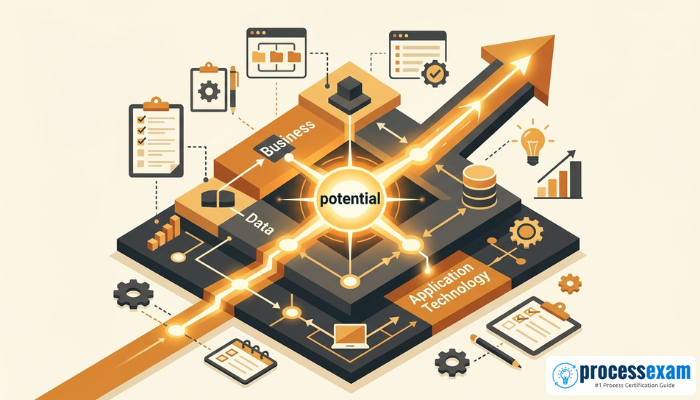
Isometric view of business, data, application and technology architecture layers connected around a central hub

It is also the whole difference between the two TOGAF levels. Part 1 checks that you know what the TOGAF Standard says. Part 2, examined as OGEA-102, checks that you can pick the right move when a scenario gives you a half-finished programme, an unhappy sponsor and four plausible things to do next.

This guide walks through what practitioners are expected to do, how The Open Group builds the Part 2 exam around that work, what the syllabus covers phase by phase, and how to get ready without reading the entire standard cover to cover.

What does a TOGAF Enterprise Architecture Practitioner actually do?

Strip away the vocabulary and the role comes down to one job: keep a large change programme coherent. Someone has to decide which business capabilities the transformation touches, which data has to move, which applications are retired and which technology the target state needs. Someone has to show the finance director why the sequence costs less in that order, and show the delivery teams what they are allowed to change. That is the practitioner's work, and the Architecture Development Method is the routine that keeps it repeatable across programmes.

What Is CF APMP? Meaning, Cost, Exam Format and Study Plan

CF APMP is the exam code for the APMP Foundation-Level Certification, the entry credential of the Association of Proposal Management Professionals. The exam is 75 questions in 65 minutes, open book, graded Pass / Fail, and it costs USD $425 for APMP members or USD $780 for non-members. It tests the vocabulary and good practice of bid and proposal work, not deep specialist skill.

Woman reviewing a bid management dashboard on a tablet beside a laptop showing a proposal, with CF APMP title text

People find this page by typing "cf apmp", "what is cf apmp" or "cf apmp meaning", and they usually want four things: what the letters stand for, what the exam costs, what it feels like to sit, and whether it is worth doing. This guide answers those in that order, then gives a four-week plan and a method for using the open-book rule without losing time. It was checked against APMP's own Foundation page in September 2026, which describes Version 4 of the study guide.

What does CF APMP mean, and where does it sit in the APMP ladder?

APMP is the professional body for people who write, manage and win bids, proposals and tenders. "CF" marks the Foundation level. APMP's other levels are Practitioner (CP APMP) and Professional (CPP APMP), so CF APMP is the bottom rung: it shows you know the shared language of the profession, while the higher levels ask you to prove you can apply it to real bids.

Why Conventional ICGB Prep Fails: A New Expert Blueprint

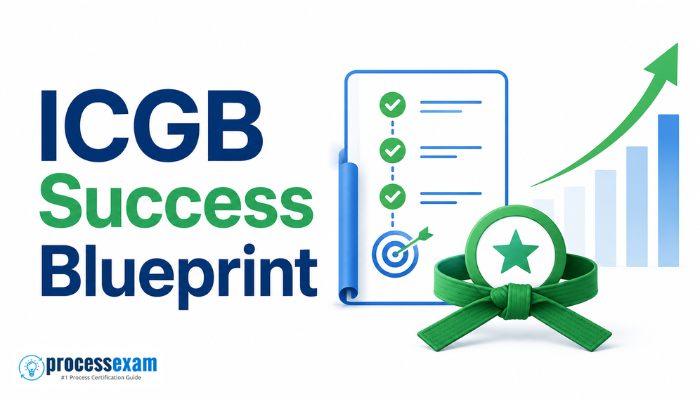
Image titled “ICGB Success Blueprint” with a checklist blueprint, target icon, green certification belt badge, and rising

The IASSC Certified Lean Six Sigma Green Belt (ICGB) certification validates a professional’s competence in applying Lean Six Sigma methodologies, tools, and practices to improve processes and reduce defects within an organization. Achieving this credential signifies a deep understanding of problem-solving techniques and a commitment to operational excellence. Many aspiring Green Belts approach the ICGB exam with traditional study methods, often finding themselves unprepared for the nuanced application of concepts required. This article delves into the inherent shortcomings of conventional preparation and outlines an expert blueprint designed for authentic mastery and successful certification, distinguishing itself from typical study guides by emphasizing a strategic, holistic approach.

Syndicate content