
How CSSYB Certification Opens Up New Career Paths?
Updated on 22 September 2026. What’s new: exam fees corrected to ASQ's current $334 for members, $434 for non-members and $234 for retakes
CSSYB stands for Certified Six Sigma Yellow Belt, the entry-level Six Sigma credential awarded by ASQ, the American Society for Quality. It rarely hands you a brand-new job title on its own. What it does is earn you a seat on improvement projects, collecting data, mapping processes and holding gains for Green Belt and Black Belt leads, and from that seat many people move into quality, operations and continuous-improvement careers.
This rewrite, checked against ASQ's own pages in September 2026, follows that path in order: what the letters mean in practice, the jobs and industries where a Yellow Belt is useful, what the exam asks and how its 80 scored questions are shared out, when you can test and what it costs, a six-week plan for a complete beginner, the traps that catch first-time candidates, and where the career can go after the first belt.
What does CSSYB mean, and what does a Yellow Belt do on a real project?
Take the letters one at a time. Certified means you passed an exam set by an independent body rather than only attending a course. Six Sigma is the improvement method built on reducing variation, usually run through the five DMAIC phases: define, measure, analyze, improve and control. Yellow Belt is the first rung of the belt ladder, below Green Belt and Black Belt. The belt colours signal how deep your training goes and how much of a project you are expected to carry.
ASQ writes the credential for people who are new to Six Sigma and have a small role in it, a passing interest, or a need for foundational knowledge. Its own description covers two very different groups: entry-level employees who want to improve the work in front of them, and executive champions who sponsor projects and need an overview of the method without running the statistics themselves. That breadth is useful to know, because it explains why the exam stays at the "understand and apply" end of the scale rather than asking you to design experiments.
On an actual project, a Yellow Belt is the person closest to the process. The Green Belt or Black Belt leads, owns the charter and runs the heavier analysis. The Yellow Belt supplies what the lead cannot see from a desk:
- Process knowledge. How the work really flows, including the unofficial workarounds that never made it into the procedure.
- Data collection. Filling check sheets, logging cycle times and following the data collection plan so the numbers can be trusted.
- Process maps. Helping draw the SIPOC and the detailed flowchart, then spotting the hand-offs where errors creep in.
- Local fixes. Trying small changes through a PDCA cycle or a short kaizen event and reporting what happened.
- Holding the gain. Following the new work instruction, keeping the run chart going and raising a flag when the process drifts.
A short example makes the role concrete. An outpatient clinic wants to cut the time patients spend in the waiting room. A Black Belt from the hospital's improvement office leads the project. The receptionist, trained as a Yellow Belt, records arrival, check-in and call-in times on a simple check sheet for three weeks, helps map the check-in steps, and notices that insurance details are re-typed at two different desks. That observation becomes one of the root causes the team tests, and the receptionist later trains colleagues on the revised check-in routine. Nobody on that team needed the receptionist to run a regression. They needed someone who understood the method well enough to collect clean data and speak the project's language.
Which careers and industries does a CSSYB open up?
Six Sigma began in manufacturing, but the Yellow Belt travels well because every organisation has processes that repeat and go wrong. The credential tells a hiring manager that you already know what a charter, a Pareto chart and a control plan are for, so you can join an improvement effort in your first month rather than your sixth. The table shows where that tends to matter, the kind of titles people hold while using the belt, and the part of ASQ's Body of Knowledge the work draws on most.
| Setting | Typical roles that use it | Yellow Belt work you would do | Body of Knowledge area it leans on |
|---|---|---|---|
| Manufacturing and assembly | Production associate, line lead, quality technician trainee | Scrap and rework tallies, 5S, check sheets at the line | Measure phase, Lean tools in the Analyze phase |
| Hospitals and clinics | Unit coordinator, patient-access lead, clinical support staff | Waiting-time studies, handover mapping, error logs | Define phase (voice of the customer), data collection |
| Banking, insurance and shared services | Operations analyst, claims processor, process associate | Rework counts, turnaround time tracking, SOP updates | Six Sigma metrics, work instructions and SOPs |
| Logistics and supply chain | Warehouse supervisor, supply chain coordinator, planner | Pick-error analysis, supplier mapping, cycle time tracking | Supply chain management, root cause analysis |
| IT and service desks | Service desk lead, support analyst, release coordinator | Ticket categorisation, repeat-incident analysis | Corrective and preventive action |
| Public sector and education | Administrative officer, programme assistant | Form redesign, backlog reduction, approval-step mapping | Project management basics, team tools |
Within those settings, the Yellow Belt tends to feed three distinct career paths. Knowing which one you are on changes what you do after the exam.
The quality path
Here the belt is an early marker on the way to a quality job: inspector, technician, quality analyst, and later quality engineer or quality manager. The Yellow Belt covers the vocabulary those roles use every day, from control charts to corrective action, and it pairs naturally with ASQ's other entry-level quality credentials.
The continuous-improvement path
This is the classic belt ladder. You support projects as a Yellow Belt, lead smaller ones as a Green Belt, and eventually run a portfolio or coach others as a Black Belt. Organisations with a formal improvement office often expect people to climb in exactly that order, so the Yellow Belt is the first thing they look for.
The "better at my own job" path
Many holders never take an improvement title at all. A shift supervisor, a finance team lead or a nurse manager uses the method to run their own area with fewer surprises. For them the belt is a leadership signal: it shows a manager that this person solves problems with data rather than with opinions, which is often what decides who gets the next promotion.
What does the CSSYB exam involve on the day, and how is it scored?
The computer-delivered exam is a single part, taken in English, with a mix of scored and unscored multiple-choice items. The key figures come straight from the exam's listing.
| What you need to know | ASQ CSSYB figure |
|---|---|
| Certification | ASQ Certified Six Sigma Yellow Belt (CSSYB) |
| Awarding body | ASQ |
| Questions | 90 (80 scored, 10 unscored) |
| Time (minutes) | 138 |
| Passing score | 550/750 |
| Fee (USD) | ASQ MEMBERS - $334; NON-MEMBERS - $434; RETAKES - $234 |
| Eligibility | No education or work experience required |
| Question style | Multiple choice, open book |
| Content outline | 2022 CSSYB Body of Knowledge, five sections |
Three points in that table are worth slowing down for.
The unscored questions. Ten of the 90 items are being trialled for future forms of the exam. They are mixed in with the real ones and look exactly the same, so treat every question as if it counts. The practical effect is on pacing: you are answering 90 questions, not 80, inside the time limit.
The clock. 138 minutes for 90 questions is a little over a minute and a half per item. Most Yellow Belt questions are definitions, scenario judgements or short calculations, so that is enough time, provided you do not spend five minutes hunting through a reference book for one answer.
The scaled score. A pass is 550 on a scale that runs to 750. Because the result is converted onto a scale, it cannot be read as a simple tally, and nobody can promise in advance that a particular count of right answers will be enough; the conversion keeps results fair when one version of the exam turns out slightly harder than another. Computer-based candidates see a pass or fail on screen when they finish, and ASQ emails a breakdown by section a few business days later.
The exam is open book, and that surprises many first-timers. You may bring your own references, but they have to be properly bound, and loose pages are turned away. A basic calculator is available on screen, and a silent, non-programmable hand-held one is also allowed. ASQ also runs a paper version in some locations, which has 80 questions and a two-hour limit, so check which delivery you are booking. The full list of rules sits on ASQ's CSSYB certification page.
How are the 80 scored questions split across ASQ's 2022 Body of Knowledge?
ASQ publishes the 2022 CSSYB Body of Knowledge as a short brochure. It was introduced at the September 2022 exam administration, when the scored questions rose from 75 to 80, and it is still the outline ASQ links from the exam page as of September 2026. Every topic that may be examined is listed, each section shows its share of the scored items, and each topic ends with a label saying how deeply it will be tested. Most Yellow Belt topics are set at Understand, and a handful at Apply, which means you will be asked to use a tool or run a calculation rather than just define it.
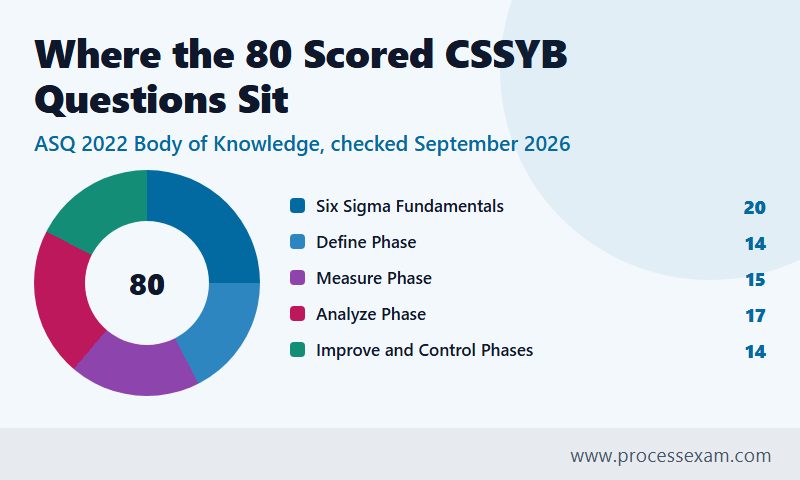
The weighting is flatter than many candidates expect. No section falls below 14 questions, so there is no safe area to skip. If you want the full topic list laid out alongside each section's weighting as a checklist, our CSSYB syllabus page follows the 2022 outline.
Six Sigma Fundamentals: 20 of the 80 scored questions
A quarter of the exam sits here, the largest single share. It covers why Six Sigma focuses on reducing variation and how it grew out of the wider quality movement; the Lean ideas that sit beside it, such as waste elimination, just-in-time, poka-yoke, kanban and value stream mapping; and who does what on a project, from team member through Yellow, Green, Black and Master Black Belt to process owner, champion and sponsor. Team basics follow: types of teams, the forming-storming-norming-performing-adjourning sequence, decision tools such as brainstorming, multivoting and nominal group technique, and meeting tools such as agendas, minutes and status reports. The section ends with the seven basic quality tools and the core metrics: defects per unit, defects per million opportunities, rolled throughput yield, cycle time and cost of poor quality. The tools and metrics are tested at the Apply level.
Define Phase: 14 questions
Define is about choosing the right problem and framing it. Expect questions on turning the voice of the customer into critical-to-quality characteristics, selecting projects, analysing stakeholders and building a SIPOC. The 2022 update added supply chain management and how it relates to projects. The project management basics complete the section: the charter and its problem statement, scope, baseline and goal; the communication plan; work breakdown structures and Gantt charts; planning tools such as affinity diagrams, tree diagrams and activity network diagrams; and tollgate reviews between phases.
Measure Phase: 15 questions
This is where the arithmetic starts. You need to calculate and interpret the mean, median and mode, and understand range, variance and standard deviation. The data collection topics ask what goes into a data collection plan, how qualitative data differs from quantitative data, and how surveys, interviews, check sheets and checklists are used. Measurement system analysis closes the section: precision, accuracy, bias, linearity and stability, and the difference between repeatability and reproducibility in a gauge R&R study.
Analyze Phase: 17 questions
The second-largest section, and the one that surprises beginners most. It mixes Lean tools such as 5S and value analysis with FMEA, where you must work out a risk priority number from severity, occurrence and detection. Root cause tools follow: the 5 Whys, process mapping, 8D, force-field analysis and matrix charts. The 2022 update added full topics on corrective action and preventive action, both at the Apply level. Finally come the first statistical ideas: normal and binomial distributions and how skewed or bimodal shapes change interpretation, common versus special cause variation, correlation, regression, and the language of hypothesis testing, including null and alternative hypotheses, type I and type II errors, p-values and power.
Improve and Control Phases: 14 questions
The last section pairs improvement techniques with the tools that make them stick. On the improve side sit kaizen and kaizen blitz, the plan-do-check-act cycle and cost-benefit analysis. On the control side sit the control plan, how an X-bar and R chart monitors an improved process, document control, and, new in 2022, work instructions and standard operating procedures.
When can you sit the CSSYB, and what will it cost you?
ASQ delivers the computer-based exam in testing windows rather than all year round, and each window has an application deadline several weeks ahead of it. At the time of checking, in September 2026, ASQ's page listed these windows:
- 1 to 30 September 2026: the window running now; its application deadline of 10 August 2026 has passed.
- 1 to 30 November 2026: apply by 12 October 2026.
- 1 to 31 January 2027: apply by 7 December 2026.
ASQ revises this calendar every year, and its full list of testing windows is the place to check before counting study weeks back from a booking. The practical lesson is that the deadline, not the window, is the date that matters. Someone who decides in mid-October to sit in November has already missed it.
Booking runs in a fixed order. You apply to ASQ online and pay, ASQ approves the application, and an email follows with instructions for choosing a test centre and a time inside the window you selected. Remote, online-proctored delivery is also described on ASQ's computer-based testing pages if a test centre is inconvenient.
The full cost of the attempt
The exam fee in Master's listing reads ASQ MEMBERS - $334, NON-MEMBERS - $434 and RETAKES - $234. ASQ presents it as a $434 fee with $100 off the initial exam for members, which is the same thing expressed differently. A few other costs belong in the budget:
- Membership. Whether it pays for itself depends on whether you will use it beyond the exam. For one attempt, compare the membership price with the $100 saving before joining.
- The retake rate. The lower retake fee is available for two years after a previous attempt, which takes some of the risk out of a first try.
- Changes to your appointment. ASQ's page lists a $130 fee for moving an appointment, which must be done at least five days before it. Missing the appointment altogether forfeits the fees.
- References. ASQ Quality Press publishes a CSSYB Handbook and a CSSYB Study Guide. One good bound reference is enough for an open-book exam.
- Practice and training. Neither is required. Timed practice is the cheapest way to find out whether your pacing works.
How can a complete beginner prepare for the CSSYB in six weeks?
Six weeks at five to six hours a week suits most people with no statistics background. The plan follows the Body of Knowledge in order, because each section builds on the one before it.
- Week 1: The method and the people. Read the whole Body of Knowledge once. Then learn DMAIC, the belt roles, the Lean ideas in section one and the team tools. Write each role's job in one sentence of your own.
- Week 2: Quality tools and metrics. Draw every one of the seven basic tools by hand from a small made-up data set. Then work the metrics until they are automatic (see the worked example below).
- Week 3: Define. Write a practice charter for a problem at your own workplace: problem statement, scope, baseline, goal. Build a SIPOC for the same process. This makes the Define questions feel familiar rather than abstract.
- Week 4: Measure. Calculate mean, median, mode, range and standard deviation for small data sets until you can do it with the on-screen calculator without thinking. Learn the MSA terms by pairing each with an everyday example, such as a bathroom scale that always reads two kilograms heavy (biased, but possibly precise).
- Week 5: Analyze. Work through FMEA scoring, the root cause tools and the corrective and preventive action steps. Build a one-page sheet of hypothesis-testing terms written in plain words.
- Week 6: Improve, Control and a full rehearsal. Cover PDCA, kaizen, control plans and the X-bar and R chart. Then sit a full timed rehearsal with your real references, and spend the last days on the two sections where you scored lowest.
That full rehearsal matters more than any single chapter. A timed CSSYB mock exam taken with the same bound book you will carry on the day shows whether 138 minutes is comfortable or tight, and which sections still send you flicking through pages.
A worked example of the three metrics
Suppose an accounts team checks 400 invoices, each with 5 fields that can be wrong, and finds 12 errors. Defects per unit is 12 divided by 400, or 0.03. Defects per million opportunities divides the 12 errors by the 2,000 chances for error (400 invoices times 5 fields), then multiplies by one million, giving 6,000. Now suppose the invoice passes through three steps whose first-time yields are 0.95, 0.90 and 0.98. Rolled throughput yield multiplies them: 0.95 times 0.90 times 0.98 is about 0.838, so only around 84 percent of invoices get through all three steps without rework. Questions like these reward people who have done the arithmetic a dozen times before exam day.
Getting the most from an open-book exam
Open book helps only if you know exactly where things are. Put one tab on each of the five Body of Knowledge sections and a smaller tab on the pages you used most in practice, such as the metric formulas and the control chart explanation. If you write your own notes, have them bound before exam day and practise with them in that form. The goal is to look up a formula in under a minute, not to learn it in the exam room.
What trips up first-time Yellow Belt candidates?
The Yellow Belt has a reputation as the easy belt, and that reputation causes most of the failures. These are the patterns that show up again and again:
- Assuming "entry level" means no maths. Measure and Analyze together carry 32 of the 80 scored questions, and several topics are set at the Apply level. You will calculate.
- Treating Analyze as optional. At 17 questions it is the second-largest section, and the 2022 update made it broader by adding corrective and preventive action.
- Mixing up common and special cause variation. Common cause is the background noise of a stable process; special cause is a signal that something specific changed. Many scenario questions turn on this one distinction.
- Getting FMEA arithmetic wrong. The risk priority number is severity times occurrence times detection. A failure scored 8, 4 and 6 gives 192. Candidates lose marks by adding instead of multiplying, or by forgetting that a high detection score means the failure is hard to detect.
- Learning tool names without their purpose. The exam rarely asks "what is a Pareto chart?" It asks which tool fits a situation. For every tool, learn the question it answers.
- Applying too late. Because the deadline falls weeks before the window, a well-prepared candidate can still end up waiting two months. Pick the window first, then plan the study.
- Carrying a reference you have never practised with. A thick book you do not know slows you down more than having no book at all.
Where can the career path go once you hold the Yellow Belt?
The first thing to know is that the Yellow Belt does not expire. ASQ lists it among its lifetime certifications with no recertification requirement, so once you have passed, the credential stays on your record without renewal fees or recertification units. That makes it a low-risk first step: the effort you put in now keeps paying back.
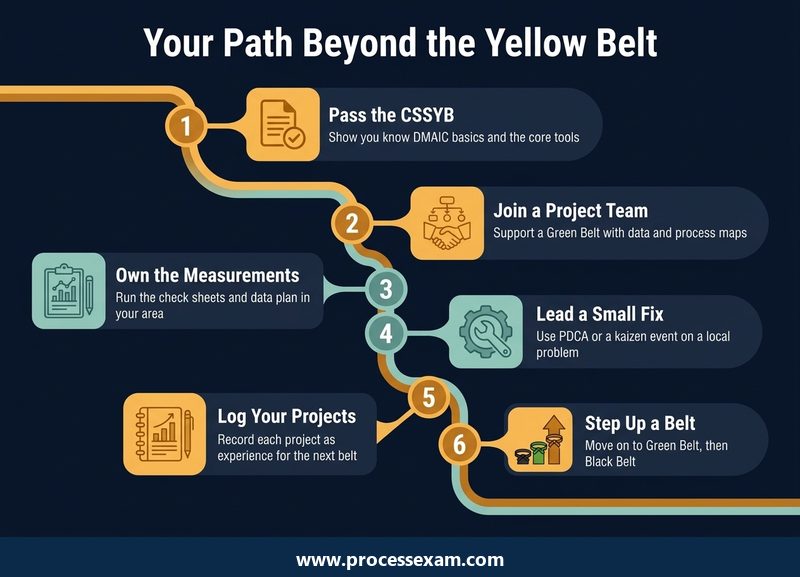
After that, the path depends on which of the three career routes you are on. On the improvement route, the natural next step is the Green Belt, where you start leading projects rather than supporting them. ASQ describes the Six Sigma Green Belt as suited to professionals with at least three years of work experience, so the projects you support as a Yellow Belt double as the experience that qualifies you later. Keep a simple log of each one: the problem, your part in it, the tools you used and the result. It will help on the application and in interviews.
On the quality route, the Yellow Belt sits comfortably beside ASQ's other foundation credentials, and many people add one of those before specialising as an inspector, technician, auditor or engineer. On the "better at my own job" route, the next step is usually not another exam but a visible result: one small project in your own area, measured before and after, that your manager can point to.
Making the credential work on a CV
List it under certifications with the full name and the year: ASQ Certified Six Sigma Yellow Belt (CSSYB), followed by the year you passed. Then back it up in the experience section with one line per project, written as a result, for example "collected and analysed three weeks of check-in data that identified duplicate data entry as a root cause of patient delays". Recruiters see many belts listed without context. A belt next to a real contribution is what turns the credential into an interview.
So does a CSSYB open new career paths? It opens the door to the projects where careers in quality and improvement are built, and it does so at modest cost, with no experience requirement and no renewal. The career itself still comes from what you do once you are through that door.
Frequently Asked Questions
What does CSSYB stand for?
CSSYB stands for Certified Six Sigma Yellow Belt. It is ASQ's entry-level Six Sigma certification, aimed at people who are new to the method, support improvement projects or need a working overview of DMAIC. It sits below the Green Belt and Black Belt on ASQ's belt ladder.
What are the ASQ Six Sigma Yellow Belt certification requirements?
There are none beyond passing the exam. ASQ asks for no degree, no work experience and no completed project before you apply for the CSSYB. You choose a testing window, apply before that window's deadline, and sit the 90-question exam at a test centre or through online proctoring.
How much does the ASQ CSSYB exam cost?
The fee is ASQ MEMBERS - $334, NON-MEMBERS - $434 and RETAKES - $234. The retake rate applies for two years after a previous attempt. ASQ also charges a fee to move an appointment, so check the current amounts on ASQ's certification page before you apply.
How many questions are on the ASQ Yellow Belt exam, and what is the pass mark?
The computer-delivered CSSYB has 90 multiple-choice questions in 138 minutes. Eighty are scored and ten are unscored trial items that look like the rest. The pass mark is a scaled score of 550/750, so it does not match a fixed number of correct answers.
Does the CSSYB certification expire?
No. ASQ lists the Six Sigma Yellow Belt as a lifetime certification with no recertification requirement, so there are no renewal fees or recertification units to collect. Many holders still move on to the Green Belt once they have enough project experience.
- Six Sigma |
- ASQ Six Sigma Yellow Belt Sample Questions |
- ASQ Six Sigma Yellow Belt Test Questions |
- CSSYB Question Bank |
- CSSYB Exam Questions Download |
- CSSYB Test Questions |
- Six Sigma Yellow Belt PDF |
- ASQ Six Sigma Yellow Belt Book |
- ASQ CSSYB BOK PDF |
- Six Sigma Yellow Belt Certification Cost |
- Six Sigma Yellow Belt Certification Requirements |
- CSSYB Body of Knowledge (BOK) |
- CSSYB Handbook


