
IIBA CCA Certification: A Worthwhile Investment
Updated on 22 September 2026. What’s new: non-member exam fee corrected to $405, which now includes a first year of IIBA membership, with the current remote exam and renewal rules.
For a business analyst who keeps getting pulled into access reviews, vendor risk questions or security requirements, the IIBA CCA is worth it: it costs Member - $250, Non-Member - $405, needs no application or experience check, never has to be renewed, and teaches the security vocabulary those meetings run on. For a hands-on security engineer, it is the wrong tool, because it tests awareness rather than technical depth.
That short answer hides the useful detail. The value of a credential depends on three things: what you pay in money and hours, what the exam actually proves, and whether anyone you work with will notice the difference. This guide works through each of those for the IIBA Certificate in Cybersecurity Analysis, using IIBA's own figures and its May 2026 handbook, checked in September 2026, so you can decide with numbers rather than a sales pitch.
It is written for business analysts, product owners, project managers and IT generalists who sit next to security teams without being part of them. If that describes your week, read on; if you configure firewalls for a living, the comparison section will tell you where your money is better spent.
What does the IIBA CCA prove, and what does it leave out?
The Certificate in Cybersecurity Analysis is a joint programme from IIBA and the IEEE Computer Society. Its purpose is narrow and deliberate: to show that a business analysis professional understands enough about cybersecurity to do analysis work on security-related initiatives without slowing the security specialists down. It is a certificate, not a professional certification, and IIBA is careful about that distinction.
IIBA describes every competency on the exam at one of two levels. General Awareness means you understand what something is and why it matters, without being expected to carry it out. Practical Knowledge means you can follow prescribed rules to do a piece of work in a guided, lower-risk setting. There is no level above those two. You will be asked what residual risk means, what separates a threat from a vulnerability, or which principle governs access requirements. You will not be asked to write a firewall rule, read packet captures or design an encryption scheme.
That scope is both the strength and the limit of the credential. It proves that you can:
- talk to a security architect in their own terms and turn what they say into requirements a delivery team can build;
- spot the security implications in an ordinary business process, a requirements list or a vendor proposal;
- keep a risk log, understand the four treatment options and explain residual risk to a sponsor;
- place data and access questions in the right frame, from information classification to least privilege.
It does not prove that you can defend a network, run an incident response or audit a control framework. Anyone who presents the CCA as a technical security qualification will be found out quickly, and that is the fastest way to turn a sensible investment into an embarrassing one. Presented honestly, as a business analyst's security literacy, it carries real weight in the rooms where it belongs.
Why a certificate and not a certification matters to you
IIBA's certificates, the CCA among them, have no eligibility gate and no renewal cycle. There is no hours log, no reference check and no continuing development requirement to keep the credential. For a busy analyst, that removes most of the administrative cost that makes professional certifications expensive in time. The trade-off is that a certificate signals knowledge at a point in time rather than an ongoing commitment, so it pairs best with visible project experience on security work.
What does the CCA cost, and which option gives the best value?
Price is where the "worthwhile investment" question starts, and the CCA is unusually transparent about it. Master figures for the exam are below; the other rows come from IIBA's certification fees page and apply at the time of checking.
| Exam detail | IIBA CCA |
|---|---|
| Exam code | CCA |
| Exam name | IIBA Certificate in Cybersecurity Analysis |
| Exam fee | Member - $250, Non-Member - $405 |
| Retake fee | Member - $195, Non-Member - $350 |
| Duration | 90 minutes |
| Questions | 75 |
| Passing score | Pass or Fail |
| Application fee | Not required |
| Recertification | Not required; the certificate does not expire |
Two details change the arithmetic. First, IIBA states that the non-member exam fee includes the first year of IIBA membership, so a non-member who pays the higher rate is not paying for nothing: the membership brings member access to the Cybersecurity Learning Modules PDF and to KnowledgeHub, which is the core self-study material. Second, IIBA sells a Learning and Exam Package that bundles the exam with the learning modules, listed at $550 for non-members and $395 for members on the fees page. If you would buy the study material anyway, compare the package against the exam plus separate material before you check out.
Setting the money against what you get back
Measured against other security-adjacent credentials, the CCA is inexpensive, and there is no annual maintenance fee to add in year two or year three. The real cost is time. A candidate who already works as a business analyst typically needs a few weeks of steady evening study; someone new to both business analysis and security terminology needs longer. Price your own hours honestly, because they are usually worth more than the exam fee.
The return is harder to put a number on, and this guide will not invent one. IIBA's own page argues that the certificate supports salary negotiation and promotion, and that is plausible where security work is already part of the job. What you can count on is more concrete: the credential gives a hiring manager or a project sponsor a reason to trust you with security-related analysis, which is often the difference between being in the requirements workshop for a sensitive system and being left out of it.
How are the 75 questions spread across the eight knowledge areas?
The exam blueprint is published in the IIBA CCA handbook and on IIBA's CCA page. Every question is multiple choice and knowledge based, and the eight areas are weighted as follows.
| Knowledge area | Weight | What it asks of an analyst |
|---|---|---|
| KA1: Cybersecurity Overview and Basic Concepts | 14% | The analyst's role in security, stakeholders, RACI, frameworks, ISMS, privacy, audits |
| KA2: Enterprise Risk | 14% | Cyber risk, risk assessment, business case inputs, continuity and recovery plans |
| KA3: Cybersecurity Risks and Controls | 12% | Controls, confidentiality, integrity and availability, threats versus vulnerabilities |
| KA4: Securing the Layers | 5% | Layers of technology to protect, endpoint security |
| KA5: Data Security | 15% | Classification, categorisation, data at rest and in transit, encryption, signatures |
| KA6: User Access Control | 15% | Authentication, authorisation, privileged accounts, least privilege, access requirements |
| KA7: Solution Delivery | 13% | Security requirements, cloud service models, current and target state processes |
| KA8: Operations | 12% | Risk log, treatment options, residual risk, security metrics, root cause analysis |
Read the weights as a map of effort rather than a ranking of importance. Data Security and User Access Control together carry 30% of the paper, and both are areas where business analysts already have an advantage: eliciting who needs which access, and understanding what data a process touches, are ordinary analysis tasks with a security label attached. Enterprise Risk and the overview area add another 28%, and they reward anyone who has sat in a risk workshop or built a business case.
Securing the Layers, at 5%, is the only area where technical vocabulary dominates, and it is also the smallest. Learn what the layers are and what endpoint security means, then move on; this is not where the exam is won or lost. The full list of competencies behind each area, with the level IIBA expects for each one, is set out on our CCA syllabus page, which mirrors IIBA's blueprint.
How the competency levels shape the questions
Because most competencies sit at General Awareness, a large share of the questions test whether you can recognise the right definition or the right principle among close alternatives. The Practical Knowledge competencies, such as drafting a RACI, identifying a security requirement in a list, mapping solution components back to requirements or eliciting access requirements, produce short scenario questions where you choose the correct next step. IIBA's own sample questions show the pattern: one asks which risk-log attribute makes someone accountable for a risk, another asks what separates a policy from a standard. Neither needs technical depth; both punish a vague grasp of terms.
Where does CCA knowledge change the work on a real project?
The easiest way to judge whether the certificate is worth your time is to follow one ordinary project and see where the knowledge areas appear. Take a mid-sized insurer replacing its customer claims portal. The business analyst on the project is not a security specialist, but security questions arrive at every stage.
Discovery: who owns the security decisions?
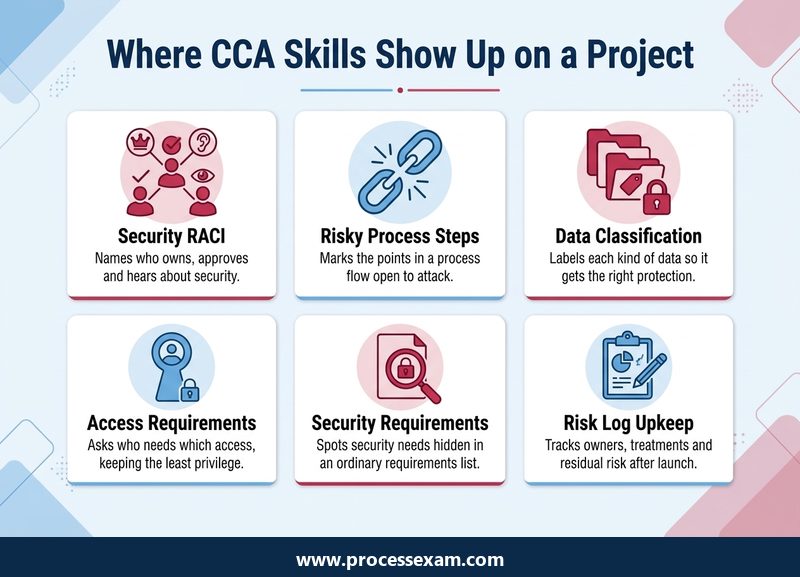
Early in discovery, the analyst runs a stakeholder analysis and drafts a RACI from existing documentation. Without a security frame, the chief information security officer, the data protection lead and the internal audit team are easy to leave off, or to list as "informed" when they need to approve. Knowing that the organisation may already have a security framework, or may not, and knowing how to find out, is a KA1 competency that saves a painful late review.
Current state: where is the process exposed?
Mapping the current claims process, the analyst draws the flow from first notice of loss to payment. A CCA-trained analyst marks the steps that present potential vulnerabilities: the point where claim documents are emailed in, the manual hand-off where an adjuster exports data to a spreadsheet, the payment approval that depends on a shared login. That is KA2 practical knowledge applied directly, and it gives the security team a list of concrete places to look instead of a general request to "review the system".
Requirements: what data, and who can reach it?
Claims data includes medical details and bank information. The analyst uses information classification to decide which fields need the strongest protection, distinguishes data at rest in the claims database from data in transit between the portal and the payment provider, and elicits access requirements role by role under the principle of least privilege. Adjusters see the claims they handle, supervisors see their team's, and nobody keeps a shared administrator account. Those are KA5 and KA6 competencies, and together they are the heaviest part of the exam for a reason: they are where analysis decisions most directly shape security.
Solution delivery: are the security needs written down?
When the vendor proposal arrives, the analyst checks whether it is software as a service or a platform the insurer will build on, because responsibility for security controls shifts with the service model. Then comes the step that most often goes wrong on real projects: security requirements hidden inside ordinary ones. "Adjusters must be able to download claim files" is a functional requirement with an obvious data-exfiltration question attached. Identifying that and tracing each security requirement to a solution component is KA7 work.
Operations: what risk is left after go-live?
After launch, a risk remains that uploaded documents could carry malware. The team accepts some of it, mitigates most of it with scanning, and records the residual risk with a named owner in the risk log. The analyst drafts a simple security metrics report so the sponsor can see whether incidents are rising or falling, and uses root cause analysis when something does go wrong. That is KA8.
Nothing in this walk-through required the analyst to configure a single control. Every step, though, required the security vocabulary and judgement the CCA tests. If your projects look like this, the certificate formalises skills you will use weekly. If they never touch security, the knowledge will fade before it pays off.
Who gets the most from the CCA, and who should choose a different credential?
The CCA sits in an unusual spot: a business analysis credential about security, rather than a security credential for technologists. That makes the "is it worth it" answer depend almost entirely on your role.
Strong fit
- Business analysts on regulated or data-heavy projects in banking, insurance, healthcare and government, where security and privacy requirements are a large share of the backlog.
- Product owners and product managers who approve features that handle personal or payment data and need to judge the security trade-offs.
- Project managers and PMO staff who run risk logs and want to understand what the security team is asking for.
- Analysts moving towards governance, risk and compliance roles, who need a first credential that shows security literacy without claiming engineering skill.
Weaker fit
- Security engineers, penetration testers and security operations staff. The CCA sits well below their working level. Technical credentials such as CompTIA Security+ or the (ISC)² CISSP test the depth their employers look for.
- Analysts whose work never touches security. An untested credential ages badly on a CV. A core business analysis certification will usually do more for you.
- Anyone expecting the certificate to open a security engineering career on its own. It is a bridge into security-related analysis, not a replacement for technical training.
How the CCA compares with technical security credentials
| Question | IIBA CCA | Technical security certifications |
|---|---|---|
| Who is it built for? | Business analysis professionals working alongside security teams | People who implement, operate or assess security controls |
| What does it test? | Awareness of concepts and rule-following analysis tasks | Technical configuration, architecture or assessment skills |
| Is there an eligibility check? | No | Varies; some senior credentials require verified experience |
| Does it need renewing? | No, the certificate does not expire | Most carry continuing education or renewal requirements |
| Best signal to an employer | "This analyst can run security-aware requirements work" | "This person can do the security work itself" |
Many people hold both kinds eventually. A common path is an analyst who earns the CCA, spends a year or two on security-heavy projects, and then chooses a technical or governance credential once they know which direction they prefer. The CCA is a sensible first step on that path precisely because it is cheap and quick.
How does booking and sitting the exam work?
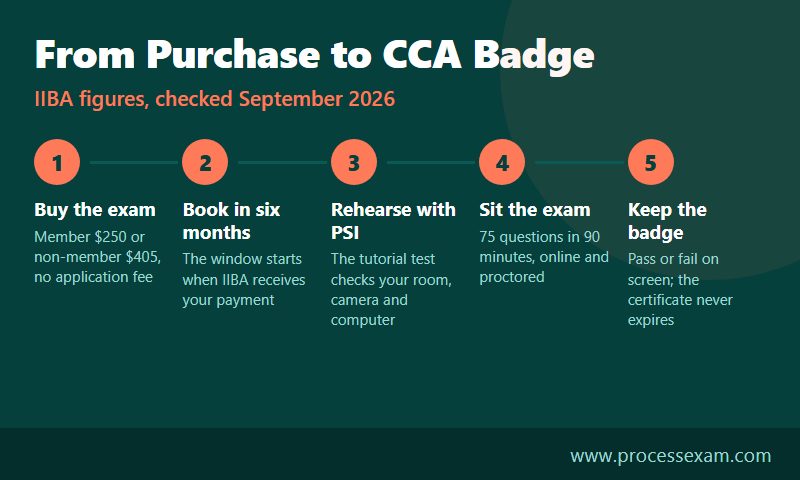
The CCA is delivered only as an online, remotely proctored exam through PSI, booked and launched from your IIBA profile. The practical sequence runs like this.
- Buy the exam or the package from the Certification menu of your IIBA profile. From the date IIBA receives your payment, you have six months to both book and complete the exam, and a refund can be requested within 30 days of that payment.
- Book a slot through the Schedule/Cancel/Launch Exam option in your profile, which hands you over to PSI's scheduling page. PSI needs 48 hours' notice for any booking, change or cancellation; later than that, the fee is lost.
- Run the PSI tutorial test at least once before exam day. Budget roughly thirty minutes for it: you walk through check-in, the room scan and the exam screens on the same computer you will use for the real attempt.
- Sit the exam: 75 questions in 90 minutes, launched from your IIBA profile rather than directly on PSI's site.
- Read your result on screen at the end. IIBA confirms it by email within 48 hours, and a digital badge follows through Accredible, which you can share on LinkedIn.
Two preparations deserve a calendar reminder of their own. Your name has to be identical on your photo identification, your IIBA profile and your PSI booking, and only IIBA can correct the profile, so check it the day you buy rather than the week you sit. And plan to use a personal computer: IIBA's handbook warns that work laptops and office networks often block the proctoring software. The IIBA CCA certification page links the current guide to online proctored exams, which is the document to reread the week before.
Pacing the 75 questions
Ninety minutes for 75 questions leaves a little over a minute per question. That is comfortable for definition questions and tight for scenario questions if you reread every option twice. A workable rhythm is a first pass that answers anything you know at once and flags the rest, followed by a second pass on the flagged items with the time that remains. Leaving a question blank gains nothing, so answer every one before the clock runs out.
How should you prepare, and which mistakes waste the most time?
The CCA does not demand a long study plan, but it does reward an organised one. The four-week outline below assumes you already work in business analysis and can give the exam around six to eight hours a week. Stretch it to six or eight weeks if security terminology is entirely new to you.
- Week one: vocabulary and risk. Work through the overview and Enterprise Risk areas. Build a glossary as you go, in your own words: threat, vulnerability, risk appetite, business continuity, ISMS. Finish by explaining the difference between an internal and an external audit without looking anything up.
- Week two: data and access. Spend the week on Data Security and User Access Control, the two heaviest areas. Draw one diagram that shows a piece of data moving from a form to a database to a partner, and label where it is at rest, in transit and encrypted. Write out the access rules for one real system you know, applying least privilege.
- Week three: controls, layers, delivery and operations. Cover Cybersecurity Risks and Controls, Securing the Layers, Solution Delivery and Operations. Practise picking the security requirement out of a mixed requirements list, and fill in a risk log for an imaginary system, including owner, treatment and residual risk.
- Week four: timed practice and repair. Take IIBA's fifteen free sample questions from its CCA page first, untimed, to calibrate. Then move to full-length timed attempts. A CCA mock exam run under the real 90-minute limit shows both your weak areas and whether your pace holds; review every wrong or guessed answer against the competency it tests.
Mistakes that cost candidates time
- Studying like a security engineer. Hours spent on network protocols and attack techniques rarely earn marks here. Stay at the depth the competencies describe.
- Relying on memory of terms instead of their differences. Many options are near-synonyms: classification and categorisation, authentication and authorisation, risk appetite and risk capacity. Learn each pair as a pair.
- Skipping the business analysis half. Candidates from IT backgrounds sometimes underestimate the RACI, business case and process-mapping questions. They are straightforward if you know BA practice and surprisingly slippery if you do not.
- Leaving the technical check until exam morning. A failed room scan or a blocked webcam ends the attempt as surely as a wrong answer.
- Buying the exam months before starting to study. The six-month window runs from payment, not from when you feel ready.
Knowing when you are ready
You are ready when you can take a fresh set of questions under time, score comfortably on each knowledge area rather than only overall, and explain in a sentence why each wrong option is wrong. Because IIBA reports the result only as pass or fail and publishes no percentage, aim for consistent strength across all eight areas instead of a target number.
Is the IIBA CCA a worthwhile investment for your career?
Put the pieces together and the verdict is clear for most readers of this page. The CCA is cheap to earn, has no eligibility hurdle, never needs renewing, and comes with a year of IIBA membership if you pay the non-member rate. The knowledge it tests is the knowledge a business analyst needs on any project that handles sensitive data, and the joint IIBA and IEEE Computer Society name gives it credibility with both business and technical audiences.
Its value on a CV is highest when you can point to the work behind it. "Earned the IIBA CCA and led access requirements for a claims platform migration" says far more than the credential alone. Roles where that combination is useful include business analyst on security or compliance programmes, cybersecurity business analyst, risk analyst, and product owner for data-heavy products. IIBA does not publish salary figures for the CCA specifically, so treat any claim about a pay rise as depending on your market and your role rather than on the certificate.
There are two cases where the investment does not pay back. One is a security specialist who needs a technical credential. The other is an analyst who never works on security and would get more from a core IIBA certification. For everyone between those two, the CCA is one of the lowest-cost ways to show that you understand the security side of the systems you help design. IIBA's recertification requirements confirm that the certificate carries no renewal term, so the effort you put in now keeps counting for the rest of your career.
Frequently Asked Questions
Is the IIBA CCA certification worth it?
For business analysts, product owners and project managers who work on systems holding sensitive data, yes. It costs little, has no eligibility check and never expires, and it proves security literacy for analysis work. Security engineers gain less, because the exam tests awareness and rule-following tasks rather than technical skill.
How much does the IIBA CCA certification cost?
The exam fee is Member - $250, Non-Member - $405, and a retake costs Member - $195, Non-Member - $350. IIBA charges no application fee for the CCA, and its fees page states that the non-member exam fee includes a first year of IIBA membership.
What is the passing score for the IIBA CCA exam?
IIBA reports CCA results as pass or fail and does not publish a percentage pass mark. The outcome appears on screen when you finish, and IIBA emails confirmation within 48 hours. The safest target is steady strength across all eight knowledge areas rather than a particular score.
Do I need cybersecurity experience to take the CCA exam?
No. The CCA has no eligibility requirements: no work hours, no references and no prior certification. It is aimed at business analysis professionals, and its competencies sit at general awareness and practical knowledge levels, so a working analyst can prepare without a technical security background.
Does the IIBA CCA certificate expire?
No. IIBA lists the CCA as a certificate with no expiration, so there are no continuing development units to earn and no recertification fee to pay. Once you pass, the credential and its digital badge stay valid, although refreshing your knowledge as threats change remains sensible.
- IIBA Cybersecurity Analysis Test Questions |
- CCA Question Bank |
- IIBA Cybersecurity Analysis Book |
- Cybersecurity Analysis Certification Cost |
- Cybersecurity Analysis Certification Requirements |
- IIBA Cybersecurity Analysis Sample Questions |
- CCA Exam Questions Download |
- CCA Test Questions |
- Cybersecurity Analysis PDF |
- Specialized Business Analysis |
- Cybersecurity Analysis Simulator |
- Cybersecurity Analysis Mock Exam


