Somebody on every large transformation has to make the plan hold together - the stakeholder nobody consulted, the data that cannot move yet, the sequence that costs half as much in a different order. That is the TOGAF Enterprise Architecture Practitioner's job, and OGEA-102 is where you prove you can do it: eight scenario questions, 90 minutes, open book, 60% to pass.

It is also the whole difference between the two TOGAF levels. Part 1 checks that you know what the TOGAF Standard says. Part 2, examined as OGEA-102, checks that you can pick the right move when a scenario gives you a half-finished programme, an unhappy sponsor and four plausible things to do next.
This guide walks through what practitioners are expected to do, how The Open Group builds the Part 2 exam around that work, what the syllabus covers phase by phase, and how to get ready without reading the entire standard cover to cover.
What does a TOGAF Enterprise Architecture Practitioner actually do?
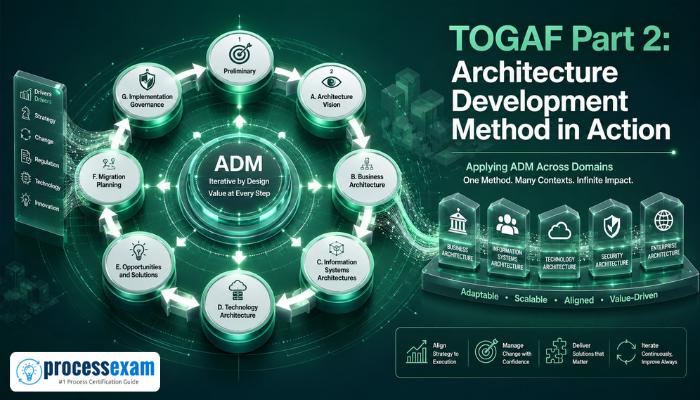
Strip away the vocabulary and the role comes down to one job: keep a large change programme coherent. Someone has to decide which business capabilities the transformation touches, which data has to move, which applications are retired and which technology the target state needs. Someone has to show the finance director why the sequence costs less in that order, and show the delivery teams what they are allowed to change. That is the practitioner's work, and the Architecture Development Method is the routine that keeps it repeatable across programmes.

 To achieve the professional designation of The Open Group TOGAF Enterprise Architecture Part 2 from the Open Group, candidates must clear the OGEA-102 Exam with the minimum cut-off score. For those who wish to pass the Open Group TOGAF Enterprise Architecture Part 2 certification exam with good percentage, please take a look at the following reference document detailing what should be included in Open Group TOGAF Enterprise Architecture Practitioner Exam preparation.


