
OGEA-102 Exam: How to Pass TOGAF Enterprise Architecture Part 2
Somebody on every large transformation has to make the plan hold together - the stakeholder nobody consulted, the data that cannot move yet, the sequence that costs half as much in a different order. That is the TOGAF Enterprise Architecture Practitioner's job, and OGEA-102 is where you prove you can do it: eight scenario questions, 90 minutes, open book, 60% to pass.

It is also the whole difference between the two TOGAF levels. Part 1 checks that you know what the TOGAF Standard says. Part 2, examined as OGEA-102, checks that you can pick the right move when a scenario gives you a half-finished programme, an unhappy sponsor and four plausible things to do next.
This guide walks through what practitioners are expected to do, how The Open Group builds the Part 2 exam around that work, what the syllabus covers phase by phase, and how to get ready without reading the entire standard cover to cover.
What does a TOGAF Enterprise Architecture Practitioner actually do?
Strip away the vocabulary and the role comes down to one job: keep a large change programme coherent. Someone has to decide which business capabilities the transformation touches, which data has to move, which applications are retired and which technology the target state needs. Someone has to show the finance director why the sequence costs less in that order, and show the delivery teams what they are allowed to change. That is the practitioner's work, and the Architecture Development Method is the routine that keeps it repeatable across programmes.
The Open Group describes the level as application and analysis rather than knowledge and comprehension. Its published competencies for a certified practitioner are short and specific:
- knowing how to apply the TOGAF approach to transform and manage change;
- knowing how to apply the TOGAF method, phase by phase;
- knowing how to apply the TOGAF techniques that support that method.
The audience follows from that. The credential is aimed at people expected to develop, sustain and transform domain architectures, people actively contributing to organisational transformation, and architects working in Agile environments who still have to keep an enterprise view. If you have never sat in a stakeholder workshop or argued over a target-state diagram, the exam will feel abstract, because every question is written from the practitioner's chair.
It is worth being blunt about what the certification does not do. It does not make you an architect on its own, and it does not test tooling, modelling notation or a vendor's platform. It tests whether, given a messy situation, you reach for the right phase, the right technique and the right artefact instead of improvising.
What does the OGEA-102 exam ask you to prove?
The Open Group TOGAF Enterprise Architecture Part 2 exam is deliberately small and deliberately hard. Eight questions is not a typo: each one is a scenario that runs for several paragraphs, and the marks sit in how carefully you read it. Here are the figures you plan around.
| Exam detail | OGEA-102 |
|---|---|
| Exam name | The Open Group TOGAF Enterprise Architecture Part 2 |
| Exam code | OGEA-102 |
| Vendor | Open Group |
| Certification | The Open Group TOGAF Enterprise Architecture Practitioner - Level 2 |
| Number of questions | 8 |
| Duration | 90 minutes |
| Exam fee | USD $405 |
| Passing score | 60% |
The Open Group's TOGAF Enterprise Architecture Practitioner datasheet describes Part 2 as a complex multiple-choice, scenario-based examination. It is supervised, it is open book, and it is delivered either at a Pearson VUE test centre or from your home or office through Pearson VUE's online proctored service. Part 1 is the companion exam, and it is the mirror image: multiple choice, closed book, more questions in less time each.
Do you need anything before you book it?
There are no formal prerequisites for the certification itself. What matters is the route you take to it. Candidates who already hold TOGAF Enterprise Architecture Foundation, or who have passed the Part 1 section of the combined examination, only need OGEA-102. Everyone else sits both parts, separately or as one combined sitting. Architects who earned the older TOGAF 9 Certified qualification have a shorter option again through the bridge route for existing TOGAF 9 holders, which is a different exam with its own code, fee and question count.
One more fact that shapes how you plan: certification at this level is tied to a version of the body of knowledge and does not expire. There is no renewal cycle and no continuing-education requirement, so the effort you put in now is not something you have to repeat every three years.
How does the open-book, scenario-based format really work?
Ninety minutes for eight questions sounds generous until you sit one. Each scenario sets up an organisation, a programme, a set of stakeholder concerns and a position in the architecture work, then offers you several courses of action that all sound reasonable. Your task is to choose the response that best follows TOGAF guidance for that situation, not the one that resembles what your own employer would do.
Three habits separate candidates who finish comfortably from those who run out of time.
- Locate the scenario before you read the options. Almost every question sits inside one identifiable part of the ADM. If the sponsor has just approved a direction and nothing has been modelled yet, you are in Architecture Vision. If solutions are being bundled into work packages, you are in Opportunities and Solutions. Naming the phase first removes half the distractors immediately.
- Read what the question asks for. "What should you do next?" and "What is the best recommendation to the board?" are different questions, and a technically correct answer to the wrong one still scores nothing.
- Treat open book as a lookup, not a library. Having the reference material available is only useful if you already know where a topic lives. Candidates who plan to read during the exam lose the clock in the first two questions.
At roughly eleven minutes per question you can afford one careful pass, a decision, and a short review at the end. Practising whole papers under that clock is the only reliable way to find out whether your reading speed matches the format, and it is the part of preparation most candidates skip.
Which TOGAF topics does the OGEA-102 syllabus cover?
The Part 2 syllabus is organised around the practitioner's sequence of work rather than around chapters of the standard. Our TOGAF Enterprise Architecture Part 2 syllabus page lists the same eight topic groups The Open Group examines, and the full text of the method sits in The Open Group's TOGAF Standard pages.
The context for Enterprise Architecture
This is the framing topic: how architecture levels organise the Architecture Landscape into strategic, segment and capability architectures, how the Architecture Content Framework classifies catalogs, matrices and diagrams into deliverables, and how the Enterprise Continuum and the Architecture Repository keep reusable material findable. Scenario questions use it to test whether you pitch work at the right level of detail for the audience.
Stakeholder management
Identifying stakeholders, classifying their power and interest, working out their concerns and choosing the views that answer those concerns. Expect scenarios where the wrong stakeholder has been left out of a decision, and the correct response involves going back to the stakeholder map rather than redoing the model.
Phase A, the starting point
Establishing the Architecture Vision: business scenarios, the statement of architecture work, capability assessment, risk identification and securing sponsorship. Many questions open here because it is where programmes most often go wrong.
Architecture development
Phases B, C and D, covering business, data, application and technology architectures. The techniques that support them matter as much as the phases themselves: architecture principles, gap analysis, business capability mapping, value streams, organisation mapping and information mapping. Being able to say what a gap analysis produces, and what you do with the result, is a recurring theme.
Implementing the architecture
Phases E, F and G: grouping gaps into work packages, building transition architectures, producing the implementation and migration plan, and then governing delivery against it. The implementation factor assessment, the consolidated gaps and solutions material, and the architecture contract all live here.
Architecture change management
Phase H, and the judgement call the exam likes most: does a change request trigger a simplification, an incremental update, or a full re-entry into the ADM cycle? Recognising which class of change you are looking at is the skill being tested.
Requirements management
The activity that runs beside every phase rather than after them. Capturing, validating, prioritising and tracing requirements, and knowing where a requirement change is fed back into the cycle.
Supporting the ADM work
The cross-cutting techniques: risk management, business transformation readiness assessment, capability-based planning, interoperability requirements and the use of The Open Group Library. These appear as the second half of scenario questions far more often than candidates expect.
How does architecture governance show up in Part 2 scenarios?
Governance is the thread that runs through Phase G and Phase H, and it is the area where practical experience shows up most clearly in an answer. The exam is interested in whether you know who decides what, and what happens when delivery drifts away from the agreed architecture.
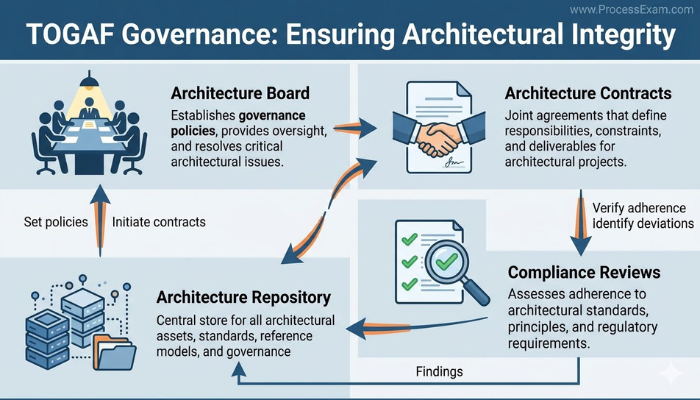
Four mechanisms carry most of the weight:
- The Architecture Board. It sets governance policy, provides oversight and resolves the arguments that individual projects cannot settle. When a scenario describes two programmes making incompatible choices, the board is usually part of the answer.
- Architecture contracts. Joint agreements between the architecture function and the delivery organisation that define responsibilities, constraints and deliverables. They turn an agreed target state into something that can be held to.
- Compliance reviews. Structured assessments of whether what is being built matches the architecture, its principles and any regulatory requirement. They produce findings, and findings either bring the project back into line or justify a formal dispensation.
- The Architecture Repository. The store for standards, reference models, the landscape and governance records. Without it, compliance reviews have nothing to review against.
Read the cycle rather than the four boxes: the board sets policy and initiates contracts, contracts give compliance reviews something to verify, review findings feed back into the repository, and the repository is what the next project is governed against. Scenarios that mention a project quietly deviating from the target technology are asking you to re-enter that loop at the right point.
How should you plan your OGEA-102 preparation?
Four focused weeks is a realistic plan for someone already working in or alongside architecture. Stretch it to six if the ADM is new to you, and shorten it only if you have recently passed Part 1 and the material is still fresh.
Week 1 - the method end to end
Walk the ADM once from the Preliminary Phase to Phase H, and write one line per phase: its purpose, its main inputs, its main outputs. Do not memorise artefact lists yet. The aim is that any scenario can be placed on that map within a few seconds.
Week 2 - the techniques
Work through stakeholder management, business scenarios, gap analysis, architecture principles, capability-based planning, risk management and business transformation readiness. For each one, answer two questions in your notes: what does it produce, and which phase consumes that output? The Open Group's TOGAF publications and library are the reference to check yourself against.
Week 3 - governance, requirements and change
Cover Phases E, F, G and H together with requirements management, because the exam rarely separates them. This is also the week to read the architecture contract and compliance review material properly rather than skimming it.
Week 4 - scenarios under the clock
Stop reading and start answering. Work in blocks of eight questions with a 90-minute timer so the pace becomes automatic, and review every question you got wrong by naming the phase you should have spotted. A full timed OGEA-102 practice exam in the last week is the cheapest way to find out which topics you only think you know - mark yourself honestly on anything you guessed, and send those topics back to week 2.
Two small logistics points belong in the plan as well. Book the exam before the final week so the date is real, and if you are sitting it online, test your room and your machine with Pearson VUE's system check well in advance rather than on the morning.
Which mistakes cost candidates marks on the Part 2 exam?
The failure patterns at this level are consistent, and almost none of them are about not knowing the standard.
- Answering from your own workplace. The most common trap. Your organisation's way of handling a stalled programme may be sensible and still not be what TOGAF guidance recommends. The exam marks the second one.
- Relying on the open book. Reference material is there for a definition you half-remember, not for learning a phase during the exam. Budget no more than a minute or two of lookup across the whole paper.
- Skipping the techniques. Candidates revise the phases and leave the supporting techniques for later, then meet them in the second half of almost every scenario.
- Ignoring the question stem. "Best", "next" and "most appropriate" are doing real work in these questions. Two options are often both valid actions, and only one of them is the right one now.
- Studying Part 2 the way you studied Part 1. Flashcards of definitions build recall, and recall is not what is being assessed. Practise judgement instead, by explaining out loud why the other options are wrong.
- Losing the clock on question one. If a scenario resists after ten minutes, make your best decision, flag it and move on. Eight questions means a single stall is an eighth of the paper.
A useful self-test before you book: take any scenario you have practised, cover the options, and write down what you would do next and why. If your reasoning names a phase and a technique, you are preparing the right way.
What does TOGAF Practitioner certification change in your career?
The practical effect is credibility in rooms where you have to be believed quickly. TOGAF is the framework most large enterprises, consultancies and public-sector programmes reference when they describe how architecture is done, so a Practitioner-level credential tells a hiring manager or a client that you can run the method rather than describe it. That matters most for enterprise architect, solution architect, domain architect, architecture consultant and transformation lead roles, and for internal moves from delivery into an architecture function.
There is a second, quieter benefit. Because certification at this level does not expire, it is one of the few credentials you earn once. The version of the body of knowledge you certified against is recorded, and there is no renewal fee or recertification exam waiting in three years.
The Open Group also publishes a directory of certified individuals and issues digital badges, which is useful when a client or an employer wants verification without asking you for a PDF. Candidates who complete accredited training that includes the Practitioner learning studies earn an additional applied badge alongside the certification.
For what comes next, the portfolio branches rather than climbs. Open Agile Architecture Practitioner suits architects working in product-centric organisations; the TOGAF Digital Specialist and TOGAF Agile Specialist credentials go deeper into those two contexts; and the role-based badges let you show a specific slice of capability. Whichever direction you pick, OGEA-102 is the point at which TOGAF stops being something you have read and starts being something you can be trusted to run.
Frequently Asked Questions
How many questions are on the OGEA-102 exam?
The OGEA-102 exam has 8 questions and a time limit of 90 minutes. Each one is a scenario-based complex multiple-choice question, so the count is small but the reading is heavy. That works out at roughly eleven minutes per question, including the time you spend re-reading the scenario.
What is the passing score for OGEA-102?
The passing score is 60%. Because there are only 8 questions, every single one carries real weight, so there is little room to write off a topic you dislike. Timed practice is the most reliable way to judge whether you are consistently above that line before booking.
How much does the OGEA-102 exam cost?
The OGEA-102 exam fee is USD $405. Pricing and local taxes can vary by country and by whether you sit at a Pearson VUE test centre or online, so confirm the current amount with The Open Group or Pearson VUE at the point of booking rather than budgeting from an older figure.
Is the TOGAF Enterprise Architecture Part 2 exam open book?
Yes. The Open Group's datasheet lists Part 2 as supervised and open book, while Part 1 is closed book. Open book means reference material is available during the exam, not that there is time to study in it, so most candidates use it only to confirm a definition.
Do I need TOGAF Foundation before taking OGEA-102?
There are no prerequisites for the certification itself. If you already hold TOGAF Enterprise Architecture Foundation, or passed the Part 1 section of the combined exam, you only need OGEA-102. Otherwise you take both parts, either separately or together as one combined examination.
- Enterprise Architecture |
- Open Group TOGAF Enterprise Architecture Part 2 Test Questions |
- OGEA-102 Question Bank |
- TOGAF Enterprise Architecture Practitioner Mock Exam |
- TOGAF Enterprise Architecture Part 2 Certification Cost |
- Open Group TOGAF Enterprise Architecture Practitioner Question Bank |
- Open Group TOGAF Enterprise Architecture Practitioner Book |
- Open Group TOGAF Enterprise Architecture Practitioner Study Guide |
- TOGAF Enterprise Architecture Practitioner Certification |
- TOGAF Enterprise Architecture Practitioner Certification Cost |
- TOGAF Enterprise Architecture Practitioner Certification Requi |
- Open Group TOGAF Enterprise Architecture Part 2 Sample Questions |
- OGEA-102 Exam Questions Download |
- OGEA-102 Test Questions |
- TOGAF Enterprise Architecture Part 2 PDF |
- Open Group TOGAF Enterprise Architecture Practitioner Exam Questions |
- Open Group TOGAF Enterprise Architecture Practitioner Sample Questions |
- TOGAF Enterprise Architecture Practitioner |
- TOGAF Enterprise Architecture Practitioner PDF


