
OGEA-10B Study Guide: Your TOGAF 10 Practitioner Bridge Exam Plan
The OGEA-10B exam is the fastest route from TOGAF 9 Certified to TOGAF Enterprise Architecture Practitioner. It has 14 questions in 60 minutes, costs USD $385 and needs 60% to pass. A good TOGAF 10 study guide for it covers what changed in the 10th Edition, the ADM phases in practice, and open-book scenario technique.
If you earned TOGAF 9 Certified, you already know the Architecture Development Method, the content framework and the vocabulary of enterprise architecture. The Open Group recognises that investment with a bridge: instead of sitting the full Foundation and Practitioner exams again, you take one shorter exam that checks whether you can apply the TOGAF Standard, 10th Edition, to real architecture work.
This study guide explains what the bridge exam covers, how its two sections work, how hard it is, and how to prepare in about three weeks. It is written for enterprise architects, solution architects and architecture leads who hold TOGAF 9 Certified and want the current Practitioner credential without wasting time on material the exam does not test.
What is the OGEA-10B TOGAF Enterprise Architecture Practitioner Bridge exam?
OGEA-10B is The Open Group's bridge examination to the TOGAF Enterprise Architecture Practitioner certification. Passing it earns The Open Group Certified TOGAF Enterprise Architecture Practitioner credential, the same Practitioner level that candidates without TOGAF 9 reach through the full learning path. The exam checks knowledge and comprehension, but its main weight falls on application and analysis: can you use the standard to develop, sustain and use an enterprise architecture?
Here are the exam facts in one place:
| Exam detail | OGEA-10B |
|---|---|
| Full name | The Open Group TOGAF Enterprise Architecture Practitioner Bridge |
| Exam code | OGEA-10B |
| Vendor | The Open Group |
| Certification | The Open Group Certified TOGAF Enterprise Architecture Practitioner Bridge |
| Number of questions | 14 |
| Duration | 60 minutes |
| Exam fee | USD $385 |
| Passing score | 60% |
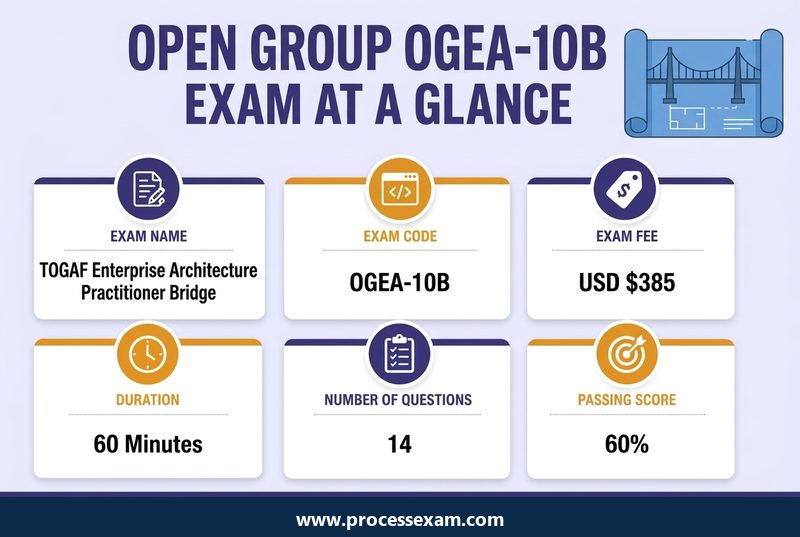
The Open Group sets out the learning outcomes, section structure, delivery options and prerequisite in its TOGAF Enterprise Architecture Practitioner Bridge datasheet. Read it before you book, because it is the definitive description of what the exam measures. If you want to find out where you stand today, the OGEA-10B practice exam on ProcessExam follows the same 14-question, 60-minute format, so you can test your readiness under realistic timing.
Two features make this exam unusual. It is short, so each question carries real weight and a single weak area can decide the result. And part of it is open book: you work with an electronic copy of the standard during the scenario section, which rewards candidates who know where information lives rather than those who have memorised the most pages.
Who is eligible, and why take the bridge instead of the full exams?
The bridge has one prerequisite: you must hold the TOGAF 9 Certified qualification. TOGAF 9 Foundation alone is not enough; the bridge is designed for people who reached the higher TOGAF 9 level through the combined exam or through Part 1 and Part 2. If you are not TOGAF 9 Certified, the route is the standard TOGAF Enterprise Architecture Foundation and Practitioner path described in The Open Group's TOGAF certification portfolio.
For those who qualify, the bridge makes sense for three reasons.
- It recognises what you already know. You are not retested on the TOGAF basics you proved years ago. The exam concentrates on applying the 10th Edition.
- It is shorter. A single 60-minute exam with 14 questions replaces the longer full path, which means less study time and one booking instead of two.
- It moves you to the current standard. TOGAF 9 Certified does not expire, but it describes a version of the standard that is no longer current. Employers and clients who ask for TOGAF increasingly mean the 10th Edition, and the Practitioner credential shows you work with it.
The certification itself does not lapse either. The Open Group certifies you to a given version of the body of knowledge, so there is no renewal fee or recertification cycle once you pass.
What changed from TOGAF 9 to the TOGAF Standard, 10th Edition?
Most of the bridge exam tests the "delta": what you must know about the 10th Edition that TOGAF 9.2 did not teach you in the same way. The core ideas are familiar. The ADM, the architecture domains, stakeholders and governance are all still there. What changed is how the standard is organised and how much guidance it gives on applying the method.
A modular structure: Fundamental Content and Series Guides
TOGAF 9.2 was one large document. The 10th Edition splits the standard into two parts. The TOGAF Fundamental Content holds the stable, universal material: introduction and core concepts, the Architecture Development Method, ADM techniques, applying the ADM, architecture content, and enterprise architecture capability and governance. The TOGAF Series Guides sit alongside it and give practical, more frequently updated guidance on specific topics, such as business architecture, security architecture, agile delivery and establishing an EA capability.
This split matters for the exam in two ways. Questions test whether you understand which kind of material answers which kind of problem. And in the open-book section, knowing whether an answer lives in the Fundamental Content or in a Series Guide saves minutes you cannot afford to lose.
More emphasis on adapting the method
The 10th Edition puts more weight on tailoring. It expects a practitioner to adapt the ADM to the organisation's context, including agile delivery, digital transformation and industry-specific constraints, rather than running every phase in the same way on every engagement. Many scenario questions turn on this: the best answer is often the one that applies the method in proportion to the situation, not the one that follows every step.
A clearer view of the practitioner's role
The standard now frames the architect as a practitioner who works through stakeholders, builds and runs an architecture capability, and connects architecture work to business value. The exam reflects this with questions on stakeholder concerns, communication and governance, not just on artefacts and deliverables.
You can find the current editions of the standard and the Series Guides on The Open Group's TOGAF Standard page. Study from the 10th Edition, not from TOGAF 9.2 notes, because several terms and document locations have changed.
What does the OGEA-10B syllabus cover?
The Open Group's datasheet lists seven areas that a certified candidate must understand. Treat them as your syllabus, and study each one with a scenario in mind rather than as a list of definitions.
1. The key changes in the TOGAF Standard
Know the modular structure described above, what belongs in the Fundamental Content, what the Series Guides add, and why the standard was reorganised. Expect direct questions on where specific guidance is found and why the change helps practitioners.
2. The context for an enterprise architecture practitioner
This area covers the environment an architect works in: the enterprise's strategy, its operating model, the drivers for change and the constraints that shape architecture work. You should be able to explain how an architecture capability supports business goals and how context changes the way you apply the ADM.
3. The stakeholder management technique
Stakeholder management is a recurring theme in scenario questions. Learn how to identify stakeholders, classify their power and interest, record their concerns and choose the views and viewpoints that address those concerns. When a scenario describes resistance, confusion or competing priorities, the answer usually starts with stakeholder analysis.
4. The Architecture Vision phase and its techniques
Phase A is where engagements are scoped and justified. Study the Request for Architecture Work, the Statement of Architecture Work, business scenarios, capability assessment, business transformation readiness assessment and risk management. Questions often describe an organisation at the start of an engagement and ask what the architect should do first.
5. ADM Phases B, C and D to develop an architecture
Business, information systems (data and application) and technology architecture work, including baseline and target descriptions, gap analysis and the architecture building blocks that result. Know the techniques that apply in these phases and how the outputs feed the later phases. You do not need to memorise every step, but you do need to recognise which phase a situation belongs to.
6. ADM Phases E, F and G to implement an architecture
Opportunities and Solutions, Migration Planning and Implementation Governance turn the target architecture into a delivered change. Study transition architectures, work packages, the Architecture Roadmap, the Implementation and Migration Plan, and architecture contracts. Scenarios in this area often involve trade-offs between speed, cost and risk.
7. Supporting the ADM work
This covers the parts of the standard that keep architecture work running: the Architecture Repository, architecture governance and compliance, the Architecture Board, requirements management and the enterprise continuum. A practitioner must know how these support each ADM cycle, and questions test whether you can choose the right governance response to a problem.
How do the two exam sections work, and how hard is the exam?
OGEA-10B has 14 questions in 60 minutes, split into two timed sections. The first section is a set of simple multiple-choice questions taken closed book: you answer from memory, so this is where knowledge of the 10th Edition's structure and terminology earns marks. The second section is a set of complex scenario questions taken open book, with an electronic copy of the standard available on screen. The Open Group's datasheet gives the exact split of questions, time and marks between the two sections.
Scenario questions are scored on a gradient. Their answer options are not simply right or wrong: the best answer earns full marks, a reasonable answer earns partial credit, and a poor one earns less or nothing. That means your aim in section two is to find the answer that best fits TOGAF practice for the situation described, not just an answer that could work.
The exam is moderately difficult for a well-prepared TOGAF 9 Certified candidate. Three things make it feel harder than it is:
- Time. Scenario questions are long, and reading them twice is expensive. Candidates who run out of time usually spent too long searching the open-book PDF.
- Close answer options. In the scenario section, several answers are defensible. The difference is often whether an option addresses the stakeholders' stated concerns, or whether it follows the ADM phase the organisation is actually in.
- Weight per question. With only 14 questions and a passing score of 60%, one or two poor scenario answers can decide the outcome.
A useful readiness test is your score on timed practice. If you pass full practice tests comfortably within the time limit, and you can explain why the second-best scenario answer is weaker than the best one, you are close to ready.
What is the best TOGAF 10 study guide plan for OGEA-10B?
This plan assumes you are TOGAF 9 Certified, have some architecture experience and can study for about an hour a day. It takes around three weeks. If your TOGAF 9 knowledge is rusty, add a few days at the start to refresh the ADM before you study the changes.
Before the final week, try the OGEA-10B practice test twice, once without the TOGAF library open and once with it, and compare the scores to see how much you still rely on searching.
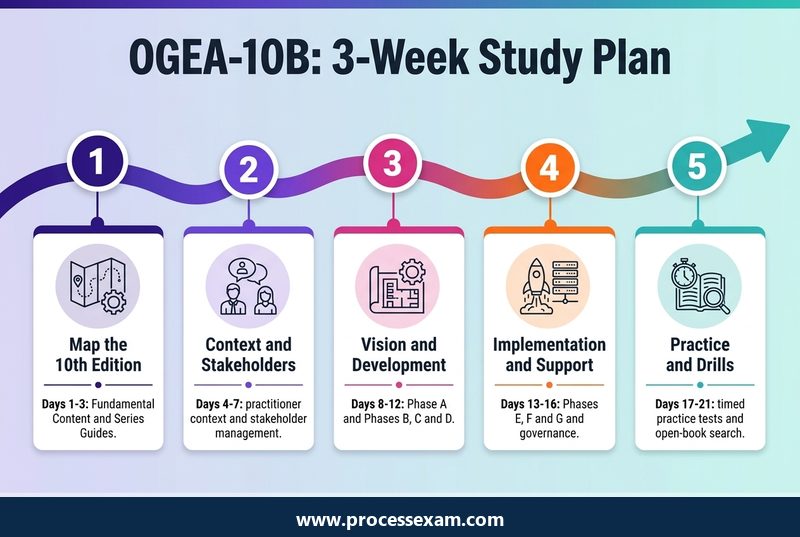
| Step | Days | Focus | What to finish |
|---|---|---|---|
| 1 | 1–3 | Map the 10th Edition | Fundamental Content documents, the Series Guides, and what moved from TOGAF 9.2 |
| 2 | 4–7 | Context and stakeholders | Practitioner context, stakeholder management, views and viewpoints |
| 3 | 8–12 | Vision and development | Phase A techniques; Phases B, C and D with gap analysis and building blocks |
| 4 | 13–16 | Implementation and support | Phases E, F and G; governance, repository and requirements management |
| 5 | 17–21 | Practice and open-book drills | Timed practice tests, PDF search drills, review of every wrong answer |
Step 1: map the 10th Edition before you study it
Start by skimming the table of contents of every Fundamental Content document and the list of Series Guides. Write a one-page map: which document covers what, and where the topics you knew from TOGAF 9.2 now live. This map is the most valuable tool you will take into the open-book section, and building it yourself fixes it in memory.
Step 2: study context and stakeholders
Read the material on the practitioner's context and the stakeholder management technique carefully. For each concept, write down one situation where it would decide what an architect does next. Scenario questions draw on these ideas constantly, even when the question appears to be about an ADM phase.
Step 3: work through Phase A and Phases B, C and D
For each phase, note its objectives, key inputs, key outputs and the techniques that apply. Then practise identifying the phase from a short description of a situation. Being able to say "this organisation is in Phase B and has not yet agreed its baseline" is the first step to choosing the right scenario answer.
Step 4: cover implementation and supporting work
Phases E, F and G, the Architecture Repository, governance and requirements management complete the syllabus. Focus on how the phases hand work to each other and on what governance does when a project departs from the architecture. These topics often form the constraint in a scenario.
Step 5: practise under exam conditions
Take at least two full timed practice tests, and review every question you got wrong or guessed. Before a full test, working through the free OGEA-10B sample questions shows you the style of both question types. Alongside practice tests, run short open-book drills: pick a topic, open the standard as a PDF, and time how long it takes you to find the relevant section using search. Aim to find any section in well under a minute.
How to answer scenario questions
Use the same four checks on every scenario. First, identify the ADM phase the organisation is in. Second, identify the constraint or concern that the question is really about, such as budget, culture, time or a particular stakeholder. Third, eliminate any option that ignores the standard or skips a phase the organisation has not completed. Fourth, from what remains, choose the option that most directly addresses the stakeholders' stated concerns. If a scenario mentions agile delivery or digital transformation, check whether the relevant Series Guide changes the answer.
Which mistakes cost candidates marks, and what should you do on exam day?
The same mistakes come up repeatedly, and each one can be avoided with the plan above.
- Studying from TOGAF 9.2 material. The bridge tests the 10th Edition. Old notes use outdated structure and sometimes outdated terms.
- Relying on the open book. The PDF helps only if you already know where to look. Candidates who search from scratch on every question run out of time.
- Ignoring the Series Guides. They are part of what makes the 10th Edition different, and scenario answers sometimes depend on them.
- Choosing an answer that could work. In a gradient-scored scenario, an answer that works but ignores stakeholder concerns earns less than the best answer.
- Leaving practice until the end. Timed practice early in the plan shows weak areas while there is still time to fix them.
Before the exam
The exam is supervised and delivered by Pearson VUE, either at a test centre or online through OnVUE at home or in your office. Book through the Pearson VUE page for The Open Group, and if you choose online delivery, run the system test in advance and prepare a quiet room with a clear desk. The day before, read your one-page map of the standard and your list of mistakes from practice tests, then stop.
During the exam
In the closed-book section, answer steadily and do not dwell on any single question. In the open-book section, read the last line of each scenario first so you know what is being asked, then read the scenario with that question in mind. Use the PDF to confirm a specific point, not to learn a topic. Keep an eye on the clock and leave a few minutes at the end to revisit any question you were unsure about.
Is the TOGAF Enterprise Architecture Practitioner Bridge worth it?
For a TOGAF 9 Certified architect, the bridge is one of the most efficient certification decisions available. It updates your credential to the current standard with a single short exam, and it shows employers that you can apply TOGAF, not just describe it.
The credential helps in practical ways. It keeps your profile current when job adverts and client tenders ask for TOGAF knowledge of the latest edition. It supports a move from solution or domain architecture into enterprise architecture roles, where stakeholder management and governance matter as much as design. And it gives you a structured understanding of the Series Guides, which is useful on any engagement that combines architecture with agile delivery or digital transformation.
Roles that benefit include enterprise architect, solution architect, business architect, architecture lead and EA consultant. After the bridge, The Open Group offers further paths, such as specialist credentials and role-based badges, if you want to extend the credential in a particular direction.
When you are ready to check your preparation, start with the sample questions, then take a full timed practice test. Together they show which syllabus areas still need work and whether your pace is right for the two sections on exam day.
Frequently Asked Questions
How many questions are on the OGEA-10B exam?
The OGEA-10B exam has 14 questions and a time limit of 60 minutes, split across a closed-book multiple-choice section and an open-book scenario section. Because there are so few questions, each one carries real weight, so practise under timed conditions before you book your exam date.
What is the passing score for OGEA-10B?
The passing score for the OGEA-10B exam is 60%. Scenario questions in the open-book section are scored on a gradient, so choosing the best answer rather than a merely acceptable one makes a real difference. Aim to pass timed practice tests comfortably before you sit the real exam.
How much does the OGEA-10B exam cost?
The OGEA-10B exam fee is USD $385. Prices can vary by country and may change, so confirm the current fee when you book through Pearson VUE, the delivery partner for The Open Group. The exam can be taken at a test centre or online through OnVUE.
Who is eligible to take the OGEA-10B bridge exam?
Only candidates who hold the TOGAF 9 Certified qualification can take the OGEA-10B bridge exam. TOGAF 9 Foundation alone does not qualify. Candidates without TOGAF 9 Certified follow the standard TOGAF Enterprise Architecture Foundation and Practitioner certification path instead of the bridge.
Is the OGEA-10B exam open book?
Partly. The first section, made up of simple multiple-choice questions, is closed book. The second section, made up of complex scenario questions, is open book, with an electronic copy of the TOGAF Standard available during the exam. Knowing where topics live in the standard saves valuable time.
How long should I study for the OGEA-10B exam?
Most TOGAF 9 Certified candidates need about three weeks of study at roughly an hour a day. Spend the first two weeks on the changes in the 10th Edition and the ADM phases, and the final week on timed practice tests and open-book search drills.
- Enterprise Architecture |
- Open Group TOGAF Enterprise Architecture Bridge Test Questions |
- OGEA-10B Question Bank |
- TOGAF Enterprise Architecture Bridge Simulator |
- TOGAF Enterprise Architecture Bridge Mock Exam |
- Open Group TOGAF Enterprise Architecture Bridge Book |
- TOGAF Enterprise Architecture Bridge Certification Cost |
- TOGAF Enterprise Architecture Bridge Certification Requirements |
- Open Group TOGAF Enterprise Architecture Bridge Sample Questions |
- OGEA-10B Exam Questions Download |
- OGEA-10B Test Questions |
- TOGAF Enterprise Architecture Bridge PDF


