CSSGB Handbook

Explore 14 resources related to CSSGB Handbook on ProcessExam. These resources help certification candidates understand key aspects of exam preparation, including exam structure, study strategies, and expectations for scenario-based or applied assessments. Reviewing these materials can help improve readiness and confidence before attempting the certification exam.

How to Use Six Sigma for Improving Business Process Re-Engineering

Picture an order-to-cash process with eleven hand-offs between sales, credit control, the warehouse and billing. An order takes nineteen days to become cash, and in the steering meeting someone finally asks: do we fix this, or throw it away? That question is where Six Sigma and business process reengineering meet. Reengineering decides whether the process deserves to survive in its current shape; Six Sigma supplies the baseline, the DMADV design discipline and the controls that make whatever replaces it perform predictably.

Eight-step business process reengineering cycle from vision and objectives to ongoing improvement

The two ideas are often presented as rivals, one radical and one incremental, and for years that was how consultancies sold them. In practice the strongest redesign programmes use both. They use data to prove that a process has hit its ceiling, a clean-sheet mindset to design something better, and a structured roadmap to make sure the new design works before it is switched on for every customer. This article walks through that combination: how the methods differ, how to tell which one a process needs, how DMAIC and DMADV fit inside a redesign, a worked example on the order-to-cash process above, and which ASQ credentials prepare you to lead this kind of work.

Enhancing Quality Through Six Sigma Implementation

Six Sigma is a rigorous, centered and extremely efficient implementation of confirmed quality principles and techniques. Incorporating components from the work of many quality pioneers, Six Sigma goals for just about error free enterprise efficiency. Sigma is a letter of the Greek alphabet used by statisticians to measure the variability in any course of, and when you can maintain the output of that course of within a six sigma-wide band (in effect, no more than 3.4 defects per million outputs).

Six Sigma Action Plan, Six Sigma Quality Improvement, Six Sigma, Six Sigma Black Belts

Six Sigma focuses on enhancing high quality (and subsequently decreasing waste) by serving to organizations produce services and products higher, quicker and cheaper. In additional conventional phrases, Six Sigma focuses on defect prevention, cycle time discount, and price financial savings. In contrast to senseless cost-cutting applications which scale back worth in addition to high quality, Six Sigma identifies and eliminates prices which give no worth to prospects.

Understanding the Tool

Six Sigma has two most important strands. First, it entails utilizing a handful of tried and true efficiency enhancements strategies and, second it entails coaching a small cadre of in-house technical leaders, often called Six Sigma Black Belts, to an excessive degree of proficiency within the utility of those methods.

How Will Six Sigma Benefit Your Workforce

Lean can sound “imply” to the individuals who hear it’s coming to their workplaces. Everyone knows that healthcare enterprises are underneath unprecedented strain to chop prices. We perceive that a lot of our work is silly and repetitive. We will discover the paperwork and provides we'd like, we don’t have the instruments we'd like, and we endure below the scrutiny of some bossy managers. Generally, our processes threaten the security of sufferers. But it surely’s our work. It’s our paychecks. We do one of the best we will.

Six Sigma Manufacturing, Six Sigma Organization, Six Sigma, Lean Six Sigma, Six Sigma Certificates

So once we study that a Lean Six Sigma or Six Sigma egghead is coming to our office, few of us feel gratitude. As an alternative we ask “Who is that this individual?” and surprise what she probably is aware of about “our” work. Worse but, we surprise what our bosses take into consideration this time. What are they not telling us? For these of us with the scars of a layoff within the household, there’s usually further worry and defensive anger.

DMAIC vs DMADV: Differences, Phases and When to Use Each

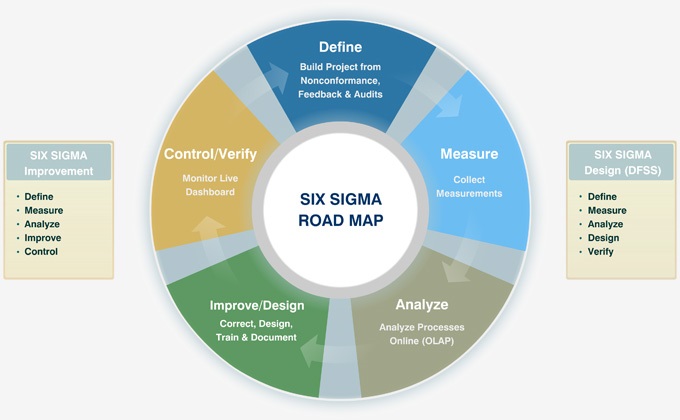
A diagnostics lab finds that one blood sample in twenty arrives with a label that does not match its request form, so the job is to repair a process that already runs. The same company wants a finger-prick kit patients can use at home, so the job is to create something that does not exist yet. The first is a DMAIC project (define, measure, analyze, improve, control); the second is DMADV (define, measure, analyze, design, verify).
Process engineer comparing two workflow plans on a glass board in a lab

Six Sigma gives you two road maps, and choosing the wrong one is an expensive way to learn the difference. This guide sets the phases side by side, follows one DMAIC project and one DMADV project from the first meeting to the last, shows how to pick between them, and then points to the exact places where ASQ's Green Belt and Black Belt Bodies of Knowledge test the distinction. It is about the methods, not an exam-prep course, though anyone studying for a belt will find the last sections useful.

What do DMAIC and DMADV stand for, and what does each one assume?

DMAIC is the improvement road map. Define the problem and the target, measure how the process performs today, analyze the data to find what causes the gap, improve the process by dealing with those causes, and control it so the gain does not leak away. The method assumes that a process exists, that it delivers an output you can measure now, and that its basic design is capable of reaching the goal once its faults are removed.


Syndicate content