
How to Use Six Sigma for Improving Business Process Re-Engineering
Picture an order-to-cash process with eleven hand-offs between sales, credit control, the warehouse and billing. An order takes nineteen days to become cash, and in the steering meeting someone finally asks: do we fix this, or throw it away? That question is where Six Sigma and business process reengineering meet. Reengineering decides whether the process deserves to survive in its current shape; Six Sigma supplies the baseline, the DMADV design discipline and the controls that make whatever replaces it perform predictably.

The two ideas are often presented as rivals, one radical and one incremental, and for years that was how consultancies sold them. In practice the strongest redesign programmes use both. They use data to prove that a process has hit its ceiling, a clean-sheet mindset to design something better, and a structured roadmap to make sure the new design works before it is switched on for every customer. This article walks through that combination: how the methods differ, how to tell which one a process needs, how DMAIC and DMADV fit inside a redesign, a worked example on the order-to-cash process above, and which ASQ credentials prepare you to lead this kind of work.
How is business process reengineering different from Six Sigma?
Business process reengineering, usually shortened to BPR, is the fundamental rethinking and radical redesign of a business process to achieve large gains in cost, quality, speed and service. The idea was popularised in the early 1990s by Michael Hammer and James Champy, whose book Reengineering the Corporation argued that many large firms had built their workflows around assumptions about technology, people and organisation that were no longer true. Their advice was blunt: do not automate an old process, replace it. The background and history of business process re-engineering are well documented, including the backlash in the late 1990s when "reengineering" became a polite word for layoffs.
Six Sigma starts from the opposite end. It assumes the process exists, measures how much its output varies, finds the causes of that variation and removes them. Its core project roadmap, DMAIC (define, measure, analyze, improve, control), is built to raise the performance of a process that is basically sound. Progress is incremental, evidence-led and deliberately tied to data at every phase gate.
Lean, which targets waste and flow rather than variation, often runs alongside both; how Lean and Six Sigma differ from each other is a separate discussion, and this article stays with the question of redesign.
The practical differences show up in how each approach behaves on a real project.
| Dimension | Business process reengineering | Six Sigma (DMAIC) |
|---|---|---|
| Starting assumption | The process design itself is wrong | The design is sound but performance varies |
| Scale of change | Radical: steps, roles and systems replaced | Incremental: causes of defects removed |
| Typical duration | Months to more than a year | Weeks to a few months per project |
| Use of data | Often weak; driven by vision and benchmarks | Central; every phase gate needs evidence |
| Main risk | Disruption, cost overrun, staff resistance | Polishing a design that can never meet the need |
| Typical output | A new process, organisation and system | A capable, controlled version of the old process |
Read that table as a pair of complementary weaknesses. Reengineering on its own tends to be ambitious but poorly measured, which is why so many 1990s programmes could not show what they had achieved. Six Sigma on its own can spend months improving a process that should not exist. Put together, the data discipline of one covers the blind spot of the other.
When should you fix a process and when should you redesign it?
The single most useful idea here is a process's entitlement: the best performance its current design can deliver if everything goes right. DMAIC can move a process towards its entitlement. It cannot move it beyond. If the customer's requirement sits above that ceiling, no amount of variation reduction will close the gap, and the honest recommendation is a redesign.
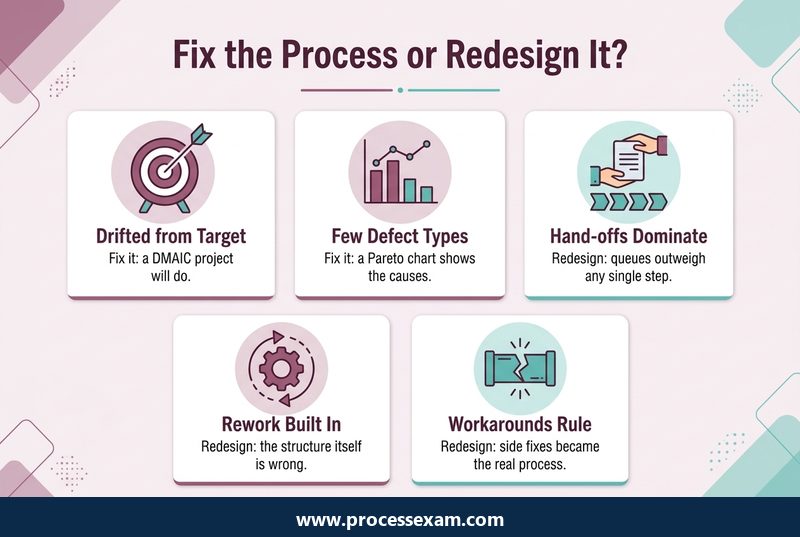
Signals that a DMAIC project is enough
- The process met its target once and has drifted. Performance used to be acceptable, so the design can deliver; something has changed in the inputs or the method.
- One or two defect types dominate. A Pareto chart shows that a small number of causes account for most of the problems, which is exactly the situation DMAIC handles well.
- The customer need is stable. Nobody is asking the process to do something fundamentally different from what it was built for.
- The gap is modest. Moving from, say, 88 per cent on-time to 95 per cent on-time is a tuning problem, not a design problem.
Signals that the design itself has to change
- Hand-offs dominate the elapsed time. When work spends most of its life waiting in queues between departments, removing variation inside each step barely moves the total.
- Rework is built into the flow. Checking, correcting and re-approving steps that exist only because an earlier step is unreliable are a sign the structure is wrong.
- The customer requirement has moved. A process designed for monthly orders cannot be tuned into one that serves same-day demand.
- Workarounds have become the process. Spreadsheets, side emails and "call Priya in credit" are unofficial redesigns that the organisation never approved.
- Technology has changed underneath it. A process built around paper forms, batch runs or a retired system carries steps that no longer need to exist.
Use the data before you decide
The mistake to avoid is making the fix-or-replace call on instinct. Run the define and measure phases first either way. A short, disciplined measurement of cycle time, first-pass yield, the number of hand-offs and where the time goes will usually settle the argument within a few weeks. If the numbers say the process can reach its target, carry on with DMAIC. If they show a ceiling below the requirement, you have the evidence to justify a redesign to a sponsor who will be asked to fund it. Either way the measurement work is not wasted, because a redesign needs the same baseline to prove its benefit later.
How do DMAIC and DMADV fit inside a reengineering programme?
Six Sigma has a second roadmap built for exactly the situation reengineering creates: designing a process rather than repairing one. It is usually called DMADV. ASQ's current Green Belt body of knowledge, downloadable from its Six Sigma Green Belt certification page, asks candidates to distinguish between DMADV (define, measure, analyze, design, verify) and IDOV (identify, design, optimize, verify) and to recognise how they align with DMAIC. The Black Belt body of knowledge goes further, with a section of its own on design for Six Sigma frameworks that covers DMADV, spelled there with "validate" as the last step, and DMADOV, which adds an optimize phase. The wording differs slightly between the two documents; the logic is the same.
Here is how the five DMADV phases map onto a reengineering effort.
Define: frame the redesign, not the defect
The charter states the outcome the new process must deliver, the boundaries of the redesign and the customer requirements it will be judged against. In a DMAIC project the problem statement names a defect; in a redesign it names a capability the organisation needs and does not have. The sponsor signs off on scope here, which is the first defence against a redesign that quietly grows into a reorganisation.
Measure: capture the current state and the voice of the customer
This is where Six Sigma rescues reengineering from its old habit of skipping the baseline. Map the current process end to end, count the hand-offs, time each step and each queue, and record first-pass yield. At the same time, translate what customers say into measurable critical-to-quality characteristics. Tools such as SIPOC and quality function deployment, both named in ASQ's Black Belt body of knowledge, do the translation.
Analyze: generate and test design concepts
Instead of drilling into the root cause of one defect, the team compares alternative designs. Which steps add value for the customer? Which exist only to compensate for another step? Which decisions could move upstream? Each concept is scored against the critical-to-quality targets, and the weakest are dropped before anyone spends money building them.
Design: build the future state in detail
The chosen concept becomes a detailed process: roles, decision rules, system changes, forms, service levels. Failure mode and effects analysis earns its place here, because a new process has no history of failure to learn from; the team has to imagine how it will break and design those breaks out before launch.
Verify: pilot, prove, then hand over
The design runs on a limited scale, one region, product line or customer segment, and its results are compared with the targets set in Define. Only when the pilot meets them does the process roll out, with a control plan, an owner and the measures that will show if it starts to slip.
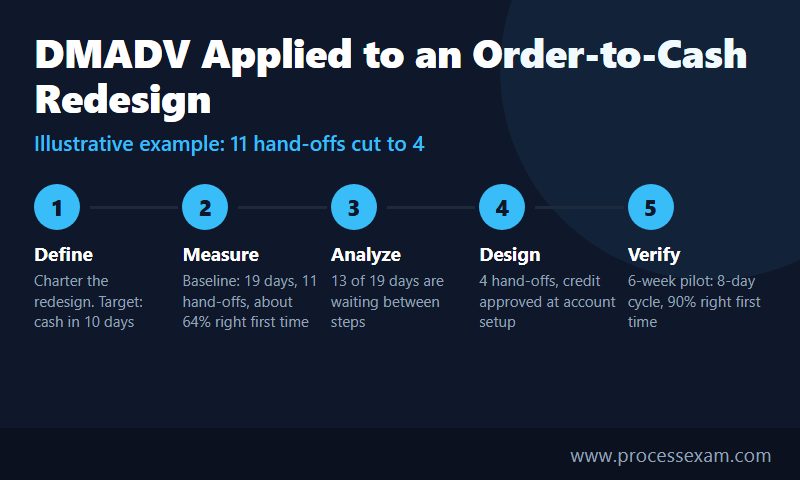
DMAIC does not disappear from the programme. It usually appears twice. At the start, a few quick DMAIC projects stabilise the worst parts of the current process so that customers are not left suffering while the redesign is built. After launch, DMAIC becomes the tool for tuning the new process as real volume exposes problems the pilot did not. Treat DMADV as the backbone of the redesign and DMAIC as the maintenance crew on either side of it.
What does a Six Sigma-led redesign look like on a real process?
Return to the order-to-cash process from the opening. The figures below are illustrative, chosen to show the method rather than taken from any particular company, but the pattern is one that finance and operations teams will recognise.
The baseline
The team samples 400 recent orders and follows each one from order entry to cash received. The current process has eleven hand-offs: sales enters the order, sales operations re-keys it into the ordering system, credit control reviews the customer, pricing checks the quote against the contract, the warehouse picks, packs and ships, logistics confirms delivery, billing raises the invoice, and accounts receivable chases payment. Average time from order to cash is nineteen days, and thirteen of those days are spent waiting between steps rather than in any step.
The team also measures how often an order passes through every step without being corrected, returned or queried. Suppose each of the eleven steps is right first time on 96 per cent of orders. That sounds respectable until you multiply it through. Rolled throughput yield, the probability that an order clears every step cleanly, is 0.96 to the power of 11, or about 64 per cent. More than a third of orders need rework somewhere, and every rework loop adds more waiting.
Why DMAIC alone would stall
A classic DMAIC project might target the worst step, say pricing errors, and lift it from 96 to 99 per cent. That is a real gain, but rolled throughput yield only rises to around 66 per cent, and the thirteen days of queue time are untouched. The ceiling is the structure: eleven hand-offs, each with its own queue and its own chance of error. That is the evidence the steering group needs to approve a redesign.
The redesign
Working through Analyze and Design, the team builds a four-hand-off process:
- credit limits are approved when an account is opened, not on every order, removing a queue that held orders for an average of two days;
- prices are pulled automatically from the contract record at order entry, so the separate pricing check and the re-keying step both disappear;
- shipment confirmation triggers the invoice directly, instead of waiting for billing to batch invoices twice a week;
- one customer-facing team owns the order from entry to cash, so questions have one destination.
With four steps, each designed to be right first time on 98 per cent of orders, predicted rolled throughput yield rises to 0.98 to the power of 4, about 92 per cent. The arithmetic makes the case in a way no slide about "streamlining" ever could: fewer hand-offs matter more than better hand-offs.
The pilot and the result
The new process runs for six weeks in a single sales region. Measured against the Define targets, the pilot brings the order-to-cash cycle down to eight days against a target of ten, and 90 per cent of orders pass through without rework against the 92 per cent predicted. The shortfall traces to one cause, contract records that were out of date when prices were pulled, which becomes a small DMAIC project before the national rollout.
| Measure (illustrative) | Before | Design target | Pilot result |
|---|---|---|---|
| Hand-offs | 11 | 4 | 4 |
| Order-to-cash cycle | 19 days | 10 days | 8 days |
| Orders right first time | About 64% | About 92% | 90% |
| Days waiting between steps | 13 | 3 | 3 |
Notice what made this credible. Every claim in the business case rests on a measurement taken before the redesign and repeated after it. That is the contribution Six Sigma brings to reengineering, and it is what the original wave of BPR programmes most often lacked.
What goes wrong when Six Sigma and reengineering are combined?
Combining the two methods removes some risks and introduces others. These are the failure patterns that recur.
Automating the mess
Buying a new system and loading the old process into it is the most expensive way to stand still. Hammer's warning from the 1990s still applies: if the design is wrong, faster execution just produces the wrong result sooner. Make the design decision before the technology decision.
Redesigning without a baseline
Teams excited by a clean sheet sometimes skip measurement because "the old process is going anyway". Six months later nobody can prove the new one is better. Measure first, even if it feels like a delay.
Running DMAIC on a process that has hit its ceiling
The mirror-image mistake: a well-run Six Sigma programme keeps chartering projects on a process whose structure caps its performance. Each project delivers a little, the sponsor loses patience, and the programme is blamed. Check entitlement before chartering the third project on the same process.
Treating the redesign as a technical problem
Reengineering changes jobs, reporting lines and daily routines. Change-management research has long pointed to the same success factors: visible executive sponsorship, a compelling business case, line ownership of the new process and a cross-functional team with real authority. A perfect DMADV design that frontline staff do not trust will be quietly worked around within months.
Letting scope creep into a reorganisation
A process redesign that starts redrawing the organisation chart has become a different project with different risks. Hold the charter's boundaries, and escalate structural changes as separate decisions.
Launching without a control plan
New processes decay faster than old ones, because the workarounds that people used to rely on are still in their heads. Without an owner, a small set of measures and a response plan for when those measures move, the redesigned process slides back towards the old one within a year.
Who does what on a combined redesign and Six Sigma programme?
Reengineering is a team sport, and the roles map neatly onto the Six Sigma belt structure plus the functions whose work is being redesigned.
- Executive sponsor. Owns the business case, approves the charter and removes obstacles that cross department boundaries. Without this role a redesign stalls at the first turf dispute.
- Process owner. A senior line manager who will run the new process after launch and is accountable for its results. Involving the owner from Define onwards is the best protection against a design that operations will not adopt.
- Black Belt. Leads the DMADV roadmap, runs the analysis of design concepts, facilitates the cross-functional team and coaches Green Belts. On larger programmes a Master Black Belt sets the method across several redesigns.
- Green Belts. Run the data collection for the baseline, lead the quick DMAIC projects that stabilise the current process and later tune the new one.
- Quality engineer. Brings design controls, failure mode analysis, measurement system checks and verification planning, especially where the process is regulated or audited.
- Finance, IT, legal and HR representatives. Validate the cost case, deliver system changes, confirm compliance and plan the people side of the change.
If you are wondering where your own career fits in that list, the answer points directly to the credential worth pursuing.
Which certification prepares you for process redesign work?
ASQ has no certification named for reengineering. The credentials that prepare you to lead or support a redesign are its Six Sigma belts and its Quality Engineer certification, and each maps onto a different role in the programme above. Here are the figures we hold for the three exams.
| Exam detail | CSSGB | CSSBB | CQE |
|---|---|---|---|
| Certification | ASQ Certified Six Sigma Green Belt (CSSGB) | ASQ Certified Six Sigma Black Belt (CSSBB) | ASQ Certified Quality Engineer (CQE) |
| Questions | 110 | 165 | 175 |
| Duration (minutes) | Total appointment time - 270 Exam time - 258 |
Total appointment time - 270 Exam time - 258 |
Total appointment time - 330 Exam time - 318 |
| Exam fee (USD) | ASQ MEMBERS - $383 NON-MEMBERS - $483 RETAKES - $283 |
ASQ MEMBERS - $485 NON-MEMBERS - $585 RETAKES - $385 |
ASQ MEMBERS - $450 NON-MEMBERS - $550 RETAKES - $350 |
| Passing score | 550/750 | 550/750 | 550/750 |
Green Belt: for the analyst who builds the baseline
If your role on a redesign is collecting and analysing the data, running the stabilising DMAIC projects and supporting a Black Belt, the Green Belt is the natural fit. Its body of knowledge covers the full DMAIC toolkit and, importantly for redesign work, an introduction to design for Six Sigma roadmaps and to design and process FMEA. For the Green Belt, ASQ wants three years of paid, full-time work that touches at least one part of its body of knowledge, and a degree cannot shorten that requirement.
Because the Green Belt is where many redesign careers begin, it is also the exam people most often underestimate. The paper is open book, but 110 questions in 258 minutes leaves little time for searching through references. Before you book, test yourself under the real clock: a timed run through our CSSGB mock exam will show whether your weak spot is the statistics of the measure phase or the design concepts that redesign work leans on, and that tells you where the remaining study weeks should go.
Black Belt: for the person who leads the redesign
If you expect to run the DMADV roadmap, face the steering group and be accountable for the pilot's results, aim for the Black Belt. Beyond DMAIC, its body of knowledge includes organisation-wide planning and deployment, organisational process management and measures such as balanced scorecards and cost-benefit analysis, team management, and a section on design for Six Sigma that names DMADV, DMADOV, design for X and robust design. Our breakdown of the Black Belt topics lists each section with its question count. ASQ's Six Sigma Black Belt certification page accepts either two finished improvement projects, each confirmed by a signed affidavit, or one such project together with three years of relevant work, and a redesign you have led can count as one of those projects.
Quality Engineer: for the person who makes the new process hold
If your strength is design controls, verification, measurement systems and corrective action, the Certified Quality Engineer is the better match. Its continuous improvement section covers total quality management, kaizen, PDCA and Six Sigma alongside Lean tools such as value stream mapping, standardized work and takt time, which is a useful combination for anyone who has to sustain a redesigned process in an audited environment. The bar is higher: ASQ's Quality Engineer certification page requires eight years of relevant work, at least three spent in a role where you made the decisions.
Plan around the testing windows
ASQ delivers these exams by computer in fixed testing windows rather than on any day you choose. When we checked ASQ's pages in September 2026, the Green Belt and Quality Engineer pages listed an October 1 to 31, 2026 window whose application deadline, September 14, had already passed, and the Black Belt window (September 1 to 30, 2026) was already under way. Anyone starting now is therefore planning for the next window, not the current one. Windows and deadlines change every year, so confirm the current dates on ASQ's own certification pages before you plan your preparation around them.
How do you keep a redesigned process from sliding back?
The last phase of a redesign is the one most often cut short, because the pilot has succeeded and the team wants to move on. It is also where the benefit is either locked in or lost.
- Name one owner. The process owner, not the project team, holds the new process from the day it goes live. Hand over the measures, the control plan and the list of known risks formally.
- Watch a handful of measures, not dozens. For the order-to-cash example that would be cycle time, first-pass yield and the dispute rate. Plot them on control charts so that the team reacts to real shifts rather than normal noise.
- Write down the response plan. For each measure, agree in advance what happens when it moves outside its limits: who is told, who investigates and how quickly.
- Remove the old path. Switch off the old forms, retire the old system screens and close the email aliases people used for workarounds. Anything left running will be used.
- Audit at 90 days and at a year. A short review against the Define targets shows whether the benefit has held and whether new workarounds have appeared.
- Feed the next redesign. Record what the pilot revealed, especially the assumptions that proved wrong, so the next team starts with evidence rather than optimism.
Handled this way, reengineering stops being a one-off upheaval and becomes a repeatable capability: measure the process, decide honestly whether it can be fixed, redesign it with a disciplined roadmap when it cannot, and control the result. That is the real answer to the question in the steering meeting. You do not choose between fixing the process and throwing it away on instinct; you let the data tell you which one it needs, and then you use the Six Sigma method that matches.
Frequently Asked Questions
What is business process reengineering in Six Sigma?
It is the use of Six Sigma methods to support a radical process redesign. Reengineering decides that a process must be rebuilt; Six Sigma measures the current state, designs the replacement through a roadmap such as DMADV, pilots it against measurable targets and keeps it under control after launch.
Is business process redesign the same as business process reengineering?
The terms overlap. Reengineering usually means a radical, clean-sheet rebuild of a process, while redesign is often used more broadly for any significant change to how a process is structured. Both differ from incremental improvement, which keeps the existing design and removes the causes of defects within it.
What are the main steps of a BPR methodology?
Most BPR methods follow the same arc: set the vision and objectives, understand the current process, pick the processes to redesign, identify the levers for change, design and implement the new process, then evaluate it and improve it continuously. Six Sigma adds measurement at each step and a pilot before rollout.
Is there a certification for business process reengineering?
ASQ offers no certification named for reengineering. Practitioners usually hold a Six Sigma credential instead: the ASQ Certified Six Sigma Green Belt and Black Belt bodies of knowledge both include design for Six Sigma roadmaps such as DMADV, which is the method used to design a new process.
How is business process reengineering related to total quality management?
Total quality management pursues gradual, organisation-wide improvement driven by everyone's participation, while reengineering pursues a sudden, radical change to specific processes. Many organisations use both: TQM and Six Sigma sustain and tune processes, and reengineering replaces those whose design can no longer meet customer needs.
- ASQ Six Sigma Green Belt Sample Questions |
- ASQ Six Sigma Green Belt Test Questions |
- CSSGB Question Bank |
- CSSGB Exam Questions Download |
- CSSGB Test Questions |
- Six Sigma Green Belt PDF |
- ASQ Six Sigma Green Belt Book |
- ASQ CSSGB BOK PDF |
- Six Sigma Green Belt Certification Cost |
- Six Sigma Green Belt Certification Requirements |
- CSSGB Body of Knowledge (BOK) |
- CSSGB Handbook


