
OMG-OCSMP-MBI300: What Changes at SysML Intermediate
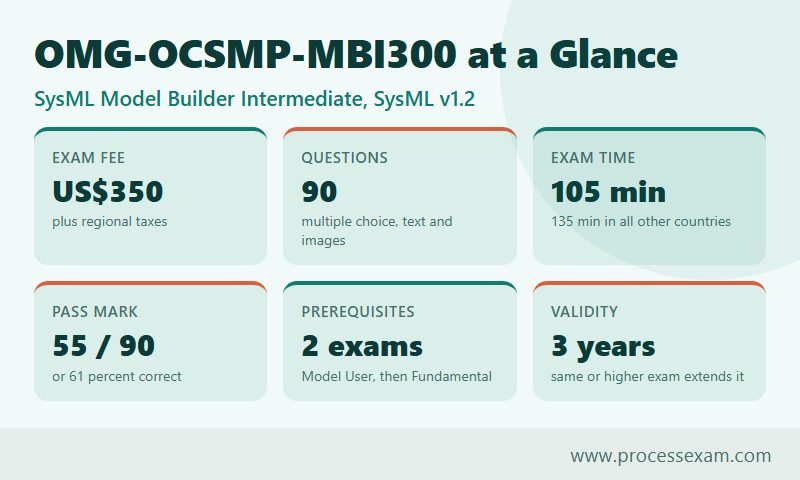
Passing OMG-OCSMP-MBF200 proves you can build a system model with SysML's basic feature set. OMG-OCSMP-MBI300 asks for something harder on a paper of the same length: build with the full set of constructs, for the same US$350 fee, inside the same 105 minutes, against the same 55-out-of-90 pass line. The step up is depth rather than breadth, and this guide maps that depth against OMG's own exam information sheet, read in September 2026.

Most candidates arrive here from the Fundamental exam with a study routine that worked once and will not work twice. Fundamental rewards recognising notation; Intermediate rewards deciding between two notations that both look plausible. What follows is the exam as OMG publishes it, section by section, with the modelling habits each section rewards, the booking rules that catch people out, and a ten-week routine built for the harder paper.
What actually changes when you move from MBF200 to the Intermediate exam?
One phrase runs through every section heading of the Intermediate information sheet: using the full set of SysML constructs. The Fundamental exam deliberately limits itself to a basic feature set, the one demonstrated in the automobile example that OMG recommends for it. Intermediate removes that fence. Every corner of the notation that a Fundamental candidate could safely skip is now examinable, and the questions are written by people who know exactly which corners those are.
The same paper, a harder question
Nothing about the logistics grows. You still answer 90 multiple-choice questions, some carrying diagrams, and you still need 55 of them right. What grows is the distance between the tempting answer and the correct one. A Fundamental item might ask which diagram kind shows a system's parts. An Intermediate item shows you an activity with a streaming input parameter and an overwrite object node, then asks what happens to the second token. Both are one mark. Only one of them can be answered from a memorised diagram key.
Where the marks have moved
The weighting tells the same story. OMG's Fundamental sheet spreads its marks fairly evenly across behaviour, structure, model organisation, requirements, parametrics and allocation. The Intermediate sheet concentrates them: behaviour takes 33% and structure 29%, so 62 marks in every hundred come from two sections. Parametrics rises to 11%, requirements and use cases together hold 10%, and the remaining 17% is split between model concepts, organising the model and defining stereotypes. Our OMG-OCSMP-MBI300 syllabus page lists the same seven sections with their percentages if you want them beside your study plan.
Building, not reading
The Model User exam at the bottom of the ladder tests comprehension: can you read someone else's model and say what it means. Both Model Builder exams test authorship. At Intermediate level, authorship means choosing a construct and defending the choice. Why a parameter set rather than two decision nodes? Why an association block rather than a plain connector with a stereotype? A candidate who has only ever opened models built by other people finds these questions uncomfortable, and no amount of reading fixes it. Time in a modelling tool does.
Should you sit MBI300 now, or wait for OMG's SysML v2 Model Builder exam?
Sit it now. Checked in September 2026, OMG's certification site still runs the whole OCSMP programme on SysML v1.2, and the Intermediate exam is one of the four levels listed there. The newer language has its own separate track, and OMG's SysML v2 certification programme currently offers a Model User exam only. A v2 Model Builder Fundamental exam is described as in development by the v2 certification working group, with release anticipated in 2027. There is no announced v2 exam at Intermediate depth at all.
What OMG says about the older credentials
OMG's position is stated plainly on that page: existing OCSMP certifications will not be superseded, both series stay active through the transition, and OCSMP holders are encouraged to add a v2 credential as their organisations adopt the new language. For someone deciding this month, that removes the only real argument for waiting. A credential that is neither retired nor replaced, in a language that thousands of live models are still written in, keeps its value for the three years it is valid.
What a move to v2 would and would not cost you
The textual and graphical syntax changes considerably in the second generation of the language. The engineering judgement the Intermediate exam measures does not. Deciding where a behaviour belongs, when a property should be redefined rather than added, how a constraint network expresses an analysis, how a requirement is traced to the element that satisfies it and to the test case that verifies it: those decisions survive a change of notation. If your employer migrates in 2028, the reasoning you built for this exam migrates with you, and the v1.2 models you still maintain need somebody who can edit them properly.
The honest exception is narrow. If your organisation has already retired its v1 models entirely, works only in v2 tooling, and has no contractual need for a building-level credential before 2027, waiting is defensible. Almost nobody is in that position today.
What are the MBI300 exam facts, prerequisites and booking steps?
Everything below comes from OMG's Model Builder Intermediate exam information sheet and is worth checking against the vendor's page before you pay, because fees and promotions move.
| Detail | OMG-OCSMP-MBI300 |
|---|---|
| Exam name | OMG-Certified Systems Modeling Professional - Intermediate |
| Exam code | OMG-OCSMP-MBI300 |
| Exam fee | USD $350 |
| Number of questions | 90 |
| Duration | 105 minutes (residents of English-speaking countries), 135 minutes (all others) |
| Passing score | 55 correct answers of 90 (61%) |
| Question format | Multiple choice, with text and images |
| Standard covered | Systems Modeling Language (SysML) v1.2 |
| Prerequisites | Passing scores on the SysML Model User and Model Builder Fundamental exams |
| Validity | Three years from the exam date |
The prerequisite chain, and why it shapes your calendar
Intermediate is the third exam in the sequence, not the second. OMG requires passing scores on both the Model User exam and the Model Builder Fundamental exam before you can sit it, so a candidate starting from nothing is looking at three bookings, three fees and three sittings. Plan them as a run rather than as isolated events: the notation stays warm, and the reading you do for Fundamental carries most of the way into Intermediate. Candidates who leave two years between Fundamental and Intermediate usually end up revising both.
Booking, delivery and the small print
Booking runs through Pearson VUE. Create or sign in to your account on OMG's exam pages at Pearson VUE, buy the exam, apply any discount or promotional code, then choose a test centre or an online sitting. If you choose online, run the system test on the exact machine you will use before you schedule, not the night before the exam. The paper is delivered in English and translation applications are prohibited during it. Candidates sitting outside an English-speaking country receive the longer allowance, which OMG confirms in an email after the order completes, so keep that message.
Cancel more than 24 hours ahead through Pearson VUE and you get a full refund; later than that and the fee is gone. A failed attempt still buys you something: your score report breaks the result down section by section and includes a 20% retake discount code, so the second sitting costs less and you know which of the seven areas to rebuild. Within hours of a pass, the Credly mail arrives and you can claim and share the digital badge, with a printable certificate behind it. Accommodations for a learning or physical disability are arranged with OMG's certification team, not with the test centre.
How much behavioural modelling does the 33% section really expect?
Behaviour is the largest section of the paper, and it is examined across all three behavioural diagram kinds rather than concentrated in one. The seven sections and their shares look like this.
Activity diagrams beyond the happy path
The information sheet is unusually specific here, and the specifics are the exam. On the object-flow side you are expected to handle optional versus required parameters, streaming parameters, continuous and discrete rates, no-buffer and overwrite behaviour, token ordering such as FIFO and LIFO, data stores and central buffers, object node states, parameter sets and probabilities on edges. On the control side: control operators, flow final nodes, decision input behaviour, join specifications, control pins and interruptible regions, primitive actions, and pre- and post-conditions written as constraints on the activity itself.
Take a railway level-crossing controller as a worked example. Road sensors feed a continuous stream of vehicle counts into a monitoring activity, so the input parameter is streaming with a continuous rate. The barrier motor accepts one command at a time and the newest command must win, which is an overwrite object node, not a queue. An emergency stop must abandon whatever the lowering sequence is doing, which is an interruptible region with an interrupting edge, not a decision node. Three modelling decisions, three constructs that never appear in a Fundamental question, and each one distinguishable from its neighbour by one property on the diagram.
Sequence diagrams and the operators people skip
Sequence questions move past simple message exchange into lifeline selectors, lifeline decomposition, nested activations, advanced interaction operators and what happens when those operators are combined or nested. Interaction use and gates connect one interaction to another, and constraints appear as observations, timing constraints and state invariants. If your working habit is to draw a sequence diagram as a straight list of arrows, this is the section that will surprise you: half the marks sit in the frames around the arrows.
State machines with hierarchy and memory
The state machine material assumes you accept the point that a state machine describes the states of a block. On top of that: graphical transition notation, internal transitions, deferred events, composite and orthogonal composite states, and the pseudo-state family - junction, choice, shallow and deep history, fork and join, entry and exit points, terminate nodes - plus submachine states and their connection points.
Back at the level crossing, the controller needs two things happening at once: the barrier is raising, lowering or parked while the signal is red or green. That is one orthogonal composite state with two regions, not two separate state machines. A power interruption that should resume the barrier at the position it reached calls for deep history, while shallow history would drop it back to the top of that region. An operator button press that must be remembered until the crossing finishes lowering is a deferred event. Examiners like these pairs precisely because both options are legal notation and only one models the requirement.
What does 29% structural modelling look like when ports and connectors get serious?
Structure is examined through the two diagram kinds you already know, block definition and internal block, with the advanced features switched back on.
Block definition diagrams with the full feature set
Expect receptions on blocks, ordered and unique collections, read-only properties, property redefinition, constraint properties that reach into the parametric section, and distributed properties. Relationships broaden to shared versus composite aggregation - the white and black diamonds, and the ownership rules behind them - association blocks and generalization sets. Value types go structured: enumerations, and types such as a position vector with X, Y and Z parts. Blocks meet behaviour through classifier behaviour, owned behaviours and activity hierarchies drawn on a block definition diagram, and you are expected to be able to define instances.
Internal block diagrams where most marks are lost
This is the hardest ground on the paper for most candidates. Property-specific types and part multiplicities come first. Then ports in two families: flow ports with their flow specifications and flow properties, conjugated ports and the compatibility rules that decide whether two ports can be connected at all, including item flows; and standard ports with required and provided interfaces, including typing a port with an interface and typing it with a classifier that uses or realizes one. Port delegation applies to both families. Connectors bring nested connector ends, item flows and item properties, conveyed classifiers, typing and ownership of item properties, and connector properties.
The level crossing again makes it concrete. The controller offers a command port and the barrier drive offers its mirror image, so the drive's port is conjugated rather than separately defined. Vehicle-count data crossing the boundary is an item flow typed by the signal it conveys, not an untyped arrow. A composite crossing assembly whose internal parts must connect outward uses port delegation instead of a connector drawn through the boundary. Each of those is a question waiting to be written, and each has a plausible wrong answer.
How are parametrics, requirements, packages and stereotypes examined?
The remaining 38% is easy to under-prepare because it is spread thinly. It is also the cheapest place to gain marks, because the material is finite.
Parametrics at 11%
Constraints are how SysML carries engineering analysis, and the Intermediate exam expects nesting of constraints, trade study support as described in the specification's trade study annex, measures of effectiveness, objective functions, alternatives and constraining flows. Suppose the crossing project must choose between a hydraulic and an electric barrier drive. The alternatives become blocks, the measures of effectiveness become value properties - lowering time, power draw, maintenance interval - and an objective function weighs them into a single figure of merit. Building that once in a tool teaches more than reading the annex three times.
Requirements and use cases, 5% each
The requirements half covers the specialised requirement kinds from the specification's requirements annex - functional, interface, performance, physical and design constraints - and the full traceability set: derive, verify, satisfy, refine, trace and containment. You also need to trace requirements in tables and matrices, and to represent verification and testing, including a test context and its test cases. The use case half is about connection: relating use cases to activity diagrams and state machines, and relating them back to requirements. Isolated use case diagrams earn nothing here.
Model concepts, organisation and stereotypes
Model concepts at 6% is about applying modelling guidelines and practices rather than notation. Organising a system model, also 6%, covers package diagrams with the full construct set: package and element import, defining and using views and viewpoints, building and using model libraries, and an awareness of assessment criteria such as structured queries over the model. The final 5% asks you to define stereotypes, properties and constraints through extension and subclassing - profile work that many practising modellers consume but never author, which is exactly why it is examined.
How should you rebuild your study routine for ten weeks at Intermediate depth?
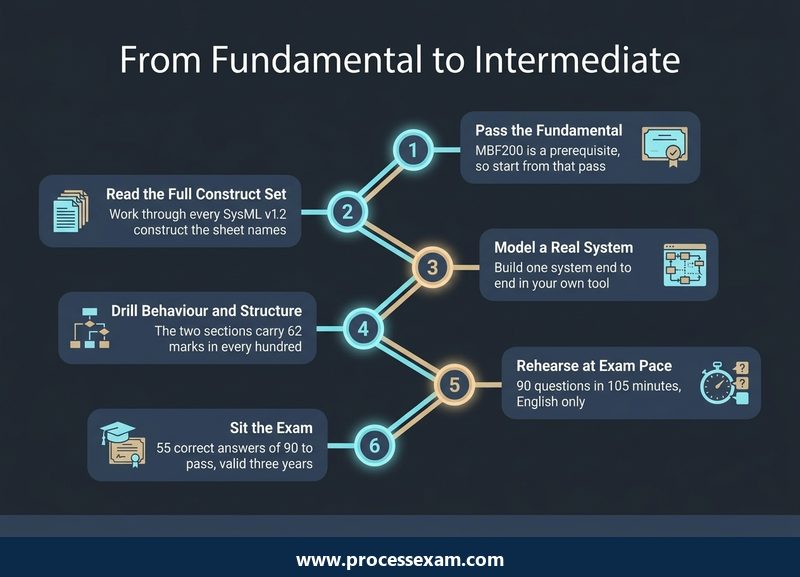
Ten weeks at six to eight hours suits most working engineers who already hold Fundamental. The shape matters more than the total: two-thirds of the time goes to behaviour and structure, because two-thirds of the marks do, and every week ends with something built rather than something read.
- Weeks 1 and 2 - reset the baseline. Re-read the Intermediate information sheet line by line and turn each bullet into a checklist row. Score yourself honestly on every row: can build it, can recognise it, have never used it. The 'never used it' rows are your syllabus.
- Weeks 3 to 5 - behaviour. One diagram kind per week. Build an activity with streaming parameters and an interruptible region, a sequence with nested operators and gates, and a state machine with orthogonal regions and history. Do not copy examples; model your own system.
- Weeks 6 and 7 - structure. Take one block and drive it into an internal block diagram with conjugated flow ports, standard ports typed by interfaces, port delegation and typed item flows. Break the compatibility rules deliberately and watch your tool complain; the error messages teach the rules faster than prose does.
- Week 8 - the thin sections. Parametrics, requirements, use cases, packages, views and viewpoints, and a hand-built profile with two stereotypes and a constraint. All of it in one week, all of it in the tool.
- Weeks 9 and 10 - timed practice and repair. Full-length timed runs, then a repair session on every wrong answer: find the construct in the specification, rebuild the example, move on.
Timing deserves its own drill. Ninety questions in 105 minutes is seventy seconds each, and diagram questions eat two minutes before you notice. Working through a full OMG-OCSMP-MBI300 practice exam under the clock is the fastest way to find out whether your reading speed or your modelling judgement is the bottleneck.
What OMG recommends you read
The Intermediate information sheet names its own reading list, and it is narrower than the internet's. A Practical Guide to SysML, third edition, by Friedenthal, Moore and Steiner, with chapter 4's automobile example and chapter 17's residential security system worked through in a tool. Weilkiens on systems engineering with SysML and UML, and his telescope modelling book for MBSE practice. The Cookbook for MBSE with SysML. Estefan's survey of MBSE methodologies, chapter 2, for the difference between a methodology and a process. Hoffmann on systems engineering best practices. OMG's own SysML tutorial, Peak's parametrics primer for simulation-based design, the hybrid SUV example built in SysML v1.2, and the notations and conventions summary. Read chapter 17 twice: it is the only full worked example on the list that exercises the wider construct set.
Practice questions, used properly
A question you answered correctly by elimination is not a question you know. Mark every item you were unsure of, even the ones you got right, and treat that list as the real score. Rebuild the model fragment behind each marked item before the next session. Two hundred questions treated this way beat a thousand skimmed, and the pattern carries into the exam room, where the second-best answer is always on the screen next to the best one.
What does passing MBI300 change in your day-to-day work and your next certification?
The credential says something narrower and more useful than 'knows SysML'. It says you can be handed a system model that other people depend on and asked to extend it without breaking it. In practice that is the difference between an engineer who contributes diagrams and one who owns the model: setting the profile, deciding the package structure, reviewing whether a colleague's parametric constraint actually expresses the analysis it claims to.
Where it lands on a team
Aerospace, defence, automotive, rail, medical devices and telecommunications all run long-lived system models, and all of them have more model readers than model authors. Titles vary - lead systems engineer, systems modelling lead, systems architect, MBSE specialist - but the gap being filled is consistent: someone accountable for the model's structure rather than its content. Because OCSMP tests the language rather than a vendor's tool, the credential travels between tools and between employers, which matters in a field where teams switch modelling suites every few years.
The next step, and the clock on this one
Above Intermediate sits Model Builder Advanced, the fourth OCSMP level, which pushes into model management and the harder analytical material. Beside it sits the v2 track, where OMG encourages current holders to add the Model User credential now and a building credential when it arrives. Either way, the certificate you earn here expires three years after the exam date, and the way to extend it is to take the same exam again or a higher one. Most people find the higher exam the better use of the fee.
If you sit it well prepared, MBI300 is not a memory test. It is a day spent proving that you make the same modelling decisions a careful reviewer would make - which is precisely what the certificate is for.
Frequently Asked Questions
What are the prerequisites for the OMG-OCSMP-MBI300 exam?
OMG requires passing scores on two earlier exams before you can sit the Intermediate paper: the SysML Model User exam and the SysML Model Builder Fundamental exam. It is the third step in the OCSMP sequence, so a candidate starting from scratch books three separate exams, each ordered and paid for through Pearson VUE.
How much does the OMG-OCSMP-MBI300 exam cost and what is the pass mark?
The exam fee is USD $350, plus any regional taxes, and you need 55 correct answers of 90, which works out at 61 percent. Fees and promotional discounts are set by OMG and change from time to time, so confirm the current price in your Pearson VUE account before you pay for the sitting.
Which SysML version does the OCSMP Intermediate exam cover?
OMG's Intermediate exam information sheet names Systems Modeling Language v1.2 as the standard covered, and that was still the case when OMG's certification pages were checked in September 2026. SysML v2 has a separate certification track, which currently offers a Model User exam and no building-level exam.
How is MBI300 different from the Model Builder Fundamental exam?
Fundamental limits its questions to the basic SysML feature set. Intermediate examines the full construct set, so streaming parameters, interruptible regions, orthogonal states, conjugated ports, nested connector ends and profile authoring all become fair game. The paper length, fee and pass percentage are unchanged; the depth of each question is not.
What happens if I fail the OMG-OCSMP-MBI300 exam?
Your score report breaks the result down by section and carries a 20 percent discount code for a retake, so the second attempt costs less than the first. Use the breakdown to target the weakest of the seven sections, and remember that a booked exam can be cancelled for a full refund only more than 24 hours ahead.
- SysML Certifications |
- OMG OCSMP Intermediate Test Questions |
- OMG-OCSMP-MBI300 Question Bank |
- SysML MBI Simulator |
- SysML MBI Mock Exam |
- OMG OCSMP Intermediate Book |
- OCSMP Intermediate Certification Cost |
- OCSMP Intermediate Certification Requirements |
- OMG SysML MBI Question Bank |
- OMG SysML MBI Book |
- OMG SysML MBI Study Guide |
- SysML MBI Certification |
- SysML MBI Certification Cost |
- SysML MBI Certification Requirements |
- OMG OCSMP Intermediate Sample Questions |
- OMG-OCSMP-MBI300 Exam Questions Download |
- OMG-OCSMP-MBI300 Test Questions |
- OCSMP Intermediate PDF |
- OMG SysML MBI Exam Questions |
- OMG SysML MBI Sample Questions |
- SysML MBI |
- SysML MBI PDF


