
PMI-SP Certification: Who Needs It and How to Pass
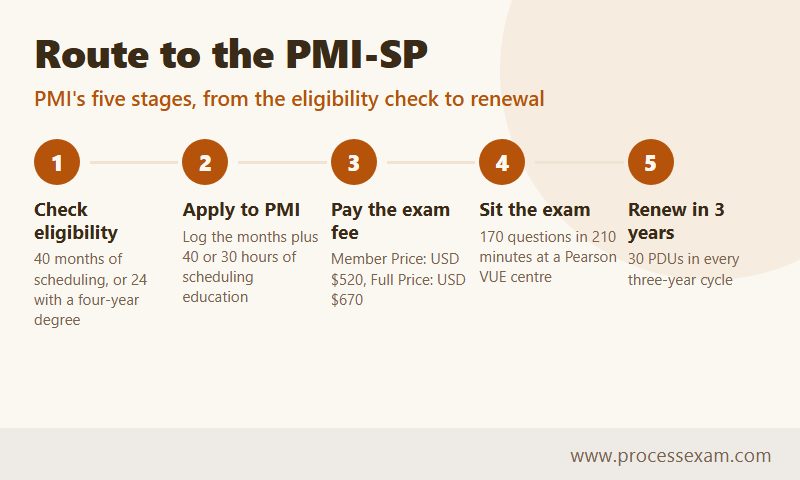
Updated on 23 September 2026. What’s new: PMI's eligibility rule now counts months, not hours: 40 months of project scheduling with a secondary degree, 24 months with a four-year degree.
Open the schedule you are running this week. If it carries an approved baseline, a critical path that other people make decisions on, resource calendars that argue with each other and a change log that would have to survive an audit, you are already doing the work the PMI Scheduling Professional (PMI-SP) certifies. The credential is not a course in drawing bar charts. It asks whether you can build a schedule, defend it, and keep it honest while the project moves underneath you.

What follows is written for the people who keep that file open all day: planners, schedulers, PMO analysts and the delivery managers who own the dates. It covers who the credential genuinely suits, what PMI's five performance domains ask of you, the eligibility rule that stops more applications than the exam stops candidates, what a sitting costs, how to revise using the scheduling tool already on your desk, and what changes at work once the letters sit after your name.
Which schedulers does the PMI-SP actually fit?
PMI files this credential among its specialist certifications rather than its core ones, and pitches it at someone with roughly two to three years of experience in the discipline. That placement tells you most of what you need. The PMI-SP is not an entry ticket into project work and it is not a smaller version of a generalist credential. It is a declaration that scheduling is your trade, that you own the schedule model rather than merely reading it, and that you can be trusted with the one artefact on a project that every other function argues about.
The roles that get the most from it
- Planners on capital programmes - construction, rail, energy, water - where the schedule is a contractual document and a slipped milestone carries a financial consequence.
- Defence and aerospace schedulers who report against an integrated master plan and a performance measurement baseline, and whose files are inspected by the customer.
- PMO analysts who roll dozens of project schedules into one portfolio view and have to explain why the totals move.
- Turnaround consultants brought in to rebuild a schedule that has lost its logic, or to produce evidence for a delay claim.
- Delivery managers in scheduling-heavy sectors who want proof of the planning half of their job rather than another general management line on the CV.
When something else is the better purchase
Be honest about where your week goes. If most of it is spent on sponsors, scope negotiation and budget, a generalist project management credential will say more about you than this one will. If you are early in your career and cannot yet document years of scheduling, an associate-level credential is the sensible first step. If your team abandoned fixed dates for rolling iterations, an agile credential describes your work better than a baseline-and-variance credential does. The PMI-SP is narrow on purpose, and that narrowness is exactly why it carries weight with the employers who need it.
There is a second, quieter benefit for anyone who already does this work informally. Plenty of schedulers arrived in the role sideways - a project manager noticed they were good with the tool - and have never had their method examined by anyone. Preparing for this exam is the first time many of them see their own habits measured against a published standard, and that audit of your own practice is worth something even before the certificate arrives.
What does the PMI-SP exam actually test?
The exam is built on five performance domains, each carrying a fixed share of the questions. The shares are not decoration: they tell you where to spend your revision hours, and they explain why candidates who prepare like project managers rather than like schedulers come away disappointed.
| Domain | Share of the exam | What the questions put to you |
|---|---|---|
| Schedule Strategy | 14% | Setting the scheduling approach, policies, configuration management and the schedule management plan before any activity is typed in |
| Schedule Planning and Development | 31% | Work breakdown, activity definition, duration estimating, sequencing, critical and near-critical paths, resource-constrained dates and the approved baseline |
| Schedule Monitoring and Controlling | 35% | Collecting status, auditing in-house and subcontractor schedules, what-if analysis, folding approved changes in and keeping the model defensible |
| Schedule Closeout | 6% | Final acceptance, performance against the original baseline, lessons learned and archiving the file for possible forensic analysis |
| Stakeholder Communications Management | 14% | Keeping the schedule visible, briefing senior management and escalating the issues that threaten dates |
Where the weight really sits
Two thirds of the paper - 66 per cent - lives in planning, development, monitoring and controlling. That is the part of the job you do on a Tuesday afternoon: the model already exists, something has moved, and you decide what the schedule should now say. The next largest slice is not a technical one at all. Strategy and stakeholder communications together carry 28 per cent, and both are about judgement: what the scheduling approach should be before the work starts, and how you tell a sponsor that a date is no longer safe. Closeout takes only 6 per cent, but it is the cheapest section to prepare, because five tasks cover the whole of it.
That distribution also warns you off a common revision plan. Learning every float calculation and every dependency type will carry you through part of the paper and leave you guessing on the rest. If you want the full task list under each domain before you plan your weeks, our task-by-task syllabus breakdown sets them out in PMI's own wording.
Why PMI's outline carries a 2012 date
Worth saying plainly, because it surprises people: the document PMI links from its own certification page, the PMI-SP Examination Content Outline, carries a 2012 copyright and there is no newer edition (checked September 2026). It came out of a role delineation study PMI commissioned in 2011, validated by a survey of project schedulers in 83 countries. The domain percentages printed on PMI's current certification page match that outline exactly, so it is not an abandoned file left on a server - it is the live blueprint for the exam you will sit.
The practical consequence is a vocabulary one. The outline speaks the language of precedence diagramming, earned value, critical chain, Monte Carlo simulation and the performance measurement baseline. It does not speak the language of story points and cadence. If your daily tool is a sprint board, you will need to spend real time on the predictive vocabulary, because the exam will ask for it in those words.
How many months of scheduling experience does PMI ask for?
Months, not hours - and this is where old advice does the most damage, because guidance written years ago still counts experience in thousands of hours. PMI now publishes three eligibility sets, and you need to satisfy one of them in full:
- Set A - a secondary degree (high school diploma, associate's degree or the global equivalent), 40 months of project scheduling experience within the last five years, and 40 hours of project scheduling education.
- Set B - a four-year degree (bachelor's or the global equivalent), 24 months of project scheduling experience within the last five years, and 30 hours of project scheduling education.
- Set C - a bachelor's or post-graduate degree from a GAC accredited programme, at least 12 months in the specialised area of professional project scheduling within the last five consecutive years, and 30 contact hours of formal education in project scheduling.
Read the five-year window carefully, because it is the clause that catches career changers. Scheduling you did eight years ago before moving into a different role does not count, however good it was. The education hours are friendlier than most candidates expect: PMI states that hours spent in training for Microsoft Project and for other scheduling tools count toward the requirement, so a vendor tool course you sat for work may already be sitting in your file.
What the application itself asks for
The form wants your role, not your project. PMI's own guidance is to describe your responsibilities rather than the thing being built, which means "maintained the resource-loaded baseline for a 14-month plant upgrade and issued weekly variance reports" rather than a paragraph about the plant. Applications can be saved and returned to, so gather your dates, employers and course certificates before you start. If you are selected for an eligibility audit you will be asked for a copy of your degree and verification of your experience signed by a supervisor, so keep names and contact details alongside the dates. PMI's PMI-SP certification page lists the sets and the audit documents in full.
What does the PMI-SP cost, and what do you get back?
The fee is where PMI membership starts to look like arithmetic rather than loyalty. The exam is priced at Member Price: USD $520 and Full Price: USD $670, a gap of 150 dollars on a single sitting. Membership is bought separately from PMI, so run the sum yourself: if the saving on the exam plus the member price of the standards you will need comes close to the subscription, the decision makes itself.
Budget for more than the sitting. You will need the education hours before you can apply, and they are only free if your employer already paid for a tool course. Plan for the standards you will study from, and for the time itself, which for most working planners is the largest cost of the three. A failed sitting does not void the application either: the eligibility year holds room for three attempts in all, each charged separately - a good argument for booking only once your practice results have settled, rather than when the year is about to run out.
Once you hold it, the credential runs in three-year cycles and needs 30 professional development units in each cycle. A PDU is an hour spent learning, teaching, presenting, reading, volunteering or creating content, which for most schedulers is a comfortable target - the webinars, tool training and conference sessions you attend anyway will usually cover it if you remember to record them.
How do you prepare using the scheduler you already run?
The most useful thing about preparing for this exam is that your revision material is already open on your second monitor. Most candidates who struggle are not short of scheduling skill; they are short of PMI's words for what they do. Closing that gap is mainly a translation exercise, and it goes faster if you keep your own project in front of you.
Start from the tool, not the textbook
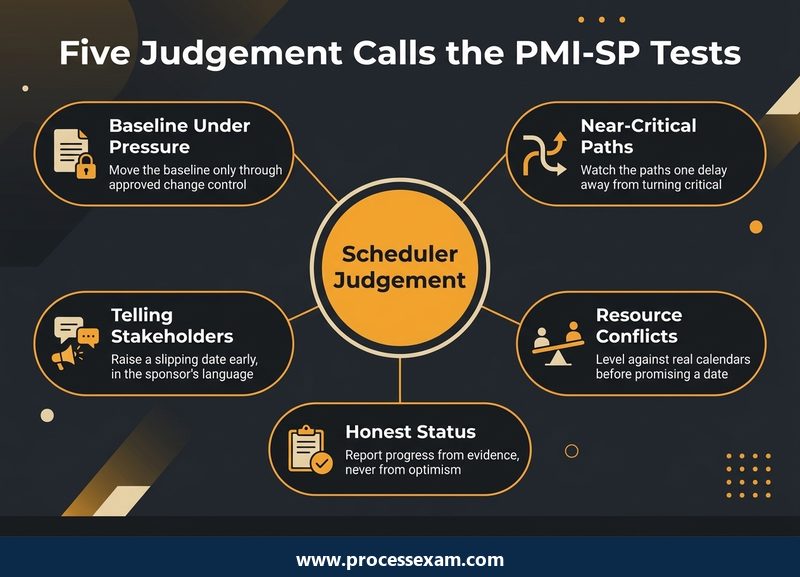
Take a live schedule of your own and work through PMI's task list against it. Where is your work breakdown structure, and does it reconcile to a control account? Which dependencies are genuine and which are habit? Can you name the near-critical paths, or only the critical one? Have you ever levelled resources against a real calendar rather than assuming availability? Each question you cannot answer from your own file is a revision topic with an example already attached, which is far stickier than a definition learned cold.
Read the two standards against that file
PMI names the PMBOK Guide and the Practice Standard for Scheduling - Third Edition as the reference material, and the second of those is the one to spend time in. Read a section, then look at your own schedule and ask whether it would satisfy the practice described. Where it would not, you have found either a gap in your method or a place where your organisation deviates deliberately - and knowing which is which is precisely the judgement the exam rewards.
Then rehearse the clock
Allow around eight to ten weeks if you are working full time, weighted to match the domain shares: roughly a third of your hours on planning and development, a third on monitoring and controlling, and the remainder split across strategy, communications and closeout. In the final fortnight, switch from reading to timed sets. Sitting a full-length PMI-SP practice exam under the real clock is the only reliable way to find out whether your pace survives 170 questions, and the domain-level breakdown afterwards will tell you which of the five areas is still costing you marks while there is time to fix it.
How does PMI-SP exam day run, and what if you fall short?
The exam is delivered at a Pearson VUE test centre and runs to 210 Minutes for 170 multiple-choice questions. Twenty of those are unscored pretest items PMI is trialling for future papers, so 150 count toward your result - and because they are not identified, the only sensible tactic is to treat every question as if it counts. The arithmetic gives you a little under 75 seconds per question, which is generous for a recall item and tight for a scenario with a network diagram in it. Bank time on the short ones early.
Your result does not arrive as a percentage. PMI reports performance in bands - Above Target / Target / Below Target / Needs Improvement - so there is no published pass mark to aim at, and any percentage you see quoted online is somebody's inference rather than PMI's figure. What the bands do give you is a diagnosis: a candidate who misses will usually see exactly which domains pulled the result down, which makes planning a second attempt much easier than a bare score would.
If the news is bad, the eligibility year you already paid for keeps running, and two further sittings fit inside it. Resist the urge to rebook immediately. The most common pattern among successful re-sitters is a short, targeted block of work on the one or two domains the report flagged, rather than a second full pass through material that was already solid.
Where do practising planners lose marks?
The failure modes here are unusual, because they come from experience rather than from ignorance. Five in particular recur.
- Answering as the project manager. Asked what to do about a slipping deliverable, an experienced manager reaches for a decision - reallocate, escalate, renegotiate. The exam usually wants the scheduler's action: analyse the impact, model the options, present them to whoever owns the decision.
- Letting the tool speak for the method. Software will happily accept a constraint that breaks the logic, and after a few years the workaround feels like the technique. The exam tests the technique, so a habit your software tolerates can still be the wrong answer.
- Underrating stakeholder communications. Fourteen per cent of the paper sits in a domain with no calculations in it. Candidates who skim it lose marks on questions about visibility, escalation and briefing senior management that they could have answered from daily experience had they read the four tasks once.
- Skipping closeout. Six per cent looks ignorable until you notice how few tasks cover it. Final acceptance, performance against the original baseline, lessons learned, distributing final reports and archiving for potential forensic analysis - an hour's reading is worth several marks.
- Treating earned value as someone else's job. Schedule variance, the schedule performance index and reserve analysis run through the middle of this exam. If cost control owns those numbers in your organisation, you still need to be able to read and explain them.
What does the PMI-SP change in a planner's career?
The honest answer is that it changes how you are categorised. Scheduling is one of those disciplines where competence is obvious to colleagues and invisible to everyone else - the person who runs a clean baseline rarely gets credit for the crisis that did not happen. A recognised credential converts that quiet competence into something a recruiter's filter, a bid evaluation or a framework qualification can actually see. On public-sector and defence work in particular, named credentials in the planning function are sometimes written into the tender response, and the supplier with certified schedulers on the team has an easier conversation.
Inside an organisation, it tends to move people toward the roles where the schedule is a governance instrument rather than a status report: lead planner, PMO standards owner, the person who writes the scheduling procedure everyone else follows. It also travels. The domains are the same in Rotterdam, Riyadh and Houston, which matters in industries that move their planners between projects and jurisdictions.
What it will not do is substitute for judgement. A credential proves you know what a defensible schedule looks like; the job is still to produce one when the client wants an earlier date and two disciplines have booked the same crew. If that is the work you want to be known for, the PMI-SP is the clearest way to say so - and it stays true for as long as you keep recording your PDUs and using the method on real projects.
Frequently Asked Questions
What is the PMI Scheduling Professional (PMI-SP) certification?
It is PMI's specialist credential for project schedulers. It certifies that you can develop, maintain, analyse and defend a project schedule to a published standard, across five performance domains covering strategy, planning and development, monitoring and controlling, closeout and stakeholder communications. It sits beside PMI's generalist project management credentials rather than replacing them.
What are the PMI-SP eligibility requirements?
PMI publishes three sets. With a secondary degree you need 40 months of project scheduling experience within the last five years and 40 hours of scheduling education. With a four-year degree it is 24 months and 30 hours. With a degree from a GAC accredited programme it is 12 months and 30 contact hours.
How much does the PMI-SP exam cost?
PMI prices the exam at Member Price: USD $520 and Full Price: USD $670, so membership saves 150 dollars on a single sitting. Membership itself is bought separately. Budget also for the required scheduling education hours and the reference standards, and remember that each re-sit within your eligibility year is charged again.
What is the passing score for the PMI-SP exam?
PMI does not publish a percentage. Results are reported as performance bands - Above Target, Target, Below Target and Needs Improvement - across the five domains, so any percentage you see quoted is someone's estimate rather than an official figure. The band report does show which domains were weakest, which helps if you re-sit.
How do you maintain a PMI-SP certification?
The credential runs in three-year cycles and needs 30 professional development units in each one. A PDU is an hour spent learning, teaching, presenting, reading, volunteering or creating content in the discipline, so tool training, webinars and conference sessions usually cover the requirement if you record them as you go.
- Project Management |
- PMI Scheduling Professional Test Questions |
- PMI-SP Question Bank |
- PMI Scheduling Professional Book |
- Scheduling Professional Certification Cost |
- Scheduling Professional Certification Requirements |
- PMI Scheduling Professional |
- PMI Scheduling Professional Sample Questions |
- PMI-SP Exam Questions Download |
- PMI-SP Test Questions |
- Scheduling Professional PDF


