
PSK Certification: What Scrum.org's Kanban Credential Proves
Updated on 10 October 2026. What’s new: the certification is lifetime with no annual renewal fee, according to the current Scrum.org assessment page.
Plenty of Scrum Masters assume a Kanban credential means swapping Sprints for a never-ending board. Scrum.org's PSK certification teaches the reverse: keep every Scrum rule and add flow practices on top. The assessment has 45 questions, a 60-minute limit and an 85% passing score, and it costs $200 per attempt. This guide covers what it tests, how to read its questions and how to prepare.
Does adding Kanban mean a Scrum Team drops its Sprints?
No Sprint disappears. The Scrum Guide's accountabilities, events and artifacts all stay in place, and every Sprint still aims at a Done Increment. Kanban sits inside that frame as a way to make the flow of work visible and to steer it with numbers. Scrum.org describes the PSK I certification as validating knowledge of how Scrum Teams can use Scrum with Kanban to support value creation and delivery. Notice the direction of that sentence: the team is a Scrum Team first, and Kanban is something it uses.
The myth survives because the two ideas arrive from different places. Scrum came out of product development and gives a team a rhythm of plan, build, inspect, adapt. Kanban grew out of manufacturing scheduling and optimises how smoothly items move from started to finished. A team told to "go Kanban" often drops its timeboxes along with its estimates, then wonders why nothing gets inspected any more. Scrum.org says many PSK I questions ask you to interpret scenarios, so a team that has abandoned a Scrum rule in the name of flow is exactly the situation to be ready for.
What the combination adds
Scrum asks a team to inspect and adapt but does not say which data to inspect. Kanban fills that gap with four flow measures, a visible workflow and a habit of limiting how much work is open at once. The Sprint Goal still gives the Sprint its purpose, and the Sprint Backlog is still the plan for achieving it. What changes is how the Developers manage the items inside the Sprint: they look at age, queue length and blockages instead of waiting until the end of the Sprint to learn that three items stalled in review.
What stays untouched
Timeboxes, the Product Backlog, the Definition of Done and the accountabilities of the Product Owner, Scrum Master and Developers all stay as the Scrum Guide describes them. A useful test for any practice scenario: if an answer option removes one of these to improve flow, treat it with suspicion. If an option keeps the Scrum structure and adds a visible, measurable improvement, it is usually closer to what Scrum.org describes.
What do 45 questions, 60 minutes and an 85% bar look like in practice?
The table gives the figures as Scrum.org lists them on its assessment page, checked in October 2026. The fee is charged for each attempt, and the passwords Scrum.org issues have no expiry date but are valid for one attempt only.
| Item | PSK I |
|---|---|
| Vendor | Scrum.org |
| Certification | Scrum.org Certified Professional Scrum with Kanban (PSK I) |
| Exam fee | $200 USD per attempt |
| Number of questions | 45 |
| Time limit | 60 minutes |
| Pass mark | 85% |
| Item formats | Multiple choice, multiple answer and true/false |
| Language | English |
| Validity | Lifetime, no annual renewal fee |
Two small calculations help you plan. First, 60 minutes across 45 questions is about 80 seconds a question, which is generous for true/false items and tight for a long scenario with four plausible options. Second, if every question carries equal weight, 85% of 45 is 38.25, so you would need 39 correct answers to clear the bar. Scrum.org does not publish how items are weighted, so treat 39 as a planning figure rather than a promise, and aim to sit comfortably above it in practice.
Reading the format
Multiple-answer items can eat the clock. The question tells you how many options to choose, and every chosen option has to be right. A good routine is to read the final line of the question first, so you know whether you are hunting for one answer, several answers or a true/false judgement, and then read the scenario with that target in mind.
Class or no class
Attending a class is not a prerequisite. Scrum.org highly recommends its Professional Scrum with Kanban course, and its site says each Scrum.org class includes a free attempt at the associated certification. Without a class the $200 fee applies, and a failed attempt means another password. That is a good reason to measure yourself on the free open assessment before paying, which the study section below describes. Confirm fees and rules on the vendor's own page before you buy: Scrum.org's PSK certification page.
Which subject areas decide the result?
Scrum.org grounds the assessment in the Professional Scrum with Kanban subject areas and names three on its page. The first is understanding and applying the Scrum framework: how Scrum and Kanban can be used together for greater benefit without compromising the core tenets of either. The second is Kanban practices, meaning the practices listed in the Kanban Guide for Scrum Teams. The third is agile metrics for Kanban, meaning the required metrics in that same guide and how to use them well. The page adds that many questions ask you to interpret scenarios based on theory from the Kanban Guide for Scrum Teams and the Scrum Guide.
That sentence tells you what to read. Two short documents carry most of the exam: the Scrum Guide and the Kanban Guide for Scrum Teams. Neither takes long to read once, but the exam rewards knowing them closely enough to spot a paraphrase that bends a rule. The vendor gives no percentage weighting for the three areas, so any claim of an exact split is a guess. If you want the topics as a checklist you can tick off, the PSK I syllabus breakdown lays them out in study order.
Area one: Scrum, applied with Kanban
Rehearse situations where a team has a Sprint Backlog, a board and some friction between them. One example: the Developers want to pull a new item mid-Sprint because the board shows spare capacity. A sound answer respects the Sprint Goal and the Scrum Team's ability to renegotiate scope with the Product Owner, instead of treating the board as permission to start anything. Another: a team asks whether the Daily Scrum can be replaced by a board review. It cannot be dropped, but the board and its flow data can make the 15 minutes sharper.
Area two: the Kanban practices
The practices come down to a short list you should be able to explain in your own words: define and visualise the workflow, limit the work in progress, manage items that are in progress actively instead of waiting for them to finish, and keep reviewing the definition of the workflow so it improves. Expect to be tested on the reasoning behind them, such as why a cap on open items shortens the time each item takes, or what a blocked item should trigger.
Area three: the flow metrics
Work in progress, cycle time, throughput and work item age are the four measures to know cold. The next section works through them with numbers, because Scrum.org says the assessment asks you to apply concepts, not only recall them.
How do the four flow metrics turn into answers?
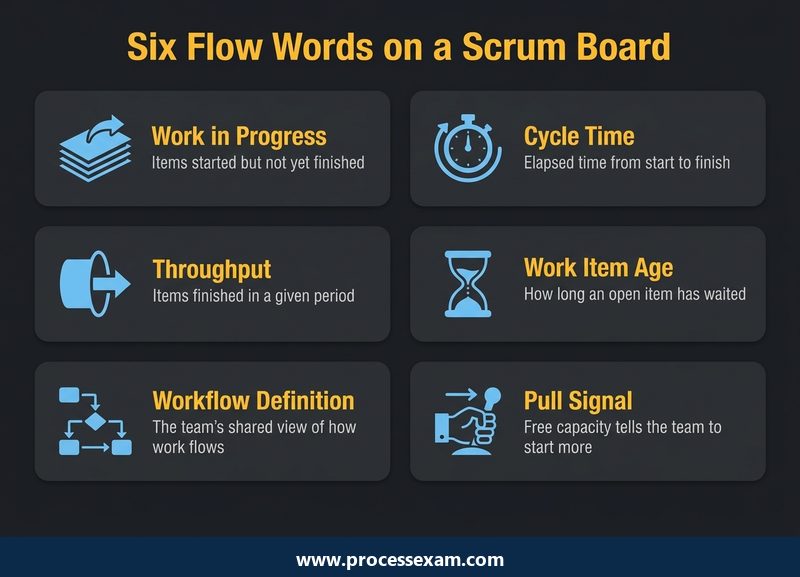
Each measure has a plain definition. The wording below follows the Kanban Guide, which Scrum.org's page names as the source for the required metrics.
- Work in progress (WIP): the number of work items that have started but not finished.
- Cycle time: the elapsed time between an item starting and finishing.
- Throughput: the number of items finished in a period of time, counted exactly rather than estimated in points.
- Work item age: the elapsed time between an item starting and today, for an item that is still open.
A worked example with cycle time
Suppose a Scrum Team finished six items last Sprint and they took 2, 3, 3, 4, 5 and 9 days from start to finish. The average hides the story, because the 9-day item sits far from the others. A more useful statement is that five of the six items, about 83%, finished in 5 days or fewer. The general Kanban Guide, revised in May 2025, calls a statement like this a service level expectation and shows the shape "85% of work items will be finished in eight days or less". Read the Kanban Guide for Scrum Teams itself for exactly what it asks of a Scrum Team. The idea to carry into the exam is that a forecast should state both a time and a probability.
A worked example with work item age
Now suppose an item started on a Tuesday morning and today is the following Monday. Its age is six days and it is still open. If most finished items in this team's history took five days or fewer, that item has outlived most of them and deserves the Daily Scrum's attention before anyone starts something new. Cycle time looks backwards at finished work. Age looks at what is open right now, which is why it is the measure a team can act on today.
A worked example with WIP and throughput
If a team finishes seven items per Sprint on average but always has fourteen open, items spend around two Sprints in the system on average. That relationship comes from queueing theory, where it is known as Little's Law, and you can reason with it even if the exam never names it. Limiting WIP to a smaller number shortens the time without anyone working harder. Watch for answer options such as "add more people" or "start more items so nobody is idle". The flow answer is to finish before starting.
Where the data gets used in Scrum
These measures replace no Scrum event. They give the existing events better evidence. At Sprint Planning, throughput from earlier Sprints supports a more honest forecast. At the Daily Scrum, the Developers can look first at the items with the greatest age. At the Sprint Review, finished-item counts and cycle times help stakeholders judge progress. At the Sprint Retrospective, a trend in cycle time or a column that keeps filling up is a concrete topic for improvement. Events stay as they are, and inspection gets sharper.
How should a Scrum Team design and run its board?
Board design deserves its own section because every Kanban practice shows up on the board. The board is the visual form of the team's workflow: the columns are the states an item passes through between started and finished, and the cards are the units of value moving through them.
Start from the real workflow, not a template
Draw the columns the work actually passes through, such as ready, in development, in review, in testing and done. Add a column only when work genuinely waits there. A team that copies a five-column template it does not follow will see items sitting in "testing" while testing really happens in "in development", and its data will mislead it. Writing down what "started" and "finished" mean for each kind of item is the step teams most often skip, and every metric depends on it.
Put limits where work piles up
A WIP limit is a visible cap on how many items can sit in a column or in the whole workflow. When a column reaches its cap, the team does not pull more into it. It helps get the existing items moving: swarming on the review that blocks everyone, or removing the dependency that stalled an item. Limits feel uncomfortable at first because people look idle. The payoff is that the time an item spends waiting falls, and with it the amount of half-finished work.
Keep the Sprint Backlog and the board in step
The Sprint Backlog is the Developers' plan for the Sprint, and the board is where its items flow. Cards on the board that are not in the Sprint Backlog suggest the team is carrying work the Sprint Goal never agreed. A scenario worth rehearsing: an urgent request bypasses the board, and you must say how the Scrum Team should handle it. A sound answer involves the Product Owner and the Sprint Goal, not a silent exception.
Review the workflow itself
A team inspects more than its product. It inspects how it works, and the board is a draft that gets edited. The Sprint Retrospective is a natural moment to change a column, adjust a limit or tighten a policy, though nothing stops a team making a small change sooner when the data shows a problem.
Who should take PSK I, and how does it compare with PSM I, PSPO I and PSD I?
Anyone working in Scrum has a reason to hold it. Scrum Masters, Product Owners and Developers all deal with the flow of items. Scrum.org's role credentials ask how a person performs a job, whereas PSK asks how a whole Scrum Team applies Kanban practices, so it sits beside the role tracks as a practice-based credential.
| Credential | Main focus | Questions and fee |
|---|---|---|
| PSM I | Running Scrum as a Scrum Master | 80 questions, $200 |
| PSPO I | Maximising value as a Product Owner | 80 questions, $200 |
| PSD I | Building a Done Increment as a Developer | 80 questions, $200 |
| PSK I | Applying Kanban practices inside a Scrum Team | 45 questions, $200 |
Three differences stand out. PSK I has fewer questions than the role-based tests, so if items carry equal weight each one moves your score further. Its scope is narrower, which makes it a sensible second credential after a role-based one. And PSK has no second level: PSM and PSPO each have higher tiers, while PSK stands alone. To understand the Scrum framework in depth first, Scrum.org's PSM I assessment page describes the Scrum Master entry point.
Two details people get wrong
Some older write-ups say that passing makes you a Scrum Alliance member for two years. That is mistaken. The credential is issued by Scrum.org, which describes it as a lifetime certification with no annual renewal fee and includes a free Credly digital credential. Pay claims deserve the same caution: a salary range with no named survey behind it is not a figure a candidate can rely on, so this guide quotes none.
What it changes at work
A certificate does not make a team faster. What it shows an employer is that you can use the vocabulary of flow correctly and tie it back to Scrum, which matters in organisations that already run Scrum and want more predictable delivery. In practice, the people who study for it tend to be the ones who bring a cycle-time chart to a Sprint Retrospective, or who ask the team to finish an old item before pulling a new one. That habit is the real value, and the credential is evidence that you studied the guides behind it.
What study routine takes you from the Kanban Guide to 85%?
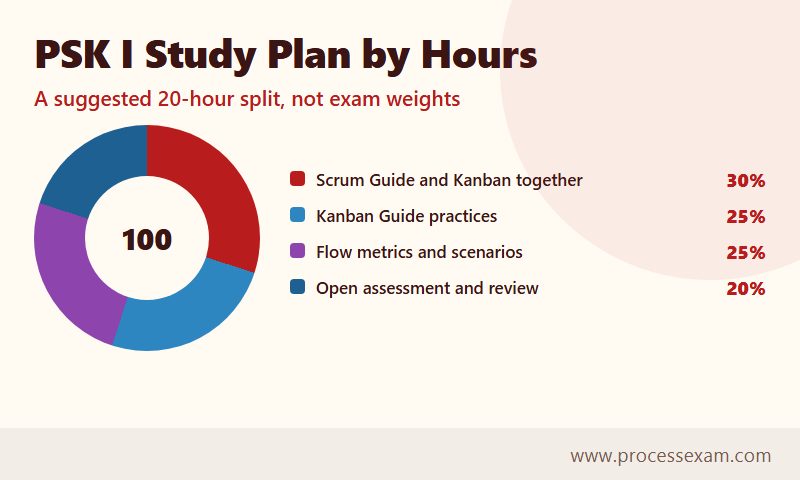
The chart is a suggested split of about 20 study hours. It is a plan, not a weighting from Scrum.org, which publishes no percentages by topic. Adjust it to what you already know: an experienced Scrum Master can shift hours out of the first block, while someone new to flow metrics should spend longer on the third.
Block one: Scrum and Kanban together (about 6 hours)
Read the Scrum Guide again, even if you know it. Then read the Kanban Guide for Scrum Teams alongside it and write one line per Scrum event on what flow data would change. If you cannot say how a board helps the Daily Scrum without replacing it, go back to the text.
Block two: the Kanban practices (about 5 hours)
Take a real board, yours or an imagined one, and write a definition of workflow for it: what counts as started, what counts as finished, which states exist and what the policies are. Set a limit and note what the team does when the limit is reached.
Block three: metrics and scenarios (about 5 hours)
Invent small data sets like the ones above and calculate the four measures by hand. Then write scenario questions yourself: a team has an old item, a full column and a request from a stakeholder, and you decide the next step. Writing questions teaches you what the distractors look like.
Block four: the open assessment and review (about 4 hours)
Scrum.org offers the Scrum with Kanban Open assessment free of charge. It has 15 questions drawn at random from a larger pool and carries no certification, so use it as a baseline before you pay for the real attempt. Repeat it until your score is consistently high, then check every answer you missed against the guides, not against your memory of an explanation.
Once the guides feel familiar, a timed PSK I mock exam shows whether long scenario wording still catches you, and running it at 45 questions in 60 minutes trains the pacing. On the day, read the last line of each question first, mark anything doubtful, and spend leftover minutes on multiple-answer items, where one wrong option sinks the whole question.
What if you miss the mark, and how do you know you are ready to book?
Each attempt needs its own password, and Scrum.org lists the $200 fee per attempt. The page describes no cooling-off period or discounted retake, so do not assume one exists, and read it again before buying. Afterwards you receive a breakdown of your performance based on the Professional Scrum competencies, though not a list of which individual questions you got right or wrong.
Accessibility and language
The assessment is in English. Scrum.org's page notes that many people use the Google Translate plugin to sit it in their own language, following instructions the vendor publishes, and says it cannot guarantee translation quality. For physical or intellectual disabilities the page asks you to write to its support team so each case can be examined individually.
A short readiness check
- You can define WIP, cycle time, throughput and work item age without notes and compute each from a small data set.
- You can say, for each Scrum event, what flow data adds without replacing the event.
- You score consistently high on the open assessment and can justify every answer from the guides.
- You can finish a timed 45-question run with minutes to spare for multiple-answer items.
If one of those is missing, spend another study block on it before spending $200. The credential does not expire, so no deadline pushes you to book early, and the only cost of waiting a week is a week.
Frequently Asked Questions
What is the PSK certification?
PSK I, Professional Scrum with Kanban, is a Scrum.org certification showing you understand how Scrum Teams can use Kanban practices and flow metrics without giving up Scrum's rules. It is earned by passing an online assessment, whether or not you attended a class, and it is based on the Kanban Guide for Scrum Teams and the Scrum Guide.
How much does the PSK I assessment cost?
Scrum.org lists the fee as $200 USD per attempt, with additional taxes possibly applying at checkout. Passwords have no expiry date but work for one attempt only. Scrum.org also says each of its classes includes a free attempt at the matching certification, so attending the Professional Scrum with Kanban course can cover the fee.
How many questions and what passing score does PSK I have?
The assessment has 45 questions in 60 minutes, in multiple choice, multiple answer and true/false formats. The passing score is 85%. If every question counts equally, that means 39 correct answers. Scrum.org does not publish how questions are weighted, so that number is a planning guide only.
Does the PSK I certificate expire?
No. Scrum.org describes PSK I as a lifetime certification with no annual renewal fee, and a free Credly digital credential is included. You pay only for the assessment attempt itself. Unlike some other vendors, there is no continuing-education requirement to keep it listed as active.
Do you need to attend a class before taking PSK I?
Attendance is not a prerequisite. Scrum.org says taking its Professional Scrum with Kanban class is highly recommended, but anyone can buy a password and sit the assessment. The free Scrum with Kanban Open assessment, with 15 random questions, is the vendor's own practice tool.
- Scrum |
- Scrum.org Professional Scrum with Kanban Test Questions |
- PSK I Question Bank |
- Scrum.org Professional Scrum with Kanban Book |
- Professional Scrum with Kanban Certification Cost |
- Professional Scrum with Kanban Certification Requirements |
- Scrum.org Professional Scrum with Kanban Sample Questions |
- PSK I Exam Questions Download |
- PSK I Test Questions |
- Professional Scrum with Kanban PDF


