
Is UML Still Worth Learning? What a Foundation Credential Proves
"Nobody draws UML any more" is half true: few teams still produce wall-sized diagrams before writing code, yet class, sequence and state diagrams live on in pull requests, design documents and architecture reviews. UML 2.5.1 is still the current specification, and OMG's Foundation exam checks, in 90 questions, whether you can read and build those diagrams correctly.

The myth survives because it confuses two things: UML as a heavyweight design phase, which really did fade, and UML as a shared sketching vocabulary, which did not. This article sorts the two apart for developers, business analysts and architects. You will see where UML still turns up at work, which diagrams repay the effort, when another notation is the better choice, and what OMG's Foundation-level credential, the first of three OCUP 2 exams, does and does not prove. Exam figures come from OMG's Foundation exam information sheet and its certification page, read in October 2026.
Who still draws UML, and where does it show up?
UML appears wherever two people have to agree on structure or behaviour without reading each other's code. The most common home today is not a modelling tool at all. It is a text block in a repository or a wiki that renders as a diagram. PlantUML's own site lists sequence, use case, class, object, activity, component, deployment, state and timing diagrams, plus support for Markdown and AsciiDoc and a browser extension that renders PlantUML directly in GitHub. Mermaid, another diagrams-as-code tool, lists class, sequence and state diagrams among its core types. Neither tool would carry that vocabulary if teams had stopped using it.
That is a fact about tooling, not a survey of how many teams draw UML, and no honest article can give you a percentage. What the tooling does show is the shape of modern use. Diagrams are small, text-based, kept next to the code and redrawn when the design changes. They are rarely the single source of truth, and almost never generate the whole application.
Four everyday situations explain most of the survivals:
- A design discussion before a risky change. A developer sketches a sequence diagram showing which services call which, in what order, and where a failure could leave data half-written. The diagram lives in the pull request description.
- A domain model for a new feature. A class diagram with five or six classes, their multiplicities and one or two inheritance relationships settles vocabulary between an analyst and the team faster than a page of prose.
- A lifecycle that has rules. Orders, tickets, loans and subscriptions all move through states, and a state machine diagram shows which transitions are legal and which guard conditions apply.
- A hand-off between business and technology. Analysts use activity diagrams and use case diagrams to describe a process or a set of goals in a form developers and testers can both read.
There is a second, quieter reason UML endures. Other notations borrow from it. OMG's systems-engineering language SysML, in its widely deployed 1.x versions, is defined as a profile of UML, so engineers who read a block diagram or a state machine there are using UML ideas. SysML v2 has its own metamodel, but it keeps the concepts of structure, behaviour and requirements that UML users learned first. Anyone moving into model-based systems engineering later finds the groundwork already laid.
Which UML diagrams earn their keep for developers and analysts?
The specification defines many diagram types, and most practitioners use a handful. The short list below follows the eight areas OMG examines at Foundation level, because those are also the diagrams you meet most often at work.
| Diagram | Question it answers | Typical user |
|---|---|---|
| Class diagram | What things exist, and how are they related? | Developers, analysts, architects |
| Sequence diagram | Who talks to whom, in what order? | Developers, integration engineers |
| Activity diagram | What steps happen, and which can run in parallel? | Analysts, testers, process owners |
| State machine diagram | What states can this thing be in, and what moves it? | Developers, embedded and workflow engineers |
| Use case diagram | Who uses the system, and for which goals? | Analysts, product owners |
| Object diagram | What does one concrete snapshot look like? | Anyone checking a class model with real data |
| Package diagram | How is the model grouped and which groups depend on which? | Architects, tech leads |
If you only have an afternoon to learn UML for work, spend it on the first four rows. A reader who can follow a class, sequence, activity and state machine diagram can take part in nearly every design conversation that uses UML.
A developer gets the most from class and sequence diagrams. The class diagram forces you to decide whether a relationship is an association, a composition or a generalization, which are decisions your code makes anyway. The sequence diagram exposes ordering problems early: a call that blocks, a response nobody handles, a participant that does too much.
An analyst gets more from activity and use case diagrams. An activity diagram shows a decision and a parallel split side by side, which is hard to do in a bulleted requirement. A use case diagram gives stakeholders a one-page boundary: these actors, these goals, nothing else.
Notice what the list implies: nobody needs every diagram on every project. The skill that lasts is choosing the one diagram that answers the question in front of you and drawing it correctly, which is exactly what a foundation-level credential tries to check.
When is UML the wrong tool, and what replaces it?
UML is a poor fit when the diagram would be bigger than the problem. A three-step script does not need an activity diagram, and a ten-line function does not need a class diagram. It is also a poor fit when a diagram cannot stay current. A full-system class diagram drawn once and never updated misleads more than it helps, which is the real origin of the "nobody draws UML" complaint.
Other notations beat it in specific places:
- Business process detail. When a process needs events, message flows between organisations and exception handling, BPMN is built for the job. OMG maintains BPMN and runs its own certification track for it.
- Systems with hardware, physical quantities and requirements traceability. SysML, also from OMG, is designed for these, and its v2 version is a separate language rather than a profile of UML.
- Data design. An entity-relationship diagram or a schema file is closer to what a database engineer ships.
- Architecture overviews. Many teams use lightweight box-and-arrow diagrams or the C4 model for context and container views, and keep UML for the detail underneath.
The practical rule is to treat UML as a vocabulary, not a method. Use the part of it the situation calls for, label the diagram so nobody has to guess which notation you mean, and keep it small enough that updating it takes minutes. That habit is also the one the Foundation exam rewards, because its questions ask you to interpret precise notation, not to produce elaborate models.
What does the Foundation exam test, and how are the 90 questions weighted?
OMG describes the Foundation exam as testing "a subset of the most used UML behavioral and structural diagram types and UML elements and attributes", together with why certain domains use software modeling and the benefits they gain. It is the entry level of three OCUP 2 exams and has no prerequisite. The exam is multiple choice, with text and images, and its element list is drawn from UML 2.5.1.
The weights below come from the OCUP 2 Foundation syllabus breakdown. OMG's own page lists the topics but, as read in October 2026, does not print percentages, so treat the weights as a planning guide.
| Topic area | Weight |
|---|---|
| Class diagram | 25% |
| Activity diagram | 20% |
| Sequence diagram | 15% |
| Why we model | 15% |
| State machine diagram | 10% |
| Object diagram | 5% |
| Package diagram | 5% |
| Use case diagram | 5% |
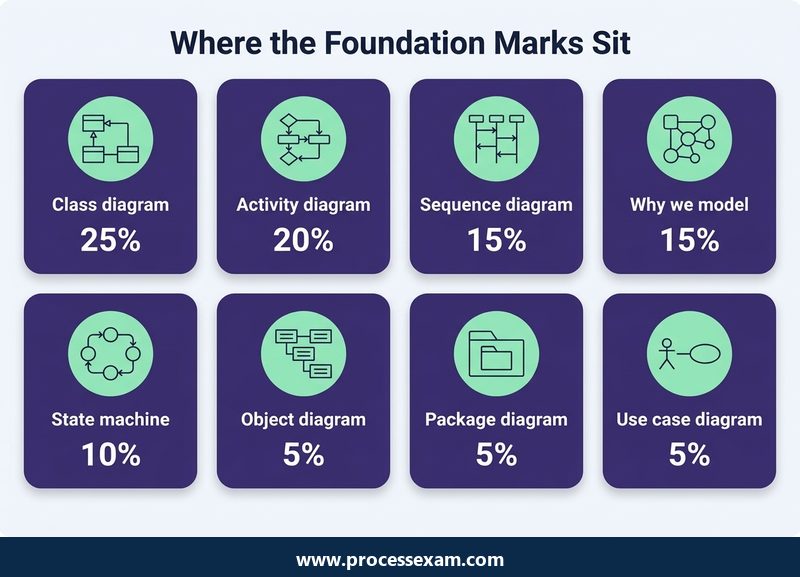
Two conclusions follow. First, class and activity diagrams together carry 45% of the paper, so a weak spot there costs far more than a weak spot in package or object diagrams. Second, 15% sits under "why we model", which is not a drawing skill at all. It asks what modelling is for, what a model leaves out on purpose and what benefits an organisation gets. Candidates who skip it as "common sense" can be caught by answer choices that sound sensible but contradict the reasoning in OMG's reading list, which includes short papers such as "Why Model?" and "The Value of Modeling".
The information sheet also names the elements you need from the specification, chapter by chapter. A few examples show the level of detail:
- Classes and associations (chapters 9 to 11): aggregation kinds (composition and aggregation), generalization, instance specifications and slots, properties, operations, parameters, data types, enumerations, interfaces, interface realization, signals and receptions.
- Packages (chapter 12): Package and PackageMerge, along with visibility and package import from chapter 7.
- State machines (chapter 14): state, transition, final state and the initial, choice and junction pseudostates.
- Activities and actions (chapters 15 and 16): initial, final and flow-final nodes, decision, merge, fork and join nodes, control and object flows, and actions such as accept event, send signal, and call behaviour or operation.
- Interactions (chapter 17): lifelines, messages, execution and occurrence specifications and the destruction occurrence. The sheet does not name combined fragments in that list, so check the sheet itself before deciding how far to go with them.
- Use cases (chapter 18): actor, include and extend.
The list is a better map than any summary, including this one. When a term in it is unfamiliar, find it in the UML 2.5.1 text, which OMG publishes as a formal specification dated December 2017.
What does a typical question look like?
Imagine a class diagram in which Order is joined to OrderLine by a line with a filled diamond at the Order end, labelled 1 at the Order end and 1..* at the OrderLine end. A question asks which statement about the model is correct. The distractors are predictable: one calls the relationship plain aggregation, one reverses the multiplicity, one says an OrderLine can exist without an Order. The right answer reads the filled diamond as composition, so each OrderLine belongs to exactly one Order and does not outlive it. Nothing here needs memory beyond the notation, but every symbol must be read exactly. That is the pattern across the paper: images, short statements and small differences in notation.
State machines supply a similar trap. A transition written as cancel [paid = false] / refund() has a trigger (cancel), a guard in square brackets and an effect after the slash. Candidates who confuse the guard with the effect pick the wrong answer. In activity diagrams the common trap is mixing up a decision node, which chooses one path, with a fork node, which starts parallel paths, and the matching merge and join nodes that close them.
What does a Foundation pass prove, and what can it not prove?
A pass shows that you can read and construct the most-used UML diagrams correctly, and that you understand why organisations model. OMG states that the certification targets practitioners whose "depth of UML knowledge and skill supports proficient model building and interpretation". Model users can interpret UML diagrams, and model builders can contribute to a modelling team. It is a vendor-neutral credential issued by the organisation that maintains the UML specification, delivered as a digital badge through Credly within hours of passing.
What it does not prove is equally clear:
- It is not proof you can design well. A multiple-choice paper checks notation and concepts. Judgement about which classes a system needs comes from practice.
- It is not tool training. The exam is about the language, not about any modelling product.
- It is not an architecture credential. Foundation covers diagram literacy. Architecture frameworks and enterprise modelling are separate subjects.
- It does not last for ever. OMG says certifications expire three years after the exam date, and taking the same or a higher level exam extends their validity.
Who benefits? Candidates in three situations tend to get the most. Developers who want a recognised way to show they can follow design documents. Analysts moving towards solution design who want a common vocabulary with engineers. And engineers heading for OMG's systems-modelling track, because UML knowledge there is useful groundwork. If your day job never touches a diagram, the credential adds little; if you already read and draw UML weekly, the exam mostly converts experience into a dated, verifiable statement.
Employers can verify a Credly badge, which is more convincing than a line on a CV saying "familiar with UML". It would be wrong to oversell it, though. No source I can cite quantifies a salary or hiring effect for this credential, so the honest claim is narrower: it is evidence of literacy in a notation that many design conversations still assume.
How much does the exam cost, how long is it, and how do you book?
All of the following comes from OMG's Foundation exam information sheet and certification page, read in October 2026.
| Item | Rule |
|---|---|
| Questions | 90, multiple choice (text and images) |
| Passing score | 60 of 90 correct, or 67% |
| Time | 120 minutes in native English-speaking countries, 150 minutes in all others (OMG emails any extra time once the order is complete) |
| Fee | US$350 plus taxes, with regional currency equivalents |
| Prerequisites | None |
| Languages | English and Japanese; translation apps are prohibited during the exam |
| Delivery | Through Pearson VUE, in a secure test centre or remotely online |
| Credential life | Three years after you pass |
Booking runs through a Pearson VUE account. You can sit the exam after OMG-accredited training or after self-study, and training is optional. If you plan to test online, test your own computer with Pearson VUE's system check before you schedule, because technical problems on the day are handled through Pearson VUE customer service. Cancel through Pearson VUE more than a day ahead and you get the full fee back; cancel later and the fee is lost.
After a fail, check your score report: it holds a 20% discount code for the retake. OMG's page does not describe any other retake rule, so check Pearson VUE when you book rather than assuming a waiting period either way. Candidates with a learning or physical disability should write to OMG's certification address for accommodations before booking.
A word on the arithmetic. Sixty of ninety is a pass line of about two-thirds, and the 120-minute allowance gives you a little over a minute and a quarter per question. Most Foundation-style questions take well under that, which leaves room to flag and revisit the diagram-heavy ones. Working through timed practice is the cheapest way to find out where your own pace falls; the OMG-OCUP2-FOUND100 practice exam lets you rehearse the 90-question rhythm against the clock before you commit the US$350 exam fee.
What does a five-week route from sketching to passing look like?
Five weeks at six to eight hours each suits a working developer or analyst who has seen UML before. Someone starting from nothing should add a week at the front for notation and vocabulary. The order below follows the weights and puts the heaviest areas early, so you meet them twice.
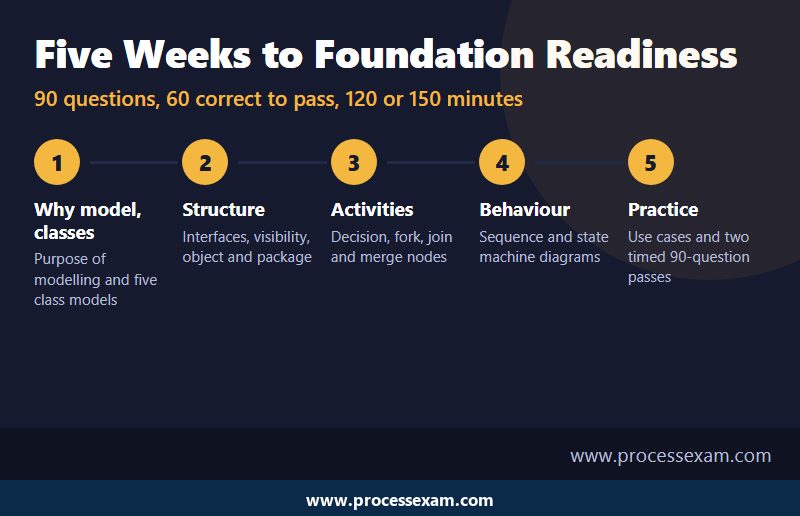
Week 1, why we model and class diagram basics. Read the short papers on OMG's reading list that cover the purpose of modelling, then draw five small class models from systems you know. For each one, label every multiplicity and say aloud whether each relationship is an association, a composition or a generalization.
Week 2, the rest of the structural diagrams. Finish the class chapters: interfaces and realization, enumerations and data types, visibility (public, private, protected and package), instance specifications and slots. Add object and package diagrams, which are small areas but easy marks once you can read them.
Week 3, activity diagrams. This is the second-heaviest area. Draw the same process three ways: with a decision, with a fork, and with object flow. Be able to explain what the token does at each node and why a join waits while a merge does not.
Week 4, sequence and state machine diagrams. Redraw one real interaction from your own work as a sequence diagram, with synchronous calls, asynchronous signals and a destruction. Then model a lifecycle as a state machine with a guard, an effect and a choice pseudostate.
Week 5, use cases and full-length practice. Cover actor, include and extend, then do two timed passes of 90 questions. Mark every miss with the chapter it came from and reread that part of UML 2.5.1. Stop learning new material two days before the exam.
For reading, OMG's information sheet recommends Chonoles' OCUP 2 Certification Guide, which includes practice questions by the exam designer, along with books such as UML 2.0 in a Nutshell and UML 2 for Dummies. Use the specification itself as the tiebreaker whenever a book and your instinct disagree.
Three habits improve scores more than extra hours. Cover the answer options and describe the diagram in your own words first. Read multiplicities and arrowheads before any text. And when two options differ by one symbol, find the symbol and name it before choosing.
Where does the Foundation credential lead next?
Foundation is the prerequisite for the two higher OCUP 2 exams. OMG's certification page shows Intermediate as requiring Foundation and Advanced as requiring Intermediate, and each exam costs US$350. Intermediate moves from reading to building, with deeper work on structure and behaviour. Advanced goes further still into the language's metamodel and execution semantics.
Beyond OCUP 2 there are two natural moves. One is OMG's systems-modelling track, where UML habits transfer to SysML. The other is OMG's business-process track, where BPMN takes over from activity diagrams for anything with message flows and events. Both are optional, and neither depends on a second UML credential.
The decision itself is simple. If you read or draw UML at least a few times a month, the Foundation exam is a modest, well-defined step: 90 questions, US$350, no prerequisite and a credential good for three years. If you do not, spend a weekend with a text-based diagram tool first. If the diagrams start to feel useful, the credential is a reasonable way to make that skill visible. If they do not, you have learned something cheap about your own work.
Sources used above: OMG's UML certification page, its UML 2 Foundation exam information sheet, the UML 2.5.1 specification page, PlantUML and Mermaid. Exam rules can change, so confirm the fee, timing and booking steps with OMG and Pearson VUE before you book.
Frequently Asked Questions
How many questions are on the OMG Foundation UML exam, and what is the passing score?
The exam has 90 multiple-choice questions, in text and images. You need at least 60 of 90 correct, which OMG also states as 67%. There is no prerequisite for Foundation, and the paper is based on a defined subset of UML 2.5.1 diagram types and elements.
How much does the OCUP 2 Foundation exam cost?
As of October 2026 OMG lists the fee at US$350 plus taxes, with a regional currency equivalent. If you fail, your score report includes a 20% discount code for a retake. An exam cancelled more than 24 hours before its scheduled date is refunded in full through Pearson VUE.
How long do you get for the Foundation exam?
You get 120 minutes if you live in a native English-speaking country and 150 minutes in all other countries. OMG confirms any extra time by email after the exam order is completed. You can sit the exam at a secure Pearson VUE test centre or online.
Which UML version does the Foundation exam use?
OMG's Foundation information sheet lists its study elements by chapter of UML 2.5.1, the formal specification published in December 2017. The exam covers a subset of that specification: class, activity, sequence, state machine, object, package and use case diagrams, plus the reasons for modelling.
How long is the OCUP 2 Foundation credential valid?
OMG says certifications expire three years after the exam date. Taking the same or a higher level exam extends the validity. Foundation is also the prerequisite for the Intermediate exam, which in turn is the prerequisite for the Advanced exam, so progressing up the levels renews the credential.
- OMG OCUP 2 Foundation Test Questions |
- OMG-OCUP2-FOUND100 Question Bank |
- OMG OCUP 2 Foundation Book |
- OCUP 2 Foundation Certification Cost |
- OCUP 2 Foundation Certification Requirements |
- OMG OCUP 2 Foundation Sample Questions |
- OMG-OCUP2-FOUND100 Exam Questions Download |
- OMG-OCUP2-FOUND100 Test Questions |
- OCUP 2 Foundation PDF |
- UML 2 Certifications |
- UML 2 Foundation Simulator |
- UML 2 Foundation Mock Exam |
- OMG UML 2 Foundation Question Bank |
- OMG UML 2 Foundation Book |
- OMG UML 2 Foundation Study Guide |
- UML 2 Foundation Certification |
- UML 2 Foundation Certification Cost |
- UML 2 Foundation Certification Requirements |
- OMG UML 2 Foundation Exam Questions |
- OMG UML 2 Foundation Sample Questions |
- UML 2 Foundation |
- UML 2 Foundation PDF


