
Top Management Support in Six Sigma: What Executives Must Do
A regional distributor launches Six Sigma with a keynote from its chief executive, twelve new Black Belts and a wall chart of projects. By the third quarter the executive has missed two reviews, a hiring freeze has pulled two belts back to their old jobs, and nobody can say who approved the latest charter. Top management support is vital because only executives control priorities, time and barriers, and this guide sets out what they must actually do.
The distributor is made up for illustration, but the pattern is familiar to anyone who has worked in a deployment. The sections below follow the sponsor's job in order: what the stall looks like, the duties that prevent it, the questions worth asking in a review, the signs that attention is slipping, and the way a Master Black Belt coaches leaders who have little time. The guide stays on leadership. The project methods themselves, DMAIC and DMADV, are covered elsewhere on this blog.
Why does a Six Sigma deployment stall when the sponsor stops showing up?
A Black Belt can analyse data, run a team and write a control plan. A Black Belt cannot decide that a project outranks a shipping deadline, cannot release a machine operator for a week of measurement, and cannot tell another vice president to share a data set. Those decisions sit with executives, and when executives stop making them, the programme does not collapse in a single event. It thins out, one deferred decision at a time.
The made-up distributor shows how gradual the slide is. Nothing in the table below is dramatic, and each row looks reasonable on the day it happens.
| Quarter | What the executive does | What the programme does in response |
|---|---|---|
| Qtr 1 | Opens the programme, chairs the first two reviews, approves six projects | Belts start work fast and expect answers within days |
| Qtr 2 | Sends a deputy to one review and postpones another for a customer visit | Two projects wait three weeks for a decision on data access |
| Qtr 3 | Freezes hiring and recalls two belts to cover absences | Teams shrink; the remaining belts stop proposing bigger problems |
| Qtr 4 | Asks in the budget meeting what the programme has "actually delivered" | Nobody has a validated figure, so the answer is anecdotes |
The last row is the one to notice. When the executive finally asks for results, the programme cannot answer, because the review that would have produced a validated figure was the one that got postponed. The executive then concludes that Six Sigma does not pay, and the evidence for that conclusion is a gap the executive created. Support that fades is rarely a decision. It is a calendar that fills with other things.
The loss is not only the missing projects. Belts read leadership attention as a signal about what matters, so they stop proposing difficult work and choose topics that need no executive help. The portfolio becomes safer and smaller, and the savings shrink with it. Wikipedia's overview of Six Sigma describes a method that began in manufacturing and moved into other industries; what travelled with the statistics was a management system, and executives are the ones who run it.
What does an executive sponsor have to do, quarter by quarter?
ASQ describes the executive's part in its Certified Master Black Belt Body of Knowledge as providing resources, managing change and communicating ideas. Each of those can be turned into something an executive does in a diary week, and each leaves a record that others can check. The table pairs the duty with the evidence that it happened.
| Duty | What it looks like in the diary | Record that proves it |
|---|---|---|
| Choose what matters | A planning session where each candidate project is tied to a business goal | Charters that name the goal and carry the sponsor's signature |
| Free the time | A manager is told in writing how many days the belt may spend on the project | The belt's objectives and calendar show the protected days |
| Review the work | A fixed slot every month or at each gate, held even when the news is dull | Minutes with decisions, not just updates |
| Remove barriers | A call to a peer who controls data, systems or people the project needs | A barrier log with dates opened and closed |
| Reward results | Thanks and visibility for the team that closed a project, in front of its peers | Project results inside appraisals and bonus criteria |
Pick the few projects that earn the executive's name
Executives who sign every charter that arrives end up sponsoring a hundred small things and none of them well. A better habit is to name the handful of projects that serve the year's most important goals and to attend to those personally, leaving the rest to champions. The choice is itself a message. When a belt sees the chief operating officer ask about a project by name, it moves up every other manager's list without a memo.
Release the time in writing
Most "support" is verbal and most project delays are about time. A line manager who hears "support the belts" from the chief executive will still protect the quarter's output first, because that is what the manager is measured on. The sponsor's job is to change the measure: a short note that says how many days per week a belt may spend on a project, copied to the manager and to the belt, removes the argument before it starts.
Show up with decisions, not applause
A review that ends with "good work, keep going" has used an hour and decided nothing. The executive's contribution is a ruling on whatever the team cannot settle for itself: extend, narrow, stop, borrow another team's analyst, or call the owner of a stubborn process. The next section lists questions that bring those decisions out.
Clear one barrier a month
Every project hits obstacles that sit outside the team's authority: a department that will not share records, a system change that has not been scheduled, a supplier that must agree to a trial. Ask the belts for a barrier log and deal with the oldest item every month. The count of open barriers is a plain measure of how useful the sponsor is, and it costs nothing to keep.
Reward the money kept, and say so in public
Recognition has to be specific to land. Thanking a team for "great effort" teaches nothing, while naming the process that now fails less often and the amount finance has validated tells everyone what the programme values. Where the project results appear in the manager's own objectives, recognition stops depending on the sponsor's mood and becomes part of how the company runs.
Which questions should leaders ask when they review a project?
The question an executive asks sets what the team prepares. Ask "are we on track?" and the team prepares a green slide. Ask "what is blocking you?" and the team prepares a list of things the executive can fix. ASQ's Body of Knowledge makes the point by listing "timing, questions to ask, and setting expectations" among the things a Master Black Belt works out with executives and champions before reviews begin.
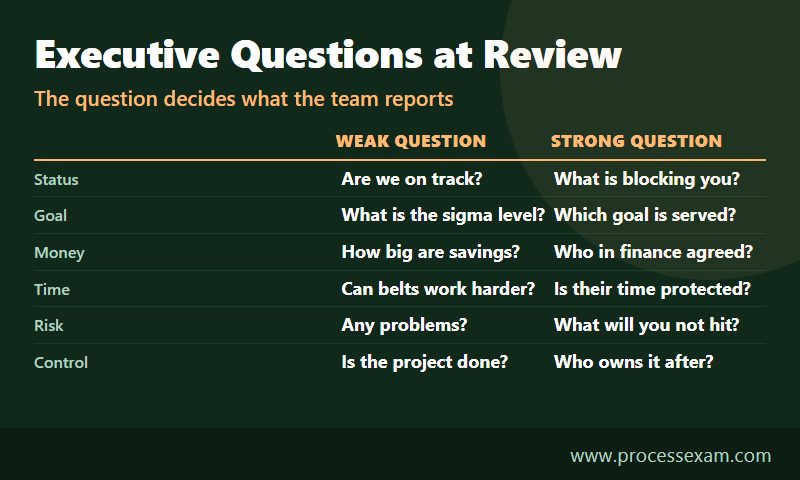
The comparison above pairs a common question with a sharper replacement. Four of the pairs deserve a closer look.
"Which goal is served?" instead of "what is the sigma level?"
A sigma level is a technical result. It says how often a process produces a defect, and it does not say whether the defect matters to a customer or to the year's targets. The goal question keeps the project pinned to something the business cares about and exposes the charter that drifted away from it.
"Who in finance agreed?" instead of "how big are the savings?"
Asking for a figure invites the most generous one. Asking who validated it brings the finance partner into the conversation and shows quickly whether the programme has one agreed definition of a saving. ASQ's Body of Knowledge distinguishes hard from soft dollars and lists cost of poor quality among the measures a Master Black Belt uses, so the distinction is exam material as well as practice.
"What will you not hit?" instead of "any problems?"
Nobody answers "any problems?" honestly in front of a senior audience. A question that assumes something will slip makes it safe to say what. The executive hears about the risk while it can still be managed, which is the whole reason to hold the review.
"Who owns it after?" instead of "is the project done?"
A project is done when the team says it is; an improvement is done when somebody else is running it and the measure holds. The ownership question forces the control plan into the conversation before the team disbands. If the owner's name cannot be given, the project is not ready to close, however good the slides look.
A useful rule for the sponsor is to ask no more than three questions per project and to write down what was decided. Three keeps the review short enough to survive a busy calendar, and the written decision is what a later audit, or a later executive, can check.
Which warning signs show that leadership support is fading?
Support fades in behaviour long before it fades in words, since few executives will say they have lost interest. The signs below can be read from calendars, minutes and wording. Each is more reliable when it appears twice, because one cancelled review is a busy week and three is a pattern.
| What you see | Likely cause | Conversation to have |
|---|---|---|
| Reviews moved, shortened or handed to a deputy | The programme has dropped down the executive's list | Offer a fixed fifteen-minute slot with a one-page agenda |
| Questions about cost have replaced questions about results | A budget squeeze, or doubt that the savings are real | Bring the validated figure and the finance signatory |
| Belts are recalled to routine work "for a few weeks" | Output targets outweigh the protected days | Show what each recalled belt's project stands to lose |
| The word "programme" gives way to "initiative" or "those projects" | The executive is distancing from the brand | Ask what outcome the executive wants to be known for |
| A new method or tool is announced without reference to the work already done | Attention has moved to the next fashion | Show how the new idea fits the existing pipeline |
| Project results never appear in company updates | Nobody outside the programme knows what it delivers | Supply two short stories with figures for the next briefing |
| Barriers stay open for months | Escalation goes to a person who cannot act on it | Escalate to the sponsor directly and name the delay |
Two of these carry extra weight. The first is the recall of belts, because it converts a statement of priority into a staffing decision, and staffing decisions are what employees believe. The second is silence about results. A programme whose gains are not told inside the company will be cut by the first executive who has not heard of them, however good the numbers are.
None of the signs proves bad faith. Most executives who drift away have simply been given a bigger job, a crisis or a merger to run. That is why the response is a conversation about the executive's own goals and not a complaint about the executive's attendance.
How does a Master Black Belt coach executives who are short of time?
The Master Black Belt sits between the programme and the leadership team, and ASQ gives that job a whole domain of its own. Its Certified Master Black Belt Body of Knowledge lists coaching executives and champions on scoping and resourcing, on reviews, on constancy of purpose and message, and on giving feedback. The graphic shows the five habits that follow from those topics.
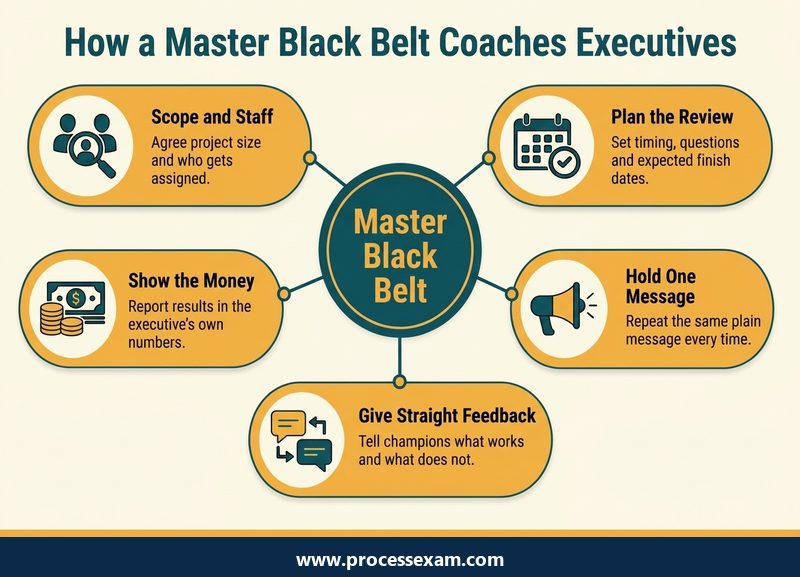
Scope and staff the work with them
Before any belt starts, the Master Black Belt sits with the executive or champion and settles how big each project will be and who will be assigned to it. Executives tend to want large scopes because large scopes promise large savings. The Master Black Belt's contribution is experience of how long such projects really take, offered as a choice: one project that finishes in five months, or one that is still open after two years.
Plan the review before it happens
A short briefing ahead of each review does more than the review itself. It tells the executive what the team will present, what decision is wanted and which two questions are worth asking. Executives who walk into a room prepared tend to attend again, since the experience was not a waste of an hour. The same briefing tells the team what the executive cares about, so presentations get shorter.
Keep one message, repeated
The Body of Knowledge uses the phrase "constancy of purpose" for the habit of repeating the same reason for the programme in the same plain words. Executives who change the explanation every quarter, from cost to quality to growth, leave staff unsure which one to believe. The Master Black Belt helps the leadership team agree a single sentence about what the programme is for and checks that it appears in every briefing.
Give feedback that an executive can use
Telling a senior leader that attendance is slipping is awkward, and it works best when it is tied to something the executive wants. "The two delayed projects are the ones tied to your customer-retention goal" will get a response that "you have missed reviews" will not. Feedback is easier to take when it comes with data, one specific request and a suggested way to fix the problem.
Report in the executive's numbers
Leaders think in revenue, margin, cost of quality and return on investment, and a Master Black Belt who reports in defects per million loses the room. The Body of Knowledge lists these financial measures under organisational performance metrics for that reason. Translate each project into one of them, agree the translation with finance, and the programme speaks a language the executive already uses to decide.
Use a change model for the harder conversations
The Body of Knowledge also names change management models, among them Kotter's eight steps and ADKAR, and expects candidates to describe techniques for gaining commitment from leadership and overcoming barriers. These models are less about theory than about order: build urgency, form a guiding group, show early wins, then reinforce. A sponsor who understands that order stops expecting the whole organisation to adopt the method after one announcement.
What can a project leader do when top management is not yet convinced?
Many programmes start in a department with little more than a manager's curiosity, and the first executive attention arrives only after something has worked. If that is your position, support from the top is not a precondition. It is something you can earn, and the route is well worn.
Start with a quick, visible win
Choose a problem that is small enough to finish in a few months and annoying enough that people will notice when it goes away. The first project is evidence, and evidence persuades executives faster than a presentation about the method. Keep it narrow: a slow approval step or a frequent billing error is better than a plan to transform a whole function.
Pick a team that wants the result
People who feel the pain will give up their time and tell their colleagues. A project aimed at a pain point the team has complained about for years will attract volunteers, and that gives the first project its energy. Avoid teams who were simply told to take part, as their reluctance will show in the results.
Leave the jargon at the door
Early on, describe the work in the department's own words: fewer reworked invoices, shorter waits, fewer calls from customers. Sigma levels, charters and control charts can arrive later, once people have seen the benefit. Technical vocabulary at the start makes a method look like an import from head office.
Be your own champion, and be honest about the numbers
When the project works, tell the story, internally first and then wherever the company listens, with the figure and the name of the person who validated it. Be careful about what you promise. Not every improvement produces a hard-dollar saving; some deliver time, fewer complaints or lower risk, and executives who expected cash and receive something else feel misled. Agree at the outset which kind of result the project is aiming at.
The aim is to turn a departmental experiment into a request from the top. Once an executive asks for the next project, you have the support this article started with, and the sponsor's duties above begin to apply.
Where does ASQ test executive leadership and coaching in the CMBB exam?
Leadership for deployment is a large part of ASQ's Certified Master Black Belt credential. In the Body of Knowledge, which ASQ publishes in its certification insert, executive roles sit under Organizational Competencies for Deployment, executive engagement under Project Portfolio Management, and the coaching of executives and champions under Coaching and Mentoring. The exam carries 100 scored multiple-choice questions out of 110 and a performance-based part, and the domains are weighted as follows.
| Domain | Scored questions |
|---|---|
| Enterprise-wide Planning | 20 |
| Organizational Competencies for Deployment | 20 |
| Project Portfolio Management | 15 |
| Training Design and Delivery | 10 |
| Coaching and Mentoring Responsibilities | 10 |
| Advanced Data Management and Analytic Methods | 25 |
Most of the leadership material is tested at the analyse, evaluate or create level, so recalling a definition is not enough. A question may describe a sponsor who has begun to miss reviews and ask what the Master Black Belt should do first, or give two charters and ask which should be cancelled. Working through the sponsor's duties above, with an example from your own workplace for each, is good preparation. Eligibility has two gates: ASQ requires a current Certified Six Sigma Black Belt and a portfolio review before registration, as its exam page explains. The figures below are as listed by ASQ.
| Exam detail | CMBB |
|---|---|
| Full name | ASQ Certified Master Black Belt |
| Exam code | CMBB |
| Vendor | ASQ |
| Number of questions | 110 |
| Duration | Total appointment time - 330 minutes Exam Time - 320 minutes |
| Exam fee | ASQ MEMBERS - $1,499 NON-MEMBERS - $1,599 RETAKES - $1,399 |
| Passing score | 550/750 |
Use the CMBB syllabus to see each topic area in the order ASQ sets them. When the leadership domains feel familiar, a run of the CMBB practice exam will tell you whether the case-style questions come as easily as the definitions.
Frequently Asked Questions
Why is top management support important in Six Sigma?
Executives control what a Black Belt cannot: which projects take priority, whether belts get protected time, and who clears barriers between departments. Without those decisions projects wait, teams shrink and savings go unvalidated. Visible leadership also tells staff the programme matters, which keeps volunteers and good project ideas coming.
What is the role of an executive sponsor in a Six Sigma project?
The sponsor ties the project to a business goal, releases people's time in writing, reviews progress at fixed points, removes barriers the team cannot clear and recognises results. The sponsor does not attend every meeting; the sponsor makes the decisions that only senior authority can make and records them.
What happens if top management does not support Six Sigma?
Reviews are postponed, belts are recalled to routine work, barriers stay open and savings are never validated, so the programme cannot show results. Executives then conclude it does not pay. Projects usually survive only where a local manager protects them, and the effort stays small and fragile.
How do you get top management buy-in for Six Sigma?
Deliver a small, visible win first: pick a problem the team already complains about, finish it in a few months and report the validated result in plain words. Avoid jargon, say whether the gain is cash, time or risk, and ask the executive which goal the next project should serve.
What does the CMBB exam cover about leadership and executives?
ASQ's Master Black Belt Body of Knowledge covers executive leadership roles and leadership for deployment, executive engagement in portfolio management, and coaching executives and champions on scoping, reviews, consistent messages and feedback. The exam has 110 questions, of which 100 are scored, plus a performance-based part.
- Six Sigma |
- ASQ Master Black Belt Test Questions |
- ASQ Master Black Belt Book |
- Master Black Belt Certification Cost |
- Master Black Belt Certification Requirements |
- ASQ Master Black Belt Sample Questions |
- Master Black Belt PDF |
- CMBB Question Bank |
- CMBB Body of Knowledge (BOK) |
- Master Black Belt Simulator |
- Master Black Belt Mock Exam |
- ASQ CMBB BOK PDF |
- CMBB Exam Questions Download |
- CMBB Test Questions |
- CMBB Handbook


