
Six Sigma and the Psychology of Change: Bringing People With You
Why does a Six Sigma project with clean data and a signed-off control plan still drift back to the old way within a few months? Usually because nobody planned for the people who have to work the new process. Statistics settle what to change; psychology decides whether anyone changes. This guide covers resistance, how individuals adjust, stakeholder analysis, communication and keeping the gain.
Ask a Black Belt what makes a deployment hard and the answer is rarely the statistics. It is the conversation after the analysis, when a team that did not take part in the project is asked to work differently on Monday. Six Sigma is a low-engagement method by design: a small group of trained Black Belts and Green Belts does the measuring, while the people who live in the process every day mostly watch. That gap is where good projects lose their results.
The pages below treat the human side of a project as a skill in its own right, with methods you can apply at each DMAIC phase. They assume you already know the basics of Six Sigma and want to know why improvements stall and what to do about it. One section near the end covers a formal change management qualification for readers who want a structured vocabulary for this work.
Why do people resist a process change that the data says is better?
Resistance is rarely stubbornness. It is usually a sensible reaction to something the project team has not yet explained. Five causes account for most of what practitioners see, and each calls for a different response.
Loss feels bigger than gain
Research on decision making, including the loss aversion work of Daniel Kahneman and Amos Tversky, shows that people weigh what they might lose more heavily than an equal gain. A new approval workflow that saves the company hours each week may cost one clerk the task she is known for. To her, the saving is abstract and the loss is personal. Name the losses honestly in your first conversation, and show what replaces each one.
Habit and competence
People who have run a process for years are experts at it. A change turns them back into beginners in front of colleagues. The reluctance that follows looks like resistance but is really protection of a hard-won skill. Training that leaves room to practise without an audience works better than a single classroom session.
Doubt about the evidence
Black Belts trust control charts and capability indices. Operators trust what they see on the floor. If your analysis says the main cause of defects is a step the team believes is fine, they will not accept the result until they have seen the data themselves. Walk the people who own the step through the data before you present it to their manager.
Fairness and trust
Staff watch who benefits. If the project removes work from one group and adds it to another with no explanation, the second group will see unfairness rather than efficiency. Previous initiatives matter as well: a team that watched three earlier programmes fade will wait for this one to fade too.
Fear for status or employment
Process improvement language is full of waste, defects and variation. People hear the same words applied to their own work. Where headcount is not at stake, say so plainly and early. Where it is, resistance will not respond to better slides, and the honest answer is a candid timeline and support for those affected.
The pattern across all five is the same: resistance is information. A question such as "What would have to be true for this to work for you?" turns it into design input, and the answers often improve the solution.
How do individuals move through a change, and where do DMAIC phases ignore it?
Change happens to individuals at different speeds, and a project plan that treats the organisation as one block will be wrong for most of them. Several well-known models describe the personal journey, and they agree on more than they differ.
Kurt Lewin, whose career is summarised on Wikipedia, described change as three stages: unfreezing the current way of working, moving to the new one, and refreezing so it holds. William Bridges separated the external change from the internal transition and described three zones: an ending, a neutral zone of confusion, and a new beginning. Curves adapted from Elisabeth Kubler-Ross show energy dropping into a dip after an announcement before it recovers. Prosci's ADKAR model asks whether each person has awareness, desire, knowledge, ability and reinforcement, and points out that a change stalls at the first element that is missing.
For a Six Sigma practitioner, the useful lesson is that DMAIC is a technical sequence while people move through their own sequence in parallel. The two are out of step more often than not. The team reaches the Improve phase excited about a solution, and the staff who must adopt it are still at the stage of asking why anything is changing at all. Planning the people work means asking, at every phase, what each group probably feels and what they need from you.
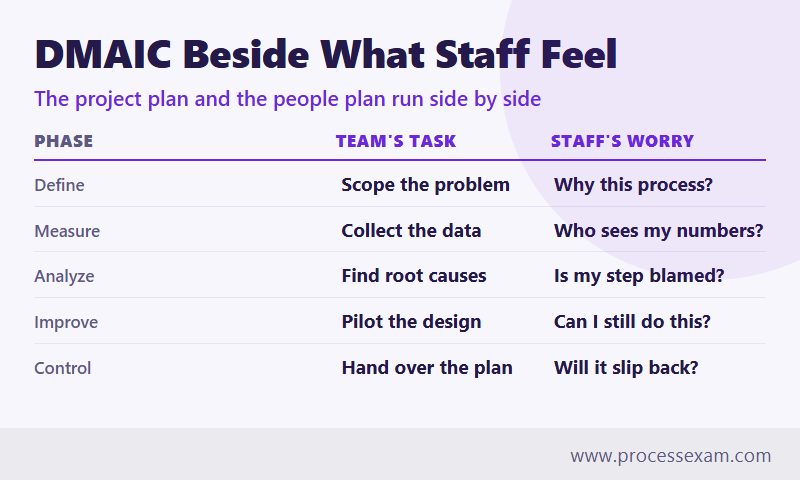
| DMAIC phase | What the project team is doing | What staff are probably feeling | What the leader should do |
|---|---|---|---|
| Define | Scoping the problem, drafting the charter | Curiosity and suspicion: why this process, why now? | Explain the business reason and who sponsors it before staff hear it second-hand |
| Measure | Collecting data, timing steps, mapping the process | Being watched, with a fear that the data will be used against them | Say what the data will be used for and who will see it |
| Analyze | Testing root causes with statistics | Defensiveness if a cause points at their step | Review the findings with the process owners before any wider briefing |
| Improve | Piloting and rolling out the new design | Loss of competence, doubt, unease about the neutral zone | Involve operators in the pilot, train in the workplace, fix problems fast |
| Control | Handing over a control plan and dashboards | Relief, fatigue, a pull back to old habits | Reinforce, review and recognise adoption, not only results |
The table is a planning aid, not a prediction. Individuals differ, and a person may be enthusiastic in Define and anxious by Improve. What matters is that you ask the question for each group at each phase rather than assuming the answer.
Everett Rogers' diffusion work, outlined on Wikipedia's diffusion of innovations page, adds a useful reminder: in any group, a small share adopt early, a larger middle follows once it sees peers doing so, and a minority comes last. Do not wait for unanimity before moving. Win the early adopters, make their success visible, and the middle will follow.
How do you find out who supports, opposes or is undecided before the Improve phase?
Stakeholder analysis answers that question while you can still act on it. It is a short exercise, not a document for the filing cabinet, and it belongs in the Define phase with a refresh at Analyze. The overview of stakeholder analysis describes the general technique.
Step 1: list everyone the process touches
Go beyond the project charter. Include process operators, their supervisors, upstream suppliers of inputs, downstream customers of outputs, support functions such as IT and finance, and anyone whose budget, headcount or targets would move. A process map with swim lanes is a quick way to find groups you would have missed.
Step 2: rate influence and attitude
For each group note how much influence they have over the result and where they currently stand: advocate, supportive, neutral, doubtful or opposed. A simple grid with influence on one axis and attitude on the other is enough. The groups in the high-influence, doubtful corner need your attention first, because a quiet veto from them costs more than open resistance from a low-influence group.
Step 3: ask why, in person
Fifteen-minute conversations with a handful of people from the doubtful groups teach more than any survey. Ask what works in the current process, what annoys them, and what would worry them about a change. Write down what they say in their own words. Those words often become the headlines of your later communication.
Step 4: choose a response for each group
- Advocates: ask them to speak in team meetings and to show a colleague the new method.
- Supportive but low influence: keep them informed and use them as early pilot participants.
- Neutral, high influence: brief them in person, share the data and ask for an explicit commitment.
- Doubtful: involve them in design decisions and take their objections seriously in writing.
- Opposed: understand the root of the opposition before trying to persuade. If it is a legitimate risk, change the plan.
Revisit the grid at each tollgate. A group that moved from doubtful to neutral is evidence that your engagement is working, and a group that moved the other way is an early warning you should not ignore.
What gets front-line staff to own the solution instead of merely obeying it?
Ownership comes from involvement in the work, not from information about it. This is the part of the older thinking on Six Sigma and change that still holds up: if only a few Black Belts are engaged, the organisation does not own the improvement, and it is dropped when the Belts move on.
Use structured participation, not suggestion boxes
General Electric made a method known as Work-Out popular in the 1990s: a facilitated session in which a cross-section of employees, with a sponsor present, takes a specific problem, proposes solutions and gets a yes or no from management on the spot. The format matters more than the name. Tools such as structured brainstorming, idea prioritisation and action planning let ordinary staff convert their knowledge into decisions within days. Used on problems where the process is still well short of a high sigma level, this approach clears the simple causes quickly. It leaves the Black Belt free to apply deeper statistical analysis to the stubborn problems that remain.
Pilot with the people who will run it
A pilot run by the project team proves the design works. A pilot run by the operators proves it can work with the people who will have to live with it. Let the operators adjust the procedure during the pilot, record what they change and why, and bring that back to the design. Local adjustments can mean some variation between sites, so set clear boundaries: what must be identical everywhere, such as the critical-to-quality steps, and what a team may adapt. The ownership you gain is generally worth more than the small variation you allow.
Give Green and Yellow Belts a role beyond the project
Green Belts and Yellow Belts live closer to daily work than a full-time Black Belt does. Ask them to coach colleagues through the new method, to collect early feedback and to flag problems to the process owner. Their credibility with peers is something the project team cannot manufacture.
Let sponsors do what only sponsors can
Front-line staff watch what leaders do, not what they say. A sponsor who attends the pilot review, asks about adoption and removes obstacles shows that the change matters. A sponsor who only signs the charter shows the opposite, and the project team will not be able to correct that impression.
How should you communicate while a Six Sigma project is running?
Poor communication fills the gap with rumour. Good communication is planned like any other project deliverable, with an audience, a message, a channel and an owner for each item.
Start with the reason for the change rather than the method. People can accept a new process if they understand the problem, the cost of leaving it alone and what you are asking of them. Avoid arriving with jargon: terms such as sigma level, DPMO and tollgate mean something to the team and little to the people on the floor. Describe results in the units they already use, such as orders returned, hours of rework or days to approve a request.
| Audience | What they need to hear | Best channel |
|---|---|---|
| Senior sponsors | Progress against the charter, risks, decisions needed | Short tollgate reviews, one-page summary |
| Middle managers | What changes for their team, what is asked of them, how their targets are protected | Small briefings before any wider announcement |
| Process operators | Why, what will be different next week, where to get help | Team huddles, demonstrations at the workplace |
| Upstream and downstream partners | Changes to inputs and outputs, dates, contact person | Direct conversation and a written note |
Three habits make the plan work. First, talk to middle managers before their teams: nothing damages trust faster than a manager learning about a change from an employee. Second, make communication two-way by building in a place for questions and answering them in the same channel. Third, repeat yourself. People who have not yet decided whether the change affects them may not absorb the first message, so say the key points again in different forms across several weeks.
Bad news belongs in the plan too. If the pilot exposed a design flaw, say what went wrong and what you are doing about it. Teams forgive honest corrections and remember concealed ones.
How do you stop the old process creeping back after the project closes?
The Control phase is where most projects declare victory and most losses begin. Lewin's idea of refreezing is useful here: a new way of working needs support until it becomes the normal way, and that takes more than a control chart.
Consider a typical case, described here as an illustration rather than a real client. A finance team cuts the time to approve supplier invoices from nine days to four by removing a duplicate review. For three months the results hold. Then a busy period arrives, a manager reinstates the extra review "just this once", and within weeks it is back. The statistics were sound. What was missing was an owner for the process, a reason for the new design that the manager remembered, and a signal that skipping the new step would be noticed.
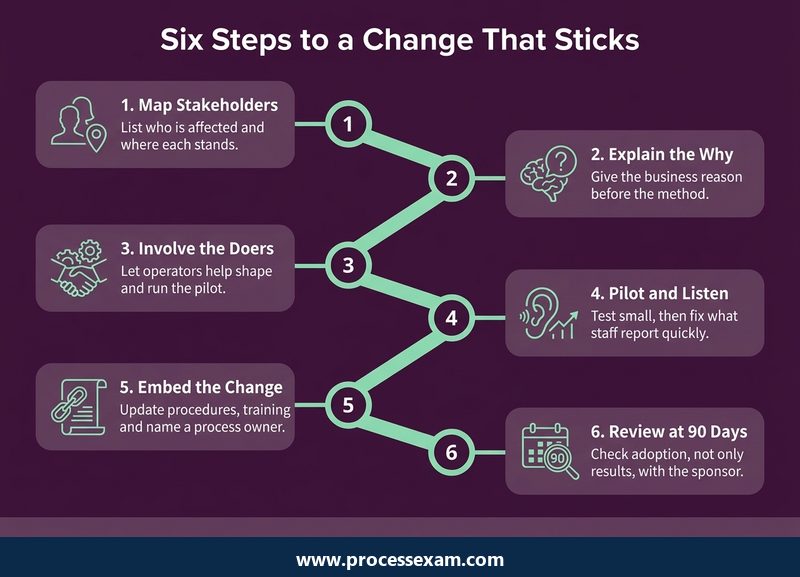
Four actions make that scenario less likely:
- Name a process owner with the authority to say no to shortcuts, and put the role in a job description, not an email.
- Embed the change in routines. Update the standard operating procedure, the training for new joiners and the audit checklist, so the new way is the default and not a favour.
- Measure adoption as well as results. A chart of cycle time tells you whether the process works. A count of how many cases followed the new steps tells you whether people are using it.
- Recognise the behaviour. Praise the teams who keep to the new method when it is inconvenient and share their stories with their peers.
Schedule a review ninety days after handover and again after six months, with the original sponsor attending. Reviewing at a fixed date makes the follow-up a commitment and stops it from being forgotten when the next project begins.
What to do when a gain starts to slip
Slippage is a signal, not a failure. Return to the stakeholder grid and ask which group moved. Talk to that group before you reach for a new control chart. Often the root cause is a legitimate difficulty that the original design did not foresee, such as a seasonal workload or a system limitation, and the right response is a design update rather than more enforcement.
Where does a formal change management qualification fit for a Six Sigma practitioner?
Six Sigma belts study measurement, statistics and process control. Few receive formal training in how people adjust to change, even though they spend much of their working time on it. A change management qualification gives a shared language for the work described above: stakeholders, impact, communication, resistance and reinforcement. It does not replace the belt; it fills a gap beside it.
One recognised option is the APMG International Change Management qualification. At the time of checking in October 2026, APMG runs the third edition, known as CM3, launched in April 2024, and presents the Foundation level on its Change Management certification page. Foundation is the first of two levels; the second is Practitioner. The Foundation paper is multiple choice, and the facts are below.
| Exam detail | Change Management Foundation |
|---|---|
| Full name | APMG International Change Management - Foundation |
| Exam code | Change Management Foundation |
| Vendor | APMG International |
| Edition | Third edition (CM3) |
| Number of questions | 50 |
| Duration | 40 minutes |
| Passing score | 50% |
| Exam fee | USD $406 |
A belt with solid project experience will recognise much of the Foundation ground already: stakeholder mapping, communication planning and the effect of change on individuals. What is new for many is the vocabulary and the model-based way of describing it. For a first look at the style of question, the sample questions for the Foundation exam are a quick way to test your reading.
Once you decide the qualification is worth pursuing, a run through the Change Management Foundation practice exam will show how much of the change vocabulary you already carry from project work. This article covers the people side of improvement projects only; the syllabus and the study plan for the exam itself are in a separate guide on this site.
A short checklist for your next project
- In Define, list stakeholders and rate their influence and attitude.
- In Measure, tell staff exactly how the data will be used.
- In Analyze, share findings with the process owners first.
- In Improve, run the pilot with the operators and agree what can vary.
- In Control, name an owner, track adoption and schedule the 90-day review.
None of these steps needs a special budget. They need the project leader to treat the human side of change as part of the method, with the same planning discipline as the statistics.
Frequently Asked Questions
Why do Six Sigma improvements often fail to stick?
Most slip because the people running the process were not engaged, nobody owns the new method, or adoption was never measured. The statistics may be sound while old habits return under pressure. Naming a process owner, embedding the change in procedures and reviewing at 90 days all help.
How does the psychology of change relate to DMAIC?
DMAIC is a technical sequence, while people move through their own emotional sequence in parallel. Applying psychology means asking at each phase what each group probably feels and needs, then planning communication, involvement and reinforcement accordingly rather than waiting until the Improve phase.
What is stakeholder analysis in a Six Sigma project?
It is a short exercise listing everyone the process touches, rating their influence and attitude, and choosing a response for each group. It is usually done in Define and refreshed at Analyze, so that doubtful, high-influence groups are engaged before the solution is rolled out.
How do you reduce resistance to a process change?
Treat resistance as information. Explain the reason for the change, name what people will lose and what replaces it, involve operators in the pilot, and answer questions in person. Resistance usually reflects loss, doubt about the evidence or lack of trust, and each calls for a different response.
Is a change management qualification useful for Six Sigma belts?
It can be. Belts study measurement and control, but few learn formally how people adjust to change. A qualification such as the APMG Change Management Foundation gives a shared vocabulary for stakeholders, communication and reinforcement, and complements belt skills rather than replacing them.
- APMG International Change Management Foundation Exam Questions |
- APMG International Change Management Foundation Question Bank |
- APMG International Change Management Foundation Questions |
- APMG International Change Management Foundation Study Guide |
- Change Management Foundation Certification |
- APMG International Change Management Foundation Level Questions |
- APMG International Change Management Foundation Level Question Bank |
- APMG International Change Management Foundation Level Study Guide |
- Change Management Foundation Level Certification |
- APMG International Change Management Foundation Sample Questions |
- Change Management Foundation PDF |
- APMG International Change Management Foundation Level Exam Questions |
- APMG International Change Management Foundation Level Sample Questions |
- Change Management Foundation Practice Test |
- APMG International Change Management Foundation Quiz |
- Change Management Foundation Questions |
- Change Management Foundation Sample Exam |
- Change Management Foundation Test Questions


