
SHRM Certified Professional: SHRM-CP Certification Cost, Requirements & Top Preparation Tips
Updated on 21 September 2026. What’s new: SHRM-CP exam fees corrected to $399 for SHRM members and $499 for non-members.
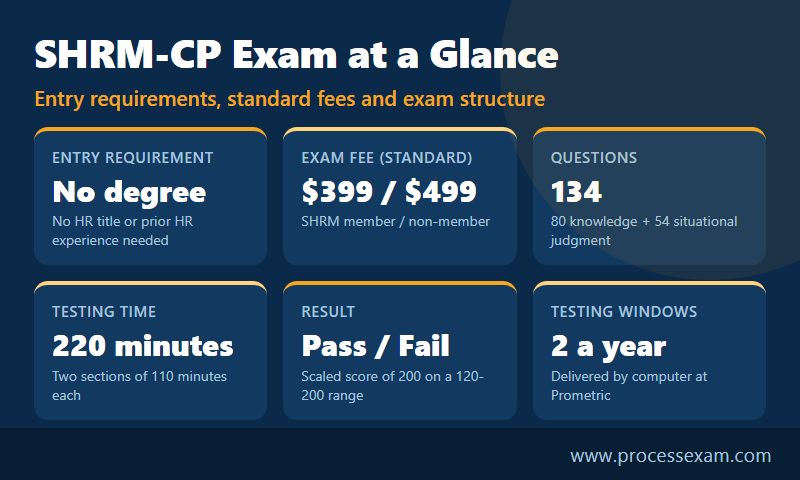
No, you do not need an HR degree to sit the SHRM-CP, and you do not need an HR job title either. SHRM sets no education minimum and no experience minimum for this credential; a basic working knowledge of HR practice is recommended, not required. That makes money, not eligibility, the first real gate. The standard exam fee is USD $399 for SHRM members and USD $499 for non-members, and applying before the early-bird deadline brings that down to USD $350 and USD $450.

That combination is unusual. Most professional certifications at this level ask for a degree, a set number of years in the field, or both, and they check before they take your money. SHRM checks nothing of the sort for the SHRM Certified Professional. The door is open; what stands behind it is a 134-question paper that half the time asks not what you know but what you would do.
This guide is about getting through that door well. It covers who can apply, what the whole thing costs once the application fee and the avoidable extras are counted, how the application windows work, what the exam is built from, and how to prepare so that you pay the fee once. Everything about the credential's senior sibling and about life after you pass is deliberately left aside here.
Can you take the SHRM-CP without an HR degree or an HR job title?
Yes. SHRM's position is stated plainly in its eligibility criteria for SHRM certification: candidates for the SHRM-CP are not required to hold an HR title and do not need a degree or previous HR experience to apply. A basic working knowledge of HR practices and principles is recommended, and that is the strongest word SHRM uses.
Three further points catch people out, all of them in your favour:
- SHRM membership is not an eligibility requirement. Membership changes what you pay, not whether you may apply.
- You do not have to be employed when you apply. Candidates between jobs, on a career break, or still studying are eligible.
- Part-time, hourly and consulting work all count when experience matters. For the SHRM-CP it does not, but it matters for the other credential, and the same definitions apply.
The one thing that does decide your answer is the kind of HR work you do. SHRM designed the SHRM-CP exam to assess competency at the operational level: implementing HR policies, supporting day-to-day HR functions, and serving as an HR point of contact for staff and stakeholders. Its senior counterpart, the SHRM-SCP, is for strategic-level work and does carry a three-year requirement, which is the single sentence this article will spend on it.
Who actually sits this exam
In practice the SHRM-CP suits four groups. HR generalists and coordinators who have been doing the work for a year or two and want it verified. Managers outside HR whose role has quietly absorbed hiring, onboarding and employee relations. Career changers moving into HR from operations, recruitment, payroll or office management. And students and recent graduates, who have their own reduced fee and their own reason to be careful about timing.
The eligibility review nobody expects
Because the SHRM-CP asks for no experience, most applicants never meet a verification request. SHRM does, however, run random reviews of applications during each testing window. If yours is selected, you are notified by email and have ten business days to send the documentation requested, and you cannot continue until you do. Missing that deadline, or misrepresenting anything on the form, means the application is denied and the fees are forfeited. Answer the application honestly, keep it simple, and this is a non-event.
What does the SHRM-CP certification actually cost?
The headline number depends on two things: whether you are a SHRM member when you submit the application, and whether you apply during the early-bird period or after it. Both are decided by you, and together they are worth a hundred dollars.
Here are the individual rates SHRM publishes for the SHRM-CP, in US dollars:
| Rate | Member early bird | Member standard | Non-member early bird | Non-member standard |
|---|---|---|---|---|
| SHRM-CP | $350 | $399 | $450 | $499 |
| Student rate | $150 | $199 | $250 | $299 |
| Military rate | $320 | $369 | $420 | $469 |
The standard member and non-member figures are the ones quoted throughout this article and on our exam pages. Every rate already contains a non-refundable application fee, which is why the standard rate is higher than the early-bird one rather than simply later: every rate includes a $50 non-refundable application fee, and the standard rate adds a $49 standard-deadline fee on top, which is the whole of the $350 to $399 step. SHRM keeps the current schedule on its exam options and fees page, and rates move between years, so confirm the figure before you pay.
The costs that are not in the headline
Three fees exist purely to undo a decision, and all three are avoidable:
- Transfer, $150. Moving your application to the next testing window. One transfer per application, next window only, and you must first cancel the appointment with Prometric, which charges its own fee.
- Reset, $100. One reset per testing window.
- Appointment cancellation or reschedule, $45 or $60. Paid directly to Prometric. More than 30 days ahead it is $45; between 29 and five days ahead it is $60. Inside five days you cannot reschedule at all.
There is also a $100 results-review fee if you do not pass and want the result checked, which the section on scoring explains, and no fee at all for a test accommodation. What none of the rates covers is study material, a prep course, or travel to the testing centre. Budget those separately, because for most candidates preparation costs more than the exam.
One rule underpins all of this: SHRM certification fees are non-refundable. You are not buying an attempt you can defer casually, you are reserving a seat in a specific window. That is the practical argument for applying only when your study plan is already written.
When do you apply, and which testing window should you aim for?
SHRM tests twice a year, and this is where candidates lose either money or months. Each testing window has an early-bird application period and a standard application period, and the application period closes well before the window itself ends. You are choosing an application deadline, not an exam date.
The next testing window, as SHRM's exam options and fees page showed it when checked in September 2026:
| Window | Early-bird application | Standard application | Testing |
|---|---|---|---|
| Winter 2026-27 | June 3 - Aug. 31, 2026 (closed) | Sept. 1 - Dec. 24, 2026, 11:59 p.m. ET | Dec. 1, 2026 - Feb. 15, 2027 |
Read that row backwards from the date you want to test. The early-bird saving for this window ended on 31 August, so an application submitted now is charged the standard rate, and it has to be in by 11:59 p.m. Eastern Time on 24 December. Miss that and the next chance to test is the spring 2027 window, whose dates SHRM had not published when this was checked, so watch the same fees page before you plan past February.
Once the application is approved and paid, SHRM emails an Authorization to Test letter and you schedule the appointment with Prometric yourself. Do it the day the letter arrives. Seats in the popular weeks go first, and SHRM's own advice is to search a date range of at least seven to ten days rather than fixing on one morning. Applying early and booking late is the most common way to end up testing on an inconvenient date you then pay to change.
What does the SHRM-CP exam cover, and how is it weighted?
The exam is built from the SHRM Body of Applied Skills and Knowledge, the SHRM BASK. If you studied from older material you may know it as the BoCK, the Body of Competency and Knowledge; the name changed, and any guide still using the old one is out of date. The BASK sets out nine behavioral competencies, grouped into three clusters, and fourteen HR functional areas grouped into three knowledge domains. SHRM publishes it free on its SHRM BASK page, and it is the first thing to download.
Roughly half the scored items come from the behavioral competency clusters and half from the HR knowledge domains. The published weightings are these:
| Area | Type | Weighting |
|---|---|---|
| Leadership | Behavioral competency cluster | 19% |
| Business | Behavioral competency cluster | 17.5% |
| Interpersonal | Behavioral competency cluster | 13.5% |
| People | HR knowledge domain | 19% |
| Organization | HR knowledge domain | 18% |
| Workplace | HR knowledge domain | 13% |
Two things follow from that table. First, no area is small enough to skip: the lightest, Workplace, still carries more weight than a rounding error, and the heaviest, People and Leadership, are only six points above it. A candidate who is strong in three areas and absent in three does not pass. Second, the behavioral half is the half most candidates underestimate, because it cannot be revised the way a list of employment-law terms can.
By item type the split is different again: about half of the paper is HR-specific knowledge, about forty per cent is situational judgment, and the remaining tenth is foundational knowledge drawn from the competency clusters. If you want the areas broken out topic by topic against our own exam pages, the SHRM-CP syllabus breakdown lists them with the same weightings.
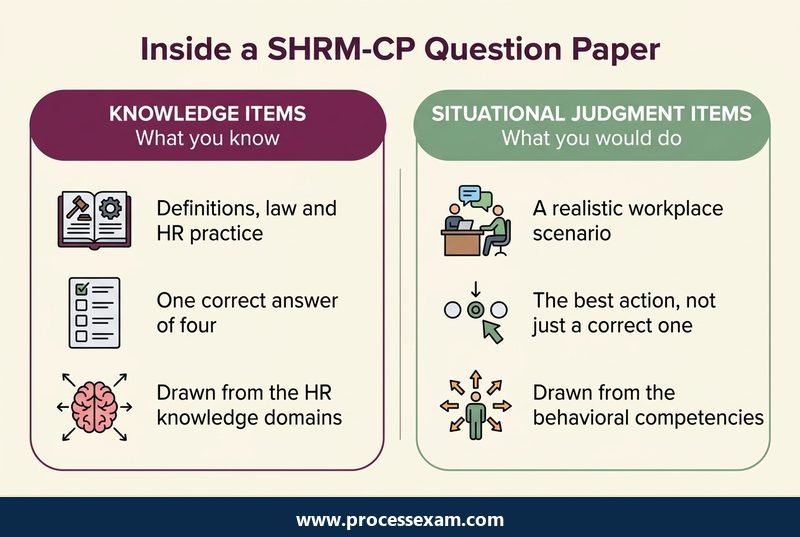
Knowledge items and situational judgment items are different exams in one paper
Knowledge items test understanding or application of factual information: one question, four options, one of them correct. Some draw on the HR knowledge domains, others on the competency clusters.
Situational judgment items do something else entirely. You are given a realistic work scenario and asked to choose the best of several possible actions. More than one option will usually work in real life. Credit goes only to the most effective course of action, which means the skill being tested is judgment, not recall. This is why experienced practitioners sometimes score better than candidates who memorised more, and why reading alone does not prepare anyone for this paper.
What happens inside the 220 minutes of testing time?
Here is the exam in Master's figures, which are the ones our exam pages use:
| Exam detail | SHRM-CP |
|---|---|
| Exam code | SHRM-CP |
| Certification | SHRM Certified Professional (SHRM-CP) |
| Vendor | SHRM |
| Category | Human Resources |
| Number of questions | 134 |
| Duration | 220 minutes |
| Exam fee | Member - $399, Non-member - $499 (standard rate) |
| Passing score | Pass / Fail (200 Scaled Score) |
Those 220 minutes are not one block. The paper runs as two independently timed sections of up to 110 minutes each. Unused minutes in the first section are not added to the second, and once you leave a section you cannot go back to it. Plan two halves, not one marathon, and finish each half with a few minutes in hand rather than banking time you will never be given.
The appointment itself is four hours, because around the testing time sit a two-minute confidentiality reminder, a ten-minute introduction and tutorial, and an eight-minute survey at the end. Clear the half day.
Of the 134 questions, 24 are unscored field-test items that SHRM is trialling for future papers. They are mixed randomly through the exam and you cannot tell them apart from the scored ones, so the only sane response is to treat every question as if it counts. It also means an unusually odd question is not necessarily a sign that you have misunderstood the syllabus.
Exam day logistics
The exam is delivered by computer at Prometric testing centres. Bring an unexpired, original government-issued photo ID with a signature, and make sure the name on it matches the name on your Authorization to Test letter. A mismatch is not negotiable at the desk; candidates are turned away for it. Lockers are provided for phones, bags and jackets, and wearable technology, smartwatches and earbuds are not allowed in the room.
How do you prepare for the SHRM-CP and pass on the first attempt?
A first-attempt pass comes from three habits: study the BASK rather than a summary of it, practise situational judgment separately from knowledge, and rehearse the two-section clock before exam day.
1. Start with the BASK, not with a course
Download the SHRM BASK and read the exam specifications and proficiency indicators before you buy anything. Proficiency indicators describe what SHRM expects an HR professional to be able to do, and they are effectively the answer key to how situational judgment items are marked. Highlight the indicators that describe work you have never done; that list is your syllabus.
2. Build a plan around the weightings, not around your comfort
Give each of the six areas study time roughly in proportion to its weighting, then add extra to whichever ones your first practice attempt exposes. Eight to twelve weeks at six to eight hours a week suits most working candidates. Fix the sessions in the calendar, because the application deadline is fixed and the fee is non-refundable.
3. Practise the two question types in different ways
Knowledge items respond to conventional revision: definitions, frameworks, employment practice, structured notes, spaced repetition. Situational judgment items do not. For those, read the scenario, decide your action before you look at the options, then compare. When your choice differs from the marked answer, work out which competency the marked answer serves better. That reflection is the practice.
4. Use SHRM's own sample questions early
SHRM publishes sample SHRM-CP questions covering both item types. They are not a mock exam and performance on them predicts nothing, but they show you the house style of the scenarios, which is worth seeing in week one rather than week ten.
5. Take full-length, timed practice under the real clock
Reading about pacing does not create pacing. Sit a complete paper, split into two timed halves, with no going back between them, and see what your accuracy looks like at minute 100 of each section. When you want that rehearsal before you commit to a window, a timed SHRM-CP practice test will show you where your score sits today and which of the six areas is quietly costing you marks.
6. Choose one structured resource and finish it
SHRM's own preparation options are the self-study Certification Prep System, which was called the SHRM Learning System until recently, and the instructor-led Certification Preparation+ course. Whichever route you take, finish one resource rather than sampling three. Candidates who collect materials tend to cover the easy areas repeatedly and the hard ones never.
Which mistakes cost candidates their first attempt?
The failures cluster, and the pattern is consistent:
- Treating the behavioral half as common sense. Situational judgment is roughly forty per cent of the paper and is marked against SHRM's proficiency indicators, not against what worked at your last employer.
- Studying from BoCK-era material. The framework is the BASK now. Old guides, old acronyms and old competency lists send you to the wrong content.
- Applying before studying. The fee is non-refundable and the transfer costs $150. Write the plan, then apply.
- Banking time in section one. Unused minutes do not carry into section two, and you cannot return to a finished section.
- Ignoring three of the six areas. The lightest area is 13%. There is no safe one to skip.
- Booking the appointment late. Approval is not a seat. Schedule as soon as the Authorization to Test letter arrives.
- Turning up with the wrong name on the ID. It must match the letter exactly, and the rule is enforced at the door.
How is the SHRM-CP scored, and what happens if you do not pass?
Results are reported as scaled scores on a range of 120 to 200. Every candidate who passes receives the maximum, 200, which is why Master records the result simply as Pass / Fail with a 200 scaled score. There is no percentage to chase and no public pass mark to reverse-engineer; the only useful target is consistent accuracy across all six areas in timed practice.
You leave the testing centre with a preliminary pass or did-not-pass decision on the day. Two to three weeks later SHRM emails you to collect the official result from the My Resources tab of the SHRM Certification Portal. Results are never given out by email, phone or fax, so nobody at SHRM will tell you over the phone.
With the official result comes a Candidate Score and Feedback Report: your scaled score plus a diagnostic graph showing how you performed across the three behavioral competency clusters and the three HR knowledge domains. If you passed, it points to the areas worth developing next. If you did not, it is the most valuable page you will read, because it tells you exactly where the marks went.
Retaking the exam
You cannot retest in the same window. To try again you apply as a new candidate in a future testing window and pay the full fee again; there is no limit on how many times you may do that. Plan the retake around the feedback report and around the application deadline for the window you want, not around how soon you feel ready.
If you believe the result itself was wrong, SHRM offers a results review for $100, requested within 30 days of the official result being issued. Be realistic about it: SHRM states that changes from a review rarely occur and that none have occurred in the last eight years. For almost everyone the better $100 is spent on preparation for the next window.
Is the SHRM-CP worth what it costs?
For an HR professional at the operational level, the arithmetic is straightforward. The credential costs a few hundred dollars and a few months of evenings, and it converts experience that currently lives on your CV as a job description into something an employer can verify. Because SHRM sets no degree requirement, it is also one of the few recognised credentials that lets a capable practitioner without an HR qualification put a professional designation after their name. The exam is the barrier, not the paperwork, and the exam is passable on the first attempt by anyone who studies the BASK, practises both question types, and respects the clock.
Frequently Asked Questions
Do you need a degree or HR experience to take the SHRM-CP exam?
No. SHRM states that SHRM-CP candidates are not required to hold an HR title and do not need a degree or previous HR experience to apply. A basic working knowledge of HR practices and principles is recommended. SHRM membership is not required either, and you need not be employed when you apply.
How much does the SHRM-CP certification cost?
The standard exam fee is USD $399 for SHRM members and USD $499 for non-members, and early-bird applicants pay $350 and $450. Student and military rates are lower. Every rate includes a non-refundable application fee, and none of them covers study material or travel to the testing centre.
How hard is the SHRM-CP exam?
It is demanding rather than obscure. Around forty per cent of the paper is situational judgment, where several answers would work in practice but only the most effective one earns credit. Candidates who revise definitions but never rehearse scenario judgment are the ones most likely to fall short.
How many questions are on the SHRM-CP exam and how long is it?
The SHRM-CP has 134 multiple-choice questions and 220 minutes of testing time, split into two independently timed sections of up to 110 minutes. Of the 134 questions, 80 are knowledge items and 54 are situational judgment items, and 24 unscored field-test items are mixed in.
What is the passing score for the SHRM-CP exam?
Results are reported as scaled scores between 120 and 200, and every candidate who passes receives the maximum score of 200, so the result is effectively pass or fail. You get a preliminary decision at the testing centre and the official score report two to three weeks later.
- SHRM Certified Professional Exam Questions |
- SHRM Certified Professional Question Bank |
- SHRM Certified Professional Questions |
- SHRM Certified Professional Study Guide |
- SHRM-CP Quiz |
- SHRM-CP Certification |
- SHRM-CP Questions |
- SHRM-CP Practice Test |
- SHRM-CP Study Guide Material |
- SHRM-CP Sample Exam |
- Certified Professional Certification |
- SHRM Certified Professional |
- SHRM Certified Professional Book |
- Certified Professional Certification Cost |
- Certified Professional Certification Requirements |
- SHRM Certified Professional Sample Questions |
- SHRM-CP Exam Questions Download |
- SHRM-CP Test Questions |
- Certified Professional PDF |
- SHRM-CP BASK


