
CIS-ITSM Exam: Domains, Prerequisites and Cost Explained
Updated on 1 October 2026. What’s new: prerequisites corrected: ServiceNow now lists CIS Data Foundations as required before you register, and the exam is booked through Pearson VUE.
CIS-ITSM stands for ServiceNow Certified Implementation Specialist - IT Service Management. The exam has 60 multiple-choice questions, runs 90 minutes, costs USD $450 and reports only Pass or Fail. Three quarters of the marks come from three areas: Incident, Change, and Service Catalog and Request Management, at 25 percent each. This guide covers all six domains, the prerequisite and a study plan.
The credential is for people who set up ServiceNow ITSM for an organisation rather than just use it: consultants, partner engineers and senior platform owners who decide how incidents are prioritised, how changes are approved and how requests are fulfilled. The exam is therefore less about where a button is and more about which configuration choice fits a described business situation.
One detail changed since this article was first written. ServiceNow now asks candidates to hold the Data Foundations credential before they register, and exams are booked through Pearson VUE. The sections below explain both, and they show where to confirm the details yourself before you spend USD $450.
What does the CIS-ITSM exam ask of a candidate?
It asks you to behave like the implementer in the room. Each question describes an organisation, a requirement or a problem, and you choose the configuration, design or next step that fits. Because the platform is the same one you may use every day, experienced administrators tend to feel at home with the wording, but the exam checks why an option is right, not only that it exists.
These are the exam facts as held in the exam sheet we maintain for this credential.
| Detail | CIS-ITSM |
|---|---|
| Full name | ServiceNow Certified Implementation Specialist - IT Service Management |
| Exam code | CIS-ITSM |
| Vendor | ServiceNow |
| Number of questions | 60 |
| Duration | 90 minutes |
| Exam fee | USD $450 |
| Passing score | Pass / Fail |
| Delivery | Pearson VUE |
Ninety minutes for sixty questions leaves ninety seconds each. That is comfortable for short configuration questions and tight for the long scenarios, so aim for about a minute on the easy ones and bank the time for the multi-paragraph situations. ServiceNow keeps the live exam page, registration route and any voucher arrangements on the ServiceNow University exam page. Read it on the day you book, because that page, not any article, is what ServiceNow stands behind.
Is the CIS-ITSM exam proctored?
Yes. Registering is the payment step, and ServiceNow then passes you to Pearson VUE, where you choose a test centre or an online sitting through OnVUE with a proctor watching by webcam. From the day you register you have 90 days to schedule and complete the exam; miss that and the registration expires, so you pay the full fee again. Older descriptions of this exam named a different delivery partner, so do not rely on them.
Do you need Data Foundations before you can book it?
ServiceNow's exam listing states that candidates must hold the Certified Implementation Specialist - Data Foundations (CMDB and CSDM) credential, known as CIS-DF, before registering. That is a change. Earlier versions of this credential path asked for the System Administrator certificate, a record of end-to-end implementations and scripting experience, and that is what this page used to say.
ServiceNow's blueprint for this exam, updated January 2026, states the rule without qualification: you must hold the Data Foundations (CMDB and CSDM) certification before you register for CIS-ITSM. Late in 2025 the requirement was briefly relaxed, so some candidates sat ITSM first. If that is you, check the notices in your ServiceNow University account for when Data Foundations has to be added to keep the credential.
The practical advice is short:
- Open the official exam page and read the prerequisite line as it stands today.
- If you hold neither credential, plan Data Foundations first. Its content (configuration items, the Common Service Data Model, identification and reconciliation) also helps in the ITSM exam, where a change or incident record points at a configuration item.
- If you already hold CIS-ITSM, check the deadline for adding Data Foundations that ServiceNow gives certified holders, and put it in your calendar.
- Do not assume the System Administrator badge alone is enough, even though it is still the sensible grounding for platform work.
None of this changes the exam content, which is the same set of six ITSM domains whichever route got you in.
How are the 60 questions shared across the six domains?
The blueprint divides the exam into six domains with fixed weights. They add up to 100 percent, and three of them are worth a quarter each. Our CIS-ITSM syllabus page lists the same domains and weights, so you can read them there beside the topic breakdown.
| Domain | Weight | Roughly how many of 60 questions |
|---|---|---|
| Incident Management | 25% | 15 |
| Change Management | 25% | 15 |
| Service Catalog and Request Management | 25% | 15 |
| Problem Management | 15% | 9 |
| Service Portfolio Management | 5% | 3 |
| Configuration Management Database | 5% | 3 |
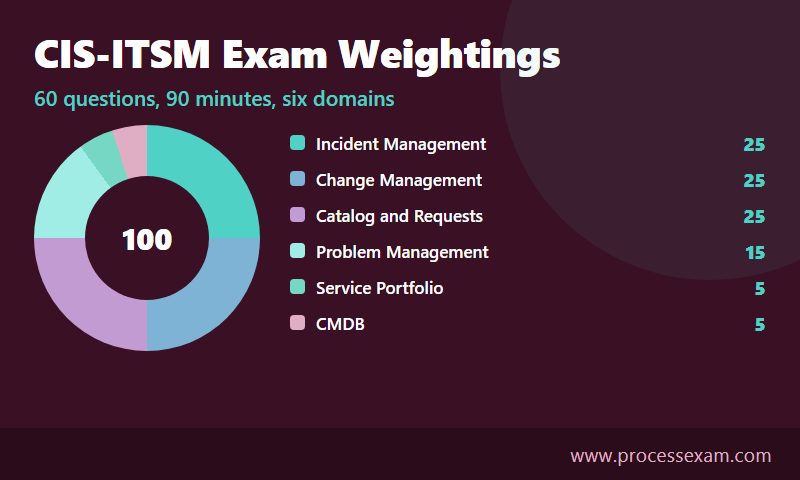
The question counts are simple arithmetic on the percentages, so treat them as a guide to where your hours should go and not as a promise about any single exam form. The pattern is what matters. Incident, Change and Catalog together carry 45 of the 60 questions, which makes it a mistake to spend a weekend on the two five-percent domains before you are fluent in the big three. At the same time, three questions are still three marks, and they are usually the easiest to win if you have read the topic once.
ServiceNow tells candidates that the section percentages shown on a result do not decide the overall outcome and should not be averaged. Since the result is Pass or Fail, the only useful reading of those percentages is as a map of where you were weak, if you need to sit again.
What do Incident, Problem and Change expect you to configure?
These three processes are the heart of ITSM, and between them they hold 65 percent of the exam. The syllabus describes each in terms of architecture, scoping and requirements, and configuration of the lifecycle. In plain words: understand how the process is built, decide what a customer needs from it, and then set it up.
Incident Management (25 percent)
Expect questions on how an incident is created from different channels, how priority is derived from impact and urgency, and how assignment gets the ticket to the right group without manual triage. SLA definitions are a favourite subject, because they hide detail: when the timer starts, what pauses it, which conditions stop it, and what happens at the warning and breach points. Escalation and major incident handling follow the same logic. Learn the incident states and which transitions are allowed, and be ready to say how a requirement such as "the business wants a different resolution target for executives" would be met without breaking the standard process.
A good practice habit is to read a requirement and name the three or four platform features that could satisfy it, then choose the one that needs the least customisation. The exam rewards that instinct, because ServiceNow's own guidance favours configuration over code wherever possible.
Problem Management (15 percent)
This domain tests how an organisation moves from fixing symptoms to removing causes. You need the relationship between incidents, problems and known errors, the purpose of a workaround, the way a problem is investigated through tasks and root cause analysis, and how a fix becomes a change request. A typical question describes a team that keeps resolving the same incident and asks what the process should do about it. The answer sits in problem creation criteria and in how related incidents are linked and closed when the problem is resolved.
Change Management (25 percent)
Change is where many candidates find the most detail. Know the three change types: normal, standard and emergency, and what makes each one different in approval and in risk. Be comfortable with change models, which decide the path a request follows, with risk assessment and impact analysis, and with the scheduling tools that stop two changes colliding, such as conflict detection and blackout windows. Approval policy questions often turn on who should approve what and when approval is skipped, for example for a pre-authorised standard change.
The link back to the CMDB matters here. A change is raised against configuration items, and impact analysis follows the relationships between them. If you can describe how a change to one server surfaces the services that rely on it, you can answer a whole group of questions in this and the CMDB domain.
Where do catalog, portfolio and CMDB questions turn up?
The remaining 35 percent is split between one big domain and two small ones, and each has its own way of catching people out.
Service Catalog and Request Management (25 percent)
The syllabus lists architecture, scoping and requirements, configuration and integrations. In practice you should know the building blocks of the catalog: catalog items, record producers, order guides and variable sets, plus the client-side controls that shape a form, such as UI policies and catalog client scripts. Equally important is the request structure underneath, in which a request contains requested items that generate catalog tasks. Questions often ask where an approval should sit, how to avoid duplicating a form across ten items, or which integration pattern fulfils an order in another system.
The exam also leans on user experience. Expect questions about how users find an item, how access to an item is limited by criteria, and how fulfilment is routed. Spend real time creating items in a practice instance, because the interface is quicker to learn by building than by reading.
Service Portfolio Management (5 percent)
This is a small domain that benefits from clear vocabulary. Know how a business service differs from a service offering, why the portfolio is the front door for publishing what the organisation provides, and how it connects to the catalog and the CMDB. Because it is worth only about three questions, one careful reading of the relevant documentation is enough for most candidates.
Configuration Management Database (5 percent)
Again about three questions, but they are fair game. You should know that the CMDB stores configuration items and their relationships, why that matters to impact analysis in incident and change records, and what good data quality looks like in practice. If you have studied Data Foundations first, this domain is the part of the ITSM exam that will feel like revision.
Standard ITSM or ITSM Pro: does it matter for the exam?
ServiceNow sells the process suite in more than one packaging. The standard offering covers the core processes: Incident, Problem, Change, Request, Knowledge and Release. The Pro tier has been described as adding analytics and prediction features, together with workspaces such as vendor management and service owner views. For the exam, treat the question as a scoping skill: be able to say what a requirement needs and which packaging, if any, supplies it. Check the blueprint to see how much licensing detail ServiceNow currently expects, and look at the ServiceNow product documentation for the feature set of your release.
How should you spread six weeks of study across the domains?
Six weeks suits someone who works with ServiceNow at least part of the week. If you do not have a developer instance, request a free one from ServiceNow's developer programme so that every study week ends with something you built. The weights drive the schedule: the three big domains get most of the time, and the small ones share a single week.
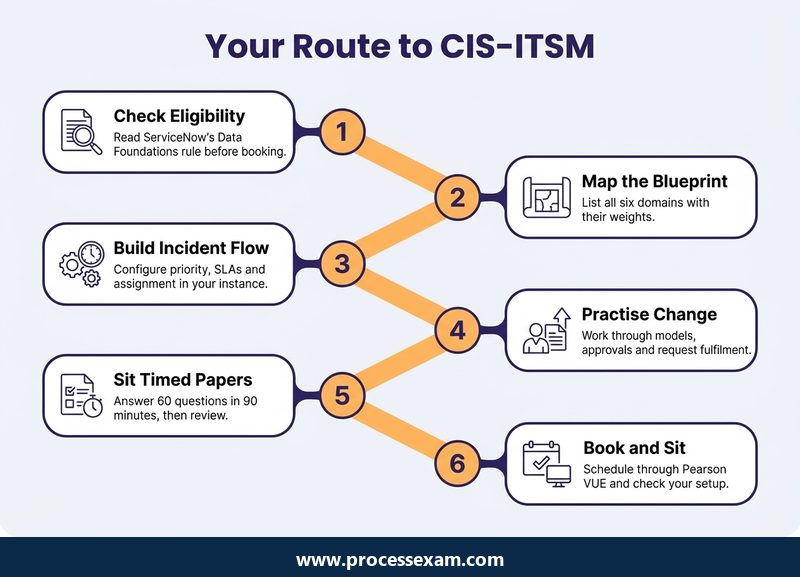
| Week | Focus | What to finish |
|---|---|---|
| 1 | Eligibility and blueprint | Confirm the Data Foundations rule, read the blueprint, and rate every topic as strong, shaky or new |
| 2 | Incident Management | Build a working incident flow with priority rules, assignment, and an SLA with pause conditions |
| 3 | Problem Management | Create a problem from related incidents, record a workaround, and push a fix through change |
| 4 | Change Management | Configure a standard change template, an emergency path and an approval policy, then run a conflict check |
| 5 | Catalog, portfolio and CMDB | Build a catalog item with variables, an order guide and an approval; review portfolio and CMDB basics |
| 6 | Timed practice and review | Two timed sittings of 60 questions in 90 minutes, then sort every miss by domain |
Learn by building, then by reading
For each domain, build the thing before you read about it. When you later meet a question on SLA conditions or change models, you will remember the screen, and you will notice the trap options that no real configuration supports. Reading alone produces confident answers to the wrong question.
Use practice questions to find gaps, not to memorise answers
Scenario practice shows you how the exam phrases a requirement. The CIS-ITSM practice exam on ProcessExam follows the 60-question, 90-minute format, which is useful for rehearsing the clock. After each set, sort every miss into three piles: did not know the feature, knew it but misread the requirement, and ran out of time. Only the first pile is fixed by reading more. Avoid any site that promises real exam questions, since those risk your credential and teach you nothing about the platform.
Plan exam day as part of preparation
Book a time of day when you are sharp, run the technical checks that Pearson VUE gives you well before the appointment, and have your identification ready. Mark a long scenario for review instead of wrestling with it, and return once the quick ones are banked. With sixty questions, a single stubborn scenario should never cost you five easy ones.
Where do experienced ServiceNow admins trip up on CIS-ITSM?
- Studying the big three only. Ignoring the 5 percent domains gives away easy marks that decide a close result.
- Skipping SLA details. Start, pause and stop conditions are asked about repeatedly, and a vague idea of a timer is not enough.
- Choosing code when configuration will do. If two options both work, the exam usually prefers the one that uses a built-in feature.
- Treating change types as synonyms. Normal, standard and emergency changes differ in approval and risk, and questions test exactly that difference.
- Forgetting the CMDB link. Incident and change questions often depend on the configuration item and its relationships.
- Relying on an outdated checklist. Prerequisites and delivery arrangements have changed, as this guide shows, so confirm them with ServiceNow.
- Reading a requirement too quickly. A single phrase such as "without customisation" or "for executives only" can change the right answer.
- Leaving practice for the last weekend. Timed sittings reveal pacing problems while there is still time to fix them.
What does passing CIS-ITSM change at work?
For a consultant or partner engineer, it is a clear statement to clients that you have been assessed on the whole ITSM implementation, not only on one module. For an internal platform owner, it supports a move from running the tool to shaping how the organisation uses it: arguing for a simpler change model, rewriting an SLA so that it reflects the business, or designing a catalog that stops requests arriving by email. It also adds weight when you move on to other implementation specialist exams, since ITSM concepts are the common language of the platform.
It does not guarantee a promotion or a rate, and this guide gives no salary figure because published numbers vary by country, partner and experience and rarely isolate the effect of one credential. A better test is practical. Read current job adverts for the role you want, count how many ask for ServiceNow implementation experience, and note whether they name ITSM specifically. Pair the credential with a portfolio of things you have built, because hiring managers in this field look for evidence of real configuration work.
Finally, remember that a ServiceNow credential is a maintained one. Releases change the platform, and ServiceNow adjusts its certification requirements as it does, as the Data Foundations change shows. Keep your learning account active, watch announcements from ServiceNow, and treat the exam page as the one source to re-read before every step: booking, preparing and renewing.
Frequently Asked Questions
What does CIS-ITSM stand for?
CIS-ITSM is the code for the ServiceNow Certified Implementation Specialist - IT Service Management exam. CIS stands for Certified Implementation Specialist, and ITSM stands for IT Service Management. It covers incident, problem, change, service catalog and request, service portfolio and CMDB topics.
How many questions are on the CIS-ITSM exam and how long is it?
The exam has 60 multiple-choice questions and a 90-minute time limit, which leaves about ninety seconds per question. Pace yourself at roughly a minute for short configuration items and flag long scenarios to revisit, so one hard question never costs you several easy ones.
What is the passing score for CIS-ITSM?
The result is reported only as Pass or Fail, and the exam sheet lists no numeric pass mark. ServiceNow also says the domain percentages on a result should not be averaged. Judge readiness from timed practice papers and from whether you can explain why each wrong option fails.
Is the CIS-ITSM exam proctored?
Yes. After you register, ServiceNow sends you to Pearson VUE, where you choose a test centre or an online sitting through OnVUE, with a proctor watching by webcam. You must schedule and complete the exam within 90 days of registering, or the registration expires and the fee is lost.
Do I need Data Foundations before taking CIS-ITSM?
Yes. ServiceNow's CIS-ITSM blueprint, updated January 2026, says candidates must hold the Certified Implementation Specialist - Data Foundations (CMDB and CSDM) credential before registering. If you hold neither, plan Data Foundations first, because its CMDB and CSDM content also helps with the ITSM exam's configuration-item questions.
- ServiceNow IT Service Management Implementation Specialist Test Questions |
- CIS-ITSM Question Bank |
- ServiceNow IT Service Management Implementation Specialist Book |
- IT Service Management Implementation Specialist Certification Cost |
- ServiceNow IT Service Management Implementation Specialist Sample Questions |
- CIS-ITSM Exam Questions Download |
- CIS-ITSM Test Questions |
- IT Service Management Implementation Specialist PDF |
- CIS-IT Service Management Simulator |
- CIS-IT Service Management Mock Exam |
- ServiceNow CIS-IT Service Management Question Bank |
- ServiceNow CIS-IT Service Management Book |
- ServiceNow CIS-IT Service Management Study Guide |
- CIS-IT Service Management Certification |
- CIS-IT Service Management Certification Cost |
- CIS-IT Service Management Certification Requirement |
- ServiceNow CIS-IT Service Management Exam Questions |
- ServiceNow CIS-IT Service Management Sample Questions |
- CIS-IT Service Management |
- CIS-IT Service Management PDF |
- Technology


