
Series 82 Exam Prep: Secrets to Pass on Your First Attempt
Updated on 19 September 2026. What’s new: exam time corrected to 90 minutes, with FINRA's current question count, fee and passing score of 70.
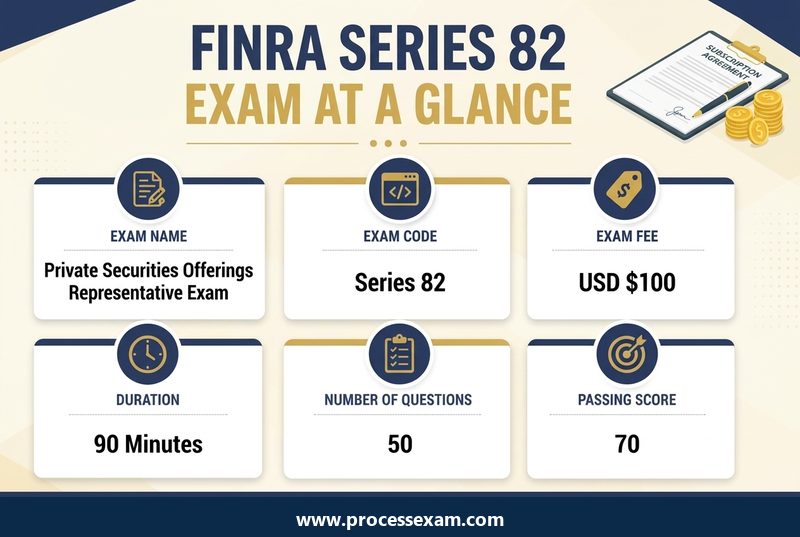
To pass the FINRA Series 82 exam on your first attempt, you need exact command of private placement rules, above all Regulation D, plus timed practice on scenario questions. The exam has 50 questions in 90 minutes, costs USD $100 and needs a passing score of 70. Half of it tests how you seek business for private offerings, so study that area first and hardest.

The Series 82, FINRA's Private Securities Offerings Representative Exam, qualifies a representative to solicit and sell private placement securities as part of a primary offering. It is shorter and narrower than the Series 7, and that is exactly why many candidates underestimate it. The questions go deep into a small body of rules: exemptions from registration, accredited investor status, placement agent duties, suitability and the records a firm must keep.
This guide explains what the exam covers, how hard it really is, how long to study, the details most candidates miss, what to do on test day and what to do if you have already failed once. Every exam figure below comes from FINRA's published exam details.
What is the Series 82 exam, and who needs to pass it?
The Series 82 is a representative-level qualification exam run by FINRA. It is designed for entry-level Private Securities Offerings Representatives: people at broker-dealers, boutique investment banks and placement agents who raise capital for private companies and funds through non-public offerings. If your job is to find investors for a private placement and sell them securities in that offering, this is the registration you need.
The Series 82 does not stand alone. FINRA treats the Securities Industry Essentials (SIE) exam as a corequisite, so you must pass both the SIE and the Series 82 to be registered as a Private Securities Offerings Representative. The SIE covers general market knowledge; the Series 82 covers the specialised knowledge of private offerings. Like other representative-level exams, the Series 82 is normally taken with the sponsorship of a FINRA member firm, which files the registration on your behalf.
Here are the exam facts in one place:
| Exam detail | Series 82 |
|---|---|
| Full name | FINRA Private Securities Offerings Representative Exam |
| Exam code | Series 82 |
| Vendor | FINRA |
| Category | Representative-level |
| Number of questions | 50 |
| Duration | 90 minutes |
| Exam fee | USD $100 |
| Passing score | 70 |
| Corequisite | Securities Industry Essentials (SIE) exam |
FINRA lists the current exam details, fees and registration steps on its official Series 82 exam page. Check it before you schedule, because FINRA, not any training provider, sets the format and the fee. One detail from the outline is worth knowing early: your exam also contains five unidentified pretest items that do not count toward your score, so you will see more than 50 questions on screen even though only 50 are scored. There is no penalty for guessing, so never leave an item blank.
What is on the Series 82 exam?
FINRA's Series 82 content outline divides the exam into four major functions. The weighting is very uneven, and your study time should follow it.
| Function | What it covers | Scored items | Share |
|---|---|---|---|
| 1 | Seeks business for the broker-dealer from customers and potential customers | 25 | 50% |
| 2 | Opens accounts after obtaining and evaluating customers' financial profile and investment objectives | 9 | 18% |
| 3 | Provides customers with information about investments, makes recommendations, transfers assets and maintains appropriate records | 13 | 26% |
| 4 | Obtains and verifies customers' purchase instructions and agreements; processes, completes and confirms transactions | 3 | 6% |
A structured topic list for each of these functions is on our Series 82 syllabus page. Below is what each one means in practice.
Function 1: Seeking business for private offerings (25 items)
This is the heart of the exam. It covers how you contact investors and what you are allowed to say, and then the full mechanics of a private offering. On communications, you need FINRA Rule 2210: the difference between retail communications, institutional communications and correspondence, which ones need principal approval, and the limits on marketing a private offering compared with a public one.
The larger part is the offering itself. Expect questions on the types of offerings (primary, private placement, PIPE), the exemptions from registration under the Securities Act of 1933, methods of distribution (firm commitment, best efforts, all-or-none, mini-max, standby), due diligence and feasibility studies, the role of the placement agent and dealer manager, selling group agreements, the components of the spread, and the ban on paying unregistered finders. The regulations named here include Regulation D (Rules 500 to 508), Regulation A, Regulation S, Rule 144A, Rule 147, Section 4 of the Securities Act, Exchange Act Rules 10b-9 and 15c2-4, and FINRA Rule 5123 on filing private placements.
Function 2: Opening accounts (9 items)
This function tests the account-opening process for private placement investors. That means customer identification and know-your-customer duties under FINRA Rule 2090, the customer account information required by Rule 4512, account authorisations such as powers of attorney, trust documents and corporate resolutions, predispute arbitration agreements under Rule 2268, and privacy rules under Regulation S-P. It also includes documents that are specific to private deals: the subscription agreement, the investor questionnaire and the qualified institutional buyer certification letter.
A key item here is the verification of investor accreditation and sophistication, along with suitability under Rule 2111 and Regulation Best Interest. You need to know what information you must gather about a customer's finances, tax status and objectives before a recommendation, and which supervisory approvals are required before an account is opened.
Function 3: Recommendations, disclosures and records (13 items)
Function 3 asks whether a private placement recommendation meets best interest and suitability standards. Private securities are usually illiquid and concentrated, so the outline stresses the customer's ability to hold an investment through market swings, liquidity needs, diversification, and the risks of equity and debt instruments in private deals. FINRA Rule 5122, which governs private placements of securities issued by member firms themselves, sits here, along with fair prices and commissions (Rule 2121), Form CRS and books-and-records rules such as Exchange Act Rules 17a-3 and 17a-4 and FINRA Rule 4510. Regulation FD also appears in this function.
Function 4: Processing and confirming transactions (3 items)
The smallest function covers subscription agreements and their retention, payment and settlement for private placement securities, confirmations under Rule 10b-10 and FINRA Rule 2232, and customer complaints: how they are recorded under Rule 4513, what must be reported under Rule 4530 and on Form U4, and how disputes are resolved through arbitration or mediation. With only three items, this area deserves review but not weeks of study.
How hard is the Series 82 exam?
The Series 82 is moderately hard, and harder than its length suggests. Fifty scored questions sounds manageable, but the narrow scope means each rule is tested in more detail than it would be on a broad exam. On the Series 7, a weak topic can be offset by strength elsewhere. On the Series 82, Regulation D and private offering mechanics make up so much of the exam that a gap there is difficult to recover from.
Three things make it feel harder than candidates expect. First, the questions are applied, not definitional. A typical item describes an issuer, a raise and a mix of investors and asks which exemption fits, or what the placement agent must do next. Second, the answer choices are close. Several options are often partly correct, and the right one depends on a single condition such as whether general solicitation was used or whether a purchaser is accredited. Third, daily work experience can mislead. What your desk does in practice is not always what the rule requires, and the exam tests the rule.
The pace itself is reasonable. Ninety minutes for 50 scored questions plus five pretest items gives you well over a minute and a half per question. Most candidates who fail do not run out of time; they run out of precise knowledge. That is good news, because precise knowledge can be built with a plan.
How long should you study for the Series 82 exam?
Plan on three to five weeks of steady study if you already work around private placements, and closer to six weeks if the rules are new to you. What matters more than the calendar is covering every function in proportion to its weight and finishing with timed practice. A study plan in five steps looks like this:
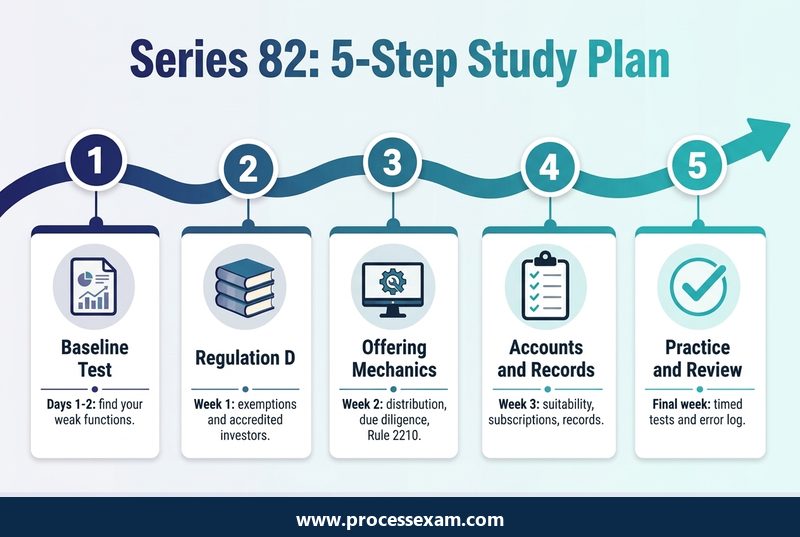
Step 1: Take a baseline test (days 1 to 2)
Start with a timed practice test before you read anything. The score does not matter yet. What matters is the list of topics you missed, sorted by function. That list becomes your study order and stops you from spending a week on material you already know.
Step 2: Master Regulation D and the exemptions (week 1)
Spend the first full week on the exemptions from registration. Learn the Regulation D rules one by one, then Regulation A, Regulation S, Rule 147 and Rule 144A, and practise telling them apart. A short neutral overview of Regulation D is a useful starting point before you move on to the rule text and your study guide.
Step 3: Learn offering mechanics and communications (week 2)
Move to the rest of Function 1: methods of distribution, due diligence, placement agent and selling group roles, the spread, finder rules, and FINRA Rules 2210, 5122 and 5123. By the end of this week you should be able to walk through a private offering from the engagement letter to the closing and name the rule that applies at each step.
Step 4: Cover accounts, suitability and records (week 3)
Work through Functions 2, 3 and 4 together, because they follow the same customer from account opening to confirmation. Focus on accredited investor verification, subscription documents, Regulation Best Interest, suitability for illiquid products, confirmations, complaints and record retention.
Step 5: Timed practice and review (final week)
Take at least two full-length timed practice exams on fresh questions. Review every question you missed or guessed, write the rule behind each one into an error log, and revisit the source for any topic that appears more than once. A rising score on questions you have not seen before is the clearest sign you are ready. The Series 82 practice exam on ProcessExam uses the same 50-question, 90-minute format, so you can rehearse the timing before the real thing.
What are the Series 82 exam secrets most candidates miss?
None of these are tricks. They are the areas where the exam asks for more detail than candidates prepare, based on how the outline is written and how scenario questions are built.
1. Know the Regulation D rules side by side
Rule 504 is a limited-dollar exemption. Rule 506(b) allows an unlimited raise without general solicitation, from any number of accredited investors and up to 35 non-accredited purchasers who must be sophisticated, as the SEC's Rule 506(b) guidance sets out. Rule 506(c) allows general solicitation, but every purchaser must be accredited and the issuer must take reasonable steps to verify that status. Rule 507 disqualifies certain issuers, and Rule 503 requires a Form D notice filing after the first sale. Build one comparison table and learn it until you can answer without looking.
2. The accredited investor definition is wider than income and net worth
Most candidates know the individual tests: income above $200,000, or $300,000 jointly with a spouse or spousal equivalent, in each of the last two years, or net worth above $1 million excluding the primary residence. Fewer know the entity categories and the 2020 amendments, both summarised in the SEC's accredited investor overview, which added natural persons holding certain professional credentials, including the Series 7, Series 65 and Series 82 licences. Questions on accreditation often turn on these less familiar categories.
3. General solicitation changes what you must verify
Under 506(b), a self-certifying investor questionnaire and a pre-existing relationship are common practice. Under 506(c), the burden is heavier: reasonable steps to verify, such as reviewing tax returns or obtaining a written confirmation from a qualified third party. If a scenario mentions advertising or a public website, check immediately which exemption is still available.
4. Communications rules are marks you should not drop
Rule 2210 questions are more predictable than the offering questions. Know the three categories of communication, which need principal pre-approval, and what content limits apply to private offerings. Candidates who learn this area thoroughly bank marks that protect them on the harder scenario items.
5. Rule 144 and Rule 144A are not the same thing
Rule 144 governs the public resale of restricted and control securities, with holding periods and volume limits. Rule 144A is a safe harbour for resales of restricted securities to qualified institutional buyers. The names are similar and the answer options exploit that. Know which one applies to which buyer.
6. FINRA's own private placement rules are tested directly
Rule 5123 requires member firms to file offering documents for most private placements they sell, and Rule 5122 adds disclosure and use-of-proceeds conditions when the member itself, or a control entity, is the issuer. Learn who files, what is filed and the deadline, and which offerings are exempt from filing.
How do you pass the Series 82 exam on test day?
By exam day your knowledge is fixed; what you can still control is how you apply it. These habits turn preparation into points.
The best rehearsal for test day is a timed Series 82 practice exam taken at the same hour of day as your appointment, so the pace and the fatigue both feel familiar.
- Read the last line first. On a long scenario, read the actual question before the story so you know which facts matter.
- Watch for EXCEPT and NOT. Negative questions are common, and a rushed reader picks the first true statement.
- Find the deciding fact. In an exemption question, look for the detail that settles it: general solicitation, the number of non-accredited purchasers, the size of the raise, or where the buyers are.
- Eliminate before you choose. Most items have one or two options you can rule out immediately. Narrowing the field improves your odds on anything you are unsure of.
- Flag and move on. With 90 minutes, you have time to come back. Mark any question that stalls you past two minutes and return to it after your first pass.
- Answer everything. There is no penalty for guessing, so a blank answer is always a wasted mark.
You may not bring reference materials into the session, so your final revision should be a single page of notes you have already memorised: the Regulation D comparison, the accredited investor tests, the communication categories and the filing deadlines. Read it the evening before, confirm your appointment details, then stop studying and rest.
What should you do if you failed the Series 82 exam?
Failing once is common and fixable. FINRA Rule 1210 sets a waiting period before a retake, with a longer wait after three failures in a row within two years. FINRA amended those waiting periods in 2026 and is announcing when the shorter periods start, so confirm the period that applies to you on FINRA's site before you rebook, and use the wait deliberately.
Start with your score report. FINRA provides feedback on performance by function, and that breakdown is the most valuable study document you have. If Function 1 was weak, that alone may explain the result, because it carries half the scored items. Rebuild your plan around the weakest function, and change your method rather than simply repeating it: if you studied mainly by reading, switch to scenario practice; if you only did practice questions, go back to the rule text for the topics you keep missing.
Candidates searching for how to pass the Series 82 after failing often find that the gap was narrow but deep: one or two topics, usually exemptions or accreditation, that were understood in outline but not in detail. Keep an error log from every practice session, and do not book the retake until your scores on fresh timed tests are consistently and comfortably above the passing level.
Is the Series 82 license worth it for your career?
For anyone who raises capital in the private markets, yes. The Series 82 is the focused registration for representatives who sell private placements, and it lets you do that work without taking the broader Series 7, which covers products you may never sell. For boutique investment banks, private placement desks, real estate syndications and fund placement agents, it is often the most direct route to registered status.
It also gives you practical fluency in the rules that shape every private deal: which exemption fits, who can invest, what can be said in marketing, and what must be filed. That knowledge makes you useful beyond sales, in deal structuring, investor relations and compliance-facing roles. And because the 2020 accredited investor amendments recognise holders of the Series 82, passing it can also qualify you personally as an accredited investor.
The registration is narrow by design. If your career moves toward public securities, a wider range of products or supervisory roles, you will need further FINRA exams. For a representative whose work is private offerings, however, the Series 82 is exactly matched to the job, and a disciplined plan of study, practice and review is enough to pass it on the first attempt.
Frequently Asked Questions
How many questions are on the Series 82 exam?
According to FINRA, the Series 82 exam has 50 multiple-choice questions and a time limit of 1 hour and 30 minutes, with a passing score of 70. There is no penalty for guessing, so answer every question and flag the harder scenarios to revisit before time runs out.
What is the passing score for the Series 82 exam?
The passing score for the Series 82 exam is 70. FINRA places all candidate scores on a common scale through a process called equating, which adjusts for small differences in difficulty between exam forms, so every candidate is held to the same passing standard.
How much does the Series 82 exam cost?
The Series 82 exam fee is USD $100. The Securities Industry Essentials exam is a separate corequisite with its own fee. FINRA sets and occasionally changes its fees, so confirm the current amount on FINRA's official Series 82 page before you or your sponsoring firm register.
Is the SIE exam required for the Series 82?
Yes. FINRA treats the Securities Industry Essentials exam as a corequisite. To register as a Private Securities Offerings Representative, you must pass both the SIE and the Series 82. You can take them in either order, but the registration is granted only when both are passed.
How long should I study for the Series 82 exam?
Most candidates need three to five weeks of steady study, and up to six weeks if private placement rules are new to them. Spend the most time on Function 1, which carries half the scored items, and finish with at least two timed full-length practice exams.
Which topics carry the most weight on the Series 82 exam?
Function 1, seeking business for the broker-dealer, carries 25 of the 50 scored items. It covers communications, types of offerings, Regulation D and other exemptions, distribution methods, due diligence and FINRA's private placement filing rules. Function 3 follows with 13 items, then Function 2 with 9 and Function 4 with 3.
Can I retake the Series 82 exam if I fail?
Yes. FINRA Rule 1210 lets you retake the Series 82 after a waiting period, which is longer after three failures in a row within two years. FINRA shortened these periods in 2026, so check the current wait on FINRA's site, and use your score report's breakdown to target weak areas.
- Representative-level |
- FINRA Private Securities Offerings Representative Exam Test Questions |
- Series 82 Question Bank |
- FINRA Private Securities Offerings Representative Exam Book |
- Private Securities Offerings Representative Exam Certification Cost |
- Private Securities Offerings Representative Exam Certification Requirements |
- FINRA Private Securities Offerings Representative Exam Sample Questions |
- Series 82 Exam Questions Download |
- Series 82 Test Questions |
- Private Securities Offerings Representative Exam PDF


