
Series 22 License: What DPPs Are and How to Pass the Exam
A direct participation program is an ordinary business - an apartment block, an oil
well, a fleet of leased equipment - wrapped in a limited partnership so that its income,
losses, deductions and credits pass straight through to the investors instead of being taxed
at the entity first. The Series 22 licenses you to sell interests in those programs. Most
candidates meet the product for the first time in this exam, which is why it feels unfamiliar
even to people who have sold securities for years.

That unfamiliarity, not the length of the exam, is what catches people out. The Series 22
is short: 50 scored questions and 90 minutes. But almost every question assumes you already
know how a limited partnership behaves, who carries the liability, which costs are deductible
and which are not, and why an interest that cannot be sold on next week is not automatically
unsuitable. This guide starts with the product, then works outward to the exam that tests
it.
What exactly is a direct participation program?
The phrase is literal. In a direct participation program the investor participates
directly in the cash flow and the tax items of the underlying business. There is no corporate
layer in between taking a bite of the profits first. FINRA's content outline calls this the
conduit nature of the entity: the program files an informational return on IRS
Form 1065, allocates each partner a share of profits, losses, deductions and credits, and
reports that share to the investor on a Schedule K-1. The investor pays the tax.
Most DPPs are limited partnerships, and the exam expects you to describe that structure
without hesitating. A general partner manages the program, owes a fiduciary duty to the limited
partners and carries unlimited liability for the partnership's obligations. Limited partners put
up capital, take a share of the results, and risk no more than their capital contribution - but
they get only narrow voting rights in exchange, typically the right to replace the general
partner, to approve the sale of substantially all the assets, and to amend the partnership
agreement. A limited partner who starts managing the business risks that protection.
The partnership agreement itself is examinable material. It sets out the types of
partners, the capital contribution obligations, how income, loss, capital gain and cash
distributions are allocated, and how the general partner is compensated. So is the end of the
program's life: a limited partnership dissolves when the last general partner withdraws, when
the partners vote to wind it up, when all the assets are sold, or when the stated term
expires.
Limited partnerships are not the only wrapper. The outline also covers limited liability
companies, which behave like limited partnerships except that a manager has limited liability
and the LLC may elect pass-through treatment; S corporations, which pass through but cannot make
disproportionate allocations and are capped on shareholder numbers and types; general
partnerships, where a passive general partner interest is itself treated as a security; and
joint ventures and grantor trusts. Expect at least one question that turns on telling two of
these apart.
One more feature shapes almost every suitability question on the paper. DPP interests
do not trade on an exchange. Transfer is restricted, holding periods are long, and the only exit
may be a share redemption programme on the sponsor's terms. That illiquidity is a fact about the
product, not a defect to be hidden, and the exam rewards candidates who treat it that way.
Which DPP families does the Series 22 expect you to tell apart?
Function 3 of the outline - the largest function on the exam - opens with "types of
direct participation programs" and then lists them by asset class, each with its own benefits and
its own characteristic risks. Learning the list is not enough. The questions pair a program type
with a risk and ask whether they belong together, so study each family as a benefit-and-risk
pair.
Real estate programs
The outline breaks real estate into five sub-types. Affordable housing programs run on
tax credits and passive losses, and their risks are policy risks: a change in government policy,
the loss of a subsidy or credit, thin cash distributions, an uncertain residual value.
Development properties offer appreciation and partially tax-deferred cash flow, against excess
development costs, occupancy and rental rates that never materialise, and long-term mortgage
financing that may not be available. Operating properties come with in-place leases and net
operating income, and fail when occupancy or rents fall, maintenance and replacement costs climb,
or the program cannot cover debt service. Land development offers appreciation and nothing else -
carrying costs with no cash flow while the developer waits. Mortgage programs pay predictable
income and may share in appreciation, and their risk is borrower default.
Oil and gas programs
This is the area most candidates underestimate. Exploratory programs offer the biggest
up-front tax benefit and the highest return if reserves are found, and carry dry holes, joint and
several liability, environmental hazard, changing regulation and commodity pricing. Development
programs sit on known structures, so there are fewer dry holes, with the same regulatory and
pricing exposure. Income programs buy producing reserves for predictable cash flow and partial
tax benefits, and their danger is an overestimation of those reserves.
Then come the interests themselves, and these are worth drilling until they are
automatic. An overriding royalty interest shares in production revenue free of
program costs, payable out of total production under the lease. A working interest
shares in revenue and in the costs. A reversionary working interest pays the
holder nothing until the investors have recovered their costs, and shares in revenue after that.
A disproportionate sharing arrangement lets the sponsor pay a smaller share of
the costs in return for a larger share of the revenue, often with the investors taking the
deductible costs and the sponsor the non-deductible ones. Questions in this area are almost always
about who pays what and who gets paid when.
Equipment leasing programs
Shorter to learn, and reliably tested. Equipment leasing offers partially sheltered cash
flow. Its risks are lease defaults, an uncertain residual value when the equipment is finally
sold, and phantom income on that sale - taxable income arriving with no cash to pay the tax
with.
Debt programs, other programs and like-kind exchanges
Business development companies and other debt investment programs pay income and modest
capital gains, and suffer when borrowers default or when rising interest rates push asset values
down. The outline's "other programs" list is short but examinable: agricultural, livestock,
entertainment, research and development or venture capital, and commodity pools. Finally,
like-kind exchanges appear by name - tenants in common, the Delaware statutory trust, and Section
1031 - and candidates do get asked about them, so do not skip the category because it looks
peripheral.
How does partnership taxation show up in Series 22 questions?
Tax is not a separate topic on this exam; it is woven through the recommendation
questions, because the tax treatment is often the reason a program exists. You are not being asked
to prepare a return. You are being asked whether a tax consequence has been described correctly to
a customer.
Start with the distinction between a credit and a deduction, because it is the cheapest
mark on the paper and candidates still lose it. A credit is offset against the tax liability
itself. A deduction is offset against income. Affordable housing programs trade on credits;
most other programs trade on deductions.
Next, the passive activity rules. Losses from a passive activity are deductible only to
the extent of passive income, and unused losses are carried forward, never back. Keep
that direction straight and a whole family of questions becomes easy.
Then the non-cash deductions. Depreciation, depletion and amortisation each let the
program deduct a share of an asset's cost without spending cash, which is how a program shelters
part of its distributions. The method varies by asset - term, straight-line, accelerated - and the
outline expects you to know that it varies rather than to compute it.
Three more concepts round out the area, and each has its own question shape:
- Phantom income. Taxable income allocated to a partner with no matching cash
distribution. Common on equipment sales and on debt relief. - At-risk limitations. A partner may deduct losses only up to the capital
contributed plus the share of partnership liabilities for which that partner is personally liable.
The exception worth memorising is that qualified non-recourse financing in real estate is exempt
from the at-risk limitation. - Alternative minimum tax. Several DPP items are AMT preference items, so a
program that looks tax-efficient on the face of it can pull a customer into AMT.
Adjusted tax basis underpins all of it - it is what determines the gain or loss when an
asset is sold - and Section 1031 sits at the other end, deferring the gain on a real estate
exchange and carrying the basis across to the replacement property. If you can explain basis,
passive losses and phantom income in plain English to a customer, you have covered most of what
the exam wants from this function.
Where does the Series 22 sit in FINRA's registration ladder?
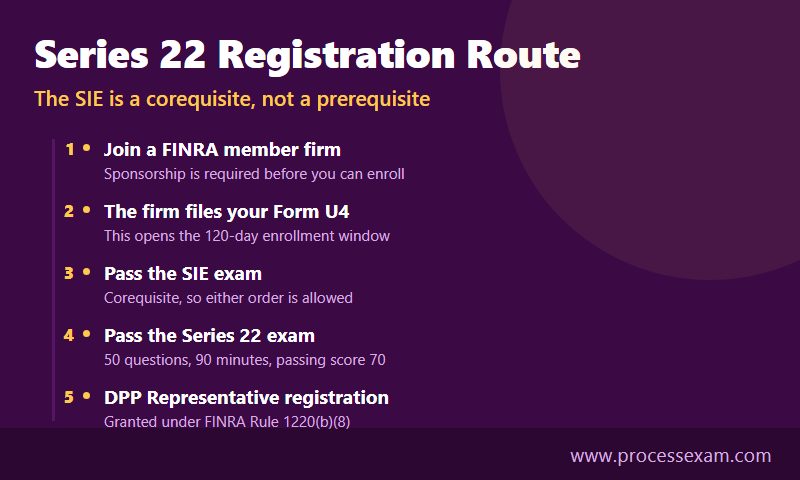
The Series 22 is not a standalone credential and you cannot walk in off the street and
sit it. FINRA states on its Series 22 qualification page that the Securities
Industry Essentials exam is a corequisite, not a prerequisite. That wording
matters: the two exams may be taken in either order, and it is only when both are passed - and a
firm has requested the registration - that the Direct Participation Programs Representative
category under FINRA Rule 1220(b)(8) is granted.
Sponsorship is the other gate. A candidate for the Series 22 must be associated with and
sponsored by a FINRA member firm, or another applicable self-regulatory organisation member firm.
The firm files the Form U4, and once the enrolment is approved FINRA posts a 120-day window in
which the exam has to be taken. Appointments cannot be booked past the end of that window, and
extensions are not granted as a matter of course.
It is worth knowing where the Series 22 sits next to its neighbours. The General
Securities Representative registration covers direct participation programs among a great deal
else, and takes a far longer exam to get there. The Series 22 is the narrow door: if your firm
distributes DPPs and nothing else, it is the proportionate qualification, and it is the one your
compliance department will ask for.
On retakes, do not work from a number you read on a forum. Waiting periods after a failed
qualification exam are set by FINRA Rule 1210, with a longer wait after repeated
failures inside a two-year period. FINRA filed a reduction to those periods in June 2026 and has
said the shorter waits are not yet in force for candidates, with the timing to follow in a
regulatory notice. Check the rule, or ask your registration team, before you plan a second
attempt.
How are the 50 questions split across the four job functions?
Here is what you are actually sitting, with the figures as FINRA and our exam records
carry them.
| Item | Detail |
|---|---|
| Exam name | FINRA Direct Participation Programs Representative Exam |
| Exam code | Series 22 |
| Scored questions | 50 |
| Duration | 90 minutes |
| Passing score | 70 |
| Fee | USD $100 |
| Format | Multiple choice, four answer choices |
| Corequisite | Securities Industry Essentials exam |
The 50 scored questions are allocated across four job functions, and the allocation is
lopsided enough to plan around:
- Function 1 - seeks business for the broker-dealer: 17 questions, 34%.
Communications with the public under FINRA Rule 2210, types of offering, prospectus requirements,
methods of distribution, syndication, the dealer-manager role, wholesalers, finders, and due
diligence. - Function 2 - opens accounts: 4 questions, 8%. Account types, retirement and
ERISA plans, customer identification and know-your-customer, privacy under Regulation S-P,
account authorisations, and supervisory approval. - Function 3 - provides information, makes recommendations, transfers assets and keeps
records: 27 questions, 54%. The programs themselves, their tax treatment, how a DPP is
evaluated, required disclosures, and customer reporting including the Schedule K-1. - Function 4 - obtains purchase instructions and processes transactions: 2
questions, 4%. Subscription and installment procedures, escrow, supervisory review of the order,
and customer confirmations.
Two administrative details change how the paper feels. Your exam contains five additional
unidentified pretest items that do not count toward your score, so you answer 55 items in the 90
minutes, not 50. And there is no penalty for guessing, so an unanswered question is simply a
question thrown away. Scores are placed on a common scale by equating, which is why you should
ignore anecdotes about one sitting being "the easy version".
The full breakdown, function by function and rule by rule, is in FINRA's official
Series 22 content outline; our own
list of the exam's topic areas maps those functions onto the material most
candidates have to revisit.
What does suitability mean when the product cannot be sold on?
This is the question the Series 22 keeps asking in different clothes, and it is where
candidates who have sold listed securities go wrong. Illiquidity is not a reason to reject every
recommendation; it is a factor to be weighed and disclosed.
FINRA Rule 2310 sets out the DPP-specific standard. Suitability
standards for a program are disclosed in the prospectus, and before recommending an interest a
member must have reasonable grounds to believe that the customer can realistically benefit from
the program, has a net worth sufficient to sustain the risks including the loss of the investment,
and that the investment is otherwise suitable. That is a higher, more concrete bar than a general
"know your customer" instinct.
Layered on top are the general obligations: Rule 2090 on knowing your customer, Rule 2111
on suitability, Regulation Best Interest under SEC Rule 15l-1, and Form CRS delivery under Rule
17a-14. The outline is explicit about the factors that go into the judgement - whether the
customer can understand the risks of the underlying investment, whether the program's objective
matches the investor's, the composition and diversification of the current portfolio, liquidity
needs, net worth and income, and verification of accreditation or sophistication where the
offering relies on Regulation D.
Cost is part of suitability too, and Rule 2310 puts numbers on it. Organisation and
offering expenses are presumed unfair if they exceed fifteen percent of the gross proceeds of the
offering, and total underwriting compensation is presumed unfair above ten percent of gross
proceeds. Compensation arrangements have to be disclosed in full. Expect at least one question
that hangs on whether a stated arrangement clears those presumptions.
Finally, the evaluation checklist from Function 3 is a suitability tool in its own right:
the economic soundness of the program, its stated objectives, the valuation of specified assets,
the risk factors and conflicts of interest, the sponsor's track record, the sources of capital, how
the offering proceeds are used, the anticipated composition of returns before and after tax, and
the liquidity provisions. Rule 2165 on the financial exploitation of specified adults sits
alongside it, and older investors plus illiquid products is exactly the fact pattern the exam
likes to build.
How should you plan study time around the 54 percent function?
Work backwards from the allocation. Functions 1 and 3 together are 44 of the 50 scored
questions. If your study time is split evenly across four functions you are spending nearly half
of it on twelve percent of the paper. Four weeks of honest evening study is enough for most
candidates who already work at a member firm; allow six if direct participation programs are new
to you.
Weeks one and two - the product
Live in Function 3. Build a single table with a row for each program family - affordable
housing, development, operating, land, mortgage, exploratory, development and income oil and gas,
equipment leasing, BDCs - and columns for the benefits and the typical risks. Then add the
partnership mechanics: general and limited partner rights, the partnership agreement, dissolution,
and the LLC, S corporation and general partnership comparisons. Finish the fortnight on tax:
credits against deductions, passive loss carry-forwards, depreciation and depletion, phantom
income, the at-risk limitation and its non-recourse exception, and AMT.
Week three - selling it, and opening the account
Move to Function 1. Learn the offering types side by side - publicly registered,
Regulation D, Regulation A, intrastate - and what each one permits. Learn the communications
categories under Rule 2210 and who has to approve what. Learn the due diligence checklist: material
statements and risk factors, compliance with registration or exemption rules, financial data,
management background and prior performance, the assumptions behind any forecast, fees and use of
proceeds, and the opinion of tax counsel. Give the last two days of the week to Functions 2 and 4,
which are small but cheap to secure.
Week four - questions under the clock
Switch from reading to answering. Fifty-five items in ninety minutes is a little over a
minute and a half each, which is comfortable only if you are not re-deriving the tax rules from
first principles in the exam room. Work through a full timed set, mark every item you guessed as
well as every item you got wrong, and rebuild the weak rows of your program table from those two
lists. When you can explain why each distractor is wrong, you are ready. If you want a timed set
to work from, our Series 22 mock exam runs to the real question count and
clock, which is the part a textbook cannot give you.
One habit is worth more than any single resource on this paper: answer in the customer's
language. If a question describes a recommendation, ask yourself what you would actually have to
tell that customer, and the correct option usually declares itself.
What does a Series 22 registration let you do at work?
The registration authorises you to sell interests in direct participation programs for
your firm. What that looks like day to day depends on where the firm sits in the distribution
chain, and the exam outline quietly describes most of the roles.
The commonest is the representative who sells DPP interests to retail customers,
gathers the investment profile, documents the suitability judgement and hands over the prospectus.
Behind that sit the wholesaling and product roles the outline names directly: the functions of
wholesalers, the dealer or manager who performs due diligence, solicits and allocates retail
participation by other broker-dealers, maintains the books and records and signs the
dealer-manager agreement with the sponsor. Due diligence itself is a career - reading offering
documents against the checklist in Function 1 and deciding whether the firm will distribute the
program at all.
Supervisory and compliance work is the third direction. Rule 3110 supervision, Rule 3120
supervisory controls, the handling of written customer complaints under Rule 4513, reporting under
Rule 4530 and the arbitration and mediation codes all appear in the outline, and a supervisor who
has personally held the product registration reads an order ticket differently from one who has
not.
Pay for these roles varies too widely by firm, region and commission structure for a
single figure to mean anything, and we will not invent one. What can be said plainly is that the
registration is a gate: firms that distribute limited partnership interests cannot let an
unregistered person sell them, so the licence is the entry condition rather than a differentiator
among people who already hold it.
If your firm's shelf runs to real estate partnerships, energy programs or equipment
leasing, the Series 22 is the proportionate qualification, and the reading it forces on you -
structure, tax, disclosure, suitability - is the reading that makes the conversations with
customers honest.
Frequently Asked Questions
Is the SIE exam required for the Series 22?
Yes. FINRA treats the Securities Industry Essentials exam as a corequisite to the Series 22, not a prerequisite, so the two may be taken in either order. The Direct Participation Programs Representative registration is granted only once both exams are passed and your firm has requested the registration.
How hard is the Series 22 exam?
It is short but unfamiliar. Fifty scored questions and a passing score of 70 are manageable; the difficulty is that limited partnerships, oil and gas interests and pass-through taxation are new to most candidates. People who have sold listed securities often find the suitability scenarios harder than the product detail.
How long should you study for the Series 22 exam?
Four weeks of steady evening study suits most candidates already working at a member firm, and six weeks is realistic if direct participation programs are new to you. Weight that time toward Functions 1 and 3, which together carry 44 of the 50 scored questions on the paper.
How many questions are on the Series 22 and how long is it?
The Series 22 has 50 scored questions and a time limit of 90 minutes. FINRA adds five unidentified pretest items that do not count toward your score, so you actually answer 55 items in that time. There is no penalty for guessing, so leave nothing blank.
What happens if you fail the Series 22 exam?
You may sit it again after the waiting period in FINRA Rule 1210, which is longer after repeated failures within a two-year period. Your firm re-enrols you and a fresh scheduling window opens. Use the score report, which breaks performance down by job function, to decide what to restudy.
- Representative-level |
- FINRA Direct Participation Programs Representative Exam Test Questions |
- Series 22 Question Bank |
- FINRA Direct Participation Programs Representative Exam Book |
- Direct Participation Programs Representative Exam Certification Cost |
- Direct Participation Programs Representative Exam Certification Requirements |
- FINRA Direct Participation Programs Representative Exam Sample Questions |
- Series 22 Exam Questions Download |
- Series 22 Test Questions |
- Direct Participation Programs Representative Exam PDF


