
Scrum.org Certifications: Which to Take and in What Order
No. The Roman numerals on Scrum.org certificates mark levels inside one role, not steps on a single ladder that everyone climbs from PSM I upward. A product owner has little to gain from starting at PSM I, and a developer can skip PSM entirely. Scrum.org lists 18 certifications today, and this map shows which role each fits, the order to take them in, and what each costs and tests.
The old advice to "collect them all" comes from an era when Scrum.org offered a handful of credentials and charged for renewal. That has changed. Scrum.org's assessment pages now describe each certification as lifetime, with no annual renewal fee, and say that attending a course is recommended but not a prerequisite. So the real question is no longer how many to collect. It is which one answers the job you do this year.
Do you have to take the Scrum.org certificates in number order?
Scrum.org names each credential after a role and then adds a level. PSM is the Scrum Master line, PSPO is the Product Owner line, and PAL is the leadership line. The numbers I, II and III only rank the depth within that line. Nothing in a PSPO I attempt asks you to hold PSM I first, and the PSM I page lists no prerequisite at all.
The myth survives for two reasons. The first is that most candidates begin with PSM I, because the Scrum Guide is the shared text under everything else and PSM I is the best-known name in the family. The second is that the numbering looks like a staircase. Scrum.org does attach readiness advice to some higher levels: the PSPO II page says you should have experience as a Product Owner and a strong understanding of Scrum fundamentals. That is guidance about preparation, not a gate you must pass through first.
What does hold is the order inside a line. PSM II is harder than PSM I, PSM III is harder again, and the PSPO line works the same way. Jumping from level I straight to level III costs real money, because the third-level attempts are $500 each and the format changes completely, as the section on formats below shows.
How many certificates does Scrum.org run, and what does each one test?
Scrum.org's Professional Scrum certifications page lists 18 entries. Thirteen of them are covered below with exact figures. The other five are the Professional Scrum Product Owner - AI Essentials certification, Professional Scrum Facilitation Skills, Professional Scrum Product Backlog Management Skills, Professional Product Discovery and Validation, and AI Fluency for Product Team Members I. Read their details on Scrum.org before you plan around them, because this article quotes no figures for those five.
| Certification | Fee per attempt | Questions | Time | Passing score |
|---|---|---|---|---|
| PSM I | $200 | 80 | 60 minutes | 85% |
| PSM II | $250 | 30 | 90 minutes | 85% |
| PSM III | $500 | 24 | 150 minutes | Pass/Did Not Pass |
| PSM-AI Essentials | $200 | 40 | 60 minutes | 85% |
| PSPO I | $200 | 80 | 60 minutes | 85% |
| PSPO II | $250 | 40 | 60 minutes | 85% |
| PSPO III | $500 | 24 | 150 minutes | Pass/Did Not Pass |
| PSD I | $200 | 80 | 60 minutes | 85% |
| SPS | $250 | 40 | 60 minutes | 85% |
| PSK I | $200 | 45 | 60 minutes | 85% |
| PSU I | $200 | 60 | 60 minutes | 85% |
| PAL I | $200 | 36 | 60 minutes | 85% |
| PAL-EBM | $200 | 40 | 60 minutes | 85% |
Two patterns stand out. Every first-level attempt costs $200, so price never decides which line to start with. And the question counts drop as the level rises: 80 questions at level I, 30 or 40 at level II, 24 at level III. Fewer questions does not mean an easier test. Each question carries more reasoning, which is why the next sections separate the lines by what they ask of you.
Which certificate fits which job?
Start from what you do on a Monday, not from the name that sounds the most senior. The table maps each credential to the person it was built for.
| If your work is | Start with | What it proves |
|---|---|---|
| Running Scrum for a team as Scrum Master | PSM I | You know the Scrum Guide, the Scrum Master accountabilities and how to apply Scrum in a Scrum Team |
| Owning the Product Backlog and value | PSPO I | You can manage a product with agility, from product value to stakeholders |
| Building the Increment in software | PSD I | You can develop and deliver products professionally inside a Scrum Team |
| Managing managers or running a department | PAL I | You understand how leaders support self-managing teams |
| Steering decisions with measured outcomes | PAL-EBM | You can use evidence to set goals and judge results |
| Coordinating several teams on one product | SPS | You can apply the Nexus framework when teams share one Product Backlog |
| Running a board and watching flow | PSK I | You can combine Kanban flow practices with Scrum |
| Designing the experience of the product | PSU I | You can fit UX discovery and delivery into Scrum |
| Using AI assistants as a Scrum Master | PSM-AI Essentials | You can apply AI to Scrum Master work with sound judgment |
Few of these rows depend on one another. A designer can sit PSU I with no Scrum Master badge, and a manager can sit PAL I without ever having run a Sprint.
How do the Scrum Master, Product Owner and Developer lines differ in what they ask?
All three first-level tests draw on the Scrum Guide, but each one leans on a different part of it. The Scrum Master line asks you to judge how a Scrum Team should behave when something goes wrong: a Developer who skips the Daily Scrum, a stakeholder who wants to change the Sprint Backlog, a team that treats the Definition of Done as optional. The Product Owner line asks about value, ordering the Product Backlog, forecasting and the relationship with stakeholders. The Developer line asks how a team turns a Product Backlog item into a Done Increment inside one Sprint, with engineering practices as the thread.
The overlap is large, which is why a candidate who studied for one line often finds the next one a smaller step than the $200 price suggests. The part that does not overlap is the part worth studying for. Leaders, scaled teams, flow and UX each add a layer on top of this core rather than replacing it.
A six-person team as an example
Picture a team of a Scrum Master, a Product Owner and four developers, with a department head above them. Sensible choices differ for each person. The Scrum Master takes PSM I. The Product Owner takes PSPO I. The developers take PSD I, and perhaps one of them adds PSK I because the team's board has become the main topic of every retrospective. The department head takes PAL I. Five people hold five different credentials, none of which is a prerequisite for another, and the team shares one vocabulary because all of them read the same Scrum Guide.
That shared vocabulary is the quiet benefit of the family. When the Product Owner and the Scrum Master both studied the same short text, an argument about whether the Sprint Goal can change mid-Sprint stops being a clash of opinions and becomes a question of what the Guide says.
What order makes sense for each starting point?
The orders below are suggestions built from the levels, the fees and the way the topics lean on each other. They are not Scrum.org rules.
If you are a Scrum Master or want to become one
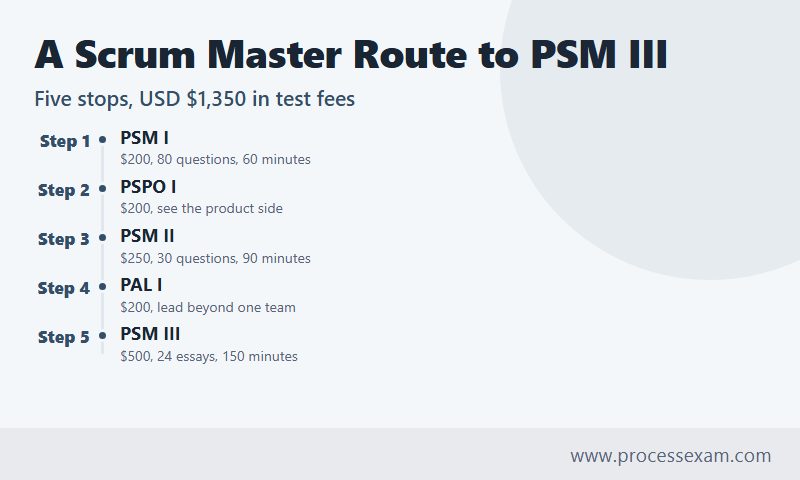
Begin with PSM I, because its focus areas span the whole framework, from empiricism and the team's values to the events, artifacts and Done, plus self-managing teams, facilitation, coaching, and managing products with agility. Those ideas show up in every other line, so this one assessment doubles as a base for the rest. Add PSPO I next if you want to see the product side that your Product Owner lives in. Move to PSM II once you have several Sprints of real facilitation behind you, and keep PSM III for when you coach beyond a single team. Following that exact route, the five test fees add up to $1,350.
If you own a product
Begin with PSPO I. Its $200 fee and 80-question format match PSM I, but the questions centre on product value, backlog management and stakeholders. PSPO II, at $250 for 40 questions, is where Scrum.org expects real Product Owner experience. Add PSM I afterwards only if you want to understand the Scrum Master's side of the team you work with.
If you write or test the software
PSD I is the developer credential, with 80 questions in 60 minutes at $200. The certifications page shows no PSD II or III, so a developer who wants more depth usually adds PSK I for flow or PSM I for the wider framework. Developers on design-heavy products can add PSU I.
If you manage people
PAL I comes first, with 36 questions. PAL-EBM follows if your job involves goals, metrics and funding decisions. A manager gains more from these two than from PSM I, since the questions are about enabling teams rather than facilitating one.
If several teams share one product
SPS builds on single-team Scrum and asks about the Nexus framework across 40 questions at $250. Take PSM I or PSPO I before it so the single-team vocabulary is automatic, then use SPS to show you can handle integration, dependencies and shared backlogs.
Why are the third-level attempts a different kind of exam?
PSM I, PSPO I, PSD I, PAL I and the rest are multiple-choice, multiple-answer and true/false tests scored against an 85% bar. PSM II and PSPO II keep that style but give partial credit on some questions, and PSM II allows 90 minutes for 30 questions. PSM-AI Essentials is multiple-choice only.
PSM III and PSPO III are a different animal. Scrum.org's pages describe essay questions only: 24 of them in 2.5 hours, typed by hand with no pasting of prepared responses, at $500 per attempt, and graded as Pass or Did Not Pass. The pages label the difficulty "Expert". You cannot memorise your way through; you have to write a reasoned position on a messy situation.
That has two practical consequences. First, practice for level III means writing, not clicking: draft answers to scenario prompts, then compare each against the wording of the Scrum Guide and ask where your reasoning went beyond it or against it. Second, the $500 price makes a blind attempt expensive, so do not book one until you have worked through real situations from your own team. The cheaper level II attempt is a fair test of whether you are close.
Is a course required, and what does a certificate keep costing?
A course is not required. The PSM I page puts it plainly: attendance is not a prerequisite, though a skills course is strongly recommended. The PSD page recommends a class in applying Professional Scrum to software development, the SPS page recommends a Scaled Professional Scrum class, and the PAL pages recommend their own classes. A course helps most in the rooms where you can argue a case with an instructor, which suits the higher levels more than level I.
Some figures people still quote are out of date. Older descriptions of Scrum.org certificates mentioned a required two-day course at about $1,195 and renewal every two years. Today the assessment pages state that each credential is lifetime with no annual renewal fee, and the PSM I page states a $200 fee per attempt with test passwords that do not expire until used. That last point is a small advantage: you can buy when the price suits you and sit when you are ready.
A realistic budget therefore looks like this.
| Plan | Certificates | Test fees |
|---|---|---|
| One credential | PSM I | $200 |
| Team pair | PSM I and PSPO I | $400 |
| Scrum Master growth | PSM I, PSM II, PAL I | $650 |
| Full Scrum Master route | PSM I, PSPO I, PSM II, PAL I, PSM III | $1,350 |
| All thirteen in the table above | One attempt each | $3,350 |
These are test fees for a first attempt at each; a retake costs the full fee again, and any class is extra. Nobody needs the last row, which is why choosing matters.
How do you prepare without writing thirteen study plans?
Every first-level test leans on the same short text, the Scrum Guide, so the shared groundwork is one careful reading. After that, each line needs only its own add-on: the Nexus Guide for SPS, the Kanban Guide for PSK I, the Evidence-Based Management Guide for PAL-EBM, and so on, all published by Scrum.org.
A workable pattern for any of them looks like this.
- Week one: read the relevant guide twice, then write the accountabilities and definitions from memory.
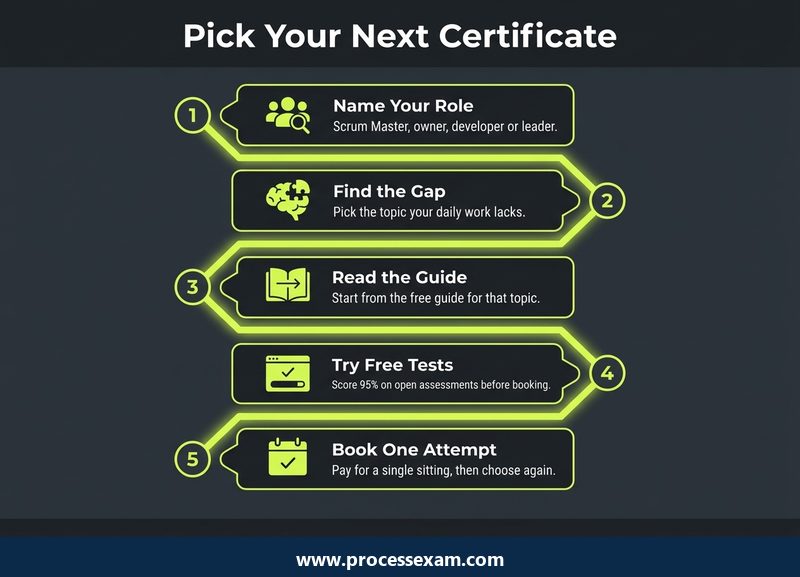
- Week two: take Scrum.org's free open assessments repeatedly. Scores near the top several times in a row are a better signal than one good run; many candidates wait for the mid-90s before booking, though that is a rule of thumb, not a Scrum.org figure.
- Between the two: after each open assessment, sort every miss into a cause: you misread the question, you did not know the term, or you knew it but chose the "practical" answer instead of the Scrum Guide's. Only the second cause needs more reading; the other two need slower, more literal reading of the question.
- Last days: read the questions you missed and rewrite the reasoning in your own words. Do not add new material the night before.
Because the 85% bar applies to nearly every one of these tests, an 80-question paper allows only twelve misses. That is why precision on wording beats speed: the questions often hinge on a word such as "must" or "only".
Which certificates can you safely skip or postpone?
Skip anything that does not match the work you will do in the next twelve months. A developer with no coaching duties rarely needs PSM II. A manager who never touches the Product Backlog can leave PSPO alone. Postpone third-level attempts until you have lived through the situations the essays describe.
Also postpone certificates for newer topics unless your team has adopted them. The AI Essentials credential makes sense when you already use assistants in Scrum work. SPS makes sense once you have more than one team on a product. Without that context you would be studying for a badge instead of a job.
Consider two people with the same budget of $400. One is a Scrum Master of two years who keeps running into stakeholder pressure and a muddled backlog. For that person, PSM I plus PSPO I is a good pair, because the second certificate fills the gap the daily work exposes. The other is a developer who moves into a lead role. For that person PSD I plus PAL I fits better, since the new job is less about building and more about enabling. Same money, different plans, and neither plan starts with the number one on a staircase.
Showing the result without a wall of letters
Three or four credentials read as a pattern; ten read as a collection. On a CV, put the one that matches the job you are applying for first, group the rest on a single line, and be ready to explain in an interview what each changed in how you worked. Recruiters can see the names, but a short example of a Sprint Goal you protected or a backlog you reordered does more than the letters.
The strongest single move for most people is one well-chosen credential followed by a pause. Use it for a quarter, notice which questions at work you could not answer, and let that gap pick the next certificate. Before you pay the $200 for the most common first step, check your readiness on the PSM I practice exam, and read the focus-area breakdown on the PSM I syllabus page to see how it connects to the rest of the family.
Frequently Asked Questions
Do I need PSM I before other Scrum.org certificates?
No. Scrum.org lists no prerequisite on the PSM I page, and the other lines such as PSPO I, PSD I and PAL I can be taken on their own. Some higher levels, such as PSPO II, carry readiness advice about experience, but that is guidance rather than a required earlier certificate.
How much do Scrum.org certification exams cost?
First-level attempts for PSM I, PSPO I, PSD I, PSK I, PSU I, PAL I, PAL-EBM and PSM-AI Essentials cost $200. PSM II, PSPO II and SPS cost $250. PSM III and PSPO III cost $500. All prices are per attempt, in US dollars.
Do Scrum.org certifications expire?
The assessment pages describe each certification as lifetime with no annual renewal fee. That differs from older descriptions that mentioned renewal every two years, so rely on the current Scrum.org pages rather than blogs or forum posts that quote earlier rules.
Which Scrum.org certificate is best for a beginner?
Match it to your role. A future Scrum Master starts with PSM I, a product owner with PSPO I, a developer with PSD I, and a manager with PAL I. PSM I is the most common first choice because its Scrum Guide base supports every other line.
Is PSM III or PSPO III multiple choice?
No. Scrum.org describes both as essay-only assessments with 24 questions in 150 minutes, typed by the candidate with no pasting of prepared responses. They cost $500 per attempt, and the result is Pass or Did Not Pass rather than a percentage.
- Scrum |
- Scrum.org Professional Scrum Master Test Questions |
- PSM I Question Bank |
- Scrum.org Professional Scrum Master Book |
- Professional Scrum Master Certification Cost |
- Professional Scrum Master Certification Requirements |
- Professional Scrum Master PDF |
- Scrum.org Professional Scrum Master Sample Questions |
- PSM I Exam Questions Download |
- PSM I Test Questions


