
PSM I Study Guide: How to Prepare for the Scrum Master Exam and Pass at 85%
An 85% pass mark sounds brutal, and the Scrum Guide is short enough to read in an evening, so candidates tend to assume PSM I is either impossible or trivial. Both beliefs cost attempts. The exam has 80 questions in 60 minutes and costs USD 200, and if every question counts equally you can miss about 12. What decides the result is how closely you have read a very short document, not how much Scrum experience you bring.
This guide is about passing PSM I itself: how deep to take the Scrum Guide, how the questions are phrased, how to use Scrum.org's open assessments, and how to run the hour on exam day. It is written for first-time candidates, for practising Scrum Masters who assume experience is enough, and for people retaking after a near miss.
Is the short Scrum Guide really all you need to pass PSM I?
Almost, but only if you read it the way a lawyer reads a contract. The current Guide, the 2020 edition that Scrum.org explains on its Scrum Guide 2020 update page, runs to only a few pages. Every word in it was chosen on purpose, which is why the exam can ask about a single verb. A sentence such as "the Product Owner is one person, not a committee" is a complete exam question waiting to be asked.
Candidates with years of practice often underperform for a simple reason: the workplace teaches local habits, and the exam does not test local habits. If your team has a Scrum Master who assigns tasks, a Daily Scrum that reports to a manager, or a Sprint that ends early when work runs out, you have seen Scrum as practised, not Scrum as written. The exam rewards the written version every time.
What the Guide gives you for free
The Guide is organised into purpose, definition, theory, values, the Scrum Team, the events and the artifacts. It uses a small, stable vocabulary: Developers, Product Owner, Scrum Master, Sprint, Product Backlog, Sprint Backlog, Increment, Product Goal, Sprint Goal and Definition of Done. If you can define each term in your own words and say where it appears in the text, you already hold most of what the exam draws on.
What it does not give you
The Guide says what Scrum is. It says little about what to do when a team is half-way through a Sprint and a stakeholder demands a change. PSM I questions often describe a situation like this and then ask which answer fits Scrum. That is why reading the Guide once is not enough: you need to practise turning its statements into decisions.
Old vocabulary that still lives in study material
Many blogs, slide decks and older books were written for earlier editions of the Guide, and they use words the current edition retired. Mixing the two vocabularies is a quiet way to lose marks, because an answer that sounds right in an old textbook may not match the text you are being tested on.
| You may have read | The 2020 Guide says | Why it matters in a question |
|---|---|---|
| Development Team | Developers, inside one Scrum Team | There are no sub-teams or hierarchies in the Scrum Team |
| Self-organising | Self-managing | The team decides who does what, when and how |
| Artifacts without commitments | A commitment for each artifact: Product Goal, Sprint Goal, Definition of Done | Each artifact has exactly one commitment attached |
| What and how in Sprint Planning | Why, what and how in Sprint Planning | The Sprint Goal is created in Sprint Planning |
| Roles | Accountabilities | The question is usually who answers for something |
Treat the table as a translation aid. If you are studying from a source that still says "Development Team", mentally convert it, and prefer the vendor's own text whenever the two disagree.
What do the PSM I numbers tell you about how to work?
The facts are simple, but their consequences are not obvious until you do the arithmetic.
| Exam detail | PSM I |
|---|---|
| Full name | Scrum.org Professional Scrum Master I |
| Exam code | PSM I |
| Exam fee | $200 USD |
| Number of questions | 80 |
| Duration | 60 minutes |
| Passing score | 85% |
| Question format | Multiple Choice, Multiple Answer, True/False |
Scrum.org lists the current details on its Professional Scrum Master I certification page; check it on the day you book.
Forty-five seconds a question
Sixty minutes divided by eighty questions is 45 seconds each. Nobody can look an answer up in that time, so the exam is a test of recall that has become automatic. A question about the length of the Daily Scrum should cost you two seconds, not twenty, because the harder items will need the saved time.
About twelve misses are allowed
At 85%, a perfect score is not required. If all 80 questions carry the same weight, you may miss roughly twelve and still pass. That sounds generous until you remember that multiple-answer questions usually give credit only when you select exactly the right set of options. One careless tick can cost a whole question.
The fee covers one attempt
The $200 fee is per attempt, and the access password you receive is valid for a single sitting. A failed attempt is therefore a second payment, which is a better reason than pride to book only when your practice scores say you are ready.
Which parts of the Scrum Guide deserve the closest reading?
All of it is fair game, but some passages generate far more questions than others because they are easy to mis-remember. Read these slowly and more than once.
Theory and values
Empiricism rests on three pillars: transparency, inspection and adaptation. Know what each one means and which event supports which. Learn the five Scrum Values (commitment, focus, openness, respect and courage) well enough to recognise a scenario in which one of them is being ignored. The Guide also says that Scrum is purposefully incomplete, a framework rather than a method, and that is the right instinct whenever an option invents a mandatory practice such as story points or a daily written report.
Accountabilities, not job titles
The Scrum Team is one team with no sub-teams or hierarchies, and it is self-managing. Developers are accountable for the plan for the Sprint, for quality through the Definition of Done and for adapting daily toward the Sprint Goal. The Product Owner is accountable for maximising value and for managing the Product Backlog, and is one person. The Scrum Master is accountable for establishing Scrum and for the team's effectiveness, serving the team, the Product Owner and the organisation in different ways. Questions often hinge on who owns a decision, so make a one-line list of who decides what.
Events and the timeboxes
Every event is a chance to inspect and adapt, and the Sprint itself contains all the others. Timeboxes are maximums, and they scale: the figures below are for a one-month Sprint, with shorter times for shorter Sprints.
| Event | Maximum length (one-month Sprint) | What the Guide expects |
|---|---|---|
| Sprint | One month or less | A new Sprint starts right after the previous one ends |
| Sprint Planning | 8 hours | Why is the Sprint valuable, what can be done, how will the work get done |
| Daily Scrum | 15 minutes | Every day, for Developers, to inspect progress toward the Sprint Goal |
| Sprint Review | 4 hours | Inspect the outcome with stakeholders and adapt the Product Backlog |
| Sprint Retrospective | 3 hours | Plan ways to increase quality and effectiveness |
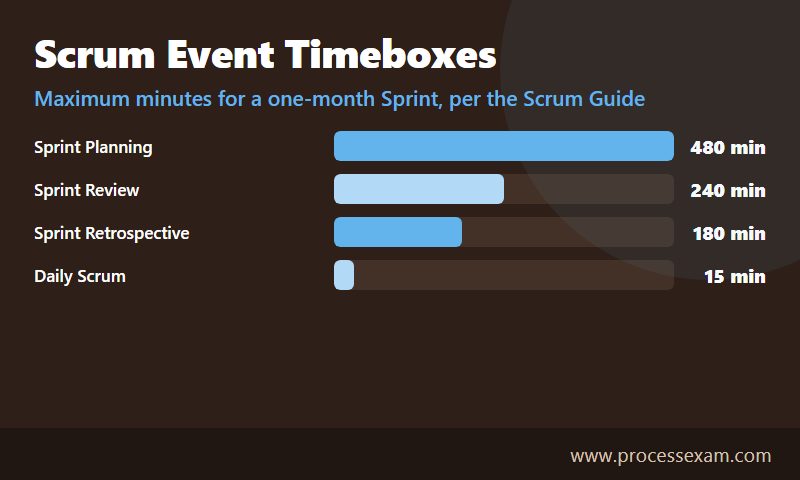
Two details catch people repeatedly. The Daily Scrum belongs to the Developers, so it is not a status meeting for the Scrum Master or a manager. And a Sprint Review is a working session with stakeholders, not a demonstration to be approved.
Artifacts and their commitments
Each artifact carries a commitment that gives it focus: the Product Goal for the Product Backlog, the Sprint Goal for the Sprint Backlog and the Definition of Done for the Increment. Be able to say which commitment belongs to which artifact without stopping to think. Remember that an Increment must be usable, that several Increments can be created within one Sprint, and that work not meeting the Definition of Done cannot be released or even presented as part of the Increment at the Sprint Review. The Guide also says that only the Product Owner can cancel a Sprint, and only if the Sprint Goal becomes obsolete.
If you want a structured outline of the same material, the PSM I syllabus on ProcessExam breaks the topics into the focus areas Scrum.org lists, which makes a handy checklist while you read.
How are PSM I questions worded, and how should you read them?
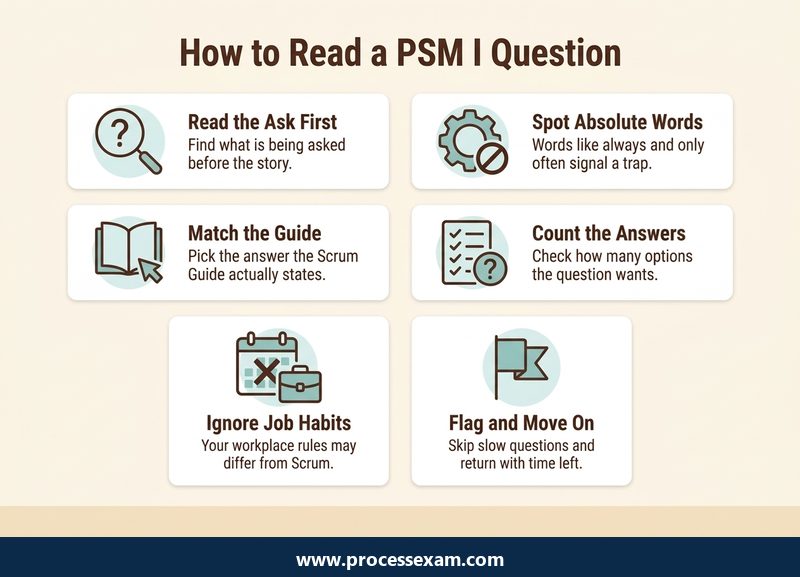
The questions follow a few patterns. Once you recognise the pattern, you stop reading the story and start reading the ask.
Pattern one: the plain statement
These are true/false or single-answer items that restate a Guide sentence, often with one word changed. "The Product Owner may be a committee if the product is large" is the kind of sentence that fails on a single clause. The right response is not to reason about large products but to remember what the Guide says.
Pattern two: the absolute word
Options containing words such as always, never, only, must and all deserve suspicion, because Scrum rarely deals in absolutes. Equally, an option that says "can" or "may" often matches the Guide's permissive wording. Treat these words as the part of the sentence that carries the answer.
Pattern three: the workplace story
A short scenario describes a team that has fallen into a habit and asks what the Scrum Master should do. Several options sound helpful. The correct one usually protects the team's self-management, serves the Product Owner or the organisation, or makes the problem visible, rather than solving it on the team's behalf. If one option has the Scrum Master deciding, assigning or approving, be careful.
Pattern four: choose all that apply
Multiple-answer items state how many options to pick. Read that number first. Mark the options you are sure about, then test each remaining option against the Guide sentence rather than against your sense of what seems sensible.
A worked example of word traps
Consider this invented question, written in the style of the exam rather than taken from it: "Which two statements about the Daily Scrum are true?" Suppose the options say that the Scrum Master must lead it, that it is held for the Developers, that it lasts at most 15 minutes, and that it must be held at a manager's request. Two options fit the Guide: the Developers hold it, and it is capped at 15 minutes. The Scrum Master leading it fails because the event belongs to the Developers, and a manager's request has no standing in the Guide at all. Checking each option against a specific sentence is faster and safer than debating it.
A worked example of a workplace story
A second invented example: "A Developer says the Sprint Backlog is too long and asks the Scrum Master to remove items." A tempting answer has the Scrum Master trimming the list. The Guide places the Sprint Backlog with the Developers, who adapt their plan during the Sprint, and negotiation about scope happens with the Product Owner. The Scrum Master coaches that conversation rather than performing it. The pattern generalises: when an option takes a decision away from the people who own it, it is rarely the one the exam wants.
How should you use open assessments and other practice material?
Scrum.org publishes open assessments, among them the Scrum Open assessment, so that candidates can check their knowledge before paying for the certification attempt. They are useful for one reason in particular: they show you how Scrum.org words its questions, in the vendor's own voice. Use them early and often.
Use practice to diagnose, not to memorise
The point of a practice attempt is the review afterwards. For every question you miss, or hit by luck, write down the Guide sentence that settles it. After a few attempts you will see that the misses cluster: perhaps all about timeboxes, or all about who may decide. Go back to the Guide for those passages instead of doing more questions on the same topic, because repeated questions on a weak topic mostly repeat the same misunderstanding.
Rotate the sources
One bank of questions teaches you that bank's habits. Mix the vendor's open assessments, a reputable course if you take one, and a set of timed full-length mocks. When you want realistic timing, the PSM I practice exam on ProcessExam runs the same 80-question, 60-minute shape, so you can test your pace as well as your knowledge.
Beware answer memorisation
If you recognise a question because you have seen it before, you are measuring your memory of that question, not Scrum. Treat a score as meaningful only on questions you have not seen. When that score stays in the 90s across several fresh attempts, you have a margin above the 85% line.
What about open-book rules?
Candidates often ask whether PSM I is open book. Scrum.org publishes its own rules for what is allowed during an attempt, and they can change, so read them on the vendor's pages before you sit. In practice the question matters less than it seems: with 45 seconds a question there is no time to search, and a candidate who needs to look up the length of a Sprint Review is not ready.
How do you know when you are ready to book the attempt?
Readiness is a set of observable signs, not a feeling. Use this table as a checkpoint before you pay.
| Checkpoint | What to do | Sign you are ready |
|---|---|---|
| Guide read twice | Read it slowly, marking every "must", "is" and "only" | You can restate any section without looking |
| Vocabulary fixed | Write one line for each term and accountability | You answer definition questions in seconds |
| Open assessment attempts | Take several, reviewing each miss against the Guide | Scores stay in the 90s on fresh questions |
| Timed full run | Complete 80 questions in 60 minutes | You finish with about ten minutes to review flags |
| Explain, do not recite | Teach a colleague why each event exists | You can justify an answer without quoting |
A course is optional, and it can speed things up if you learn better from discussion, but it does not replace this checklist. Candidates who finish a class and skip the Guide often still lose marks on exact wording. Likewise, a few weeks of daily half-hour sessions usually works better than one long weekend, because the exam rewards recall that has had time to settle.
What should you do in the hour of the exam itself?
Treat the attempt as a pacing exercise with a knowledge test inside it.
Before you start
Have your password ready, close other applications, and confirm that you will not be interrupted for an hour. The password has no expiry date but works for one attempt, so do not open the exam until you are ready to finish it. Read Scrum.org's current instructions on that day instead of relying on what a past candidate remembers.
Pace in thirds
Aim to reach question 27 by about minute 20 and question 54 by about minute 40. This keeps you on a 45-second average and leaves the last ten minutes for flagged items. If a question runs past a minute and a half, choose your best answer, flag it and move on.
On the hard questions
Remove options that contradict a Guide sentence, then choose among those left. For multiple-answer items, confirm the count before you submit. For true/false items, read the whole sentence again for a small word that flips its meaning.
After you submit
You receive a result and a breakdown by competency, which is useful if you need to retake. If you pass, the credential never lapses, nothing is due each year to keep it, and you receive a Credly badge to share. If you miss, use the breakdown to aim your reading at the weakest area before you pay for another attempt.
Is PSM I worth sitting, and where does it lead?
For anyone who works with a Scrum Team, PSM I gives a shared, precise vocabulary and independent proof that you know the framework as written. That helps in interviews for Scrum Master, delivery and agile coordination roles, and it is a sensible entry point whether you are changing careers or formalising years of practice. It also settles arguments: when two colleagues disagree about what Scrum requires, the person who has read the Guide closely usually wins.
It is also a foundation. Scrum.org offers PSM II and PSM III as further steps for people who want to show that they can apply Scrum in harder situations. Start with PSM I, build experience, and decide on the next step once you have run Sprints with the framework you have now learned precisely.
Frequently Asked Questions
How many questions are on the PSM I exam?
The PSM I exam has 80 questions in 60 minutes, which averages 45 seconds per question. Formats include Multiple Choice, Multiple Answer and True/False, so practise reading quickly and confirm how many options a multiple-answer item wants before you select anything.
What is the passing score for PSM I?
The passing score is 85%. If all 80 questions carry equal weight, you can miss roughly twelve and still pass. Multiple-answer items usually need the complete correct set, so a single wrong tick can cost a whole question, which makes careful reading as important as knowing the content.
Is the PSM I exam open book?
Scrum.org sets its own rules for what you may use during an attempt, and they can change, so read them on the vendor's pages before you sit. With 45 seconds per question, searching is not a realistic plan anyway. Prepare as though you must know the Guide.
What is the best way to prepare for PSM I?
Read the current Scrum Guide closely at least twice, define each term in your own words, then take open assessments and timed mocks. Review every miss against the exact Guide sentence. A course can help, but Scrum.org does not make one mandatory for the exam.
Does the PSM I certification expire?
No. Once earned, PSM I stays valid for life and nothing is charged yearly to keep it. The fee is USD 200 per attempt, and the access password is valid for one sitting only, so book the attempt when your practice scores are consistently above the pass mark.
- Scrum |
- Scrum.org Professional Scrum Master Test Questions |
- PSM I Question Bank |
- Scrum.org Professional Scrum Master Book |
- Professional Scrum Master Certification Cost |
- Professional Scrum Master Certification Requirements |
- Professional Scrum Master PDF |
- Scrum.org Professional Scrum Master Sample Questions |
- PSM I Exam Questions Download |
- PSM I Test Questions


