
PM4SD Foundation Exam: Syllabus, Pass Mark and Study Plan
A destination board, a heritage charity or a grant-funded tourism programme that wants proof its project will be run with discipline will often put one name in front of its staff: PM4SD. The Foundation paper from APMG International has 50 multiple-choice questions, runs 40 minutes, is closed-book and needs 25 marks to pass. This guide shows what it tests, using a tourism project people actually recognise.
Who ends up needing PM4SD Foundation, and who asks for it?
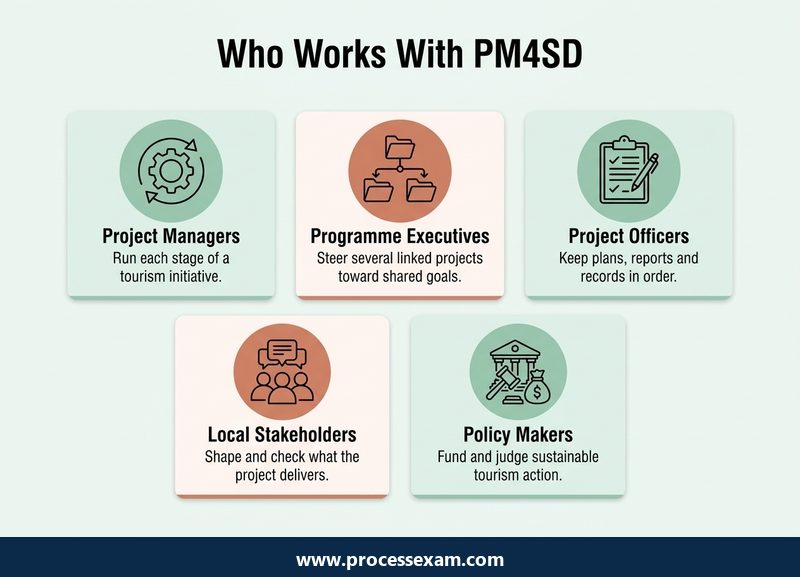
PM4SD stands for Project Management for Sustainable Development. APMG International describes the Foundation level as written for people involved in the day-to-day management of tourism initiatives, whether projects, programmes or strategies, with sustainable development as the aim. Its examples are project and programme managers, executives, project officers and stakeholders, plus people who make decisions on sustainable development policy and tourism management at local, regional, national or international level.
In practice that gives four typical readers. The first is a project officer at a destination management organisation or regional tourism board who has to turn a funding award into a delivery plan. The second is a programme manager at an NGO or heritage trust who reports to a donor and needs the donor to see clear roles, stages and benefits. The third is a consultant who writes and runs grant-funded tourism projects for several clients and wants a common language with them. The fourth is a student or early-career professional in tourism who wants a project credential that speaks about communities and the environment, not only budgets and schedules.
The people who ask for it are usually the ones who pay for the work or answer for it: a funder who wants a delivery method named in the proposal, a public authority that wants roles and responsibilities written down before money is released, or a client who has already adopted PM4SD and wants everyone to use the same terms. A training note from one accredited provider put the pitch this way: the method gives public authorities a guarantee that a project will become concrete actions with defined roles, and that those actions will have a real effect on local communities. Treat that as the provider's description rather than a rule, and check what a specific funder or employer expects before you book.
No prerequisite is listed for the Foundation level on APMG's page, so a first job in a tourism office and a ten-year project veteran sit the same paper.
What is PM4SD, and what does it borrow from PRINCE2?
PM4SD is a project management method built on PRINCE2 and adapted for tourism and cultural projects. If you know the PRINCE2 vocabulary, a lot of PM4SD will feel familiar: a business case that justifies the work, defined roles, work split into stages, management by exception, and a set of processes from starting up to closing. If you have never met PRINCE2, nothing is lost; the Foundation paper expects you to learn PM4SD's own terms, and there is a short overview of PRINCE2 on Wikipedia if you want to see the method it grew from.
The difference is the purpose. A PRINCE2 project asks whether it delivers what the business case promised. A PM4SD project asks that too, and then asks whether the benefit lasts, who in the community feels it, and what the environment and local culture carry afterwards. That shift explains why the method adds sustainable tourism indicators, attention to tourism policy and stakeholder and benefits management to the core structure. A 2016 course outline from one accredited provider lists modules on sustainable tourism indicators, tourism policies, stakeholder management, benefits management and destination management alongside the usual project components and processes. Treat that module list as one provider's choice; APMG's own page names the Foundation learning areas used in this guide.
The same provider's note names Dr Silvia Barbone, founder of the Foundation for European Sustainable Tourism, as the developer and main author of PM4SD, and describes her background in European tourism, cultural and social policy and funding. That European public-funding background shows in the method's attention to policy, partnership working and accountability, which is why people on projects supported by public or donor money meet it more often than someone running a private hotel renovation would.
How is the Foundation paper set out, and what are its limits?
APMG International publishes the format on its PM4SD Foundation page. The exam is multiple choice, with 50 questions in one paper, 40 minutes allowed, closed book, and 25 marks out of 50 (50 percent) needed to pass. That page also lists what you are expected to learn: the characteristics and context of a project and the advantages of adopting PM4SD; the purpose of the PM4SD roles, management products and components; the PM4SD principles; and the purpose, objectives and context of the PM4SD processes.
| Exam detail | PM4SD Foundation |
|---|---|
| Exam name | APMG International Project Management for Sustainable Development Foundation |
| Exam code | PM4SD Foundation |
| Vendor | APMG International |
| Number of questions | 50 |
| Duration | 40 minutes |
| Passing score | 50% (25 of 50 marks) |
| Exam fee | USD $371 |
| Format | Multiple choice, closed book |
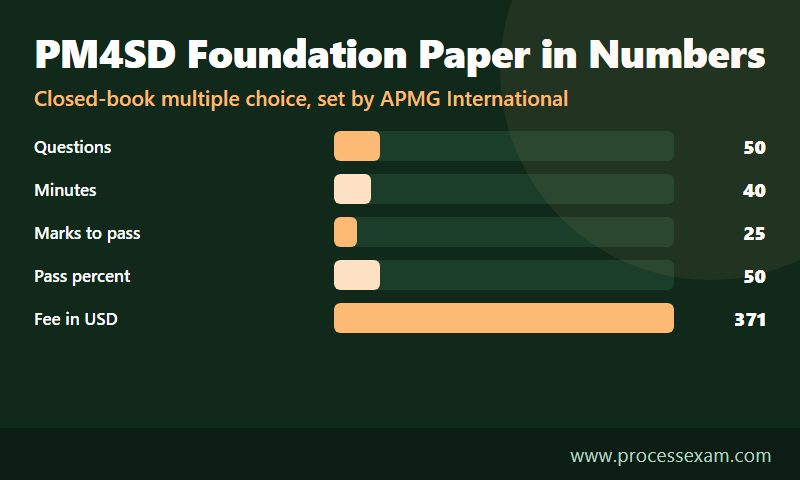
The numbers need some unpacking. First, 40 minutes for 50 questions is 48 seconds a question, so a question you cannot answer in under a minute should be flagged and left. Next, the pass line is half the marks, which is lenient on paper but only if your knowledge has no big hole: a handful of questions in one area can be the difference. Last, the fee is the examination fee as listed for the exam; the price of a training course, a manual and any retake is separate, and APMG exams are normally booked through an accredited training organisation, so ask the provider what its price covers.
The exam sits at the bottom of a two-step route. APMG's Practitioner page describes the next level as applying and tailoring PM4SD in a scenario, with 8 questions of 10 marks each, 40 of 80 marks to pass, 2.5 hours and an open book restricted to the PM4SD manual. The Foundation paper is a test of knowing and recognising; Practitioner is a test of using.
Which parts of a sustainable tourism project does the syllabus map to?
A syllabus list is easier to remember when you attach each item to a project you can picture. Take the Lakeside Heritage Trail, an invented example: a regional board has won a grant to turn a disused railway into a walking and cycling route linking five villages, with a small visitor centre, local guides and a seasonal cap on numbers. It is used below only to show how the method's pieces fit; it is not from the exam.
Principles and context: why the method exists
The Foundation learning areas begin with the context of a project and why PM4SD is worth adopting. In the trail project, the context is a funder, a board, five village councils, a wildlife site and several hundred thousand potential visitors, all with different interests. The principles are the habits that keep such a project honest, for example that the work has a continuing business justification and that it learns from experience. The paper expects you to recognise a principle from a short description of what a team did or failed to do. A useful drill: take any sentence in a project report and say which principle it follows or breaks.
Business case and benefits: why this trail, and who gains
The business case holds the reasons for the trail, the options considered, the cost and the benefits expected. In PM4SD, benefits are not only visitor numbers. They can include income that stays in the villages, jobs for local guides, reduced erosion on the old track bed or visitor behaviour that protects the nesting site. The question to practise is whether a stated benefit is measurable, who owns it and when it will be reviewed, including after the grant has ended. Questions here often show a weak statement, such as a promise to raise awareness, and ask which option makes it checkable.
Sustainable tourism indicators belong here too. A usable indicator has a starting value, a target, a source of data and a person who reads it. Guest nights spent in village-owned lodging, the share of the trail-side shops that are locally owned, tonnes of waste sent to landfill and the number of days the nesting site was closed to visitors are all things a team could count. Compare that with a wish to improve the visitor experience, which nobody can count. When a question asks which statement could serve as an indicator, pick the one that someone could measure on a date.
Risk, issue and change: when something moves
Three words, three different things. A risk is something that might happen, such as a storm that damages the bridge before opening. An issue is something that already has happened, such as a landowner withdrawing access. A change is a request to alter what was agreed, such as adding a sixth village. The paper checks that you can sort a short scenario into the right category and name the sensible next management step. Tourism adds seasonality, weather, political shifts and community opposition, so expect realistic situations rather than abstract definitions.
Organisation: boards, owners and the people affected
Roles are the part of the syllabus that most punishes guessing. The trail needs a decision-making board with someone accountable for the business case, someone who represents the users and someone who speaks for the suppliers, plus a project manager, team managers, assurance and support. PM4SD also pushes the idea that communities and other stakeholders are managed deliberately, not informed at the end. Learn who decides, who advises, who delivers and who checks, and learn why a role should not be held by the person it is meant to check.
Quality: sustainability inside the acceptance test
Quality in the method means a product is fit for its purpose and meets stated criteria. For the visitor centre, one criterion is that the building is finished; another might be that waste is sorted and that signage is in the languages of the main visitor groups. The sustainability measure has to be written into the criteria before work starts, or it will be forgotten at handover. Expect questions that ask when a criterion should be defined and who confirms it was met.
Planning: products first, then activities
Planning in this family of methods starts from the products to be delivered, not the tasks. For the trail, products include the surfaced path, the signage set, the guide training programme and the visitor-numbers monitoring plan. Tasks and a schedule follow from those. The paper tests whether you know what a plan contains, which levels of plan exist and why the next stage is planned only when the current one is nearly finished.
Progress control: staying inside tolerance
Control means the board gives the project manager limits, called tolerances, for time, cost and other aspects, and the manager reports and escalates when a forecast goes outside them. If the surfacing contractor says the path will cost much more than the stage plan allows, that is an exception, and it goes upward with options instead of being quietly absorbed. Questions here are logic questions: who may do what, at what point, and what must be reported.
This site's syllabus page lists the areas in a similar order, which makes it a handy checklist: PM4SD Foundation syllabus.
How does the Lakeside Heritage Trail move through the five processes?
The processes describe the life of a project from the first idea to the last handover. The course outline mentioned earlier names five: direction, initiation, stage definition and planning, stage control and product delivery, and closure. Walking one project through them gives you a story to hang the questions on.
- Directing the project. The board authorises the start, gives the go-ahead for each stage, gives ad hoc direction when something big changes, and confirms closure. The board does not manage day-to-day work; it decides at defined points. A common exam trap is an option that has the board doing the manager's job.
- Initiating the project. Before the first village signs anything, the team sets down the business case, the plan, the way risks and quality will be handled, and how it will deal with communities and partners. In PM4SD this is where sustainability goals become specific targets that can be checked later.
- Defining and planning a stage. Near the end of each stage, the manager plans the next, updating the business case and the risks with what was learned. For the trail, stage one could be design and consents, stage two construction of the path, stage three the visitor centre and training.
- Controlling a stage and delivering products. Work is handed to teams in packages, progress is watched, problems are captured and escalated, and finished products are accepted against their criteria. Questions about work packages, reports and checkpoints belong here.
- Closing the project. The trail is handed to the people who will run it. Closure checks that products were accepted, records lessons, and, in a sustainability project, makes sure someone has the job of measuring whether the benefits actually arrive after the project team has gone.
The useful habit is to place any scenario in the process where it happens. A question describing a funder who asks for a change halfway through construction belongs to stage control and change handling; a question about who signs off the end of the design stage belongs to directing. Once the process is named, the answer options usually separate themselves.
What does a Foundation question look like, and where do candidates slip?
The paper uses single-answer multiple choice. Most questions give a short statement or a mini-scenario and ask you to pick the option that matches the method. The wrong options are not random; they are typically one that is true of another method, one that is right but belongs to a different role, one that is right but at the wrong time, and one that is simply absurd. Your task is to find which of the plausible options is wrong in context.
Here is an invented example in that style, so you can practise the reading. A village council on the trail project says it will only allow the path across its land if a share of the visitor income stays in the village. Which part of the project should record this? The likely answer is the business case, with a measurable benefit and an owner, rather than the risk log or a one-off meeting note, because it is a reason for the project and a benefit to be tracked. A second: during construction, a contractor reports that a rare bird has begun nesting beside the planned path. Is this a risk, an issue or a change? It is an issue, because it has already happened and needs a management response, and it may then prompt a change request to reroute the path.
APMG hosts sample papers on its examination site, so read the format first-hand: the APMG sample papers page is where its published samples are listed. Use them for wording and level, not as a prediction of what you will see.
Here are patterns that cost candidates points on method-based Foundation papers and that suit this syllabus especially well:
- Generic project management answers. An option can be good advice for any project and still not be what PM4SD says. If you are unsure, prefer the option that names a PM4SD role, product or process over one that sounds like common sense.
- Mixing the board and the manager. The board decides and is accountable; the manager runs the stage. Options that give one the other's duty are usually wrong.
- Treating sustainability as a late add-on. If an option puts a sustainability measure into the closing report only, check whether another option places it in the business case and the acceptance criteria. The earlier placement tends to be the one the method wants.
- Confusing risk, issue and change. Read the verb. Might happen is a risk, has happened is an issue, wants to alter what was agreed is a change.
- Running out of time on a hard question. At 48 seconds a question, there is no room to puzzle for three minutes. Mark it, move on, return.
Which study plan works for people with no PRINCE2 background?
Since the paper is closed book and every question is multiple choice, the goal of study is fast recall and recognition of terms, plus the ability to tell similar options apart. A plan of three weeks at about an hour a day suits most working people; two weeks is enough if you already use PRINCE2 or a similar method; allow four if you are new to project work. Adapt the days below rather than copying them.
| Week | Focus | What to finish |
|---|---|---|
| 1 | Vocabulary and roles | Principles, roles, management products, the five processes in order; one-page diagram of who decides what |
| 2 | Components with your own project | Write a one-paragraph business case, a small risk register, acceptance criteria and a stage plan for any tourism project you know |
| 3 | Questions and timing | Two timed sets of 50 questions in 40 minutes, review every wrong or guessed answer, fix by topic |
Building your own small project is the single best use of week two. It forces you to decide which sustainability measure goes in which document and who approves it, and that is what the questions ask. Pick something real near you: a village trail, a museum's accessibility plan, a coastal clean-up and visitor code of conduct.
Courses are the usual route. APMG exams are booked through accredited training organisations, and the Foundation course has been described by one provider as three intensive days with the exam on the last day. Self-study is possible if the exam can be booked separately, but you need the method's manual and a way to be tested on it. Whichever route you pick, build in timed practice, because the clock is what surprises well-read candidates. After the first week, the PM4SD Foundation practice exam makes a good first benchmark: attempt a paper cold, then go back through the explanation for any miss.
Making use of the week before the exam
Keep the last week for consolidation. Redraw your one-page diagram from memory; if you cannot, that is the topic to revisit. Re-do the questions you got wrong, not new ones. The evening before, read your error list and stop. On the day, take the first minute to decide how you will pace: roughly 20 minutes for a first pass answering what you know, 15 for the flagged questions and the rest as a buffer.
What can a PM4SD Foundation certificate lead to?
Foundation is an entry credential. It shows you know the method's vocabulary and structure. It does not by itself show you can run a project with it; that is what Practitioner assesses. Many people stop at Foundation because their role is to work inside a team: a project officer, a coordinator at a destination board, a community representative on a project board, a researcher working on tourism policy.
For those who want to lead, the Practitioner paper is the next step and APMG describes it as aimed at the same audience, those who manage tourism initiatives for sustainable development day to day. The open-book format means the study shifts from memorising to knowing where to find and how to apply the manual quickly.
Beyond the exam, the credential helps most where the work is funded by someone who must justify the spend. Grant applications can cite a named method. Reports to a board can use shared language. Teams from different countries on a cross-border tourism project can avoid arguments about what a stage or a tolerance means. It is less useful as a general project credential for purely commercial work, where a broader certificate such as one in PRINCE2 or a general project management qualification may be recognised more widely. Check what the employers or funders you actually deal with ask for before choosing.
When you are ready to test where you stand, work through the free sample questions first, then do a full 50-question, 40-minute attempt against the clock and look at which areas still lose you marks.
Frequently Asked Questions
How many questions are on the PM4SD Foundation exam?
The PM4SD Foundation paper has 50 multiple-choice questions, with 40 minutes allowed and no reference material, since the exam is closed book. That works out at 48 seconds per question, so practise flagging hard questions and returning to them instead of spending several minutes on one.
What is the pass mark for PM4SD Foundation?
APMG International requires 25 marks or more out of the 50 available, which is 50 percent. The line is modest, but a weak area such as roles or the business case can still cost enough questions to leave you short, so check every syllabus area before you sit.
How much does the PM4SD Foundation exam cost?
The listed exam fee is USD $371. A training course, the method manual or a retake would be extra, and APMG exams are normally booked through an accredited training organisation, so ask the provider exactly what its price includes before you commit to a date.
Are there any prerequisites for PM4SD Foundation?
APMG International's Foundation page lists no entry requirement, so you can sit the exam without prior certification. Experience in tourism, sustainability or project work helps you picture the scenarios, and PRINCE2 knowledge is useful because PM4SD is built on it, but neither is demanded.
What comes after PM4SD Foundation?
The next level is PM4SD Practitioner, which APMG describes as applying and tailoring the method in a scenario. Its paper has 8 questions worth 10 marks each, needs 40 of 80 marks, lasts two and a half hours and is open book, limited to the PM4SD manual.
- APMG International Project Management for Sustainable Development Foundation Exam Questions |
- APMG International Project Management for Sustainable Development Foundation Questions |
- APMG International Project Management for Sustainable Development Foundation Study Guide |
- PM4SD Foundation Certification |
- PM4SD Foundation Questions |
- PM4SD Foundation Practice Test |
- PM4SD Foundation Sample Exam |
- Project Management for Sustainable Development Foundation Certification |
- APMG International Project Management for Sustainable Development Foundation Book |
- APMG International PM4SD Foundation BOK PDF |
- Project Management for Sustainable Development Foundation Certification Requirements |
- APMG International Project Management for Sustainable Development Foundation |
- APMG International Project Management for Sustainable Development Foundation Sample Questions |
- PM4SD Foundation Test Questions |
- Project Management for Sustainable Development Foundation PDF


