
PCSA Certification: What the Pega CPSA Exam Covers and How to Pass It
Updated on 29 September 2026. What’s new: the exam now targets Pega Platform '25 (paper code PEGACPSA25V1) and adds a Pega GenAI topic worth 10% of the marks
PCSA is the older name for what Pega now calls the Certified Pega System Architect exam, CPSA. It is the entry-level Pega developer exam: 60 questions in 90 minutes, USD $190, and 65% to pass. The current paper is written for Pega Platform '25 and weights case management highest, at 25% of the marks. This guide covers the topics, the rules and a six-week plan.

If you searched for "PCSA certification" and landed on a page that talks about CPSA, you are in the right place. The credential is the same one, and Pega renamed the exam code in step with its platform releases. Older study notes, forum threads and practice sites still say PCSA, and some quote version 8.6 or 8.8 figures that no longer describe the paper you will sit.
The rest of this article is built around what actually earns marks. It explains what changed, where the 60 questions come from, what each topic asks you to do, how the booking and exam-day rules work, and how a beginner can prepare in six weeks. It is written for developers, analysts and business users who are new to Pega and want a plain route to the first Pega certificate.
Is PCSA the same as CPSA, and who is the exam for?
Yes. PCSA (Pega Certified System Architect) and CPSA (Certified Pega System Architect) are two spellings for the same first-level architect credential. Master lists the exam as CPSA, Certified Pega System Architect, and the Pega Academy exam page uses the same name. The exam code carries the platform release, so the current paper is PEGACPSA25V1 and earlier ones read PEGACPSA88V1 or PEGAPCSA87V1.
The exam is aimed at people who will build or configure Pega applications: junior developers, low-code builders moving into full development, business analysts who work close to the build, and consultants who want a recognised starting credential. It is the base of the architect ladder, so later Pega exams assume you already think in cases, data and rules.
Pega does not ask you to hold any earlier certificate. The exam page names one prerequisite, the System Architect mission on Pega Academy, which is the training path built for this paper. No fixed work experience is required, although candidates who have built even a small case type in a practice system find the scenario questions far easier.
The table below sets out the figures Master holds for this exam.
| Exam detail | CPSA |
|---|---|
| Exam name | Certified Pega System Architect |
| Vendor | Pega |
| Exam code | CPSA (paper code PEGACPSA25V1) |
| Version | CPSA Version 25 |
| Exam fee | USD $190 |
| Number of questions | 60 |
| Passing score | 65% |
| Duration | 90 minutes |
The vendor's own Certified Pega System Architect exam page holds the live details, including the list of languages the paper is offered in. Check it on the day you book, because Pega moves the exam to a new platform release from time to time and the fee or blueprint can move with it.
What changed since the old version 8.6 exam?
The biggest change is the platform. Older articles, including earlier versions of this one, described the exam as version 8.6. The paper that Pega Academy lists today is built on Pega Platform '25. I checked the exam page in September 2026, and it shows the code PEGACPSA25V1, matching the CPSA Version 25 entry in Master.
Three practical differences follow from that jump.
- Pega GenAI is now a scored topic. It carries 10% of the paper, the same as security or user experience. Nothing like it existed in the 8.6 blueprint.
- Insights and DevOps are named topics. Reporting and the delivery pipeline are each worth 5% and appear as their own lines in the blueprint.
- The study material moved. The System Architect mission on Pega Academy is the path Pega names as the prerequisite. The mission page I checked in September 2026 lists three missions, 13 modules and 10 challenges, about 41 hours in all, and states Pega Platform '24.2 as its version. That is one release behind the exam paper, so treat the mission as the foundation and read the current release notes for anything newer.
If a study guide you own still says 8.6, or mentions exam codes ending 87V1 or 88V1, use it only for concepts that have not moved, such as how a case is structured. Do not rely on it for topic weights, the GenAI material or the interface tooling.
How are the 60 CPSA questions split across the eight topics?
Pega publishes a weighting for every topic, and the numbers add up to 100%. Case management is the largest at 25%, followed by data and integration at 20% and application development at 15%. User experience, security and Pega GenAI are worth 10% each, while insights and DevOps are worth 5% each.
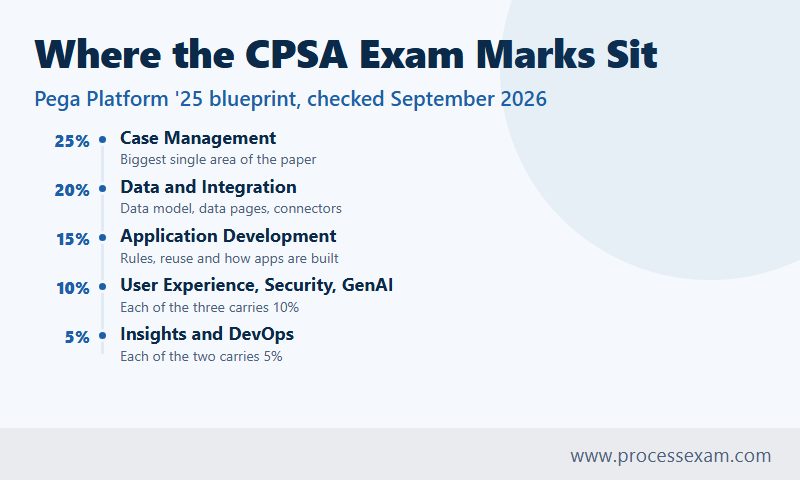
Turn those percentages into questions and the priorities become clear. On a 60-question paper, 25% is about fifteen questions on cases alone, and data and integration adds about twelve more. Those two topics together are roughly 45% of the paper. Insights and DevOps together are about six questions, so an hour spent there returns far less than an hour spent on case design.
| Topic | Weight | Rough number of questions out of 60 |
|---|---|---|
| Case Management | 25% | 15 |
| Data and Integration | 20% | 12 |
| Application Development | 15% | 9 |
| User Experience | 10% | 6 |
| Security | 10% | 6 |
| Pega GenAI | 10% | 6 |
| Insights | 5% | 3 |
| DevOps | 5% | 3 |
The question counts are simple arithmetic from Pega's percentages, not figures Pega prints, so treat them as a guide for planning your time rather than a promise about any one sitting. The percentages are the vendor's own weighting from its September 2026 exam page.
With a 65% pass mark you need 39 correct answers out of 60, which means you can miss twenty-one. That margin is generous only if you avoid throwing away a whole topic. A candidate who ignores insights, DevOps and GenAI can lose up to twelve questions before touching anything else, leaving almost no room for mistakes in the big three.
What does each of the eight topics actually ask you to do?
Case management, data and integration, and application development make up 60% of the paper. They are also the topics that a practice system teaches best, so this is where hands-on time pays off.
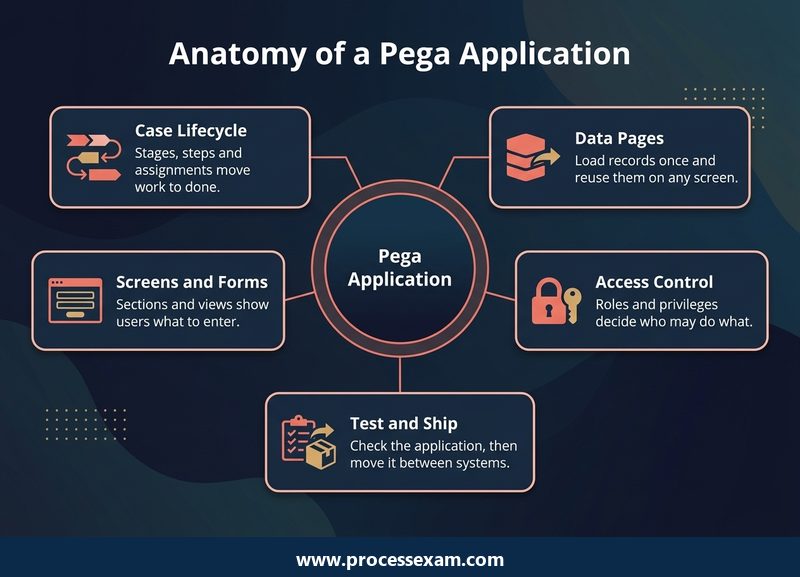
Case management: modelling work from start to finish
A Pega case is a unit of work with a lifecycle. The lifecycle is divided into stages, each stage holds processes, and each process holds steps that create assignments, run automations or wait for an outcome. Expect questions that describe a business process, such as a claim or a service request, and ask you to place its parts correctly in that structure.
Learn the difference between a primary path and an alternate stage, how a case moves when a step is skipped or fails, and when a child case is better than another step in the same process. Know how work is routed to people and to queues, how service levels raise urgency, and how a case is resolved or withdrawn. Scenario wording matters here: a question that says "separate team" or "runs in parallel" is usually pointing at a child case.
Data and integration: getting information in and out
This topic tests the data model and how an application reaches outside systems. You need to understand data types, properties, how a data page loads and caches a record so many screens can reuse it, and how to choose between a stored copy and a fresh call to a source.
For integration, know the ideas behind REST and other connectors: what a request needs, how a response is mapped back onto properties, and what should happen when the other system is slow or unavailable. Questions rarely ask for code. They ask which configuration solves the described problem, so being able to say why a data page beats copying values into the case is worth several marks.
Application development: building rules the Pega way
Here the exam moves from single features to how an application is put together. Concepts that come up include how rules are organised into classes and rulesets, how a new application reuses rules from a base layer, how a rule resolves to the version that applies, and why a specialised copy should be made rather than editing a shared one.
The safest way to prepare is to build. Create a small application from scratch, then add a second case type that reuses a data page and a section from the first. You will meet the reuse questions in practice before you meet them in the exam.
These five topics add up to 40% of the marks. Each is smaller than case management, but together they decide whether you finish comfortably above 65%.
User experience: what the worker and customer see
Expect questions on building a screen from sections and views, showing fields conditionally, validating what people type, and keeping an interface usable on small displays and for people who use assistive technology. The exam favours the low-code route: configure a view first, and reach for custom work only when the configured route cannot do the job.
Security: who can see and do what
Security questions revolve around access groups, roles, privileges and how a user signs in. A typical scenario says that one group may open a case but not approve it, and asks where the restriction belongs. Learn the chain from operator to access group to role to privilege, and remember that hiding a button is not the same as denying access to the action behind it.
Pega GenAI: assisting, not replacing, the builder
This is the newest topic and worth 10%. The blueprint centres on how generative AI features are used inside Pega applications and during design, and on using them responsibly. You should know in plain terms what these features do for a builder or a worker, where a human should still review the output, and what data-handling questions to ask before switching a feature on. Pega Academy hosts the current GenAI learning; read it rather than relying on older notes, as none of the 8.6-era guides cover it.
Insights: turning case data into answers
Insights is about reporting. Know how to build a report over case data, choose columns and filters, and share results with the right audience. Questions are usually short and practical, such as which report setup shows open cases by team.
DevOps: moving a finished application safely
DevOps covers testing and delivery. You should understand why an application is tested before it moves, how it is packaged and promoted between environments, and why the same package should travel unchanged from test to production. It is only 5%, so aim to understand the flow rather than memorise tool screens.
How do you book the CPSA exam, and what are the rules on the day?
You register through Pega Academy and schedule the sitting with Pega's exam delivery partner. Master points candidates to Pearson VUE's Pega page for scheduling. Start from the Academy exam page, because it links you to the right paper code, and confirm the code on your booking matches PEGACPSA25V1 before you pay.
Plan the booking around your study, not the other way round. A date six weeks out gives you a firm deadline and enough room for slack. Choose a time of day when you are sharp: the paper is 90 minutes long with 60 questions, which works out at one and a half minutes for each, so there is little time to recover from a slow start.
Some points to settle before the day:
- Identification and environment. Follow the delivery partner's instructions for the ID you must bring and, if you test from home, the room and equipment checks. Do these a few days early rather than in the last hour.
- Language. Pega offers the paper in several languages, including English, Japanese, Spanish, French, German and Brazilian Portuguese. Sit it in the language you studied in, because technical terms can read differently when translated.
- The pass mark. Pega sets it at 65%, which is 39 of 60 questions.
- Retakes. The vendor page I checked did not state a retake rule, so read the current policy on Pega Academy before you book and do not plan around a second attempt.
How would a beginner lay out CPSA study, week by week?
This plan suits someone who can give five to seven hours a week and has little Pega experience. If you already build in Pega at work, compress the first three weeks and spend the saved time on practice questions.
| Week | Focus | What to finish |
|---|---|---|
| 1 | Orientation and cases | Start the System Architect mission; build a first case type with two stages and a simple approval step |
| 2 | Case depth | Alternate stages, child cases, routing, service levels; rebuild the week 1 case from memory |
| 3 | Data and integration | Data model, data pages, one connector to a public service, response mapping |
| 4 | Application development and user experience | Rule reuse and versions; sections, views, validation and accessibility basics |
| 5 | Security, GenAI, insights and DevOps | Access groups and privileges; GenAI learning modules; one report; testing and packaging flow |
| 6 | Practice and revision | Timed sets of questions, error log, a last pass over the weakest topic |
Keep an error log from the first practice question. For each miss, write down the topic, what you chose, what the right answer was and why. By week six the log will show two or three recurring gaps, and closing those is worth more than reading another chapter.
When you reach the practice stage, work through the free CPSA sample questions first to see how scenarios are worded. Then move to full timed sets, such as the CPSA practice exam on ProcessExam, and stop the clock at 90 minutes exactly as the real paper does. The point is to learn your pace as much as your gaps.
Where do first-time candidates lose marks?
Most misses come from a small set of habits, and all of them can be fixed in a week or two.
- Skipping the newer topics. Candidates who trust old guides give GenAI, insights and DevOps almost no time and give away up to twelve questions.
- Reading about cases instead of building them. The lifecycle vocabulary makes sense only after you have moved a case through its stages in a practice system.
- Confusing similar features. Questions often offer two real Pega features and ask which suits the scenario, so learn what each is for, not only what it is called.
- Choosing custom work over configuration. The exam prizes the low-code answer. When two options both work, the one that reuses existing rules usually wins.
- Studying a stale version. Confirm the paper code is PEGACPSA25V1 and that your material covers Pega Platform '25 topics.
- Running out of clock. With about 90 seconds per question, flag a stubborn scenario after two minutes and return to it.
In the exam room, start each scenario from its closing question, then go back to the detail and eliminate options that break the platform's approach, such as copying data when a data page would do, or editing a shared rule when a specialised copy is safer.
What does the CPSA certificate open up after you pass?
CPSA is the first rung, and it works best as proof that you can read a requirement and build it the Pega way. It shows employers that you understand cases, data, security and delivery at a working level, which is what a junior Pega developer role asks for. It also gives consultants and analysts a shared vocabulary with the developers they work alongside.
The credential is also the door to the rest of the Pega ladder. Once you hold it, the next architect exams build on the same foundations, and specialist tracks for business architecture, decisioning and robotics assume you can already speak about cases and data. Pega Academy names Senior System Architect, Lead System Architect and Robotics System Architect as the next steps on the mission page.
Roles that commonly ask for it include Pega developer, junior system architect, low-code developer, technical business analyst and implementation consultant. This article gives no salary figures because Pega pay varies too much by country and employer to quote responsibly. If pay matters to your decision, check a current salary survey for your region before committing.
A practical tip for the weeks after you pass: add the credential to your profile, then build one small application that you can show. Employers trust a certificate more when a working case type stands behind it.
Frequently Asked Questions
Is the PCSA exam the same as the Pega CPSA exam?
Yes. PCSA and CPSA are two names for the entry-level Pega System Architect credential. Master and the Pega Academy exam page use Certified Pega System Architect, CPSA, and the paper code carries the platform release, currently PEGACPSA25V1. Older study material may still say PCSA.
How many questions and what pass mark does the CPSA exam have?
The CPSA exam has 60 questions to be answered in 90 minutes, and the passing score is 65%. That means 39 correct answers are needed, so you can miss up to twenty-one questions. Time works out at about one and a half minutes per question.
How much does the Pega CPSA exam cost?
According to Master, the exam fee is USD $190. Pega can change fees or run offers when it moves the exam to a new platform release, so confirm the current price on the Pega Academy exam page before you schedule, and check whether any training bundle includes a voucher.
Which Pega version does the CPSA exam use now?
The current paper, code PEGACPSA25V1, is written for Pega Platform '25, which matches the CPSA Version 25 entry in Master. I checked the Pega Academy exam page in September 2026. Older guides quoting version 8.6 or 8.8 describe earlier papers and miss newer topics such as Pega GenAI.
What topics carry the most marks in the CPSA exam?
Case management carries 25%, data and integration 20% and application development 15%, so the three make up 60%. User experience, security and Pega GenAI are worth 10% each, and insights and DevOps 5% each. Put most study time into the largest topics, without skipping the small ones.
- Pega System Architect Book |
- System Architect Certification Cost |
- System Architect Certification Requirements |
- Pega System Architect Sample Questions |
- System Architect PDF |
- Pega System Architect Test Questions |
- CPSA Question Bank |
- CPSA Exam Questions Download |
- CPSA Test Questions |
- PEGACPSA25V1 Mock Exam |
- PEGACPSA25V1 Simulator |
- PEGACPSA25V1 Book |
- PEGACPSA25V1 Certification |
- PEGACPSA25V1 Certification Cost |
- PEGACPSA25V1 Certification Requirements |
- PEGACPSA25V1 Question Bank |
- PEGACPSA25V1 Study Guide |
- PEGACPSA25V1 |
- PEGACPSA25V1 Exam Questions |
- PEGACPSA25V1 PDF |
- PEGACPSA25V1 Sample Questions


