
Pass FINRA Series 79: The Mistakes You Can't Afford
FINRA Series 79, the Investment Banking Representative Exam, is a pivotal credential for professionals aiming to engage in securities underwriting, mergers and acquisitions (M&A), and other corporate finance activities. This essential examination validates a candidate's mastery of the critical knowledge required for advising on and facilitating complex investment banking transactions. Individuals pursuing a demanding career in corporate finance, particularly those involved in capital raising, strategic advisory services, and deal execution, must successfully complete this rigorous test. This article will meticulously outline critical pitfalls and common mistakes often made by candidates, offering actionable guidance to help you navigate your FINRA Series 79 exam preparation effectively and significantly increase your chances of success in earning this valuable certification.
Examining the FINRA Series 79 Credential Framework
Understanding the fundamental structure and administrative details of the FINRA Series 79 exam is the initial, indispensable step toward effective preparation. This examination, formally known as the FINRA Investment Banking Representative Exam, is meticulously designed to assess a candidate's competency across a spectrum of crucial areas within investment banking. Successful completion of this Series 79 certification not only grants a necessary qualification but also demonstrates a foundational understanding of both the intricate regulatory landscape and the complex financial transactions central to the field.
Here are the key details about the Series 79 examination:
• Exam Name: FINRA Investment Banking Representative Exam
• Exam Code: Series 79
• Price: USD $395 (This fee is paid directly to FINRA upon registration for the examination.)
• Duration: 150 Minutes (Candidates are allotted two and a half hours to complete the test, requiring efficient time management.)
• Number of Questions: 75 (The exam consists of 75 scorable questions, plus an additional 10 unscored pretest questions which are indistinguishable from the scorable ones.)
• Passing Score: 73% (A candidate must correctly answer at least 73% of the scorable questions to pass the exam.)
These parameters underscore the challenging nature of the Series 79 and emphasize the need for focused and disciplined study habits.
Decoding the FINRA Series 79 Content Outline
The FINRA Series 79 exam systematically covers three primary functional areas that are critical to the day-to-day responsibilities of an investment banking representative. Each section is assigned a specific percentage weight, directly indicating its relative importance on the exam and highlighting where candidates must demonstrate robust, in-depth knowledge. A comprehensive understanding of this content outline is absolutely vital for strategic study planning and for allocating adequate study time to high-impact topics effectively.
The examination structure is segmented as follows:
• Collection, Analysis and Evaluation of Data (49%): This represents the largest and most critical portion of the exam, demanding a deep dive into advanced financial statement analysis, various equity and debt valuation methodologies (such as discounted cash flow, comparable company analysis, and precedent transactions), rigorous due diligence processes, and the astute interpretation of a wide array of financial metrics. Candidates must not only understand these tools but also be adept at applying them to evaluate complex data sets and provide sound advice to clients.
• Underwriting/New Financing Transactions, Types of Offerings and Registration of Securities (27%): This significant section comprehensively covers the intricacies of primary and secondary capital markets. Topics include different types of securities offerings (e.g., IPOs, follow-on offerings, private placements), the entire underwriting process from engagement to closing, regulatory requirements for securities registration with the SEC, and a detailed understanding of the roles and responsibilities of various parties involved in raising capital.
• Mergers and Acquisitions (M&As), Tender Offers and Financial Restructuring Transactions (24%): The focus here is on the strategic aspects, deal mechanics, and regulatory framework of M&A transactions. This includes deal structuring (e.g., stock deals, asset deals), the specific regulatory considerations for tender offers and proxy solicitations, and the fundamental principles behind financial restructuring in complex corporate scenarios like bankruptcies or distressed situations.
Successful candidates will approach each section strategically, ensuring a balanced yet weighted study effort.
Recognizing the Rigor of FINRA Series 79 Assessment
The FINRA Series 79 exam is widely recognized for its challenging nature, a factor that candidates often misjudge. This is not merely a test of memorization but a comprehensive assessment of a candidate's ability to apply complex investment banking principles, analytical techniques, and regulatory knowledge to real-world scenarios. Many candidates underestimate the level of detail and conceptual depth required, leading to inadequate preparation and unexpected difficulties on exam day. Understanding the exam's inherent difficulty from the outset is crucial for setting realistic study goals and committing the necessary effort. Recognizing this rigor can inform your entire study strategy and help you find relevant resources on the official FINRA website for the Investment Banking Representative qualification.
Avoiding Inadequate Study Plan Development
Many aspiring investment banking professionals stumble significantly by failing to construct a structured, realistic, and personalized study plan for the rigorous FINRA Series 79 exam. This crucial initial misstep often paves the way for a cascade of problems including rushed preparation, superficial learning, and the development of substantial knowledge gaps across critical domains. Without a clear and well-thought-out roadmap, candidates risk inefficiently allocating their extremely valuable and often limited study time, a particularly dangerous oversight given the immense breadth and depth of the material covered on the Series 79.
Overlooking a Comprehensive Study Schedule
A prevalent mistake is approaching the Series 79 without a detailed, week-by-week or even day-by-day schedule that realistically accounts for existing daily commitments, personal energy fluctuations, and, most importantly, the specific weighted syllabus topics. Candidates frequently underestimate the sheer volume of time required to absorb and truly comprehend complex concepts such as advanced valuation techniques, intricate regulatory frameworks, or the nuances of deal structuring. Building an effective study schedule isn't merely about setting aside blocks of hours; it’s about strategically planning how to cover all material systematically, ensuring ample dedicated time for active review, concept reinforcement, and intensive practice. A haphazard approach can lead to burnout and incomplete coverage.
Neglecting Foundational Knowledge Review
While the Series 79 primarily focuses on highly specific investment banking practices and regulations, a rock-solid grasp of foundational finance and accounting principles is absolutely indispensable. A common pitfall occurs when candidates jump straight into advanced topics, mistakenly assuming their prior academic knowledge or professional experience is sufficient. This often leads to struggles with the underlying mechanics of financial statements, the impact of economic concepts on markets, or the basic principles of corporate finance. Taking the time to revisit and solidify these core principles, perhaps through quick refreshers or targeted exercises, is crucial for building a strong scaffold upon which to layer more advanced Series 79 concepts. This reinforcement ensures that subsequent complex topics are understood, not just memorized.
Misjudging Syllabus Topic Weighting
The FINRA Series 79 syllabus explicitly details the precise percentage weight of each topic area, offering a clear guide to the exam’s focus. Yet, a significant number of candidates make the critical error of not adjusting their study intensity and time allocation according to these official weightings. Giving equal attention to a section that accounts for nearly half the exam and one that makes up a quarter of it is a recipe for inefficiency and poor score maximization. This fundamental misjudgment can lead to over-studying low-yield areas and, more dangerously, under-preparing for the high-impact content that will determine a substantial portion of the final score.
Under-prioritizing Data Analysis and Evaluation
The "Collection, Analysis and Evaluation of Data" section is not just another part of the syllabus; it accounts for a staggering 49% of the entire Series 79 exam. This translates to roughly 37 out of 75 scorable questions being derived solely from this domain. Consequently, failing to dedicate a disproportionately large amount of study time to financial modeling, various valuation methods (including discounted cash flow, comparable company analysis, and precedent transactions), and rigorous due diligence practices is a grave oversight. Mastering these intricate analytical skills, understanding their application in real-world scenarios, and interpreting their results are not merely beneficial but paramount for achieving a passing score.
Disregarding Regulatory Nuances in M&A
While the "Mergers and Acquisitions, Tender Offers and Financial Restructuring Transactions" section might appear less weighted at 24%, the questions within this domain often test intricate regulatory details and very specific procedures. A common mistake is to focus only on the high-level M&A process without delving into the specifics. For instance, the nuances concerning tender offers, proxy solicitations, and specific FINRA and SEC rules governing these transactions are frequently examined. A superficial understanding here can cost valuable points. Candidates must meticulously focus on the specific FINRA rules and SEC regulations that govern M&A and restructuring transactions, ensuring they can clearly differentiate between various deal structures and accurately identify their unique regulatory implications.
Bypassing Consistent Practice Question Engagement
One of the most detrimental mistakes Series 79 candidates routinely make is relying solely on passively reading textbooks and study guides without consistently attempting a vast array of practice questions. Rote memorization of terms and concepts is fundamentally insufficient for an exam like the Series 79, which heavily tests application, critical thinking, and a nuanced understanding of complex scenarios. Without regular exposure to authentic exam-style questions, candidates will inevitably struggle to accurately identify their genuine weak areas, effectively manage their time under pressure, or become fully accustomed to the unique question format and the often-tricky distractor options designed to mislead.
Underestimating the Value of Diverse Question Sources
Many candidates unfortunately limit themselves to practice questions from a single provider, which, while helpful, can expose them to a narrow or predictable range of question styles and difficulty levels. To truly prepare comprehensively and build resilience, it is highly advisable to use multiple reputable sources for FINRA Series 79 exam practice questions. This diversified strategy helps develop adaptability to different phrasing and question construction, ensuring broad exposure to various interpretations of the syllabus material. This, in turn, strengthens overall comprehension, enhances problem-solving skills, and better prepares you for the unpredictable nature of the actual test. ProcessExam provides comprehensive resources including practice questions that mirror the exam environment.
Failing to Simulate Exam Conditions
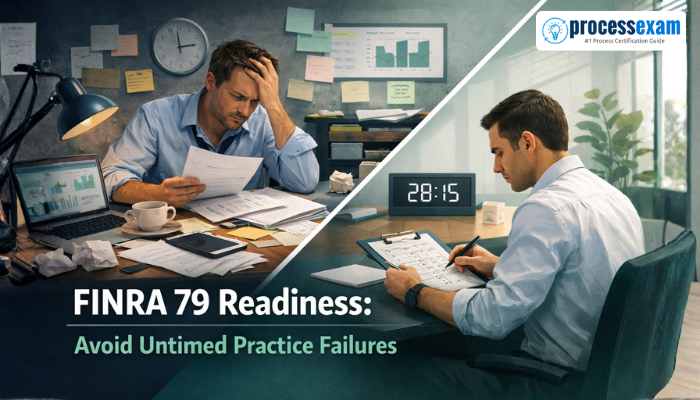
The inherent pressure and strict time limits of the 150-minute FINRA Series 79 exam can be incredibly overwhelming if a candidate has not adequately prepared for such an environment. A prevalent mistake is practicing questions in a relaxed, untimed, and often interrupted setting, which fundamentally fails to simulate the actual exam's high-stakes stress and severe time constraints. This critical lack of simulation can lead directly to poor pacing on exam day, increased anxiety, and a frustrating inability to efficiently recall and apply information when it matters most during the real test.
Ignoring Time Management During Practice
Taking multiple full-length practice exams under strictly timed conditions is not merely beneficial; it is absolutely indispensable. Candidates must diligently learn to pace themselves, allocating an appropriate amount of time per question to ensure that all questions are at least attempted. Regular, timed practice helps to build mental and physical endurance, thoroughly familiarizes candidates with the flow and structure of the exam, and critically allows for strategic adjustments to their approach when encountering particularly challenging or time-consuming questions. This discipline helps avoid rushing and making careless errors.
Not Minimizing Distractions During Mock Exams
To truly prepare for the testing environment, it is crucial to replicate the quiet, distraction-free setting of a professional testing center during mock exams. Studying with background noise, frequently taking breaks, or tolerating external interruptions will not adequately prepare candidates for the intense, sustained focus required on exam day. Treat mock exams with the same seriousness and discipline as the actual Series 79 examination, ensuring a controlled environment that fosters a realistic testing experience. This practice cultivates the mental fortitude needed for peak performance. For professionals navigating complex financial regulations, mastering the FINRA Series 79 is a critical step in career advancement. Understanding who needs this credential and how it aligns with investment banking roles is essential for a focused preparation journey. The qualification empowers representatives to advise on corporate finance transactions, including mergers, acquisitions, underwriting, and private placements. This rigorous process requires careful attention to detail and a commitment to understanding the intricacies of the financial markets. Explore additional resources for your professional development and regulatory compliance on the FINRA career management page.
Underestimating Regulatory Compliance Depth
Investment banking operates within an exceptionally complex and highly regulated environment, and the FINRA Series 79 exam significantly tests a candidate's comprehensive grasp of these numerous rules and regulations. A critical mistake candidates often make is underestimating the sheer depth, specificity, and intricate interconnectedness of regulatory compliance, treating it as a secondary or auxiliary aspect rather than a core, foundational component of the role. Exam questions frequently involve nuanced interpretations of specific SEC and FINRA rules, rendering a superficial or generalized understanding utterly insufficient for achieving a passing score.
Failing to Differentiate Rule Applicability
Candidates frequently struggle with the complex task of distinguishing precisely when specific rules and regulations apply versus others, particularly across different types of offerings (e.g., distinguishing between registered offerings under the Securities Act of 1933 and various private placements under Regulation D) or distinct transaction structures (e.g., the specific rules governing M&A deals versus those for tender offers). A truly thorough understanding of regulatory compliance involves not just knowing what the rules are, but critically understanding when, how, and to whom they are applied in various real-world scenarios routinely encountered in investment banking. This requires careful attention to detail.
Ignoring Ethical Obligations and Prohibited Practices
Beyond the technical regulations and procedural rules, the Series 79 also places a significant emphasis on ethical considerations, professional conduct, and a clear understanding of prohibited practices within the securities industry. Candidates must demonstrate a comprehensive understanding of the implications and consequences of actions such as insider trading, various forms of market manipulation, the management of conflicts of interest, and other forms of professional misconduct. Possessing a strong ethical compass, meticulously backed by a crystal-clear understanding of regulatory prohibitions and industry best practices, is an integral and indispensable component of the role of an Investment Banking Representative, and this is rigorously assessed on the exam.
Neglecting Comprehensive Review and Rote Memorization
Many candidates make the critical mistake of either postponing a thorough, integrated review until the absolute last minute, or, even worse, relying too heavily on mere rote memorization without cultivating genuine conceptual comprehension. The FINRA Series 79 exam demands a holistic and interconnected understanding of advanced investment banking concepts, where various topics interrelate and require sophisticated analytical application rather than simple recall of isolated facts. Last-minute cramming, focused solely on short-term memory, very rarely leads to sustained, applicable knowledge or the crucial ability to apply complex concepts accurately under the intense pressure of the examination environment.
Skipping Structured Review Cycles
Effective and efficient exam preparation inherently involves multiple, iterative cycles of dedicated studying, active practice, and systematic review. Neglecting structured review periods, where candidates methodically revisit identified weak areas, meticulously review their summarized notes, and strategically re-attempt challenging questions, can leave them significantly unprepared for the breadth of the exam. Implementing a systematic review process, perhaps weekly or bi-weekly, is instrumental in solidifying knowledge, reinforcing connections between topics, and ensuring the long-term retention of critical information. This layered approach prevents forgetting previously learned material.
Prioritizing Speed Over Accuracy in Final Weeks
In the final, intense weeks leading up to the examination date, there is a strong and often counterproductive temptation to prioritize sheer speed – attempting to rapidly go through as many practice questions as humanly possible. However, if this pursuit of quantity comes at the direct expense of accuracy and a deep understanding of the underlying concepts, it proves to be a highly counterproductive approach. Instead, the focus should remain steadfastly on cementing knowledge, critically evaluating the reasoning behind correct answers, and understanding the logic of incorrect options, even if this means covering fewer questions overall. Prioritizing quality over quantity in the final stretch ensures true readiness. Passing the FINRA Series 79 opens doors to significant FINRA Investment Banking Representative job opportunities, solidifying a professional's standing and credibility in the competitive financial industry. For a deeper dive into the specific requirements, detailed syllabus, and effective career paths, consider exploring the Investment Banking Representative exam study guide available at ProcessExam. This exam is fundamental for those seeking to advise clients on sophisticated financial transactions, impacting global capital markets and corporate strategies.
The journey to passing the FINRA Series 79 exam is undoubtedly demanding but profoundly rewarding for those aspiring to excel in investment banking. By consciously identifying and diligently avoiding these common mistakes from inadequate study planning and misjudging syllabus weights to bypassing consistent practice and underestimating regulatory depth candidates can dramatically enhance their chances of success. Approaching the exam with a meticulously structured study strategy, consistent practice under strictly timed conditions, and a deep, conceptual understanding of the comprehensive material is not merely beneficial but absolutely paramount. Remember, thorough preparation is not just about memorizing isolated facts but about developing the nuanced analytical and practical skills that are intrinsically required for a successful and impactful career as an Investment Banking Representative.
Investing diligently in your preparation is, in essence, a strategic investment in your future career trajectory. Ensure you have access to high-quality, up-to-date study materials and a robust bank of practice questions that align with the rigorous standards and current demands of the FINRA Series 79. For comprehensive preparation materials, detailed study guides, and effective practice tests designed to replicate the actual exam environment, visit ProcessExam's FINRA resources to equip yourself with the essential tools needed to confidently tackle and conquer this pivotal examination.
Frequently Asked Questions
1. What is the FINRA Series 79 exam?
The FINRA Series 79, or Investment Banking Representative Exam, qualifies individuals to advise on and facilitate investment banking transactions such as mergers, acquisitions, tender offers, and corporate reorganizations. It assesses knowledge of underwriting, corporate finance regulations, and valuation methods.
2. How difficult is the FINRA Series 79 exam?
The FINRA Series 79 exam is generally considered challenging due to the breadth of complex financial concepts and regulatory knowledge it covers. Success requires dedicated study, strong analytical skills, and a thorough understanding of investment banking practices.
3. What are the main topics covered in the Series 79 syllabus?
The Series 79 syllabus focuses on three key areas: collection, analysis, and evaluation of data (49%); underwriting/new financing transactions (27%); and mergers and acquisitions, tender offers, and financial restructuring transactions (24%).
4. How much does the FINRA Series 79 exam cost?
The FINRA Series 79 exam costs USD $395. This fee is paid directly to FINRA upon registration for the examination.
5. What job opportunities are available after passing the FINRA Series 79?
Passing the FINRA Series 79 opens doors to roles such as an Investment Banking Representative, Corporate Finance Analyst, M&A Advisor, and other positions involved in capital raising and strategic financial advisory within investment banks, brokerage firms, and financial institutions.
- Representative-level |
- FINRA Investment Banking Representative Exam Questions |
- FINRA Investment Banking Representative Exam Question Bank |
- FINRA Investment Banking Representative Exam Test Questions |
- FINRA Investment Banking Representative Exam Study Guide |
- FINRA Series 79 Quiz |
- FINRA Series 79 Exam |
- Series 79 |
- Series 79 Question Bank |
- Series 79 Certification |
- Series 79 Questions |
- Series 79 Practice Test |
- Series 79 Study Guide Material |
- Series 79 Sample Exam |
- Investment Banking Representative Exam |
- Investment Banking Representative Exam Certification |
- FINRA Investment Banking Representative Exam |
- IB Simulator |
- IB Mock Exam |
- FINRA IB Questions


