
Unlock CPGP Secrets: What Elite Pros Know About GMP

The ASQ Certified Pharmaceutical GMP Professional (CPGP) certification validates an individual’s deep understanding and application of Good Manufacturing Practices within the pharmaceutical industry. This credential signifies a professional's expertise in regulatory requirements, quality systems, and operational controls essential for producing safe and effective pharmaceutical products. Earning the CPGP is crucial for quality professionals, auditors, and regulatory specialists aiming to demonstrate their mastery of global GMP principles and elevate their impact in the highly regulated pharmaceutical landscape. This advanced guide delves into the core components of the CPGP exam, offering insights into its structure, syllabus, benefits, and strategic preparation to empower candidates for success.
Evaluating the ASQ CPGP Certification Program
The ASQ Certified Pharmaceutical GMP Professional certification stands as a testament to specialized knowledge in ensuring product quality and safety across the pharmaceutical lifecycle. It is specifically designed for individuals engaged in or responsible for pharmaceutical manufacturing, quality assurance, quality control, regulatory affairs, and auditing. Pursuing the ASQ CPGP certification confirms a professional's competence in navigating complex GMP regulations and implementing robust quality systems, which are paramount in an industry where compliance directly impacts public health.
This certification is particularly beneficial for those seeking to solidify their expertise and advance their careers within pharmaceutical, biopharmaceutical, and medical device sectors. It provides a standardized benchmark for professionals, ensuring they possess the critical skills to uphold the highest standards of good manufacturing practices. Understanding the rigorous expectations of the exam is the first step towards achieving this coveted credential and unlocking new professional opportunities.
Exam Details: Your Path to CPGP Distinction
Candidates pursuing the ASQ CPGP certification should be thoroughly familiar with the examination's administrative and structural specifics to plan their preparation effectively. The exam is designed to rigorously assess a candidate’s understanding and practical application of GMP principles across various domains. It is a comprehensive evaluation requiring focused study and strategic time management during the test itself.
The key details are as follows:
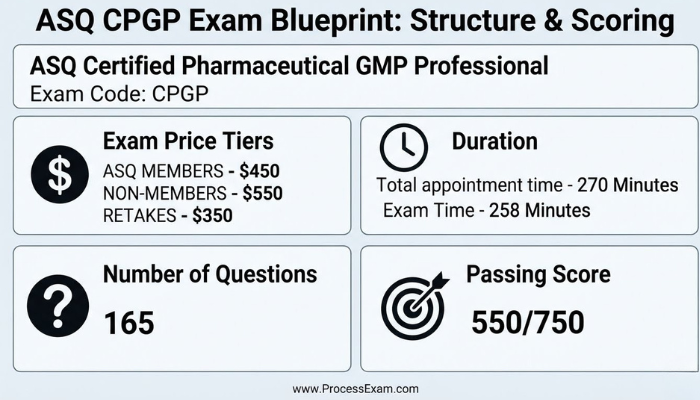
These metrics underscore the challenging nature of the ASQ CPGP exam. The extended exam time suggests a need for endurance and careful attention to detail, while the passing score indicates a high standard of competency required to achieve certification. Prospective candidates should use these details to inform their study schedule and practice exam strategy, ensuring they are well-prepared for both the content and the pressure of the testing environment. For a more detailed look at the ASQ CPGP certification, candidates can explore the official program page on ASQ's website.
Exploring the ASQ CPGP Syllabus Domains
The ASQ CPGP exam covers a broad spectrum of knowledge critical for a pharmaceutical GMP professional, organized into eight distinct domains. Each domain represents a fundamental area where a certified professional must demonstrate profound understanding and practical application. A meticulous review of these syllabus topics is essential for any aspiring candidate to formulate a targeted and effective study plan.
The comprehensive syllabus includes:
-
I. Regulatory Agency Governance: This domain examines the global regulatory landscape governing pharmaceutical manufacturing. It includes understanding the roles and responsibilities of key regulatory bodies like the FDA, EMA, and WHO, as well as the various national and international GMP regulations, guidelines, and directives. Professionals must grasp inspection processes, enforcement actions, and the implications of non-compliance.
-
II. Quality Systems: Central to GMP, this section focuses on the design, implementation, and maintenance of robust Quality Management Systems (QMS). It covers elements such as quality policy, quality manuals, documentation control, change control, deviation management, CAPA (Corrective and Preventive Actions) systems, management review, and quality risk management. The emphasis is on how a QMS ensures consistent product quality and regulatory compliance.
-
III. Laboratory Systems: This domain delves into the requirements for quality control laboratories within a pharmaceutical setting. Key topics include laboratory controls, analytical method validation, calibration of equipment, stability testing programs, out-of-specification (OOS) and out-of-trend (OOT) investigations, and data integrity principles for laboratory records.
-
IV. Infrastructure: Facilities, Utilities, and Equipment: A critical area covering the physical aspects of pharmaceutical manufacturing. This includes the design, construction, qualification, and maintenance of facilities and cleanrooms. It also covers the validation and maintenance of critical utilities such as HVAC, purified water systems, and compressed gases, along with the qualification, calibration, and maintenance of manufacturing equipment.
-
V. Materials and Supply Chain Management: This section addresses the control of raw materials, components, and finished products throughout the supply chain. Topics include supplier qualification, material specifications, receipt, sampling, testing, storage, and release of materials. It also covers supply chain security, traceability, and the management of contract manufacturers and laboratories.
-
VI. Sterile and Nonsterile Manufacturing Systems: This domain distinguishes between the unique challenges and requirements for sterile versus nonsterile product manufacturing. For sterile products, it covers aseptic processing, sterilization methods, environmental monitoring, and media fills. For nonsterile products, it addresses formulation, mixing, granulation, compression, and coating processes, ensuring appropriate controls for each.
-
VII. Filling, Packaging, and Labeling: Focuses on the final stages of product manufacturing. This includes controls for filling operations, packaging materials, packaging lines, and labeling accuracy. Prevention of mix-ups, tamper-evident packaging, serialization requirements, and batch record review for these processes are critical components.
-
VIII. Product Development and Technology Transfer: This domain examines the transition of a product from development to commercial manufacturing. It includes quality by design (QbD) principles, process validation, and the systematic transfer of knowledge and manufacturing processes between sites or organizations, ensuring consistent product quality post-transfer.
Each syllabus domain represents a vital pillar of GMP expertise, requiring candidates to not only recall information but also apply principles to realistic scenarios. A detailed understanding of the detailed CPGP Body of Knowledge is fundamental for structured exam preparation.
Why Pursue the CPGP Credential? Elevating Professional Value
The ASQ Certified Pharmaceutical GMP Professional certification offers significant advantages for individuals operating within the pharmaceutical industry. Beyond validating a professional’s expertise, it provides a tangible demonstration of commitment to quality and regulatory excellence, critical attributes in this sector. This certification can substantially enhance career trajectories, opening doors to advanced roles and increased responsibilities.
Professionals holding the CPGP credential are uniquely positioned to:
-
Lead Compliance Initiatives: The certification equips professionals with the in-depth knowledge to guide organizations through complex regulatory audits and ensure adherence to national and international GMP standards, minimizing compliance risks.
-
Drive Quality Improvement: CPGP holders are skilled in implementing and optimizing quality systems, leading to process efficiencies, reduced deviations, and improved product quality across manufacturing operations.
-
Enhance Career Prospects: Many employers in the pharmaceutical industry prioritize candidates with specialized certifications. The CPGP can distinguish professionals in a competitive job market, leading to promotions and new opportunities in quality assurance, regulatory affairs, and manufacturing leadership.
-
Command Higher Earning Potential: Specialized credentials often correlate with higher salaries. Professionals with a CPGP demonstrate a high level of expertise, which is often reflected in compensation packages.
-
Expand Professional Network: Joining the ranks of certified professionals within ASQ provides access to a global network of quality experts, fostering collaboration, knowledge sharing, and professional growth.
The CPGP certification is an investment in professional development that yields substantial returns in expertise, credibility, and career advancement within the pharmaceutical GMP domain.
Achieving Readiness: Strategic Preparation for the CPGP Exam
Success on the ASQ CPGP exam demands a structured and comprehensive preparation strategy that goes beyond rote memorization. Candidates must internalize GMP principles and be able to apply them to diverse real-world scenarios, reflecting the problem-solving nature of the exam. A multi-faceted approach incorporating official resources, study materials, and practice is crucial for optimal readiness.
Developing an Effective Study Plan
A robust study plan begins with a thorough self-assessment against the CPGP Body of Knowledge. Identify areas of strength and weakness to prioritize study efforts. Allocate dedicated study time each week and adhere to a schedule that allows for consistent progress. It’s often beneficial to break down the syllabus into manageable modules, focusing on one or two domains at a time before integrating knowledge across all areas.
Consider these study approaches:
-
Review Official Resources: The ASQ offers a range of materials, including reference books, standards, and guidelines that directly align with the exam content. These are indispensable for building a foundational understanding.
-
Utilize Study Guides: Invest in high-quality study guides specifically tailored for the ASQ CPGP exam. These often condense complex topics and provide targeted explanations.
-
Join Study Groups: Collaborating with peers can enhance understanding, provide different perspectives, and offer a platform for discussing challenging concepts.
-
Attend Training Courses: For some, formal training courses or workshops offered by ASQ or accredited providers can provide structured learning and expert instruction. These courses often cover the CPGP exam syllabus in depth, offering practical examples and case studies.
Consistently reviewing and reinforcing concepts is more effective than last-minute cramming.
Mastering the Material Through Practice
Practical application of knowledge is paramount for the CPGP exam. Theoretical understanding must be complemented by the ability to apply principles to specific scenarios, which is best honed through practice questions and simulated exams.
Consider these practice strategies:
-
Engage with Practice Questions: Regularly work through practice questions from various sources. This helps to familiarize yourself with the exam's question format, difficulty level, and time constraints. Focus on understanding the rationale behind both correct and incorrect answers.
-
Take Full-Length Practice Exams: Simulate the actual exam experience by taking full-length CPGP practice exams under timed conditions. This is invaluable for building stamina, managing time effectively, and identifying areas where further study is needed. It also helps to reduce exam-day anxiety by creating a familiar testing environment.
-
Analyze Performance: After each practice test, thoroughly review your performance. Understand why certain answers were wrong and revisit the corresponding syllabus topics. This iterative process of practice, review, and targeted study is highly effective.
Ethical preparation, relying on comprehensive study and legitimate practice materials, is critical for both success on the exam and maintaining professional integrity. Avoid any reliance on unauthorized "dumps" or unfair shortcuts, as these undermine genuine learning and the value of the certification itself. Candidates seeking ASQ CPGP certification details will find a structured approach the most rewarding.
Meeting ASQ CPGP Eligibility Criteria
Before embarking on the rigorous preparation journey for the ASQ CPGP exam, candidates must ensure they meet the specific eligibility criteria set forth by ASQ. These requirements are designed to ensure that certified professionals possess the necessary foundational experience in the pharmaceutical GMP field. Meeting these prerequisites is a non-negotiable step toward certification.
The eligibility criteria typically revolve around a combination of education and professional work experience:
-
Education and Work Experience Combination: ASQ generally requires candidates to have a certain number of years of work experience in a pharmaceutical GMP environment, which may vary based on the highest level of academic education achieved. For instance, a candidate with a bachelor's degree might require fewer years of experience compared to someone with a high school diploma.
-
Specific Industry Relevance: The work experience must be in a field that is directly related to GMP, such as quality assurance, quality control, manufacturing, regulatory affairs, or auditing within the pharmaceutical or related industries. This ensures practical exposure to the principles being tested.
It is imperative for prospective candidates to review the most current and detailed eligibility requirements directly on the official ASQ website. Failing to meet these criteria, even after successfully passing the exam, can result in the certification not being awarded. Therefore, verifying eligibility is a critical initial step in the CPGP certification journey.
Maintaining Credibility: The ASQ CPGP Recertification Process
Achieving the ASQ Certified Pharmaceutical GMP Professional certification is a significant accomplishment, but the journey toward sustained expertise doesn’t end there. To ensure that certified professionals remain current with evolving industry standards, regulations, and best practices, ASQ requires a recertification process. This mechanism underscores the dynamic nature of GMP and the continuous need for professional development.
The recertification process typically involves:
-
Accumulating Recertification Units (RUs): Over a specific period (often three years), CPGP holders must earn a predetermined number of Recertification Units. These RUs are awarded for various professional development activities.
-
Qualifying Activities: RUs can be earned through a wide range of activities that enhance professional competence and contribute to the GMP field. These may include:
-
Continuing Education: Attending seminars, workshops, conferences, or taking relevant courses.
-
Work Experience: Continued employment in a CPGP-related role.
-
Professional Contributions: Delivering presentations, publishing articles, mentoring, or participating in professional committees.
-
Further Certification: Obtaining additional relevant certifications.
-
-
Submission of Application: At the end of the recertification cycle, professionals submit an application detailing their earned RUs and demonstrating their ongoing professional growth.
The recertification process is a commitment to lifelong learning and ensures that the ASQ CPGP credential remains a reliable indicator of up-to-date expertise in pharmaceutical GMP. Understanding and planning for recertification from the outset is a key aspect of long-term professional success.
Career Advancement with ASQ CPGP Certification
The ASQ Certified Pharmaceutical GMP Professional certification acts as a powerful catalyst for career progression within the highly competitive pharmaceutical sector. Professionals who hold this credential are not merely knowledgeable; they are recognized as authorities in Good Manufacturing Practices, a skill set that is always in high demand. This recognition translates directly into enhanced career opportunities and often, a substantial increase in earning potential.
Impact on Roles and Responsibilities
CPGP certification often elevates professionals into roles with greater leadership and strategic oversight. Common ASQ CPGP certification jobs include:
-
Quality Assurance Manager: Overseeing the implementation and maintenance of QMS, ensuring compliance across all manufacturing stages.
-
Regulatory Affairs Specialist: Bridging the gap between manufacturing processes and regulatory requirements, ensuring submissions and operations meet global standards.
-
GMP Auditor: Conducting internal and external audits to identify compliance gaps and drive continuous improvement.
-
Validation Specialist: Leading the qualification and validation activities for equipment, facilities, utilities, and processes.
-
Director of Quality: Holding ultimate responsibility for an organization's quality strategy and GMP adherence.
These roles demand a deep, nuanced understanding of GMP, which the CPGP certification rigorously validates.
ASQ Certified Pharmaceutical GMP Professional Salary Outlook
While salary varies significantly based on factors such as location, experience, company size, and specific role, holding the ASQ CPGP certification generally correlates with a more favorable compensation package. The specialized expertise validated by the CPGP is a premium skill, leading to an elevated ASQ Certified Pharmaceutical GMP Professional salary compared to non-certified peers in similar roles.
Employers are often willing to invest more in professionals who demonstrably mitigate compliance risks and ensure product quality, directly impacting a company's reputation and profitability. This makes the CPGP not just a mark of distinction, but a strategic asset for individuals aiming for top-tier positions and corresponding financial rewards in the pharmaceutical industry.
Conclusion
The ASQ Certified Pharmaceutical GMP Professional (CPGP) certification is a powerful credential for any individual committed to excellence in pharmaceutical quality and compliance. It signifies mastery of the critical Good Manufacturing Practices that safeguard public health and drive operational integrity within the industry. By thoroughly understanding the exam's structure, meticulously studying its diverse syllabus, and employing strategic preparation techniques, candidates can confidently approach the CPGP exam and unlock significant career advantages.
Achieving CPGP certification not only validates a professional's expertise but also paves the way for leadership roles, enhanced earning potential, and a sustained impact on pharmaceutical quality. It is an investment in professional growth that yields tangible benefits, setting certified individuals apart as elite professionals who truly understand the secrets of GMP.
For those ready to embark on this transformative journey, robust preparation is key. Explore comprehensive study resources and practice exams to solidify your understanding and ensure exam readiness. Visit ProcessExam.com for expert preparation materials that align with the ASQ CPGP syllabus, equipping you with the tools necessary for success.
Frequently Asked Questions
1. What is ASQ Certified Pharmaceutical GMP Professional (CPGP)?
The ASQ Certified Pharmaceutical GMP Professional (CPGP) is a globally recognized certification validating an individual's expertise in Good Manufacturing Practices (GMP) within the pharmaceutical industry, covering regulatory compliance, quality systems, and operational controls.
2. Who should consider taking the ASQ CPGP exam?
The ASQ CPGP exam is ideal for quality professionals, auditors, regulatory specialists, manufacturing engineers, and anyone involved in ensuring product quality and safety across the pharmaceutical and biopharmaceutical sectors.
3. What are the eligibility requirements for the CPGP certification?
Eligibility for the CPGP typically requires a combination of education and several years of professional work experience directly related to GMP in the pharmaceutical industry. Specific requirements vary based on academic background, so checking the official ASQ website is essential.
4. How long is the ASQ CPGP certification valid, and what is the recertification process?
The ASQ CPGP certification is typically valid for three years. Recertification requires earning a specified number of Recertification Units (RUs) through continuing education, professional experience, and contributions to the field, followed by submitting an application to ASQ.
5. What career benefits can I expect from the ASQ CPGP certification?
CPGP certification can lead to enhanced career prospects, including leadership roles in quality assurance and regulatory affairs, increased earning potential, greater professional credibility, and expanded networking opportunities within the pharmaceutical industry.
- Auditing |
- ASQ Pharmaceutical GMP Professional Test Questions |
- CPGP Question Bank |
- CPGP Body of Knowledge (BOK) |
- Pharmaceutical GMP Professional Simulator |
- Pharmaceutical GMP Professional Mock Exam |
- ASQ Pharmaceutical GMP Professional Book |
- ASQ CPGP BOK PDF |
- Pharmaceutical GMP Professional Certification Cost |
- Pharmaceutical GMP Professional Certification Requirements |
- ASQ Pharmaceutical GMP Professional Sample Questions |
- CPGP Exam Questions Download |
- CPGP Test Questions |
- Pharmaceutical GMP Professional PDF |
- CPGP Handbook


