
Pass FINRA Series 79: Mistakes to Avoid and How Long to Study
To pass the FINRA Series 79, give most of your study time to data analysis and valuation, learn the offering and M&A rules by when they apply, and practise under the real clock: 75 questions in 150 minutes, with a passing score of 73. Most candidates who fail do so for predictable reasons, and this guide shows each mistake, how long to study, and how to recover if a first attempt goes wrong.
The Series 79, formally the FINRA Investment Banking Representative Exam, qualifies professionals to advise on and facilitate investment banking work: debt and equity offerings, private placements, mergers and acquisitions, tender offers and financial restructurings. It is a demanding exam because it tests judgement as much as recall. Questions describe a deal, a filing or a valuation and ask what a representative should do next.
This article keeps the practical focus of the original: the mistakes that cost candidates the exam. Around them it adds the exam facts, the content outline, a realistic study timeline, an exam-day routine and a plan for anyone who has already failed once.
What is the FINRA Series 79 exam, and who needs it?
The Series 79 is a representative-level qualification exam. Anyone at a FINRA member firm whose job involves advising on or facilitating investment banking transactions generally needs it, which usually means analysts and associates in investment banking, capital markets and corporate finance advisory teams. The registration it leads to is the Investment Banking Representative.
Two eligibility points catch new candidates out. First, you cannot simply book the exam as an individual: FINRA requires candidates for representative-level exams to be associated with and sponsored by a FINRA member firm or another applicable self-regulatory organisation member firm. Your employer opens the exam window for you. Second, the Securities Industry Essentials (SIE) exam is a corequisite. You must pass both the SIE and the Series 79 to hold the Investment Banking registration, although you can take them in either order.
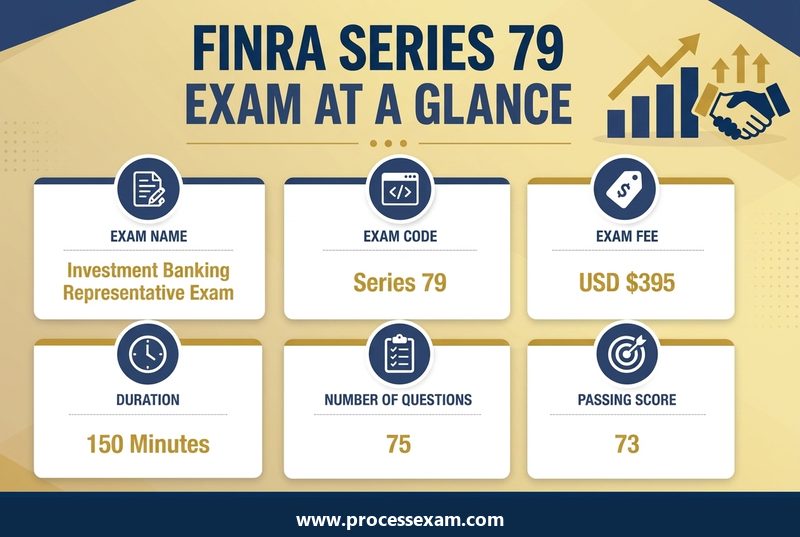
Here are the exam facts in one place:
| Exam detail | Series 79 |
|---|---|
| Full name | FINRA Investment Banking Representative Exam |
| Exam code | Series 79 |
| Vendor | FINRA |
| Category | Representative-level |
| Number of questions | 75 |
| Duration | 150 minutes |
| Exam fee | USD $395 |
| Passing score | 73 |
| Corequisite | SIE exam |
FINRA keeps the current details, the scheduling rules and the testing options on its Series 79 exam page. Read it before you plan your dates, because the fee, the delivery options and the rules around the exam are FINRA's to change. The page also links to the content outline, which is the single most useful document you can study from.
What does the Series 79 content outline cover?
FINRA's Series 79 content outline divides the exam into three functions. Each carries a fixed share of the 75 questions, and that share should drive how you divide your study time.
| Function | Share of exam | Questions |
|---|---|---|
| F1 Collection, Analysis and Evaluation of Data | 49% | 37 |
| F2 Underwriting/New Financing Transactions, Types of Offerings and Registration of Securities | 27% | 20 |
| F3 Mergers and Acquisitions, Tender Offers and Financial Restructuring Transactions | 24% | 18 |
F1: collection, analysis and evaluation of data
Almost half the exam sits here. It covers the work an analyst does before any deal is priced or announced: reading and adjusting financial statements, calculating and interpreting ratios, and valuing a business. Expect questions on discounted cash flow analysis, comparable company analysis and precedent transactions, and on how the choice of method changes the answer. Due diligence belongs to this function too, including what information a banker gathers, where it comes from and what the firm must do with material non-public information once it has it.
The questions are rarely pure arithmetic. A typical item gives you a company's figures and asks which valuation is most appropriate, what a change in an assumption does to the result, or which piece of diligence is missing. You need the formulas, but you also need to know why each method is used.
A short worked example shows the kind of reasoning involved. Suppose comparable public companies trade at about eight times EBITDA and the target earns 50 million in EBITDA. The implied enterprise value is about 400 million. If the target carries 120 million of debt and 20 million of cash, net debt is 100 million, so the implied equity value is about 300 million. An exam question might then ask what happens if the peer group is poorly chosen, or why a precedent transaction multiple would normally sit higher than a trading multiple: acquirers pay a control premium. Being able to walk through each step, and to say which input drives the answer, is exactly what F1 rewards.
F2: underwriting, offerings and registration
This function covers how securities are brought to market. It includes the registration process under the Securities Act of 1933, the types of registration statements, the periods before, during and after a registration becomes effective and what may be said in each, and the exemptions that allow private placements, such as those under Regulation D. It also covers underwriting arrangements, syndicate roles, pricing and allocation, and the FINRA rules that apply to public offerings and to conflicts of interest.
The hard part is not the vocabulary but the boundaries. Several questions hinge on whether an offering is registered or exempt, whether a communication is permitted at a given stage, or which rule applies to a particular offering type. Candidates who learn each rule in isolation often pick an answer that is correct for a different situation.
The registration timeline is a good example of how to study this function. In the pre-filing period, the issuer and its underwriters are limited in what they may say publicly about the offering. Once the registration statement is filed, the waiting period begins: a preliminary prospectus can be circulated and indications of interest gathered, but no sales can be made. After the registration statement becomes effective, sales may be confirmed and the final prospectus delivered. Learn what is allowed and what is prohibited at each stage, and then do the same for the main private placement routes, such as Regulation D offerings and resales to qualified institutional buyers under Rule 144A.
F3: mergers and acquisitions, tender offers and restructuring
The last function covers deal structure and the rules around changes of control. It includes stock and asset purchases, mergers, the regulation of tender offers and proxy solicitations, beneficial ownership reporting, fairness opinions and the principles of financial restructuring, including distressed situations and bankruptcy. The weighting is the smallest of the three, but the questions are detailed. A single item may ask about a filing deadline, a minimum offer period or the disclosure a bidder must make.
Tender offers show the level of detail required. Under the SEC's tender offer rules, an offer must stay open for at least 20 business days, and a change in the price or in the percentage of securities sought requires the offer to remain open for at least 10 further business days. The bidder files a Schedule TO, and the target company must tell its shareholders within 10 business days whether it recommends accepting, rejecting or remaining neutral, on Schedule 14D-9. Numbers like these are easy marks once learned and nearly impossible to reason out on the day.
How hard is the Series 79 exam, and what is the pass rate?
The Series 79 is widely regarded as one of the more difficult representative-level exams, and the reason is the mix of skills it tests. You need accounting and valuation ability for F1, precise regulatory knowledge for F2 and F3, and the judgement to apply both to a short scenario in about two minutes.
Many candidates search for the Series 79 pass rate. FINRA does not publish a pass rate on its Series 79 exam page, so any percentage you see quoted is an estimate by a training provider, not an official figure. What FINRA does publish is the passing score of 73, and that is the number to prepare against. A more useful test of readiness is your own performance: if you consistently score comfortably above the passing level on fresh, timed practice questions, and you can explain why each wrong option is wrong, you are close.
Three things make the exam feel harder than it is:
- Scenario wording. Questions describe a situation rather than ask for a definition, so memorised lists help less than expected.
- Close answer options. Two options are often plausible; only one fits the exact stage of the deal or the exact type of offering described.
- The clock. 150 minutes for 75 questions allows two minutes a question on average. Calculation questions take longer, so the rest must go faster.
How long should you study for the Series 79 exam?
How long you need depends on your starting point more than on any fixed number of hours. A candidate who already builds valuation models and works on live deals starts well ahead on F1 and mainly needs the rules. A candidate new to investment banking needs time for both. As a guide, most working candidates plan for about six weeks of steady study at one to two hours a day, and stretch that to eight weeks or more if accounting, valuation or securities regulation is new to them.
A useful checkpoint around week four is a timed Series 79 practice test: if valuation questions still take you far longer than the others, move more of your remaining hours there.
The six-week plan below follows the weighting of the content outline, so the largest function gets the most time and the final week is kept for timed practice.
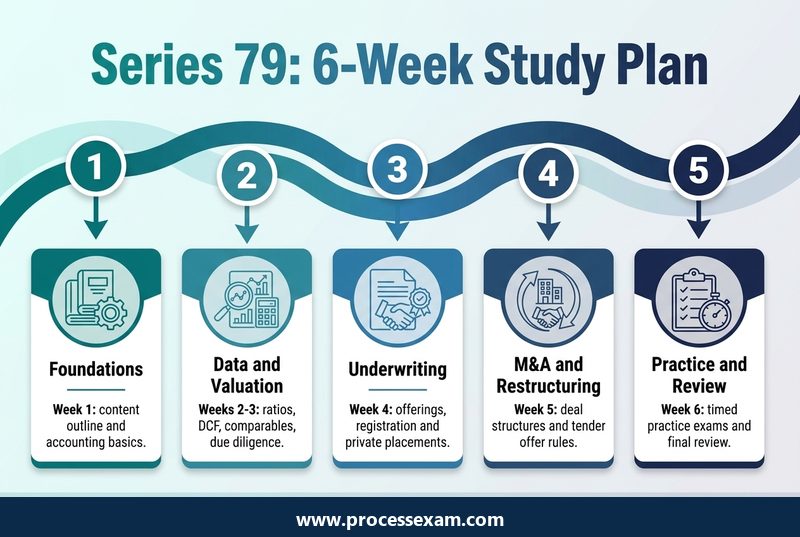
| Week | Focus | What to finish |
|---|---|---|
| 1 | Foundations | Read the content outline, refresh financial statements and accounting basics, take a short diagnostic test |
| 2-3 | F1 data and valuation | Ratios, DCF, comparable companies, precedent transactions, due diligence |
| 4 | F2 underwriting and registration | Registration process, offering types, private placement exemptions, underwriting and syndicate rules |
| 5 | F3 M&A and restructuring | Deal structures, tender offer and proxy rules, ownership reporting, restructuring |
| 6 | Practice and review | At least two timed full-length practice exams, review of every wrong answer, final notes |
Use practice scores, not the calendar, to decide when you are ready. Take a short diagnostic test in week one to see where you start, then a timed section test at the end of each function. Keep an error log with three columns: the question topic, why you got it wrong, and what you will do about it. A mistake from not knowing a rule needs reading; a mistake from misreading the question needs slower reading; a mistake from running out of time needs more timed practice. By week six, the log should be short and the reasons should be mostly careless slips rather than gaps in knowledge.
If your sponsoring firm has set a deadline, work backwards from it. Book your appointment once your practice scores are steady, not before you have started, because a fixed date with no preparation behind it is how most rushed failures begin.
What mistakes make candidates fail the Series 79?
The same mistakes come up again and again, and every one of them is avoidable. They fall into five groups.
1. Studying without a plan
The most common failure starts with no schedule at all. Without one, study drifts toward the topics a candidate already likes, and the gaps only appear in the exam. A plan should list every part of the content outline, assign it a week, and leave room for review. It should also be honest about your working hours: a plan that assumes three hours every evening during a live deal will collapse in the first week.
2. Skipping the foundations
Many candidates jump straight into advanced valuation and deal rules, assuming their degree or job has covered the basics. Then they struggle with a question about how a transaction changes the balance sheet or why a ratio moved. A few days spent refreshing financial statements, accounting adjustments and the time value of money makes every later topic faster to learn.
3. Ignoring the topic weighting
Under-preparing for data analysis
F1 accounts for 49% of the exam, about 37 of the 75 questions. Giving it the same time as the smaller functions is a costly error. This is where most of the marks are, and it rewards practice: work through valuations until you can set one up without notes, and practise explaining which method suits which situation.
Treating M&A as the easy part
At 24%, F3 looks like the lightest function, but its questions are specific. Tender offer periods, proxy rules, ownership reporting thresholds and the steps in a restructuring are tested in detail. A high-level picture of how deals work will not be enough; learn the rules and the numbers that go with them.
4. Reading instead of practising
Relying on one question source
Passive reading is the most comfortable way to study and the least effective for this exam. Series 79 questions test application, so you need to answer a large number of exam-style questions and study your mistakes. Using more than one reputable question source exposes you to different wording and helps you recognise a concept however it is phrased. A good place to begin is a set of free sample questions, which show the style before you move to full-length tests.
Practising without the clock
Relaxed, untimed practice builds knowledge but not pace. On exam day you have 150 minutes, and the calculation questions take longer than the rest. Take full-length practice exams under strict timing, in a quiet room, without notes or breaks you would not have in the test. Track how long you spend on each section and where you run short.
5. Underestimating the rules
Not knowing when a rule applies
Knowing the rules is not the same as knowing when each applies. Candidates often confuse the rules for registered offerings with those for private placements, or the procedures for a merger with those for a tender offer. For every rule you learn, write down the situation that triggers it, the parties it applies to and the stage of the deal where it matters.
Overlooking conduct and prohibited practices
The exam also tests professional conduct: handling material non-public information, information barriers between teams, conflicts of interest and the practices a representative must never engage in. These questions are often easier than they look if you have studied them, and costly if you have not.
Cramming in the final week
A final mistake runs through all five groups: leaving review to the last few days and trying to cover as many questions as possible at speed. Quality matters more than quantity at the end. Review every wrong or guessed answer, understand why the correct option is right and why each wrong option is wrong, and let that error log decide your last study sessions.
How do you pass the Series 79 after failing?
Failing the Series 79 is more common than candidates expect, and it is not the end of the road. The candidates who pass on a second attempt usually change how they study, not just how much.
Wait for the retake window
FINRA sets a waiting period before you can take a failed qualification exam again, and a longer one after repeated failures. These periods are set by FINRA Rule 1210, and FINRA filed a change in 2026 to shorten them, so confirm the period that applies to you on FINRA's site before you rebook. Your sponsoring firm will also need to open a new exam window.
Use your score report
Your score report shows how you performed in each function of the content outline. Start there. If F1 was weak, the fix is more valuation practice, not more rule reading. If F2 or F3 was weak, go back to the specific rules and build a table of when each applies.
Change the method
Most failed attempts trace back to one of the mistakes above: too little timed practice, too much reading, or equal time for unequal functions. Rebuild your plan around the weakest function, add full-length timed tests early, and keep an error log. Retake when your practice scores on new questions are steady and clearly above the passing level, not simply when the waiting period ends.
What should you do in the final week and on exam day?
The last week is for consolidation. By now every function should have been covered at least once; the aim is to turn that coverage into fast, confident answers.
Seven days out
Take a full-length timed practice exam on questions you have not seen. Sort every wrong or slow answer by function. Spend the next few days on the function with the most entries, going back to the material rather than repeating the same questions.
Three days out
Take a second full-length test and compare it with the first. Build one page of final notes: valuation formulas and when to use each method, the stages of a registered offering and what may be said in each, the main private placement exemptions, and the key tender offer rules.
The day before
Read your notes and your error log, confirm your appointment time and your identification, and check the testing requirements. FINRA offers the exam at test centres and, for many exams, online; if you test online you need a quiet private room, a clear desk, a webcam and a stable connection. Then stop studying and rest.
During the exam
Read the last line of each question first so you know what is being asked before you read the scenario. Eliminate options that break a rule outright; they are often the distractors. Aim to reach the halfway point, question 38, with at least half of your 150 minutes left. Mark any question that takes more than three minutes and return to it at the end rather than letting it eat your time.
Is the Series 79 worth it for your career?
For anyone who wants to work on investment banking transactions at a FINRA member firm, the Series 79 is not optional: it is the qualification that allows you to do the job. That alone makes it worth the effort. Firms commonly expect new analysts and associates to pass it within their first months, and passing on the first attempt is a small but real signal of reliability to the people you work for.
The value goes beyond the registration. The exam content is the working knowledge of the role: how to analyse a business, how offerings are brought to market, and how mergers, tender offers and restructurings are run within the rules. Candidates who study for understanding rather than for a pass mark find the material useful long after the exam. Combined with the SIE, the registration also supports moves between advisory, capital markets and corporate finance roles.
Roles that call for the Series 79
Typical roles include investment banking analyst and associate, capital markets analyst in equity or debt teams, M&A advisory staff, restructuring advisers at broker-dealers and corporate finance professionals at boutique advisory firms. Some professionals who previously held the broader General Securities Representative registration for banking work now hold the Series 79 because it is tailored to the job. Whatever the title, the common thread is advising on or facilitating transactions for a FINRA member firm.
When you are ready to check your preparation, work through sample questions first, then take a full, timed Series 79 practice exam in the same 75-question, 150-minute format. Together they tell you which functions still need work and whether your pace is right for exam day.
Frequently Asked Questions
How many questions are on the Series 79 exam?
The FINRA Series 79 exam has 75 questions and a time limit of 150 minutes, which averages two minutes per question. Calculation questions from the data analysis function take longer, so practise under timed conditions and mark difficult questions to revisit instead of stalling on any single one.
What is the passing score for the Series 79?
The passing score for the Series 79 exam is 73. FINRA does not publish a pass rate for the exam, so the best readiness check is your own score on fresh, timed practice questions, along with being able to explain why each wrong answer option is wrong.
How much does the Series 79 exam cost?
The Series 79 exam fee is USD $395. Your sponsoring FINRA member firm opens the exam window and often covers the fee, but that depends on the firm. FINRA can change its fees, so confirm the current amount on FINRA's Series 79 exam page before you register.
How long should I study for the Series 79?
Most working candidates plan for about six weeks at one to two hours a day, spending the most time on data analysis and valuation. Allow eight weeks or more if accounting, valuation or securities regulation is new to you, and keep the final week for timed practice exams.
Do I need to pass the SIE as well as the Series 79?
Yes. FINRA treats the Securities Industry Essentials exam as a corequisite of the Series 79. You must pass both exams to hold the Investment Banking Representative registration, but you can take them in either order, and many candidates pass the SIE before joining a firm.
Can I take the Series 79 without a sponsoring firm?
No. FINRA requires candidates for representative-level exams, including the Series 79, to be associated with and sponsored by a FINRA member firm or another applicable self-regulatory organisation member firm. The sponsoring firm files the request that opens your window to schedule the exam.
What happens if I fail the Series 79?
You can retake the exam after a waiting period set by FINRA Rule 1210, with a longer wait after repeated failures. Use your score report to find the weakest function, rebuild your plan around it, and retake once your timed practice scores are steady above the passing level.
- Representative-level |
- FINRA Investment Banking Representative Exam Test Questions |
- Series 79 Question Bank |
- FINRA Investment Banking Representative Exam Book |
- Investment Banking Representative Exam Certification Cost |
- Investment Banking Representative Exam Certification Requirements |
- FINRA Investment Banking Representative Exam Sample Questions |
- Series 79 Exam Questions Download |
- Series 79 Test Questions |
- Investment Banking Representative Exam PDF


