
From Project Manager to PMO Lead: What PMI's PMO Certification Expects
A project management office has customers, a service catalogue and a value proposition it has to keep earning. That is the idea behind PMI's newest specialist credential, the PMI Project Management Office Certified Professional, and it is also the shift that separates a project manager from a PMO lead: you stop delivering projects and start running a service that other people choose to use.
That shift is harder than it sounds. A good project manager is rewarded for closing things: a scope, a budget, a go-live date. A PMO has no go-live date. It is judged every quarter by sponsors who ask what it adds, by project managers who would rather not fill in another template, and by executives who want one honest picture of forty projects. This article follows that move step by step, using PMI's Exam Content Outline for the PMI-PMOCP as a map of what the role demands. You will see who the credential is written for, how the exam is built, what each of its six domains asks of you, how to prepare around a full-time job, what it costs and where a PMO career can lead afterwards. Every exam figure below was read from PMI's certification page and outline in October 2026.
What changes when a project manager moves into a PMO?
The first change is the unit of work. As a project manager you own one outcome and a temporary team. In a PMO you own a standing set of services, such as reporting, governance support, resource planning, methods, training and tooling, that many projects draw on at the same time. PMI's outline calls the people who draw on them customers, and it means the word literally. One whole domain asks you to identify and categorise PMO customers, build personas for them, and promote PMO services to the ones who are not yet using them.
The second change is where your authority comes from. A project manager's authority comes from a charter signed for one project. A PMO's authority comes from a mandate that has to be defined, sponsored by an executive and reviewed as the organisation changes. If nobody can say what the PMO may decide, approve or stop, it shrinks into a reporting desk, and a reporting desk is the first thing to go in a lean year.
The third change is how success is measured. A project is finished or it is not. A PMO is only ever as good as its last quarter, so it needs its own performance measures, its own feedback loop and a way of showing its contribution in terms the business already uses.
| Aspect | Project manager | PMO lead |
|---|---|---|
| Unit of work | One project with a defined end | A set of services with no end date |
| Source of authority | Project charter | PMO mandate and charter, backed by an executive sponsor |
| People you serve | Sponsor and project stakeholders | PMO customers across the organisation |
| Measure of success | Scope, schedule, cost and benefits of one project | Service performance and the value the PMO adds over time |
| Main risk | The project fails | The PMO is seen as overhead |
Three habits a new PMO lead has to drop
- Fixing the project yourself. A PMO coaches, supports and governs. The moment it takes over delivery, it has lost its view of the other projects.
- One standard for everyone. The outline asks for tailored service offerings for different customer groups, and PMI's own page says the credential favours "flexibility and customized approaches rather than a one-size-fits-all model".
- Treating the report as the product. Reporting is one service among several. What the organisation pays for is better decisions, and a report nobody acts on is cost without value.
If those three points already describe arguments you have had at work, you are closer to PMO thinking than your job title suggests. PMI describes the full scope of the credential on its PMI-PMOCP certification page, which is the source to check before you rely on any figure quoted elsewhere.
Who is PMI's PMO credential written for, and do you qualify?
PMI names three groups: PMO leaders, PMO team members, and project managers and coordinators. In other words, it is aimed both at people already inside a PMO and at delivery people who want to move into one. The eligibility rules are lighter than those of most PMI specialist credentials, and there are only three of them.
- Education: a secondary diploma, meaning a high school diploma, associate's degree or global equivalent.
- Experience: at least 36 months spent in a project-related profession within the last eight years, or a PMP in good standing.
- PMO education: 10 hours of formal education related to project management offices.
What counts toward the 10 hours
The outline is specific here, and it is worth reading before you pay for a course. The hours can come from PMI's authorised on-demand exam prep course, from PMI Authorized Training Partners, from employer-sponsored programmes, from training companies or consultants, from distance-learning providers that include an end-of-course assessment, or from university and college programmes. One hour of classroom instruction equals one contact hour, so a course that meets three hours a week for four weeks gives you 12. There is no time limit on when the hours were earned, but the course must be complete when you submit the application.
Two things do not count. Self-directed learning, such as reading books, watching videos or sessions with a mentor, is excluded. So are PMI chapter meetings, unless at least one hour of the meeting was a learning activity, in which case that hour can be recorded. If only part of a course dealt with PMOs, only those hours apply.
How the application works
You apply online. Once you start an application you cannot cancel it, but you can save it and return; it stays open for 90 days. Experience does not have to be paid work, though it must come from a professional setting, and each project is recorded individually. Current PMP holders skip the hours calculation altogether. The exam fee is paid only after PMI accepts the application, and from that point you have a one-year eligibility period in which to schedule and sit the exam.
If you have fewer than three years of project work and no PMP, this is not yet your credential. If your daily work is steering a group of related projects toward one benefit, a programme-level credential describes it better, and if you choose which projects the organisation funds, a portfolio credential does. The PMO credential fits the person who builds and runs the office that supports all of them.
How is the PMI-PMOCP exam structured on the day?
The exam is 120 questions in 165 minutes, taken at a Pearson VUE test centre or with online proctoring. The table gathers the details in one place.
| Item | Detail |
|---|---|
| Exam name | PMI Project Management Office Certified Professional |
| Exam code | PMI-PMOCP |
| Number of questions | 120 (100 scored and 20 unscored pretest questions) |
| Exam duration | 165 minutes |
| Question types | Multiple-choice and multiple-answer select |
| Break | One optional ten-minute break at the halfway point |
| Exam fee | Member Price: USD $520; Full Price: USD $700 (as of October 2026) |
| Result | PASS or FAIL |
| Delivery | Pearson VUE test centre or online proctored |
Pacing and the one-way break
Divide 165 minutes by 120 questions and you have a little over 82 seconds for each one. That is tighter than it looks, because many questions describe a situation you have to read before you can answer. The exam is delivered in two equal sections. After you finish the first section and review your answers, an optional ten-minute break appears. Once you start it, you cannot go back to the first section, so do your reviewing before you accept the break, not after.
For online proctored sittings the rules around the break are strict. You must be back in webcam view when the ten minutes end, because the exam timer starts counting down again whether you are there or not, and no other break is allowed. An optional tutorial before the exam and an optional survey after it can each take up to 15 minutes; neither comes out of your 165.
Scoring without a published pass mark
PMI reports the result as pass or fail and does not publish a percentage you need to reach. The 20 pretest questions are scattered through the paper and are not marked as such, so there is no way to spot them and no sense in trying. Answer every question as if it counts. PMI offers the exam in ten languages: English, Arabic, Brazilian Portuguese, Chinese (Simplified), Chinese (Traditional), French, German, Japanese, Korean and Spanish. Test-centre availability and the system check for online proctoring are both on Pearson VUE's PMI page.
How do the six domains share the paper, and what does each ask of a PMO lead?
PMI's outline, dated February 2025, splits the exam across six domains and 23 tasks. Three domains carry 18% each, one carries 16% and two carry 15%, so no single area can be skipped and none dominates. On a 120-question paper, 18% comes to about 22 of them, 16% to about 19 and 15% to exactly 18. Our PMI-PMOCP syllabus page lists every task and its enablers in a single table if you want to tick them off as you study.
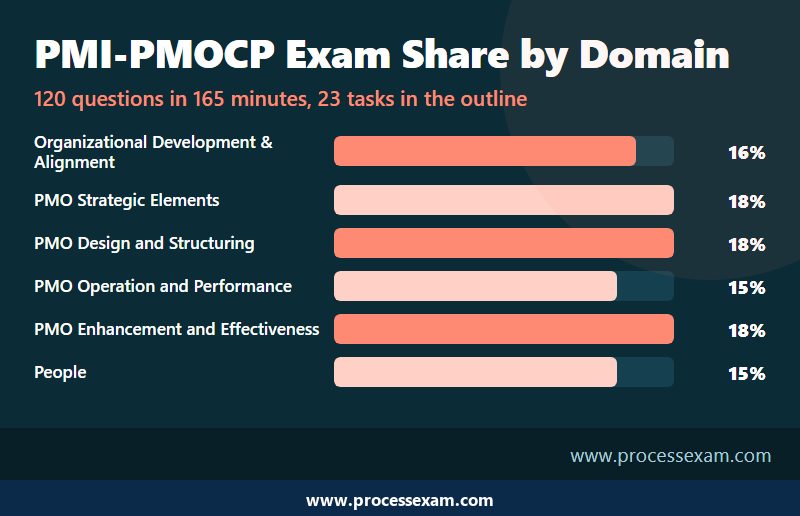
Organizational Development and Alignment (16%)
This domain looks beyond the PMO to the whole organisation's ability to run projects, which PMI calls organizational project management, or OPM. Its four tasks are to elevate OPM, shape the OPM culture, drive OPM maturity and cultivate OPM capabilities. In practice that means assessing current competencies, building a competency framework, running a maturity assessment against an established model, and writing a roadmap with milestones and key performance indicators. Mentoring programmes and change management sit here too. For a PMO lead it answers one question: is the organisation getting better at projects, and can you show it?
PMO Strategic Elements (18%)
Three tasks: architect the PMO strategy, steward the PMO mandate, and establish and maintain PMO governance. Strategy covers the PMO's vision, mission and objectives, a roadmap for setting it up or improving it, and a risk management plan for the PMO itself. The mandate task covers scope and authority, a PMO charter and executive sponsorship. Governance covers decision-making processes, reporting structures and escalation procedures, with regular reviews so that the framework keeps pace with the organisation.
PMO Design and Structuring (18%)
This is the domain that most surprises candidates from a delivery background. Its four tasks are managing potential and current PMO customers, orchestrating solutions to their needs, articulating and evolving the PMO value proposition, and designing and implementing PMO services. The enablers read like a service business plan: customer personas, surveys and interviews, a prioritisation framework, case studies, a service catalogue and a service level agreement framework. If you have only ever been a PMO's customer, spend extra time here.
PMO Operation and Performance (15%)
Three tasks cover the daily running of the office: onboarding PMO services, managing PMO services and managing PMO resources. Expect onboarding processes, user guides and training for new customers, a phased approach for complex or high-impact services, quality control and escalation for service delivery, and resource topics such as a skills matrix, capacity planning and the management of external contractors.
PMO Enhancement and Effectiveness (18%)
Four tasks deal with making the PMO better over time: optimising service performance, assessing and improving the maturity of PMO services, assessing and improving PMO team competencies, and optimising PMO value. This is where service KPIs, dashboards, performance review cycles, maturity models, individual development plans, value tracking and benchmarking appear. Notice how often the enablers end in a feedback loop. Measuring once is not the point; measuring, acting and measuring again is.
People (15%)
The People domain has five tasks and the widest spread of skills: enabling a value-driven mindset, fostering customer-centricity, elevating personal impact and effectiveness, leveraging technical skills to deliver results, and shaping organisational direction. Under those headings sit data-informed decisions, conflict management, negotiation, stakeholder management, integrity and ethics, adaptability, business acumen and cultural awareness. It is easy to underrate because none of it needs memorising, yet it carries the same weight as running the PMO's daily operations.
Taken together, the three 18% domains, which are strategy, design and enhancement, make up 54% of the paper. More than half of the exam is therefore about deciding what the PMO should be and proving that it works, and less than a fifth is about keeping it running.
Which situations test a PMO lead's judgement?
PMI says the exam assesses competence gained from practice as well as study, and that it is not written to any single text. That points to situation-based questions in which several answers sound reasonable. The four situations below are our own illustrations, built from tasks in the outline; they are not exam questions, but they show the reasoning the outline rewards.
The budget review
A finance director asks why the PMO needs six people. A project manager's instinct is to list everything the team does. The outline points another way: quantify the PMO's contribution to organisational success, show case studies of impact, and tailor the message to the person asking. The stronger response is evidence of value in the director's own terms, followed by a regular review of the value proposition so that the question does not arrive as a surprise next year.
The ignored template
Half of the project managers have stopped using the PMO's status template. Enforcing it through governance is tempting. The outline's customer tasks suggest finding out why first: survey and interview the customers, capture what they need, and adjust the service. Enforcement may still follow, but an assessment comes before it.
The new service
The PMO is about to launch resource capacity planning for every department. Launching everywhere on one date looks efficient. The outline names a phased approach for complex or high-impact services, supported by structured onboarding, user guides, training and a way to collect feedback during the rollout.
The priority dispute
Two sponsors each insist that their project gets the same scarce architect. The PMO lead who simply picks a winner has exceeded the mandate. The governance task exists for this moment: a defined decision-making process and an escalation procedure, so that the decision is made by the people authorised to make it and the PMO supplies the facts.
The same pattern runs through all four. Assess before you act, work within the mandate, treat the people affected as customers, and close with a way to measure whether the action worked. When two answers both look sensible, the one that follows that order is usually the stronger.
What does a workable study plan look like for someone already running projects?
Seven weeks at six to eight hours a week suits most working candidates who have the experience PMI asks for. Shorten it if you already work in a PMO; lengthen it if the customer and service language is new to you.
- Week 1: map yourself to the outline. Read all 23 tasks and rate each one: done it, seen it, or never met it. The "never met it" list is your real syllabus.
- Weeks 2 and 3: strategy and design. Work through PMO Strategic Elements and PMO Design and Structuring alongside PMI's practice guide. Draft a one-page charter and a short service catalogue for a PMO you know, real or imagined.
- Week 4: alignment and enhancement. Cover the OPM domain and PMO Enhancement and Effectiveness together, since both turn on maturity models, competency frameworks and KPIs.
- Week 5: operations and people. Study onboarding, service management and resources, then the five People tasks. For each People task, write down one situation from your own work.
- Week 6: timed practice in two halves. Sit half a paper, review, take ten minutes, then sit the other half, exactly as the real exam is split.
- Week 7: close the gaps. Return to the weakest tasks, sit one more full paper, and if you chose online proctoring, run the system test on the computer you will use.
What to read
PMI's outline lists five references and adds that they are not the only resources and do not guarantee a pass. They are Project Management Offices: A Practice Guide, PMI's authorised on-demand exam prep course, the PMBOK Guide Seventh Edition, The Standard for Organizational Project Management, and the Practice Standard for Project Configuration Management. The practice guide is the closest match to the six domains and the natural starting point. The prep course also satisfies the 10-hour education rule, which makes it the efficient choice if you still need those hours. PMI sells its own timed practice exam as well.
For the week-six rehearsal, a PMI-PMOCP mock exam on ProcessExam gives you timed sets of multiple-choice questions, so you can test the 82-second pace before you book a date.
Mistakes that cost prepared candidates marks
- Answering as the project manager. If your chosen answer has the PMO taking over a project, read the options again.
- Skipping the People domain. It is 15% of the paper and cannot be crammed in the final week.
- Learning terms without the order of actions. Knowing what a service level agreement is helps less than knowing that a needs assessment comes before the service is designed.
- Forgetting that the break is one-way. Candidates who plan to revisit the first section after the break lose that chance.
- Leaving the system test to exam day. Online check-in takes time, and a failed check is a poor way to start.
What does the credential cost, and what keeps it valid?
The exam fee is USD $520 at the member price and USD $700 at the full price, as of October 2026. PMI membership is not required, and the fee follows regional and membership pricing rules, so PMI's page may show the amount in your local currency. One detail catches people out: if you join PMI after paying for the exam, PMI does not refund the difference, so decide on membership first.
Retakes
You may sit the exam up to three times within the one-year eligibility period. PMI describes the retake fee as substantially discounted, again subject to regional and membership pricing, and does not print a single figure in the outline. After three unsuccessful attempts you must wait one year from the date of the last exam before reapplying, although you may apply for a different PMI certification during that year. Cancellation or no-show fees can apply once an appointment is confirmed.
Renewal
The credential runs on a three-year cycle. To keep it you earn 30 professional development units (PDUs) in each cycle, where one PDU is one hour spent learning, teaching others, presenting, reading, volunteering or creating content. PMI explains how PDUs are reported on its certification maintenance page. Most people who work in a PMO collect those hours in the ordinary course of the job, through training they deliver and material they write.
Add the cost of the 10 hours of PMO education if you do not already have them, and your study time. Whether that total is worth paying depends less on the certificate than on where you are heading: for someone already leading a PMO it confirms what they do, while for a project manager applying for a first PMO role it shows a hiring panel that you understand the job is a different one.
Where can a PMO career go once you hold it?
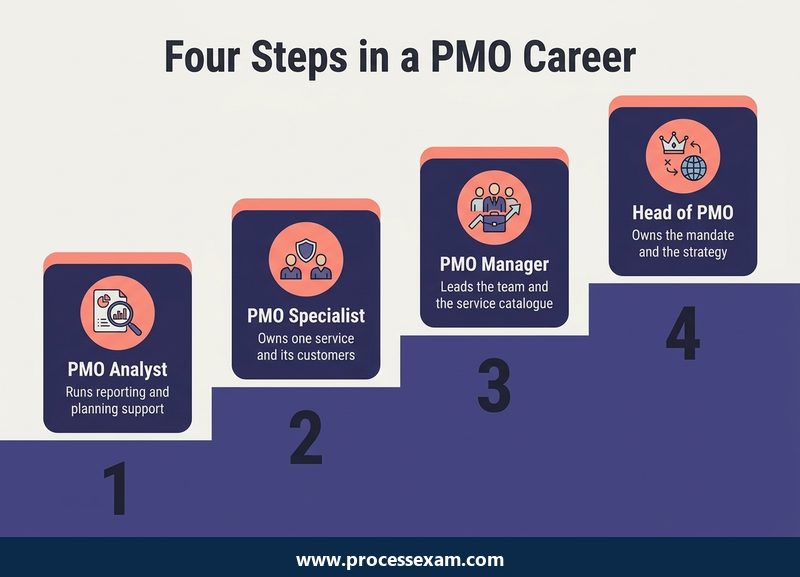
PMO roles do not have fixed titles, and a "PMO manager" in one company may do what a "PMO analyst" does in another. The usual progression still follows the amount of the office you are responsible for.
- PMO analyst or coordinator: runs one or two services, typically reporting and planning support, and learns who the PMO's customers are.
- PMO specialist or consultant: owns a service end to end, such as methods, resource planning or tooling, and onboards new customers to it.
- PMO manager or lead: owns the service catalogue, the team and the PMO's performance measures, and answers for its value.
- Head of PMO or PMO director: owns the mandate and the strategy, sits in governance forums and shapes how the organisation chooses and runs its projects.
PMI does not publish a salary figure for holders of this credential, and we will not invent one. What can be said is that the higher rungs are the ones the outline weights most heavily: strategy, mandate, governance, value. A candidate who can talk about those with evidence from their own PMO is having a different interview from one who lists the reports they produce.
From a PMO lead position, two directions are common. One is deeper into the office itself, toward an enterprise PMO or a strategy office that connects projects to business planning. The other is sideways into programme or portfolio management, where PMI's programme and portfolio credentials pick up. Either way, the habit that carries over is the one this exam is built around: treat the people you support as customers, know what you are authorised to decide, and measure whether your work made theirs better.
If the comparison table near the top of this article described a job you would rather be doing, start by rating yourself against the 23 tasks. That single hour will tell you how far you are from the role, and from the exam.
Frequently Asked Questions
Who is eligible for PMI's PMO certification?
You need a secondary diploma, at least 36 months in a project-related profession within the last eight years or a PMP in good standing, and 10 hours of formal education related to project management offices. PMI's authorised on-demand exam prep course satisfies the 10-hour education requirement.
How much does the PMI-PMOCP exam cost?
As of October 2026 the exam fee is USD $520 at the PMI member price and USD $700 at the full price. PMI membership is not required. Fees follow regional pricing rules, so PMI may show the amount in your local currency, and the fee is paid only after your application is accepted.
How many questions are on the PMI-PMOCP exam, and how long is it?
The exam has 120 multiple-choice and multiple-answer select questions and lasts 165 minutes. Of the 120, 100 are scored and 20 are unscored pretest questions placed randomly through the paper. An optional ten-minute break appears at the halfway point.
What is the passing score for the PMI-PMOCP exam?
PMI reports the result as PASS or FAIL and does not publish a passing percentage for the PMI-PMOCP. Twenty of the 120 questions are unscored pretest items that are not identified, so the sensible approach is to answer every question and prepare across all six domains.
How many times can you retake the PMI-PMOCP exam?
You can take the exam up to three times within your one-year eligibility period. After three unsuccessful attempts you must wait one year from the date of your last exam before reapplying. PMI says retakes within the eligibility period are offered at a discounted fee.
- Specialized |
- PMI Project Management Office Certified Professional Test Questions |
- PMI-PMOCP Question Bank |
- Project Management Office Certified Professional Simulator |
- Project Management Office Certified Professional Mock Exam |
- PMI Project Management Office Certified Professional Book |
- Project Management Office Certified Professional Certification Cost |
- Project Management Office Certified Professional Certification Requirements |
- PMI Project Management Office Certified Professional Sample Questions |
- PMI-PMOCP Exam Questions Download |
- PMI-PMOCP Test Questions |
- Project Management Office Certified Professional PDF


