
OMG-OCEB2-BUSINT200: OMG BPMN Certification at Intermediate Level
Updated on 10 October 2026. What’s new: the pass mark is 59 of 90 (66%) and the 105 or 135 minutes depend on where you live, not on whether English is your first language
Yes, Intermediate is a real step up from Fundamental, but the climb is depth, not length. OMG-OCEB2-BUSINT200 keeps the 90 questions and lowers the pass line to 59 correct (66%), then gives you 105 minutes in English-speaking countries or 135 everywhere else, for US$350. What changes is what each question expects you to know: complex BPMN behaviour, decision tables, business rules and governance frameworks. A pass on OCEB 2 Fundamental is the prerequisite.

Searchers who type "OMG BPMN certification" usually land on this exam, and it is fair to ask whether it fits. BPMN is the largest single block, 35% of the paper, yet the other 65% covers management, quality, rules, decisions and motivation modeling. This guide walks through the facts, the jump from Fundamental, every syllabus area, the five specifications OMG tells you to read, worked examples of the trickier ideas, a study-hours split and pacing for the clock. The figures come from OMG's own information sheet for the exam, read in October 2026.
What does OMG ask you to hold and pay before an Intermediate booking?
It is. OMG lists the BPM 2 Intermediate exam on its BPM certification program page, and the exam's information sheet carries the numbers in the table. The wider programme goes by the name OCEB 2, and this paper sits at its Business Intermediate level. You book, pay and cancel through a Pearson VUE account, either at a test centre or online, and OMG asks online candidates to run the system test before they schedule.
| Item | Detail |
|---|---|
| Exam code | OMG-OCEB2-BUSINT200 |
| Certification | OMG Certified Expert in BPM 2 - OCEB 2 - Business Intermediate Level |
| Questions | 90, multiple choice with text and images |
| Fee | USD $350, plus taxes |
| Duration | 105 minutes for residents of English-speaking countries; 135 minutes for all others |
| Passing score | 59 of 90 correct answers (66%) |
| Prerequisite | A passing score on the BPM 2 Fundamental exam |
| Languages | English and Japanese; translation apps are prohibited |
| Validity | Three years from the exam date |
Two details are easy to misread. First, the longer time depends on where you live, not on whether English is your first language, and OMG says the extra time is confirmed by email after you complete the exam order, so look for that message before exam day. Second, the prerequisite is a result, not a course: a pass on Fundamental has to be on record before the Intermediate paper can be booked, and accredited training is offered by OMG as an option rather than a requirement.
How hard is the jump from Fundamental to Intermediate in practice?
Harder in content, kinder in arithmetic. OMG's two information sheets put the papers side by side: Fundamental asks for 62 of 90 correct (69%) in 90 or 120 minutes, while Intermediate asks for 59 of 90 (66%) in 105 or 135 minutes. A lower pass line and more time can look like a gift, but they exist because the questions are denser. The table shows where the extra weight sits.
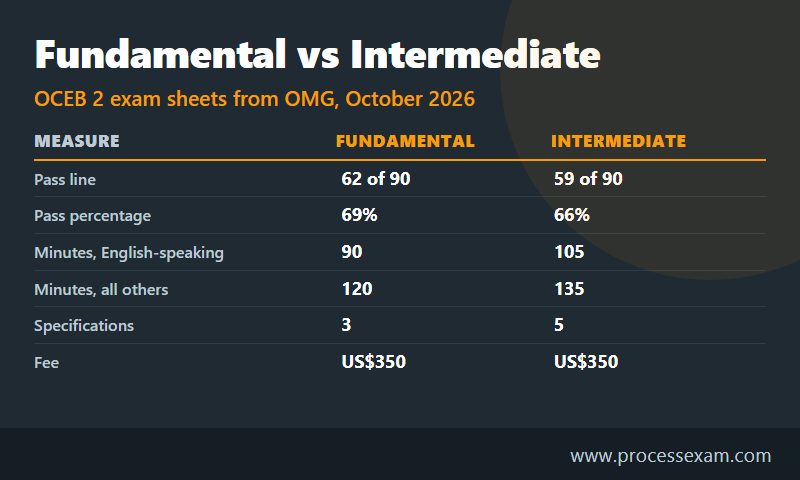
| Aspect | Fundamental | Intermediate |
|---|---|---|
| Prerequisite | None | Pass on Fundamental |
| Pass line | 62 of 90 (69%) | 59 of 90 (66%) |
| Time | 90 or 120 minutes | 105 or 135 minutes |
| Specifications on the sheet | BPMN 2.0.2, BPMM 1.0, BMM 1.3 | Those three plus DMN 1.3 and SBVR 1.5 |
| BPMN scope | Process and collaboration diagrams, basic and extended elements | "All of the remaining" elements: complex gateway, compensation, conversations, choreography, execution semantics, diagram interchange |
| Beyond modeling | Not a sheet topic | Measurement, governance frameworks, change management, business rules |
For a candidate who passed Fundamental on diagram literacy alone, the shock is the second half of the syllabus. Fundamental can be passed by knowing what each symbol means. Intermediate asks what a model does when it runs: which token goes where, when a handler fires, which rule wins in a decision table. Two specifications that Fundamental never listed, DMN and SBVR, arrive at the same time, and they make up a fifth of the paper between them.
The kinder part is real too. A pass line of 59 means 31 answers can be wrong, and the time allowance works out to roughly 70 seconds a question at 105 minutes or 90 seconds at 135. Most candidates who stumble do so by treating Intermediate as Fundamental with more of the same, and spending their weeks re-drawing basic flows instead of learning the new material.
What do the six syllabus areas ask you to do?
OMG splits the paper into six areas, and the weights sum to 100%. They are the best guide to how many of the 90 questions come from each, so they should set how your hours are spent. A full topic-by-topic list is on the OCEB 2 Intermediate syllabus page.
| Syllabus area | Weight | Rough number of questions |
|---|---|---|
| Business Process Modeling with BPMN | 35% | about 31 |
| Business Process Management Knowledge and Skills | 20% | about 18 |
| Process Quality and Governance Frameworks | 15% | about 14 |
| Business Rules Approach and Shared Business-Wide Vocabulary | 10% | about 9 |
| Decision Management and Modeling with DMN | 10% | about 9 |
| Intermediate Business Motivational Modeling | 10% | about 9 |
The question counts are simple arithmetic on 90 questions, not an OMG promise; individual papers can drift by a question or two.
Business Process Modeling with BPMN, 35%
This is the "remaining" half of BPMN 2.0.2. The sheet names global tasks and global processes, handling events, the complex gateway, compensation, conversations, choreography, execution semantics, error handling and diagram interchange. It excludes the transaction sub-process and ACID semantics, auditing and monitoring, and it states that XMI is never examined. Data handling stops at data objects (including lifecycle), data stores, data inputs and data outputs; input sets and output sets are out of scope. Expect scenario questions that show a diagram and ask what happens next.
Business Process Management Knowledge and Skills, 20%
The sheet groups this under project management (the activity lifecycle and process ownership) and measurement and optimisation. The list is long: critical success factors and KPIs, business activity monitoring, scorecarding, process simulation, BPM return on investment, model value analysis, BPMS tool fundamentals, the basics of a BPM Center of Excellence, and organisational change management. Cycle time analysis belongs here, and OMG's reading list points to chapters on flow analysis and cycle time efficiency in Dumas' textbook.
Process Quality and Governance Frameworks, 15%
OMG says questions go "one level deeper" into the scope, goals and structure of SOX, COBIT, ITIL, its own Business Process Maturity Model, Six Sigma and Lean, always as they relate to BPM. The task is recognition and placement: which framework answers a control question, which a service question, which a maturity question.
Business Rules Approach and Shared Business-Wide Vocabulary, 10%
Noun concepts, the basics of business rules, the two types of rule, how rules relate to processes, and the value of one vocabulary used across the whole organisation. OMG labels this SBVR awareness, so you need the ideas, not the formal notation.
Decision Management and Modeling with DMN, 10%
DMN 1.3 basics: scope and uses, decision requirements, relating decision logic to decision requirements, decision tables, and how DMN connects to BPMN.
Intermediate Business Motivational Modeling, 10%
The Business Motivation Model 1.3, chapters 7 and 8, plus the elements it borrows from outside: organisation unit, business process and business rule. The sheet adds that you must be able to construct BMM models and interpret brief scenarios, so this is applied, not memorised.
Which chapters of the five specifications does OMG ask you to read?
The sheet lists "standard areas covered" with chapter numbers, which is unusual and useful: it tells you where to stop reading. The table pairs each specification with the part of it that is examined and the area it feeds.
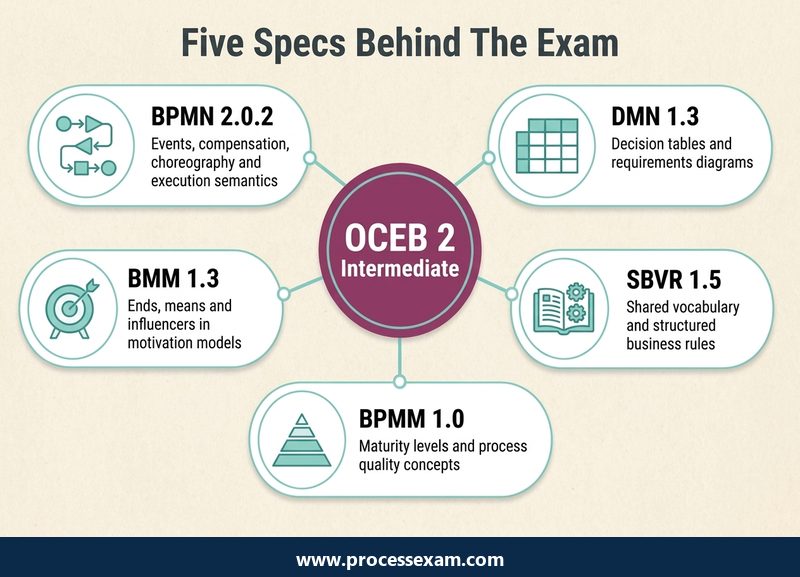
| Specification | Examined parts, in short | Feeds |
|---|---|---|
| BPMN 2.0.2 | Sub-processes, call activity, event handling, complex gateway, compensation, end event types, conversation and choreography introductions, execution semantics to 13.3.1, interchange | BPMN modeling |
| DMN 1.3 | Introduction, requirements (DRG and DRD), decision logic, notation, metamodel, examples, relation to BPMN | DMN |
| BMM 1.3 | Chapters 7 and 8, the organisation unit, process and rule links, metrics annex | Motivation modeling |
| SBVR 1.5 | Scope, conformance, overview of the approach and the business rules approach annexes | Rules and vocabulary |
| BPMM 1.0 | Conformance, uses, the BPMM family and its concepts; only the introduction to the normative content | Governance and quality |
Two readings save time. For BPMN, do not read the specification front to back; its execution semantics chapter stops being examined after section 13.3.1, apart from the complex gateway. For DMN, read the notation and requirements chapters and the examples, and leave the metamodel for last. Candidates who already work in BPMN often skip BMM because it feels like management theory, then lose a tenth of the paper.
The sheet also recommends books. The only title written for this exact exam is "Success with DMN 1.3 and OCEB 2 Business Intermediate" by Negri, Brülhart and Schiltz, which exists in German and French editions too. Others on the list cover process change (Harmon), business rules (Ross), change management (Hiatt and Creasey) and IT governance (Moeller). They are recommendations, not requirements.
What does a question on compensation, event handling or a decision table really test?
The sheet is about behaviour, so the questions are, too. These examples show the reasoning, in the style the syllabus describes. They are teaching examples written for this guide, not OMG questions.
Compensation: undoing work that already finished
An order process reserves stock, charges the card, then ships. Shipping fails after the card was charged. A compensation boundary event on "Charge card" points, by association rather than sequence flow, to a "Refund card" activity. The test is twofold: compensation only applies to an activity that completed successfully, and a throwing compensation event is what triggers the handler. A candidate who draws the handler on the normal flow has missed the point.
Interrupting or not: the border tells you
A timer is attached to "Review claim" after 48 hours. If the border of the event is a solid double line, the review stops when the timer fires. If it is dashed, the review carries on and a reminder path runs in parallel. Event sub-processes follow the same rule. Questions often hide the answer in the border style, not in the labels.
Call activity or embedded sub-process
Both look like a task with a plus sign. An embedded sub-process lives inside its parent and shares the parent's data and scope; a call activity, drawn with a thick border, invokes a global process or global task that other models can reuse. A typical question describes a "verify identity" routine used by three different processes and asks which construct fits. The answer is the call activity, because the logic is defined once and called from many places.
Errors, defaults and getting stuck
The reading list names default flow, error events and "getting stuck" as chapters to study, and the same ideas turn up in diagrams. An exclusive gateway with no default flow and no matching condition leaves the token with nowhere to go, so the instance stalls. An error end event inside a sub-process is caught by an error boundary event on that sub-process and nowhere else. A question will show a diagram with one of these faults and ask what the process does at run time, which rewards candidates who have traced tokens by hand.
Decision tables and hit policies
A delivery discount depends on customer tier and order value. Under a Unique hit policy, exactly one rule may match any input:
| Tier | Order value | Discount |
|---|---|---|
| Gold | 1000 or more | 10% |
| Gold | under 1000 | 5% |
| Standard | 1000 or more | 3% |
| Standard | under 1000 | 0% |
If a fifth rule said "Gold, any value, 7%", it would overlap two rows and the table would be invalid under Unique; under First, the order of the rows would decide. A decision requirements diagram then shows that this decision needs two inputs (tier and value) and can feed a BPMN business rule task. Questions ask you to spot the overlap, name the policy, or read the diagram.
Rules and goals in plain language
"Each rental has exactly one car" defines what a rental is, which makes it a structural rule. "A rental must not be given to a driver under 21" governs behaviour, so it is an operational rule. In the Business Motivation Model, "be the most trusted rental brand" is a goal, while "raise repeat bookings to 40% by next December" is a measurable objective; a strategy is a means that channels effort toward them. These distinctions are small, and they are exactly what a fifth of the paper turns on.
Cycle time efficiency
If a claim needs two hours of real work but takes ten hours from arrival to closure, cycle time efficiency is 2 divided by 10, or 20%. The rest is waiting. Flow analysis questions give you a few task times and a path probability, and ask for that ratio.
Where should your study hours go, given the 35-20-15-10-10-10 split?
Proportional to the weights, then bent toward whatever you have never done at work. The table assumes 60 hours as an example; scale it up or down. Someone coming straight from Fundamental should add time to DMN and SBVR, which are new, and take it from basic BPMN flows they already know.
| Block | Hours of 60 | How to spend them |
|---|---|---|
| BPMN, remaining elements | 21 | Draw each event, gateway and compensation case from memory, then check against the specification |
| BPM knowledge and skills | 12 | Work KPI, BAM, scorecard and cycle time examples; list Center of Excellence duties |
| Quality and governance | 9 | One-page summary per framework: SOX, COBIT, ITIL, BPMM, Six Sigma, Lean |
| Business rules and vocabulary | 6 | Sort sample statements into structural and operational rules |
| DMN | 6 | Build three decision tables and a decision requirements diagram |
| Motivation modeling | 6 | Map a company you know into ends, means and influencers |
Use three passes. In the first, read the sheet and the chapters it names and build your notes. In the second, switch to questions and diagrams, and write down why each wrong option is wrong. In the third, sit full 90-question papers under the time you will actually have. An OMG-OCEB2-BUSINT200 practice exam earns its place in that last pass, because the weight your mistakes cluster in matters more than the score.
Hands-on work beats rereading. Any free BPMN modeller will let you try a compensation handler, an event sub-process and a complex gateway in an afternoon, and a spreadsheet is enough to test a decision table for overlaps.
How should you pace 90 questions, and what if the first sitting does not go to plan?
With 105 minutes you have about 70 seconds per question; with 135 you have 90. Diagram questions take longer than definition questions, so bank time on the quick ones. A workable rule is one pass at about 60 seconds each, flagging anything that needs a second look, then using the remaining 20 to 40 minutes on the flagged items. Because 31 wrong answers are allowed, a single question that eats three minutes is rarely worth it.
Check the time allowance before you travel or log in. If you live in an English-speaking country the shorter allowance applies even if English is your second language, and the longer one applies elsewhere even if you are fluent.
If the result falls short, OMG's sheet says the score report carries a 20% discount code toward a retake. Cancelling through Pearson VUE more than a day ahead brings a full refund, while a later cancellation costs you the fee. Problems with your computer or connection on the day are a matter for Pearson VUE customer service; anyone needing adjustments for a disability should write to OMG's certification address before booking.
Is the Intermediate credential worth holding for its three years?
It does three jobs. It proves you can read and reason about BPMN beyond the basic symbols, which analysts and process owners are asked to do when a model has to be executed or handed to developers. It shows breadth: DMN, business rules, motivation modeling and governance sit beside the diagram skills, so it suits people whose role crosses business and IT. And it is a rung on the OCEB 2 ladder, since the Advanced exam asks for the lower levels first.
The certification expires three years after the exam date. OMG says that taking the same or a higher level exam extends the validity, so a later Advanced result also renews this one. After passing you can claim a Credly digital credential, normally within hours, and print a certificate. No salary figure is quoted here, because OMG does not publish one and no survey is cited.
The strongest argument for sitting it is practical: it forces you to learn the parts of BPMN, DMN and BMM that daily modeling work lets you avoid. The strongest argument against is timing. If you have not used Fundamental material in a year, take a week to refresh it before you start the new syllabus.
Frequently Asked Questions
Is OCEB 2 Intermediate the OMG certification for BPMN?
It is the middle level of OMG's OCEB 2 programme and the BPMN-heavy one: BPMN modeling carries 35% of the 90 questions. The same paper also tests DMN, business rules, BMM, governance frameworks and BPM management skills, so BPMN knowledge alone will not reach the 59-answer pass line.
How many questions and how much time does OMG-OCEB2-BUSINT200 give?
The paper has 90 multiple-choice questions with text and images, and you need 59 correct, which is 66%. Residents of English-speaking countries get 105 minutes and everyone else gets 135. OMG confirms extra time by email after the exam order is completed, so look for that message.
Do I need Fundamental before taking OCEB 2 Intermediate?
Yes. OMG's information sheet lists a passing score on the BPM 2 Fundamental exam as the prerequisite for Intermediate. Fundamental itself has none. Make sure your Fundamental result is on your Pearson VUE record before you try to schedule the Intermediate paper there.
What does the Intermediate exam cost and what if I fail?
The fee is US$350 plus taxes, with regional currency equivalents. After a failed attempt, OMG says the score report carries a 20% discount code for a retake. A booking cancelled more than 24 hours ahead through Pearson VUE is refunded in full; later cancellations forfeit the price.
Are brain dumps a safe way to prepare for OMG-OCEB2-BUSINT200?
No. Dumps recycle remembered questions with no explanation, while this exam asks you to reason about models, decision tables and rules. OMG's information sheet points candidates to the specifications and named books instead, and the translation-app ban shows how closely the paper is controlled.
- OMG OCEB 2 Intermediate Exam Questions |
- OMG OCEB 2 Intermediate Question Bank |
- OMG OCEB 2 Intermediate Questions |
- OMG OCEB 2 Intermediate Test Questions |
- OMG OCEB 2 Intermediate Study Guide |
- OMG-OCEB2-BUSINT200 Question Bank |
- OCEB 2 Intermediate Certification |
- BPM 2 Certifications |
- OMG-OCEB2-BUSINT200 Exam Questions Download |
- OMG-OCEB2-BUSINT200 Test Questions |
- BPM 2 Intermediate Mock Exam |
- BPM 2 Intermediate Simulator |
- BPM 2 Intermediate Certification |
- BPM 2 Intermediate Certification Cost |
- BPM 2 Intermediate Certification Requirements |
- OMG BPM 2 Intermediate Book |
- OMG BPM 2 Intermediate Question Bank |
- OMG BPM 2 Intermediate Study Guide |
- BPM 2 Intermediate |
- BPM 2 Intermediate PDF |
- OMG BPM 2 Intermediate Exam Questions |
- OMG BPM 2 Intermediate Questions |
- OMG BPM 2 Intermediate Sample Questions


