
OGIT-101 Study Plan: Pass IT4IT 3 Foundation in 6 Weeks
Updated on 9 October 2026. What’s new: exam fee corrected to $405 USD, and the syllabus now follows The Open Group's question counts for all eleven units
Six weeks is enough for the Open Group OGIT-101 exam if you treat IT4IT 3 as a model you can redraw from memory, not a glossary to cram. The IT4IT 3 Foundation paper is 40 multiple-choice questions in 60 minutes, you need 26 right (65%), and the fee is $405 USD. This plan turns those numbers into six weekly targets.

People who stall on this exam rarely lack time. They read the standard front to back, highlight everything and arrive at the test unable to say which backbone owns a data object or what separates two neighbouring value streams. The plan below is built around the questions the paper really asks, which the vendor publishes unit by unit.
Is six weeks enough to pass the IT4IT 3 Foundation exam?
For most working IT professionals, yes. The exam sits at foundation level: The Open Group describes it as testing knowledge and comprehension of the standard's terminology, structure and core concepts, not design skill or tool configuration. There is no prerequisite, so a service manager, an enterprise architect, a product owner or a student can sit it.
Six weeks at about six to eight hours a week gives roughly 40 to 50 hours. That is comfortable if you already work with ITIL, DevOps or product-based delivery, because the vocabulary will feel familiar even where the names differ. If the whole subject is new, stretch it to eight weeks by repeating weeks three and four. If you are rushed, the shape of the plan still holds, but the practice weeks cannot be shortened.
The exam at a glance
| Item | Detail |
|---|---|
| Exam | The Open Group IT4IT 3 Foundation (exam code OGIT-101, English) |
| Certification earned | The Open Group Certified IT4IT 3 Foundation |
| Questions | 40, multiple choice |
| Time limit | 60 minutes |
| Passing score | 65% (26 of 40) |
| Fee | $405 USD |
| Open book | No, and the exam is supervised |
| Prerequisites | None |
| Based on | IT4IT Standard, Version 3.0 |
The Open Group's own IT4IT examinations data sheet carries the question count, the pass mark and the delivery rules, and it is the page to re-check before you book. A training course accredited by The Open Group includes an exam voucher in its price, which matters if your employer is paying for a course anyway.
Which IT4IT version does OGIT-101 test, and what happened to the older exam?
OGIT-101 tests IT4IT Standard, Version 3.0. The Open Group runs two tracks side by side: the older IT4IT Foundation certification, based on Version 2.1 and taken through the IT4IT Part 1 exam (code OG0-061), and the newer IT4IT 3 Foundation certification, which this article covers. Both are 40 questions in 60 minutes with a 65% pass mark, so the format will not tell you which one you booked. The syllabus does.
This matters because the two versions organise the subject differently. Version 2.1 is built around four value streams: Strategy to Portfolio, Requirement to Deploy, Request to Fulfill and Detect to Correct. Version 3.0 splits the lifecycle into seven value streams: Evaluate, Explore, Integrate, Deploy, Release, Consume and Operate. Study material written for 2.1 will teach you the wrong frame, and it is the most common way people lose a week. Check that any book, video or training deck names the 3.0 standard and the seven streams before you spend time on it.
How the two question maps differ
| Area | IT4IT Foundation (Version 2.1, OG0-061), exam items | IT4IT 3 Foundation (Version 3.0, OGIT-101), exam items |
|---|---|---|
| Opening units | Overview 4, definitions not examined | Introduction 5 |
| Core ideas | Basic concepts 8, IT4IT core 8 | Digital product 8, two backbones 13 |
| Value streams | Four streams at 5 each | Seven streams at 2 each |
The shift is clear when the two columns sit together. The older paper rewards depth in four large streams, while the newer one spreads value-stream questions thinly and moves the weight to the digital product and the backbones. A plan copied from a Version 2.1 blog post will therefore over-invest in the wrong place.
The Open Group's IT4IT certification page lists both tracks, and its study materials shop sells the self-study pack for the current version. We checked both pages in October 2026 and OGIT-101 was the listed IT4IT 3 Foundation exam.
Where do the 40 exam questions actually come from?
They come from eleven syllabus units, and the weighting is not even. The data sheet gives a question count for each unit, which is the single most useful thing to read before you plan your hours.
| Unit | Topic | Questions |
|---|---|---|
| 1 | IT4IT Introduction | 5 |
| 2 | Digital Product | 8 |
| 3 | Digital Product Backbone: functional components and data objects | 7 |
| 4 | Service Offer Backbone: functional components and data objects | 6 |
| 5 to 11 | Evaluate, Explore, Integrate, Deploy, Release, Consume and Operate value streams (one unit each) | 2 each, 14 in total |
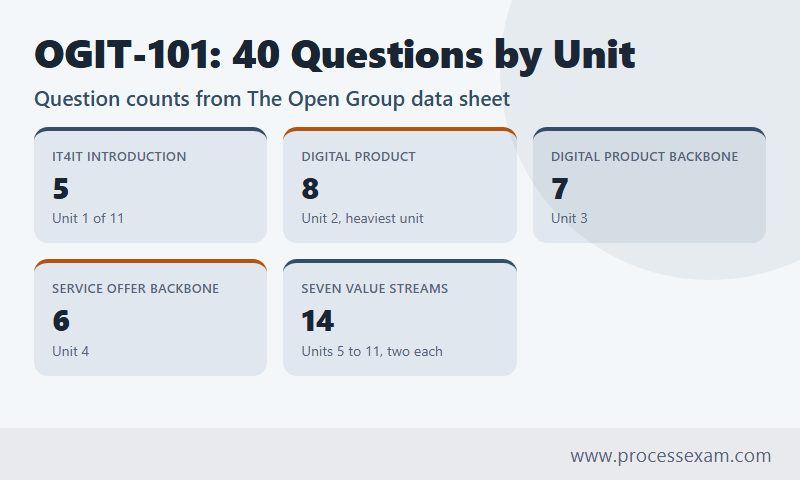
Read the table the way an examiner wrote it. Four units, covering the introduction, the digital product and the two backbones, carry 26 of the 40 questions, which happens to equal the pass mark. The seven value-stream units are worth 14 questions between them, so a single value stream is about 5% of the paper. A candidate who spends half their time memorising every activity of the Operate stream is investing in two questions.
That does not make the streams optional, because backbone and digital-product questions often use a stream as the setting. It does tell you where depth pays. If you can explain the digital product lifecycle and name what each backbone holds, you are most of the way to 26 before a single stream question is counted.
You can compare this list with the topic breakdown on our OGIT-101 syllabus page while you plan your weeks.
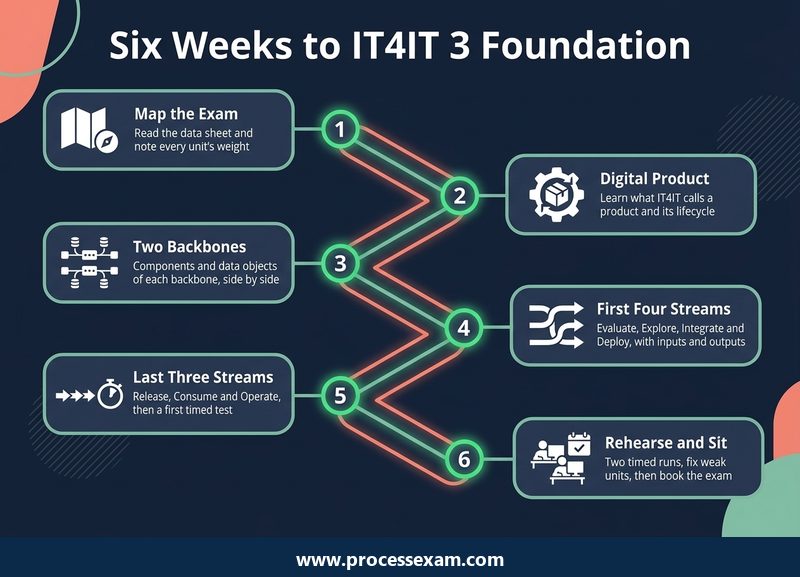
What should you study in each of the six weeks?
Each week below has one job and one proof that the job is done. If you cannot produce the proof, repeat the week's last session instead of moving on.
Week 1: map the exam and the standard
Download the data sheet, copy the unit table into your notes and write the question count beside each unit. Then skim the IT4IT 3.0 standard's contents without trying to learn it, so that you know where each unit lives. Decide your exam month and book study blocks in your calendar. Proof: you can recite from memory that the paper has 40 questions in 60 minutes and that the digital product unit is the largest.
Week 2: the digital product
This is the largest single unit at 8 questions, so give it the whole week. Learn what IT4IT 3 means by a digital product, how it differs from a project or a service in older frameworks, and how it moves through its lifecycle. Write each idea in one sentence of your own. Proof: you can explain to a colleague, in two minutes and without notes, why IT4IT manages products rather than projects.
Week 3: the two backbones
The Digital Product Backbone and the Service Offer Backbone are worth 13 questions together, and they are where memory work lives. For each backbone, list its functional components and the data objects they own, then draw a one-page map. Do not try to learn the two at once. Spend three sessions on the first, three on the second, and one session on how they connect. Proof: given a data object, you can name the backbone it belongs to and the component that creates or updates it.
Week 4: the first four value streams
Take Evaluate, Explore, Integrate and Deploy. For each, write three lines: what the stream is for, what it takes in and what it produces. Resist the urge to memorise every activity. The exam asks about purpose and handoffs, such as which stream hands a built product to which. Proof: you can walk a single digital product from the first idea to a deployed state out loud, naming each stream as you pass through it.
Week 5: the last three streams and a first timed test
Cover Release, Consume and Operate the same way, then take your first full timed set of 40 questions at the end of the week. Mark every question you guessed, even when you guessed right. Proof: you finish inside 60 minutes and have a list of the units that cost you answers.
Week 6: rehearse, repair and sit the exam
Run two more timed sets on separate days, repair the weakest unit between them and keep the final two days light. On exam day you want recall, not new reading. Proof: your last two timed scores sit clearly above 26 of 40, not on it.
Weeks 5 and 6 are when the OGIT-101 practice exam earns its place: run its timed sets there, since they follow the unit structure above, and every explanation tells you which unit you drifted from.
Which materials are worth your time?
Start with the IT4IT Standard, Version 3.0 itself, because every exam question traces back to it. The Open Group also sells a self-study pack for the Foundation certification, and an accredited training course is the other route; the vendor says courses include the exam voucher. Whatever you choose, make sure it follows the eleven units in the data sheet, because a resource organised differently will tempt you to study in the wrong proportions.
Add your own material on top: the one-page maps, the value-stream story and a short list of look-alike terms with a one-line contrast for each. Notes you wrote yourself are the ones you can recall under the clock.
What if you have three weeks, or twelve?
With three weeks, merge weeks one and two into a single weekend, split the backbones across weeks one and two, and use week three for streams and practice. Do not drop the timed sets. With twelve weeks, double each block and add a weekly ten-minute recall quiz from your own notes. Spacing the same material across more days helps retention more than adding extra hours on one day.
How do you learn value streams without memorising lists?
Lists fail because the streams look alike on paper. Seven names, seven boxes, similar verbs. The fix is to learn them as a single story rather than seven separate facts.
Follow one product from idea to retirement
Pick a product you know, such as an internal expense app or a customer portal. Walk it through the seven streams in order. Evaluate is where the portfolio decides whether the idea deserves money. Explore shapes requirements and a design. Integrate builds and tests it. Deploy puts it into an environment. Release makes it available as an offer. Consume is the user asking for and using it. Operate keeps it healthy. When a question names a stream, picture where your product is in the story and the answer usually follows.
Ask what each stream hands to the next
Exam writers like handoffs because they test understanding, not recall. For every pair of neighbouring streams, ask what object moves across: a requirement, a build, a release, a service offer. If you can state the handoff between each pair, the odd-one-out questions become easy.
Redraw, do not reread
After each study session close the book and redraw the diagram from memory on a blank page. Compare, correct and repeat the next day. Rereading feels productive and produces almost no recall, while redrawing shows you exactly which box you cannot place.
When should you start timed practice, and what score means you are ready?
Start in week 5, not week 1. Before then you do not have enough material to make a practice score meaningful, and a poor early score only teaches you to avoid testing. By week 5 you have met every unit once, which is the point where a timed set shows what you retained.
Treat the pass mark as a floor and not a target. Twenty-six of 40 sounds generous, but foundation exams punish a single weak unit: miss three of the 8 digital product questions and one blank backbone topic and you are at the edge. A sensible rule is to book the real exam once you have two timed sets in a row comfortably above the pass mark, with no unit that you cannot explain aloud.
How to review a practice set
Sort every missed or guessed question into one of three bins. A knowledge gap means you never learned it, so return to the standard. A confusion gap means you mixed up two similar things, so write a one-line contrast. A reading gap means you knew it and misread the wording, so slow down on the stem. The third bin is the cheapest to fix and is often larger than candidates expect.
Try a short untimed set early to get used to the style, and keep full timed sets for the last two weeks.
How do you book and sit the exam, and what happens on the day?
The Open Group delivers its exams through its examination provider, Pearson VUE, either at an authorised test centre or remotely through online proctoring. The data sheet describes both routes and states that the exam is supervised and closed book. If you are choosing remote delivery, run the provider's system check on the machine and network you will use a few days before, and clear your desk and room as instructed.
The 60 minutes is the time for the questions. The data sheet notes that the provider's total appointment is typically about 15 minutes longer, for registration, the tutorial and a survey, and that extra time may be available to people sitting the English exam as a second language. Ask the provider about that when you book, not on the day.
A pacing plan for 40 questions
Sixty minutes for 40 questions is 90 seconds each. Aim to finish a first pass by minute 40, flag anything that needs a second look and spend the remaining 20 minutes on the flagged items. On a closed-book paper there is no reference to consult, so a long stall on one question is a loss you cannot recover by looking it up.
The last 48 hours
Review your one-page backbone maps and the value-stream story, not new material. Sleep properly. Check your identification requirements with the provider. Arrive, or log in, early. None of this is glamorous, but it removes the avoidable ways a prepared candidate loses marks.
What does the IT4IT 3 Foundation credential do for your career?
It shows you can speak the vendor-neutral language of IT4IT, a reference architecture for managing the business of IT and the end-to-end lifecycle of digital products, as The Open Group describes it. That is useful where an organisation is rationalising its tool landscape, moving from project-based to product-based delivery or trying to give IT operations, development and architecture a shared model.
Typical beneficiaries are IT service managers, enterprise and solution architects, IT portfolio and product managers, tool owners and consultants who advise on IT operating models. The credential is a foundation, so treat it as proof of shared vocabulary and structured thinking rather than a statement that you can design a full IT4IT implementation. It pairs naturally with ITIL, TOGAF or agile and DevOps credentials, because IT4IT is the model that shows how their pieces fit together.
Making the credential pay off
After you pass, use the model in your own work. Map one team's tools to the seven value streams, or label an existing portfolio by the digital product lifecycle. A short worked example in your own organisation tells a manager more than the certificate does, and it keeps the knowledge alive after the exam.
Frequently Asked Questions
How many questions are on the OGIT-101 exam?
The Open Group IT4IT 3 Foundation exam, OGIT-101, has 40 multiple-choice questions and a 60-minute time limit. That works out at 90 seconds per question. The exam is supervised and closed book, so plan a pacing routine and practise it under the clock before you sit the real paper.
What is the passing score for OGIT-101?
The pass mark for OGIT-101 is 65%, which means 26 correct answers out of 40. Because every unit contributes questions, a candidate with one completely weak unit can fall short even when the others are strong, so aim to be comfortably above 26 on timed practice sets.
How much does the OGIT-101 exam cost?
The OGIT-101 exam fee is $405 USD. A training course accredited by The Open Group includes an exam voucher in its fee, so check whether your employer or training provider already covers the exam before you pay separately. Confirm the current price with The Open Group when you book.
How long does it take to prepare for IT4IT 3 Foundation?
Most working IT professionals can prepare in six weeks at six to eight hours a week, around 40 to 50 hours. People new to digital product thinking may want eight weeks. The two largest blocks of time should go to the digital product unit and the two backbone units.
What is the difference between IT4IT Foundation and IT4IT 3 Foundation?
IT4IT Foundation is based on IT4IT Standard Version 2.1 and taken through the OG0-061 Part 1 exam. IT4IT 3 Foundation is based on Version 3.0 and uses exam code OGIT-101. Version 3.0 describes seven value streams, so older study material built around four streams will mislead you.
- Open Group IT4IT 3 Foundation Test Questions |
- OGIT-101 Question Bank |
- IT4IT |
- IT4IT 3 Foundation Simulator |
- IT4IT 3 Foundation Mock Exam |
- Open Group IT4IT 3 Foundation Book |
- IT4IT 3 Foundation Certification Cost |
- IT4IT 3 Foundation Certification Requirements |
- Open Group IT4IT 3 Foundation Sample Questions |
- OGIT-101 Exam Questions Download |
- OGIT-101 Test Questions |
- IT4IT 3 Foundation PDF


