
Do HR Certifications Lead to Higher Pay? SHRM-CP, PHR and SPHR
A SHRM-CP costs $399 for a SHRM member and $499 for a non-member at the standard rate, and the only pay premium SHRM itself publishes is that certified HR professionals report salaries 14 to 15 percent higher than peers without one. Whether that gap belongs to the certificate is the real question. It does when the credential opens a door your pay depends on, and it does not when it simply sits beside a career that was already rising.

What does the SHRM-CP cost next to the pay gain people quote?
Start with the price, because it is the one number in this debate that is fixed. SHRM runs the SHRM-CP and SHRM-SCP in two testing windows a year. The second window for 2026-27 runs from 1 December 2026 to 15 February 2027, and standard applications for it close on 24 December 2026; the early-bird rates ended on 31 August 2026 (dates and fees read on SHRM's exam options and fees page in October 2026). The standard price includes a $50 application fee and a $49 standard-deadline fee, both non-refundable. Students enrolled in an HR degree programme pay less, and SHRM also advertises group pricing for teams of five or more.
| SHRM-CP fact | Detail |
|---|---|
| Vendor | SHRM |
| Exam code | SHRM-CP |
| Exam price (USD) | Member - $399; Non-member - $499 |
| Duration | 220 minutes |
| Questions | 134 |
| Passing score | Pass / Fail (200 Scaled Score) |
| Eligibility | No degree or HR title required |
Now set that against the claim. SHRM states, on a page for student members, that research shows certified HR professionals report salaries 14 to 15 percent higher than peers without certification (SHRM's article on the competitive edge of certification, published in June 2023). Two cautions come with it. The figure comes from the organisation that sells the credential, and it describes what certified people say they earn, not what the same person earned before and after passing.
The arithmetic is still instructive, because the fee is tiny beside any plausible raise. On a salary of $60,000, a 1 percent raise is $600, already more than the non-member fee of $499. A raise of 14 percent on the same salary would be $8,400, but treat that as a ceiling to test rather than a promise. The fee is not where the cost sits. The cost is the weeks of study, the three-year renewal cycle, and the risk of sitting an exam that does not fit the job you hold. The rest of this article is about the part the fee cannot answer: through which routes a certificate turns into money, and in which workplaces none of them is open.
Why does a certified HR professional earn more, and is the certificate the reason?
Two different stories produce the same pay gap, and a salary survey cannot tell them apart. In the first, the certificate causes the raise: it gets you through a filter, into a grade or onto a project that you would not have reached otherwise. In the second, the people who certify are already the ones heading up. They are ambitious, they are further along in the profession, they work for employers that fund exams, and they would have been paid more with or without the letters.
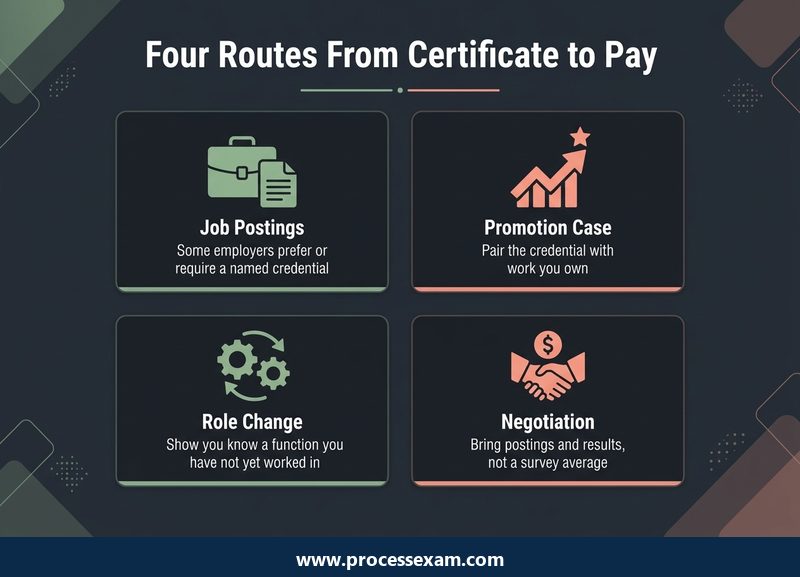
Both are partly true, and the honest position sits between them. A survey comparing certified with uncertified staff catches the ambitious group and the certificate together. That is why a 14 to 15 percent figure is a reason to look into certification, not a number to plan a budget around. What you can do instead is test each of the four mechanisms below against your own situation. Each one can be checked, and each has a cheap way to find out whether it applies to you before you spend a weekend on a study plan.
- Posting filters. Some employers name a certification in the job advert or use it to shortlist.
- Promotion eligibility. Some grade structures or hiring managers treat it as a marker for the next level.
- Role change. It helps you move from administrative work into a specialist or strategic seat.
- Negotiation. It gives you an external reference when you ask for a number.
Do job postings really ask for an HR certification?
Some do, but fewer than the marketing suggests. The US Bureau of Labor Statistics describes certification for human resources specialists as usually voluntary, while noting that some employers prefer or require it and that human resources generalists in particular may benefit because it shows knowledge and professional competence across all HR areas (read on the Bureau of Labor Statistics page for human resources specialists). That wording is worth reading twice: usually voluntary, sometimes preferred, occasionally required. It is a picture of a profession where a credential helps in some hiring pools and does nothing in others.
How to measure it for your own market
You do not need a survey. Open a job board, search the HR title you want in the city and industry you would work in, and read twenty postings. Make a tally with three columns: names a certification as required, names it as preferred, does not mention it. If most of the postings that pay at the top of the range name SHRM-CP, SHRM-SCP, PHR or SPHR as required or preferred, the filter mechanism is real for you. If hardly any do, the certificate will not change your applications, and the remaining mechanisms need to carry the case.
What the filter does and does not do
A requirement in a posting is a threshold, not a premium. It gets your application read; it does not set the offer. Where employers prefer a credential, it matters most at the first screen, when a recruiter or an applicant tracking system sorts hundreds of applications and a named credential is an easy rule to apply. After that, the pay is decided by the job's grade, your experience and the other candidates. That is why a certificate shows up as more interviews and a wider range of options rather than as a line item on your payslip.
The filter also varies by size of employer. Large companies with dedicated recruiters and formal job families lean on credentials as shorthand. A small business with a single HR generalist usually hires on references and visible experience, and may not know the difference between the credentials at all. Match the evidence to the size of employers you are actually targeting, not to HR in general.
Will a certificate make you eligible for promotion at your current employer?
Inside one organisation the effect is more local and often more useful. A certificate changes promotion odds only where somebody who decides on promotion treats it as a signal. Often that is a single person: your manager, or the head of HR. So ask them. A ten-minute conversation about what separates an HR coordinator from an HR business partner at your employer will tell you more than any survey. Ask whether certification appears in the job descriptions for the next grade, whether the company reimburses the fee, and whether anyone at that level holds one.
The Bureau of Labor Statistics describes the path from specialist to manager in the same terms: specialists who know their organisation and its regulations well may advance to manager, and may increase their chance by taking on new responsibilities or completing voluntary certification programmes. Note the order. Responsibility comes first and certification is listed as an extra, which matches how promotion panels behave. A certificate on its own rarely carries a promotion; a certificate plus a record of owning a piece of work often does.
Use the credential to document responsibility
The SHRM-CP is built around behavioural competencies as well as HR knowledge. SHRM says about half the items on each exam are allocated across three behavioural competency clusters and the other half across three HR knowledge domains, and that questions are either stand-alone knowledge items or scenario-based situational judgement items (SHRM's SHRM-CP page). That matters for promotion because a manager reading the credential sees a test of judgement, not only recall. If you are applying for a step that involves advising line managers, say so: describe the judgement the exam tests and the cases you handled at work, side by side.
Check the timing
A promotion cycle is a calendar. If your employer reviews grades once a year, the certificate has to be in hand, and mentioned, before the review. With SHRM's two testing windows a year, that means planning back from the window and the application deadline, not from the day you decide to start studying. Standard applications for the December to February window close on 24 December 2026, so a candidate who wants the result on file for a spring review has to commit this autumn.
Can a credential move you into a specialist or strategic role?
This is the mechanism with the longest reach, because a change of role is where pay actually steps up. HR pay is not a single ladder. A payroll administrator, a recruiter, a compensation analyst and an employee relations adviser sit on different bands, and moving between them is often harder than climbing within one. A credential is a way of showing a hiring manager that you know the territory of a function you have not yet worked in, which matters when your job title says otherwise.
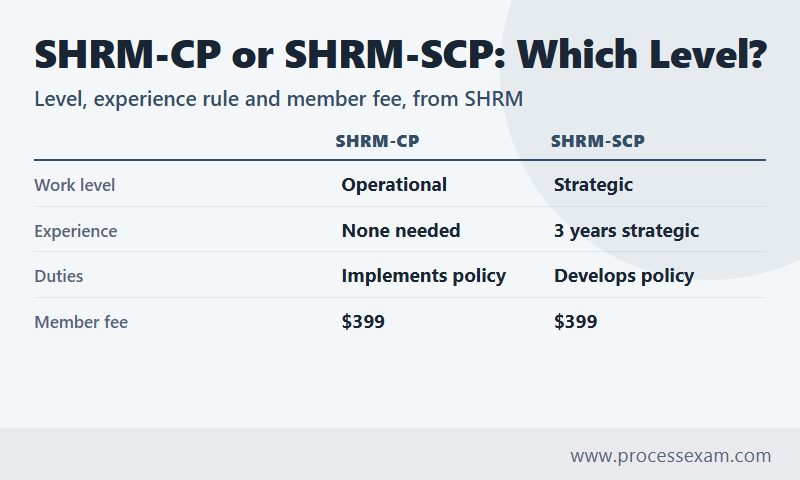
SHRM separates its two credentials by the level of the work rather than by difficulty. The SHRM-CP is for HR professionals whose work is operational: implementing policy, serving as the day-to-day point person. The SHRM-SCP is for those whose work is strategic: developing policy, directing HR operations, aligning HR strategy with business goals. For the SHRM-SCP, SHRM asks for at least three years of strategic-level HR work, counted at 1,000 hours a calendar year, or three years holding the SHRM-CP while working in or moving towards a strategic role (SHRM's eligibility criteria). So the sequence many people follow is CP first, then SCP once the job has changed.
What a hiring manager reads into each credential
A SHRM-CP on a resume tells a hiring manager you have been tested on operational HR and on judgement in realistic situations. It supports a move from coordinator to generalist, or from a non-HR job into an HR entry role, because SHRM sets no degree or HR title requirement for it. A SHRM-SCP tells them you have been tested on policy and strategy, and, because of the experience rule, that you have also done the work. The second signal is stronger, which is exactly why it is harder to earn.
Specialist moves
If your goal is a specialist seat such as compensation and benefits, a general credential helps less than evidence from the work itself: a pay structure you reviewed, a benefits renewal you ran, an analysis you presented. Use the certificate to show breadth, and the project to show depth. Pick the exam that fits the level of the job you hold today rather than the one you hope to hold; SHRM says that one in five test takers select the wrong exam for their experience, and an exam written for a different level of work is a hard way to find out.
How do you use the certificate when you negotiate your pay?
Negotiation is the mechanism you control completely, and it is where most candidates leave the credential unused. The certificate does not raise an offer by itself. It gives the other side an easy reason to say yes, because it moves your request from personal opinion to external standard.
- Decide the number first. Look at what the posting range and the market for the role say, then set a figure. Do not anchor on the 14 to 15 percent claim; an employer who has read the same article will notice that it is not a market rate.
- Ask about funding before you sit the exam. Many employers will pay the fee, and SHRM sells team packages that it says save up to 40 percent on exam fees for groups of five or more (SHRM's Certify My Team page). A fee paid by the employer changes your own cost to almost nothing.
- Time the conversation. The strongest moments are an offer, a review, and a change of scope. A request right after a pass, tied to a concrete responsibility, works better than a request attached to nothing.
- Bring the job, not the letters. Show two or three postings for the role you want that name the credential, and the work you already do that matches them. The certificate is the proof, and the postings are the evidence.
- Have a fallback. If pay cannot move, ask for the next grade review date, a title change in writing, or the fee for the next level. Each of those is a way of putting the credential to work.
One caution on honesty. Do not present a survey average as your entitlement. A hiring manager who knows the pay band cannot go above it because a certificate exists, and a flat claim that you now deserve 14 percent more undermines the stronger case you can make from your work.
When will a certification not raise your pay?
A few situations turn the credential into a cost with no return, and it is better to recognise them before you book a seat.
- The employer does not value credentials. If your tally of postings and your manager's answers both say it never comes up, the certificate has no mechanism to work through here, although it may still help you if you change employers.
- The exam is the wrong level. A SHRM-CP candidate with a strategic job, or an SCP candidate without the experience to qualify, spends the fee and the study time on the wrong signal.
- The bottleneck is something else. A pay freeze, a flat job structure or a manager who never sponsors anyone will not be moved by a pass.
- The renewal is ignored. SHRM expects 60 professional development credits within each three-year recertification cycle, and your end date is the last day of your birth month (SHRM's recertification page). Let it lapse and the signal lapses with it.
A short decision test
Answer four questions honestly. Does your tally of twenty postings show the credential as required or preferred for roles you want? Has your manager named it as relevant to the next grade? Will your employer fund it, or would the fee be small compared with a raise of one or two percent? Can you finish the exam and the first application before the review date you are aiming at? Three yes answers make a strong case. Two make a reasonable one. One or none means you should work on the role, the scope or the employer first, and revisit the credential later.
What to do with the answer
If the answer is yes, the practical step is to plan back from the testing window. Sort out the application by the standard deadline, then use the weeks between to study the competencies. The SHRM-CP syllabus lists the topic areas the exam draws on, which lets you check how much of the content you already apply at work. Once the credential has earned its place in your plan, the SHRM-CP practice exam is a way to find the weak spots in your judgement while there is still time to fix them before the window closes.
Frequently Asked Questions
Do HR certifications really lead to higher pay?
They can, through job postings that require them, promotion decisions, moves into specialist or strategic roles and negotiation. No public study isolates the certificate from experience, so the gain depends on your employer and market. Read twenty postings for the role you want to see whether the credential is asked for.
How much more do SHRM-certified HR professionals earn?
SHRM says research shows certified HR professionals report salaries 14 to 15 percent higher than peers without a certification. The figure comes from SHRM, which sells the credential, and it compares self-reported pay between groups. It does not show what one person gains after passing.
How much does the SHRM-CP exam cost?
The standard price is $399 for SHRM members and $499 for non-members, including a $50 application fee and a $49 standard-deadline fee. Early-bird rates for the December 2026 to February 2027 window ended on 31 August 2026. Students enrolled in an HR degree programme pay a lower rate.
Do employers require an HR certification?
The Bureau of Labor Statistics describes certification for HR specialists as usually voluntary, though some employers prefer or require it, and generalists in particular may benefit. Requirements appear more often at larger employers with formal job families than at small businesses that hire on references.
Will an HR certification get me promoted?
Rarely on its own. The Bureau of Labor Statistics lists new responsibilities first and voluntary certification as a further way for specialists to improve their chances of advancing to manager. A certificate carries most weight when it comes with a record of owning a piece of work.
- SHRM Certified Professional Exam Questions |
- SHRM Certified Professional Question Bank |
- SHRM Certified Professional Questions |
- SHRM Certified Professional Study Guide |
- SHRM-CP Quiz |
- SHRM-CP Certification |
- SHRM-CP Questions |
- SHRM-CP Practice Test |
- SHRM-CP Study Guide Material |
- SHRM-CP Sample Exam |
- Certified Professional Certification |
- SHRM Certified Professional |
- SHRM Certified Professional Book |
- Certified Professional Certification Cost |
- Certified Professional Certification Requirements |
- SHRM Certified Professional Sample Questions |
- SHRM-CP Exam Questions Download |
- SHRM-CP Test Questions |
- Certified Professional PDF |
- SHRM-CP BASK


