
How to Pass the FINRA Series 99 Operations Professional Exam

It is 4:40 on a Friday and a customer sale that should have settled this morning is still
open. The shares never reached the depository, the buyer's side has sent a DK, and the
close-out clock has started. Someone has to own that break, and at a broker-dealer that
person is usually a registered Operations Professional. To become one you pass the SIE and
the Series 99: 50 scored questions in 90 minutes, with 68 needed to pass.
Who at a broker-dealer has to register as an Operations Professional?
The Series 99 is not a sales licence, and it is not a badge for everyone who sits in an
operations department. FINRA created the registration category so that the people who run,
approve and commit capital to the back office are identified and qualified. The rule that
sets this out is FINRA Rule 1220(b)(3), and it names three kinds
of covered person:
- Senior management with direct responsibility over the covered functions.
- Designated supervisors and approvers – anyone senior management
names as the person who approves or authorises work, including other people's work, in
direct furtherance of a covered function. - People who can commit the firm – those with authority to commit a
material amount of the member's capital, or to bind it to a material contract, in direct
furtherance of those functions.
The covered functions are listed in the rule and repeated on FINRA's exam page. Read them
and you are reading a map of the back office: client onboarding and account records; the
collection, sweep and disbursement of funds; receipt and delivery of securities and account
transfers; bank, custody and depository reconciliation; settlement, fail control, buy-ins,
segregation and possession and control; confirmations and account statements; margin; stock
loan; prime brokerage; approval of pricing models; financial control, including the general
ledger and treasury; contributing to regulatory financial reports; and defining the business,
security and information-entitlement requirements for the systems behind all of it, plus
posting entries to the firm's books and records.
Notice what that list implies. A clerk who keys wires under supervision is not
automatically a covered person, but the manager who signs off those wires probably is. So is
the person who defines what a new settlement system must do, even if that person reports into
technology rather than operations. Firms decide the designations, which is why two candidates
with the same job title at different firms can face different requirements.
Who can register without sitting the Series 99
FINRA lets holders of certain other registrations qualify as Operations Professionals
without this exam, provided the registration is current or was held within the two years
immediately before the request. The eligible registrations are the Series 4, 6, 7, 9/10, 14,
16, 17, 24, 26, 27, 28, 37 or 38, 51 and 53. Two conditions matter: a registration held
within the past two years has to be reactivated before the Operations Professional request
is made, and the exception is not available if the eligible registration was revoked,
suspended or otherwise deemed inactive. FINRA also states that no fee is charged for
requesting the Operations Professional registration on the strength of an eligible one.
In practice this means the Series 99 is taken mostly by people who arrived in operations
without a sales or principal registration: settlement analysts moving into supervision,
treasury and finance staff, reconciliation leads, and technologists who own the requirements
for back-office systems.
The 120-day working window
One detail is specific to this registration and easy to miss. Rule 1220 gives a person
registering as an Operations Professional a period of 120 days, starting on the date the
registration is requested, to pass any required qualification exam, and allows that person
to function as an Operations Professional in the meantime. That is useful, but it is also a
deadline. If your firm files the request in March, the calendar for your study plan starts in
March, not when you feel ready.
What has to be in place before you can book the exam?
FINRA's Series 99 exam page is explicit on the two things that
catch people out.
First, sponsorship. The Series 99 is a representative-level qualification exam, and FINRA
admits a candidate only when a FINRA member firm, or a firm belonging to another applicable self-regulatory organisation, has taken that person on as an associated person and sponsors the attempt. In plain terms, a
firm has to file for you. You cannot enrol yourself for the Series 99 as a private
individual, however well prepared you are.
Second, the SIE. This has been checked on FINRA's own page rather than assumed from other
FINRA exams: the Securities Industry Essentials exam is listed as a corequisite to the Series
99, and FINRA states that a candidate must pass both the Series 99 and the SIE to obtain the
Operations Professional registration. The SIE covers general industry knowledge –
products, market structure, regulators, prohibited practices – and the Series 99 builds
the operations layer on top of it. Because the SIE does not need firm sponsorship, many
candidates clear it first and then sit the Series 99 once their firm has filed.
Once both are in place, the exam itself is scheduled through Prometric. These are the
figures to plan around:
| Series 99 detail | What to expect |
|---|---|
| Exam name | FINRA Operations Professional Exam |
| Exam code | Series 99 |
| Category | Representative-level |
| Scored questions | 50 |
| Duration | 90 minutes |
| Passing score | 68 |
| Exam fee | USD $100 |
| Corequisite | Securities Industry Essentials (SIE) |
| Unscored pretest items | 5, placed at random |
Three things from FINRA's content outline shape the way the session feels. Every question
has four answer choices. Five additional pretest items are mixed in at random and do not
count, so what you actually see is 55 items, and you cannot tell which five are the
experiments. Wrong answers cost nothing extra, which means leaving an item blank throws away a mark you might have earned. You also cannot bring reference material into the testing session, which matters on an
exam that names so many rules by number.
Scores are placed on a common scale through a process FINRA calls equating, which adjusts
for small differences in difficulty between versions of the exam. The practical reading is
that a 68 corresponds to roughly 34 of the 50 scored questions, but the exact raw number can
move slightly from one version to another. Aim well above the line rather than at it.
How are the 50 scored questions split between operations and conduct?
FINRA's Series 99 content outline divides the scored
questions between two major job functions. Function 1, knowledge associated with the
securities industry and broker-dealer operations, carries 35 items. Function 2, professional
conduct and ethical considerations, carries 15.
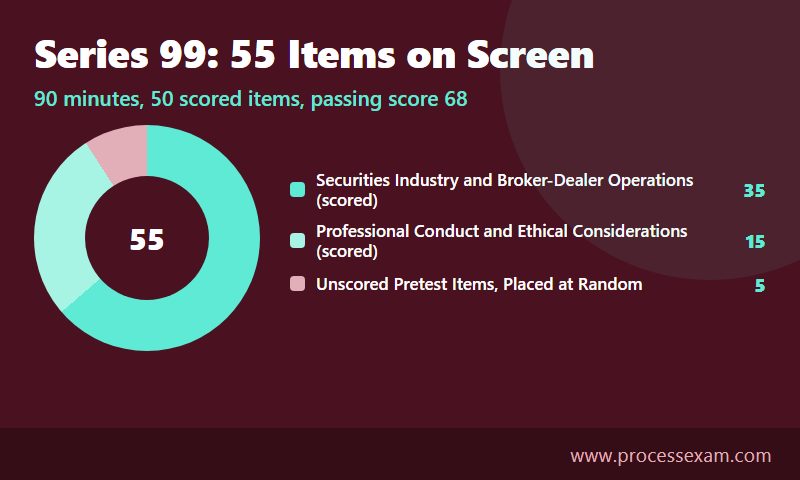
The weighting tells you where the marks are, but the outline tells you something more
useful: how many separate areas sit inside Function 1. There are nine of them, and a
candidate who knows three very well and the rest vaguely will struggle, because Function 1's 35 items, spread across nine areas, leave no room to skip one. Our
topic-by-topic list of what the Series 99 covers follows the same
headings if you want a single checklist to tick off as you go.
Function 1 – the operations core (35 items)
- Account opening and maintenance. Retail, institutional and prime
brokerage accounts; registrations such as individual and corporate; retirement accounts,
including contribution limits, required minimum distributions and the difference between a
transfer and a rollover; customer identification and know-your-customer requirements;
standing settlement instructions; escheatment; restricting or freezing an account. - Cashiering and account transfers. Wires, ACH and journals; letters of
authorisation; the medallion signature guarantee programme; Currency Transaction Reports;
ACATS versus non-ACATS transfers and residual credits; negotiable checks and the check
blotter; and the prohibited practices – check kiting, holding checks, sitting on
transfers. - Custody and control of securities. Safekeeping versus segregation,
street name, box counts and the stock record; registered versus bearer certificates, good
delivery and stock powers; DRS and DWAC; restrictive legends and Rule 144 holding periods;
Rule 15c3-3 customer protection. - Trade reporting and corrections. Reporting systems, best execution and
trading capacity, as-of and past-settlement corrections, error accounts, and conduct such as
front running, churning and prohibited breakpoint sales. - Margin and securities lending. Which accounts may trade on margin,
federal and FINRA requirements, margin calls, short sale locate and borrow requirements, and
day-trading buying power. - Settlement. Trade comparison, clearing arrangements, repo settlement,
continuous net settlement, DK notices, buy-in and close-out requirements, aged fails and
delivery versus payment. - Account statements and confirmations. What each must show, delivery
rules including electronic delivery, prospectus delivery, tax forms, cost basis and
withholding. - Regulatory financial requirements. The FINOP's responsibilities, the
FOCUS report, the general ledger, and net capital and the reserve formula. - Books and records. Reconciliations, the timing of postings, retention
including electronic storage, and the prohibition on falsifying or mishandling records.
Function 2 – conduct and control (15 items)
- Dealings with customers, vendors and colleagues. Communication methods,
nonpublic personal information, soft dollars, the ban on paying commissions to unregistered
persons, and due diligence when choosing a vendor. - Customer privacy. Confidentiality, information passed between
departments, objecting versus non-objecting beneficial owners, Regulation S-P and the
identity-theft Red Flags Rule. - Escalation. Recognising a complaint or a red flag and knowing how to
escalate it, alongside the complaint-recording and reporting rules. - Supervision and control. Segregation of duties, information barriers,
entitlement and access controls, written supervisory procedures, the annual compliance
meeting and the business continuity plan.
Fifteen items can sound like an afterthought. It is not. Function 2 is where the exam asks
what you do when something looks wrong, and those questions are written so that the
tempting answer is the efficient one and the correct answer is the controlled one.
Where does that Friday fail show up in the outline?
The best way to see how the Series 99 is built is to take one bad trade and follow it
through the departments. Suppose a retail customer sold shares on Thursday. Most US
securities trades now settle one business day after the trade date, a cycle the SEC explains
in its investor bulletin on T+1 settlement, so delivery was due on
Friday. It did not happen. Here is what each step touches.
Why the shares were not there
The customer held the position as a physical certificate and brought it in on Thursday
afternoon. Cashiering took it, but the certificate carried a restrictive legend and no
removal had been arranged, so it was not good delivery. That single fact sits in the custody
and control section: legends, control and restricted securities, the holding periods for
removing a legend, and what makes a certificate negotiable. A candidate who has only read
about street-name positions will not see why the trade was doomed before it was executed.
Why the counterparty said DK
Meanwhile the contra side's records did not match the details it received, and it
returned a don't-know notice. Trade comparison, DK procedures and the FINRA rules on
comparisons and confirmations all live in the settlement section, along with the
difference between settling through a clearing facility and through a clearing firm.
What happens to a fail
Once delivery is missed, the position is a fail. The outline asks about buy-in and
close-out requirements, the confirmation of aged fails and Regulation SHO Rule 204, which
sets close-out obligations for fails to deliver in equity securities. It also asks how
continuous net settlement treats the position. None of this is exotic to an operations team;
all of it is unfamiliar to a candidate who has never watched a fail age.
What the correction and the records must show
If the trade details were wrong as well, the fix is an as-of or past-settlement correction,
possibly routed through an error account, and every step has to appear correctly in the books
and on the customer's confirmation and statement. That is three more outline areas: trade
reporting and corrections, statements and confirmations, and books and records, with
reconciliation tying them together.
Who has to hear about it
Finally, suppose the customer insists the shares are unrestricted and asks cashiering to
push the delivery through anyway. Now the question is escalation and supervision –
recognising a red flag, following the written supervisory procedures and keeping duties
separate. That is Function 2, and it is where a candidate who thinks like a problem-solver
rather than a controller loses marks.
One trade, at least seven outline areas. Study that way – by following transactions across
sections rather than reading sections in isolation – and the scenario questions start
to feel like work you have seen before.
How hard is the Series 99, and how long should you study?
FINRA's exam page does not publish a pass rate for the Series 99, so be wary of any precise
figure you see quoted elsewhere. What can be said with confidence is where the difficulty
comes from.
- Breadth rather than depth. Nine operations areas and four conduct areas
in 50 scored items means few questions per topic and no safe topic to skip. - Departments you have never worked in. A settlements specialist may never
have handled a check blotter or a net capital computation; a finance candidate may never have
processed an ACATS transfer. Almost everyone meets several areas cold. - Rule vocabulary. The outline cites FINRA rules and SEC rules by number
throughout. You do not need to memorise numbers for their own sake, but you do need to know
what Rule 15c3-3, Rule 15c3-1 or Rules 17a-3 and 17a-4 require, because the questions assume
it. - The clock. Ninety minutes for 55 items, counting the five unscored pretest items, is a little under 100 seconds each. That is comfortable for recall questions and tight for a scenario you have to read
twice.
How long to study depends almost entirely on how many of the thirteen outline areas you
already work in. As a working guide rather than a statistic: someone with several years in
broker-dealer operations who has already passed the SIE can often be ready in three to four
weeks of steady evening study. A candidate from treasury, finance or technology with patchy
operations exposure should plan on six to eight weeks. Someone new to the industry has the
SIE to pass as well, and should treat the two exams as one longer project rather than
cramming both at once. The 120-day window from the registration request is the outer limit
either way, so fix your exam date early and work backwards from it.
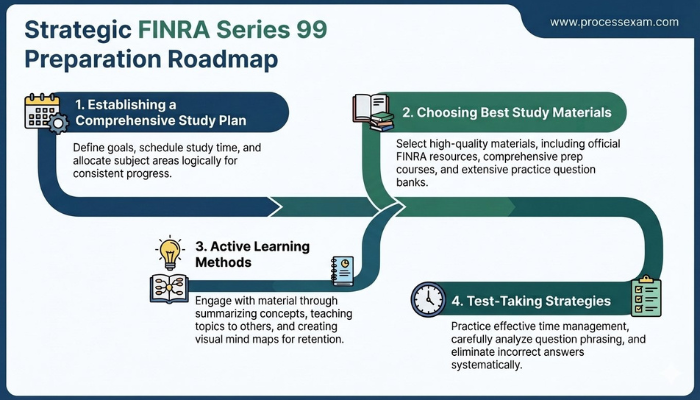
What does a six-week Series 99 study plan look like?
The plan below assumes around an hour on weekdays and a longer session at the weekend. Its
logic is simple: learn the areas you do not work in first, while you have the most time, and
keep the areas you know for the end.
Week 1 – baseline and outline audit
Take a timed diagnostic before you read anything. Then go through the thirteen sections of
FINRA's outline and mark each one as daily work, occasional contact or never seen. That
marking, not the order of a textbook, sets your study sequence.
Weeks 2 and 3 – the departments you do not know
Work through your never-seen sections first. For most candidates these are regulatory
financial requirements, cashiering and certificate handling, and margin. For each one, write
a short note in your own words on what the department does, what can go wrong and which rule
governs it. If you cannot explain a net capital haircut or a medallion guarantee to a
colleague, you do not know it well enough for a scenario question.
Week 4 – follow the transactions
Take three or four ordinary events – a new margin account, a partial ACATS transfer, a
failed sale, a customer complaint – and trace each one across every outline area it
touches, as the Friday example above does. This is the week that turns separate facts into
the joined-up judgement the exam rewards.
Week 5 – Function 2 and timed practice
Give conduct and control its own week: privacy, escalation, supervision, business
continuity. Then start sitting full papers against the clock. Sitting a full-length
Series 99 practice test at this stage shows quickly whether your
misses sit in the nine operations areas or in the conduct questions, and a timed run is the
only honest way to find out whether 50 scored questions plus five pretest items in 90 minutes feels calm or rushed.
Week 6 – repair, then rest
Sort every wrong answer from your practice papers into one of three causes: did not know
it, misread it, or knew it but chose the efficient answer over the controlled one. Fix the
largest group first. Sit your last full paper two or three days before the exam, not the
night before, and spend the final evening on a single page of notes rather than new
material.
On the day
Answer every item, because there is no guessing penalty. Flag anything that needs a
second read and move on; a question you are unsure about is worth the same single mark as
the easy one after it. And when two answers both look workable, ask which one a supervisor
reviewing the file later would expect to see – on this exam that is usually the right
one.
What happens after a failed attempt at the Operations Professional exam?
A failed Series 99 is a setback, not a disqualification, and the score report is the most
useful study aid you will get. It breaks your result down by job function, which tells you
straight away whether the problem was the operations core or conduct and control.
Under FINRA's current waiting periods, you can sit the exam again once 30 calendar days
have passed since your last attempt. If you fail three or more times in a row within a
two-year period, the next attempt has to wait until 180 calendar days after the most recent
one. Each retake is a new booking with the USD $100 fee paid again, and it still needs your
firm's sponsorship. The 120-day window under Rule 1220 does not pause while you wait, so
talk to your registration team early if a retake would take you past it.
Those waiting periods are due to change. In June 2026 FINRA filed an amendment to Rule 1210
that shortens both the standard wait and the longer wait after repeated failures, but FINRA's own update says the shorter periods do not apply to candidates yet; the start date is to be set in a regulatory notice that has not been issued.
Until that notice is published, plan any retake around the current periods above.
For the retake itself, resist the urge to reread everything. Compare the score report with
the three-cause sorting from your practice papers. If the report and your practice agree on
the weak function, spend the wait there. If the report surprises you, the likelier cause is
pacing or the pull of the efficient answer, and the fix is more timed papers rather than more
reading.
How do you keep the registration once you have it?
Passing is the start of the obligation rather than the end. Under FINRA Rule 1240, every
registered Operations Professional is subject to both parts of continuing education. The
Regulatory Element has to be completed annually, by 31 December, for each registration you
hold, and covers rule changes and regulatory developments for your registration category.
The Firm Element is your employer's own training programme, built around the firm's business
and its annual needs analysis.
If you leave the industry or your registration is terminated, the qualification does not
last indefinitely. The standard position is a two-year period in which you can re-register
without retaking the exam. FINRA's Maintaining Qualifications
Program offers eligible people a longer route: by completing continuing education every
year, a participant can keep a terminated qualification alive for up to five years. You must
have held the registration for at least a year before termination, and you must opt in
within two years of it.
Where the registration takes you
The honest career case for the Series 99 is not that it lifts salaries by a set amount
– no reliable survey isolates that – but that it is the ticket into roles that
approve, supervise and design the back office. Because FINRA requires the registration for
people who sign off covered work or commit the firm's capital, it tends to arrive at the
point where an analyst becomes a team lead, a reconciliation specialist takes over a
function, or a business analyst starts defining requirements for settlement and books-and-records
systems. For people in that position, the exam is less a hurdle than a formal record of what
the job already asks of them.
It also sits naturally beside other registrations. A number of the eligible registrations
that exempt people from the Series 99 are principal-level, such as the Financial and
Operations Principal, so operations professionals who move towards financial control often
treat the Series 99 as the first step on a longer path rather than the last.
Back to that Friday. The fail will be closed out one way or another; what the firm needs
is someone who knew why it happened before the trade was ever booked. That is the person the
Series 99 is designed to qualify.
Frequently Asked Questions
How hard is the FINRA Series 99 exam?
It is hard mainly because of breadth. Nine operations areas and four conduct areas share 50 scored questions, so no topic is safe to skip, and most candidates meet departments they have never worked in. FINRA does not publish a pass rate on its exam page, so treat any quoted figure with caution.
How long should you study for the Series 99?
It depends on how much of the outline you already work in. Experienced broker-dealer operations staff who have passed the SIE often need three to four weeks of steady study; candidates from finance, treasury or technology should allow six to eight. The 120-day registration window is the outer limit.
Is the SIE required for the Series 99?
Yes. FINRA lists the Securities Industry Essentials exam as a corequisite, and you must pass both the SIE and the Series 99 to obtain the Operations Professional registration. The SIE needs no sponsor, but the Series 99 does: a FINRA member firm, or another applicable SRO member firm, has to file for you.
How soon can you retake the Operations Professional exam?
Under FINRA's current rules you wait 30 calendar days after a failed attempt. After three or more consecutive failures within two years, the wait becomes 180 calendar days from the last attempt. FINRA has filed shorter waiting periods, but they are not yet in effect for candidates.
What is the format of the FINRA Series 99 exam?
The Series 99 has 50 scored multiple-choice questions, each with four answer choices, plus five unscored pretest items, in 90 minutes. The passing score is 68 and the fee is USD $100. Thirty-five items cover broker-dealer operations and fifteen cover professional conduct and ethics.
- Representative-level |
- FINRA Operations Professional Exam Test Questions |
- Series 99 Question Bank |
- Series 99 Body of Knowledge (BOK) |
- FINRA Operations Professional Exam Book |
- FINRA Series 99 BOK PDF |
- Operations Professional Exam Certification Cost |
- Operations Professional Exam Certification Requirements |
- FINRA Operations Professional Exam Sample Questions |
- Series 99 Exam Questions Download |
- Series 99 Test Questions |
- Operations Professional Exam PDF


