
CTAL-TM Exam Guide: v3.0 Syllabus, Format and Study Plan
CTAL-TM v3.0 is ISTQB's Advanced Level exam for people who run testing rather than just do it: 50 questions, 120 minutes, 88 points available and 58 needed to pass. It rewards judgement over recall, because most of the marks sit in questions that hand you a project and ask what a test manager should do next. This guide covers the syllabus chapter by chapter, the exam rules, worked examples and a seven-week study plan.

What does CTAL-TM v3.0 certify, and is it the version to study now?
The Certified Tester Advanced Level Test Management certificate shows that you can organise testing across a project: plan it, rank its risks, estimate it, track it, report on it, handle its defects and build the team that does it. ISTQB's own list of business outcomes has eleven items, from "manage testing in various software development projects" to "create defect reports and a defect workflow suitable for a software development lifecycle". Nothing on that list is about writing test cases. It is about decisions.
The version matters. The syllabus now examined is v3.0, a major rewrite of the older 2012 Test Manager syllabus. ISTQB's own release notes describe the rewrite plainly: the learning objectives were made atomic, the text was shortened, and the number of higher-level objectives fell, from 12 application objectives to 5 and from 10 analysis objectives to 7. Agile and hybrid development now run through every chapter instead of sitting in a corner. ISTQB's certification page for the exam lists v3.0 and nothing newer, and the syllabus document is dated 3 May 2024. We checked that page in October 2026 and found no newer Test Management version announced.
That has one practical consequence for you. Search results still throw up question lists tagged with the 2012 syllabus. They test a different structure, with a separate chapter on the test process and an old-style Agile section, so they will teach you the wrong emphasis. Study from the v3.0 syllabus PDF and treat anything tagged 2012 as history.
Who gets the most from it
The syllabus names test managers, test analysts, test engineers, test consultants, test coordinators, test leaders and project managers as its audience, and its wider note adds quality managers, development managers, business analysts, IT directors and management consultants. In practice the people who gain most are the ones already doing a lead's job without the title: the senior tester who writes the plan, argues for the schedule and reports status upwards, and wants a recognised statement that this is a discipline with its own body of knowledge.
One boundary is worth knowing before you start. The syllabus is about test management at project level. Organisation-wide test strategy and policy belong to the Expert Level, so do not spend weeks on enterprise-scale process design for this paper.
Can you book it today, and what will the exam paper look like?
Booking depends on one hard rule and one soft one. The hard rule: you must already hold an ISTQB Foundation Level certificate, and ISTQB's page accepts v4.0 or earlier versions. The soft rule: the syllabus strongly recommends at least a minimal background in testing or development, such as six months as a tester or developer, and ISTQB's page leaves the exact experience check to the national member board or exam provider you book through. If you hold no Foundation certificate yet, that comes first.
| Detail | CTAL-TM v3.0 |
|---|---|
| Certification | ISTQB Certified Tester Advanced Level - Test Management (CTAL-TM) |
| Exam code | CTAL-TM |
| Category | Core Advanced |
| Syllabus version | CTAL-TM v3.0, checked on ISTQB's site in October 2026 |
| Number of questions | 50 |
| Exam duration | 120 minutes |
| Passing score | 58 / 88 |
| Exam fee | USD $249 |
| Prerequisite | ISTQB Foundation Level certificate, plus practical testing experience |
| Validity | For life, with no renewal |
Read the scoring line twice. The paper is marked out of 88 points, not out of 50, and 58 points is about 66 per cent. Questions are worth different amounts. ISTQB's official sample exam set A has 50 questions in the same pattern: 26 are worth one point, 10 are worth two and 14 are worth three. That adds up to 88, and the 14 three-point questions alone carry 42 of those points. If you spend equal time on every question you will starve the ones that matter.
ISTQB's page also says candidates who are not native English speakers get a 25 per cent time extension, which turns 120 minutes into 150. Whether it applies to you is decided where you book, so ask the member board or exam provider early rather than the week before. The fee above is the figure we hold for the exam; local boards and training providers price it differently, and voucher bundles usually come with a course, so confirm the amount at the point of purchase. The detail of the current rules is on ISTQB's CTAL-TM v3.0 page.
Once you pass, the certificate is valid for life. ISTQB says it does not require renewal, which is one reason the exam is worth doing properly once.
What do the three chapters ask you to do, section by section?
The syllabus has three examinable chapters and 48 learning objectives. The training times below are the minimum an accredited course must spend, in minutes, and they add up to 22.75 hours. They tell you where the depth is, not how many marks each chapter carries, because ISTQB does not publish a points split for the real paper.
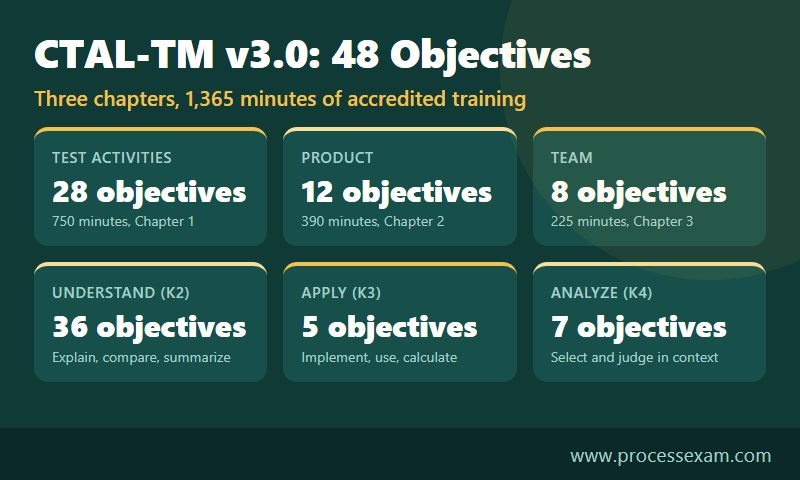
| Chapter | Training time | Objectives | Levels in the chapter |
|---|---|---|---|
| 1. Managing the Test Activities | 750 minutes | 28 | 22 understand, 2 apply, 4 analyse |
| 2. Managing the Product | 390 minutes | 12 | 8 understand, 2 apply, 2 analyse |
| 3. Managing the Team | 225 minutes | 8 | 6 understand, 1 apply, 1 analyse |
Across the whole syllabus that is 36 objectives at the understand level, 5 at apply and 7 at analyse. The apply and analyse objectives are where scenario questions come from, so they deserve a separate list in your notes.
Chapter 1: Managing the Test Activities
This is more than half the syllabus by training time, and it has six sections.
The test process covers planning, monitoring and control, and completion. The three objectives are all at understand level, but later chapters lean on them constantly, so learn what each activity produces and who receives it.
The context of testing is the busiest section, with seven objectives. It covers why different stakeholders care about testing for different reasons, how testing changes in a hybrid development model, and how a test manager's job shifts between sequential and iterative lifecycles, between test levels and between test types. The syllabus compares them in a table: a V-model project wants early, detailed estimates per test level and a full set of testware, while a Scrum project estimates inside story planning and a facilitator or coach often replaces the traditional test manager. The one analyse objective here asks you to look at a given project and decide which management activities to stress.
Risk-based testing was rewritten for v3.0 to work at project level. Learn the sequence: identify quality risks, assess likelihood and impact, mitigate through the right testing, then measure whether it worked. Know the techniques for finding risks and the split between heavyweight methods (hazard analysis, cost of exposure, failure mode and effect analysis, fault tree analysis) and lightweight ones such as Pragmatic Risk Analysis and Management and Product Risk Management. The syllabus also lists the difficulties teams meet: hard-to-estimate risk levels, enthusiasm that fades under deadline pressure, the same risks being raised on every project until nobody listens, missing key risks because the wrong people were in the room, and stakeholders who change. Questions often describe one of those symptoms and ask for the remedy.
The project test strategy has three objectives. Choose a test approach, analyse the organisational strategy against the project context, and write objectives and exit criteria that pass the S.M.A.R.T. test: specific, measurable, achievable, relevant, timely. "Test thoroughly" fails it; "all high-risk items executed with no open critical defects by the release date" passes.
Improving the test process introduces the IDEAL cycle (initiating, diagnosing, establishing, acting, learning), model-based improvement with frameworks such as TMMi and TPI NEXT, the analytical approach that works from your own project data, and retrospectives. The one application objective here is running a retrospective, so expect a question about how to conduct one rather than only what it is.
Test tools asks you to weigh regulation and security, cost, stakeholder requirements and technical fit when choosing between commercial, open-source and custom tools, to plan a selection with risks and return on investment (an analyse objective), and to recognise the four stages of a tool's lifecycle: acquisition, support and maintenance, evolution and retirement.
Chapter 2: Managing the Product
Test metrics covers which metrics fit which objective, how to steer testing with them, and how to turn results into reports that let stakeholders decide. The analyse objective is the one to practise: given a set of results, what should the report say, and to whom? The syllabus warns that even 100 per cent structural coverage at component level leaves quality risks open at higher levels, so a coverage figure on its own is never a status report.
Test estimation splits techniques into metric-based and expert-based and gives five factors for choosing between them: the estimation error you can tolerate, whether historical data exists, whether experts are available, modelling knowledge and time constraints. Three-point estimation, ratios and extrapolation, the Delphi method and planning poker all appear as examples. The analyse objective asks you to pick a technique for a given context, so you need the trade-offs, not just the names.
Defect management is the largest section in this chapter, with six objectives. It starts with the idea that cost of quality is lowest when a defect is removed in the phase that introduced it, then walks through a simple defect workflow: open, in progress, rejected, resolved and closed, extended in real organisations with states such as re-opened, deferred or clarification. You must be able to adapt that workflow to Agile and hybrid teams, name the information a defect report should carry, and use report statistics to propose process improvements.
Chapter 3: Managing the Team
The test team starts from four areas of competence: professional, methodological, social and personal. You analyse a project to decide which skills the team needs, assess the current team against a skills matrix, and pick between training, self-study, peer learning and mentoring to close gaps. The motivation section uses Herzberg's distinction: recognition, responsibility, interesting work and advancement motivate, while pay, working conditions, management style and security are hygiene factors that only demotivate when they are missing.
Stakeholder relationships has two objectives and one of them is a calculation. Cost of quality has four categories: prevention, appraisal, internal failure and external failure. You are expected to use them to build a cost-benefit case for testing. The next section shows how.
How do you answer the questions that carry three points?
The big questions are scenarios. A short case sets out a project, a constraint and a problem, and the answer options are all plausible. Three examples show the thinking the analyse and apply objectives reward. The numbers are invented for practice, not taken from ISTQB material.
Ranking risks to set test depth
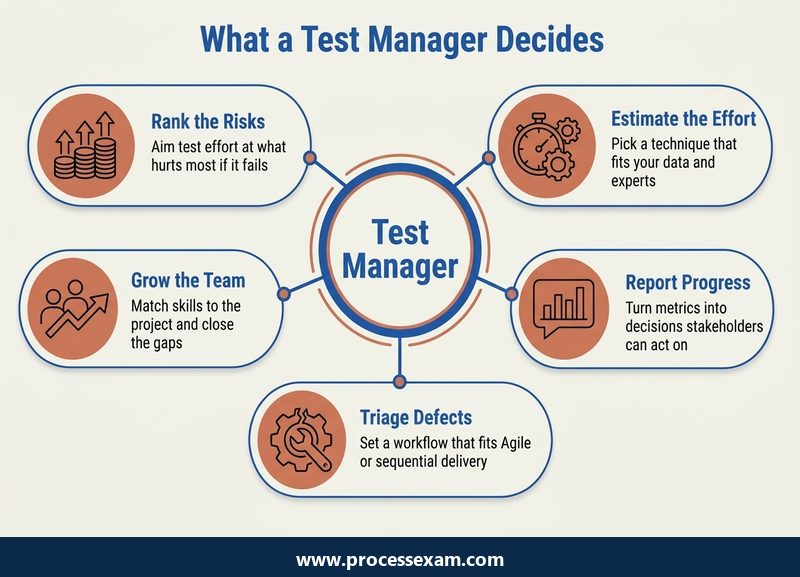
A ticketing release has three areas in scope: payment, seat selection and a newsletter sign-up box. Stakeholders score each from 1 to 5 for likelihood of failure and for business impact. Payment gets 4 and 5, seat selection 3 and 4, newsletter 2 and 1. Multiply and you get 20, 12 and 2. Payment gets the deepest testing and the earliest slot, seat selection gets a standard pass, and the newsletter box gets a light check or nothing if time runs out. The trap in the exam is the phrase "who decides the scores". The syllabus is clear that risk analysis uses stakeholder input and historical data, not the test manager's opinion alone, and that it is repeated because stakeholders and risks change.
Choosing and calculating an estimate
The test team has no history on this product and the only people who know it are two developers who are free for one afternoon. Metric-based techniques need data you do not have, and a full Delphi round needs experts you cannot assemble. A quick three-point estimate is a defensible choice: optimistic 12 days, most likely 20, pessimistic 40. The expected value is (12 + 4 x 20 + 40) / 6 = 22 days, and the spread, (40 - 12) / 6, is about 4.7 days. Report 22 days with that uncertainty, record the assumptions, and revise when scope changes. Exam options usually differ on exactly one of those three habits.
Making the business case
Management asks why testing needs another two weeks. Sort the costs into the four categories. Reviews and testing are appraisal costs. Fixing defects found before release is internal failure. A defect that reaches customers is external failure, usually the most expensive category, because it adds support, rework, lost revenue and sometimes legal exposure. Suppose testing for the release costs 14,000 and your defect data suggests 40,000 of external failure costs would otherwise land after release. The saving is 26,000 and the benefit is roughly 2.9 times the cost. The skill being tested is not the arithmetic. It is showing that the comparison is between the cost of testing and the cost of the failures it prevents.
How do you spread seven weeks across 48 objectives?
This plan assumes you already work in testing and can give six to eight hours a week. It is paced by objectives rather than by page count, because objectives are what the questions are written from. Each week's objectives are the ones listed in that section of the syllabus.
| Week | Sections | Objectives | Finish by the end of the week |
|---|---|---|---|
| 1 | 1.1 Test process, 1.2 Context of testing | 10 | Compare activities across lifecycles and test levels in your own table |
| 2 | 1.3 Risk-based testing, 1.4 Project test strategy | 9 | Score a real feature list for risk and write three S.M.A.R.T. exit criteria |
| 3 | 1.5 Process improvement, 1.6 Test tools | 9 | Run a mock retrospective and draft a tool-selection plan with costs and risks |
| 4 | 2.1 Metrics, 2.2 Estimation | 6 | Produce a one-page status report and three estimates by different techniques |
| 5 | 2.3 Defect management | 6 | Redraw your own defect workflow for Agile and for a sequential project |
| 6 | Chapter 3 Team and stakeholders | 8 | Build a skills matrix and a cost-of-quality business case with real numbers |
| 7 | Whole syllabus | All | Two timed papers, then a review of every wrong or guessed answer |
Three habits make the plan work. First, read each section of the syllabus before any other source, because the exam is written from it and standards or books cited as references are not examinable beyond what the syllabus summarises. Second, learn the keywords listed under each chapter heading: ISTQB says all of them can be asked at the remember level even when no objective mentions them. Third, make every learning objective a question you can answer aloud. If the verb is "compare", produce a comparison; if it is "select", choose between two real options and defend the choice.
If you only have four weeks, merge weeks 1 and 2, weeks 3 and 4, and weeks 5 and 6, and cut anything in chapter 1.6 and 3.1 that you already handle at work. Do not cut week 7.
Why do experienced testers still drop points?
Years in testing help, but they also create habits that the exam penalises. These are the patterns that recur.
- Answering from your own company's practice. The syllabus describes good practice in general. Your employer may do something different and sensible. The right answer is the one the syllabus gives for the context in the question.
- Ignoring the lifecycle in the question. A recommendation that suits a V-model project can be wrong in a Scrum team. Read the development model first, because it changes who owns testing, how documentation looks and what estimation means.
- Treating metrics as the report. A coverage or pass-rate figure with no link to objectives, risks or exit criteria does not let a stakeholder decide anything. The analyse-level reporting question wants the interpretation.
- Mixing up test strategy, test approach and test plan. The syllabus defines a strategy as how testing will achieve its objectives, an approach as the selection and combination of levels, types and techniques, and a plan as where these are documented. Expect options built on that confusion.
- Skimming the chapters that feel soft. Team skills, motivation and cost of quality look easy and are not. The distinction between motivators and hygiene factors, and the four cost categories, are the kind of precise vocabulary that separates two near-identical options.
- Running out of clock. 120 minutes for 50 questions is a little over two minutes each, but scenario questions take far longer than the one-point ones. Answer the short questions fast and bank the time.
How should you use sample papers and practice tests?
Start with the source. ISTQB publishes sample exam set A for v3.0, together with an answer key and rationale. Sit it once, cold, under timed conditions, before you study in earnest. The result is not a prediction. It tells you which sections you assumed you knew and did not.
Then widen the pool. Our free sample questions let you check your reading of the scenario format at no cost, and a full-length CTAL-TM practice exam taken against the clock in the final two weeks trains the pacing that the points-weighted paper demands. Whatever you use, apply three rules:
- Review every question you got wrong or guessed, and write the objective it came from next to it. A cluster of misses around one objective is a study task, not bad luck.
- Explain why each wrong option is wrong. At this level the distractors are usually true statements that do not answer the question asked.
- Be wary of question lists that carry no syllabus version. A set written for the 2012 syllabus will drill topics v3.0 dropped or changed. Prefer material that names v3.0 and maps questions to objectives.
Two clean timed runs, scoring comfortably above 66 per cent on points rather than on question count, are a reasonable signal that you are ready. A single good score on a repeated set is not.
What does the certificate lead to, and does it expire?
It does not expire. ISTQB states that the certificate is valid for life and needs no renewal, so the only recurring cost is keeping your knowledge current as test practice moves.
The syllabus lays out where you can go next. Within the Core Advanced stream, the other two certificates are Test Analyst and Technical Test Analyst. Above them sits the Expert Level, whose Test Management and Improving the Test Process modules pick up where the project-level view of this syllabus stops, with organisational strategy and process improvement across a company. Alongside, people working in Agile teams can look at Agile Test Leadership at Scale, and the specialist stream covers areas such as test automation, AI testing and mobile testing.
At work the practical change is usually about authority rather than title. A test manager who can cite the risk method, the estimation trade-offs and the cost-of-quality argument in a planning meeting gets a different hearing from one who says "we need more time". If you want the full list of what ISTQB expects a certified person to do, the eleven business outcomes in the syllabus make a useful checklist to measure your own experience against before you book.
Finally, the best preparation is still a real project. If you are managing testing now, test your notes against it each week: score the risks, write the exit criteria, draw the defect workflow. Every section above maps to something you can do on Monday morning, and that is what the exam is built to check.
Frequently Asked Questions
What is the CTAL-TM certification?
CTAL-TM is ISTQB's Certified Tester Advanced Level - Test Management certificate. It shows that you can plan, monitor, estimate and report on testing, manage defects and build a test team across Agile, sequential and hybrid projects. It sits in the Core Advanced stream and the certificate is valid for life.
How many questions are on the CTAL-TM exam and what is the pass mark?
The v3.0 exam has 50 questions in 120 minutes and is marked out of 88 points. You need 58 points to pass, roughly 66 per cent. Questions carry different point values, so three-point scenario questions matter far more than the one-point recall questions.
Do I need the Foundation Level certificate before CTAL-TM?
Yes. ISTQB requires an ISTQB Foundation Level certificate, and its page accepts v4.0 or earlier versions. The syllabus also strongly recommends some testing or development experience, such as six months, and leaves the exact experience check to the member board or exam provider you book through.
Is the old CTAL-TM 2012 syllabus still the one to study?
No. ISTQB's exam page lists v3.0, a major rewrite of the 2012 Test Manager syllabus with new chapters, Agile and hybrid coverage and fewer higher-level objectives. Question lists tagged with the 2012 syllabus follow a different structure, so study from the v3.0 syllabus and v3.0 sample exams.
How much does the CTAL-TM exam cost and where do I get a voucher?
We list the exam fee as USD $249. ISTQB exams are sold through national member boards and exam providers, so the final price and any voucher differ by country and by training bundle. Check the amount with the board or provider where you plan to book.
- CTAL-TM Question Bank |
- CTAL-TM Exam Questions Download |
- CTAL-TM Test Questions |
- ISTQB Test Management Sample Questions |
- Test Management PDF |
- ISTQB Test Management Test Questions |
- ISTQB Test Management Book |
- Test Management Certification Cost |
- Test Management Certification Requirements |
- Core Advanced |
- CTAL-Test Management Simulator |
- CTAL-Test Management Mock Exam |
- ISTQB CTAL-Test Management Question Bank |
- ISTQB CTAL-Test Management Book |
- ISTQB CTAL-Test Management Study Guide |
- CTAL-Test Management Certification |
- CTAL-Test Management Certification Cost |
- CTAL-Test Management Certification Requirements |
- ISTQB CTAL-Test Management Exam Questions |
- ISTQB CTAL-Test Management Sample Questions |
- CTAL-Test Management |
- CTAL-Test Management PDF


