
CPDC Certification: Why Should You Consider Becoming Certified Pega Decisioning Consultant?
Updated on 22 September 2026. What’s new: updated for the Pega Customer Decision Hub '26 exam, code PEGACPDC26V1, which replaced PEGACPDC25V1.
A banking app opens with a bright banner: apply for the Platinum credit card. The customer has carried that exact card for three years. That wasted slot is the problem Pega Customer Decision Hub was built to remove, and CPDC, short for Certified Pega Decisioning Consultant, is Pega's credential for the people who configure it. The current exam, PEGACPDC26V1, has 60 questions in 90 minutes and needs a 70% score to pass.

This article stays with decisioning itself: what the technology does, how it picks one offer out of hundreds, what a decisioning consultant is responsible for on a real project, and what Pega tests in the '26 version of the exam. If you are weighing whether this credential fits your career, the answer depends far more on whether that work appeals to you than on the exam figures, so the work comes first.
What does CPDC stand for, and what problem does decisioning solve?
CPDC stands for Certified Pega Decisioning Consultant. Pega awards it to professionals who take part in designing and building a solution on Pega Customer Decision Hub, the company's product for one-to-one customer engagement. Pega's exam page says the credential confirms you can apply the design principles of Next-Best-Action Designer, 1:1 Operations Manager, decision strategies and predictive analytics.
Go back to the banking app. The banner was not a bug in the app; it was the output of a campaign. Somebody built a list of customers for a card promotion, the list was pushed to the mobile channel, and nobody checked it against the product holdings system on the morning the customer logged in. Campaign thinking works in batches: pick an offer, pick a segment, push the message, measure the response weeks later. It produces exactly this kind of mistake, and it produces it at scale.
Decisioning turns the question around. Instead of asking which customers should receive this offer, it asks, at the moment a customer shows up, which single thing is best for this person right now. The answer might be an offer, but it might just as easily be a service message, a retention conversation, a reminder about an overdue payment, or nothing at all. Pega calls that answer the next best action, and Customer Decision Hub is the engine that works it out in real time for every customer on every channel.
Why banks, telecoms and insurers care
Organisations with millions of customers and dozens of products suffer most from campaign overlap. A telecom provider may run upgrade offers, roaming add-ons, loyalty rewards and churn saves at the same time, each owned by a different team. Without a central decision, the loudest team wins the banner and the customer receives four messages that contradict each other. A central decision engine gives every team a fair place in one ranking, and it lets the organisation prove that a service message sometimes earns more long-term value than another sales pitch.
Where the consultant fits
The technology only works if someone translates business intent into the building blocks the engine understands: actions, treatments, rules, limits and priorities. That translation is the consultant's job. A decisioning consultant is rarely the person writing code; they sit between marketing, product owners, data scientists and system architects, and they own how the decision behaves.
How does Pega Customer Decision Hub choose the next best action?
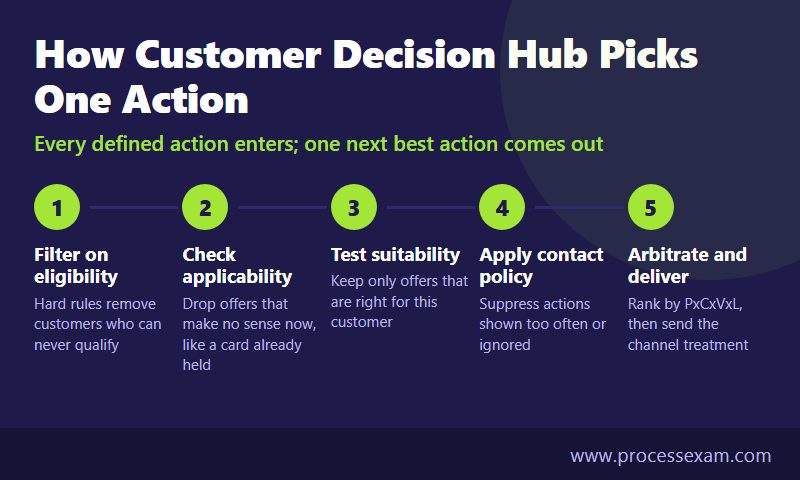
Every request to Customer Decision Hub runs through the same funnel. It starts with every action the business has defined and narrows the list step by step until one action, or a short ranked list, is left for the channel that asked. Understanding that funnel in order is the single most useful thing a CPDC candidate can learn, because most scenario questions describe one stage misbehaving and ask you to spot which one.
The business structure: issues, groups, actions and treatments
Actions live in a hierarchy. At the top are business issues, the broad reasons you might contact a customer, such as sales, retention or service. Under each issue sit groups, for example credit cards or mortgages. Each group holds actions, the individual things you could propose, such as the Platinum card. Each action then has treatments, the channel-specific versions of it: a web banner, an email, a script for a contact-centre agent. Keeping the action separate from its treatments is what lets the same decision drive every channel consistently.
Engagement policies: eligibility, applicability and suitability
Next come the engagement policies, three kinds of condition that remove actions that should not be offered.
- Eligibility covers hard rules that do not depend on context. A customer under the minimum age for credit is never eligible for a card, whatever else is true.
- Applicability asks whether the action makes sense for this customer at this moment. Our banking customer already holds the Platinum card, so the card offer is not applicable. This is the rule that was missing in the opening example.
- Suitability asks whether the action is genuinely right for the customer. A customer who is already struggling with repayments might be eligible for a higher limit, but offering it would not be in their interest.
Pega keeps these three separate for a reason. When a regulator, an auditor or a product owner asks why a customer did or did not see an offer, the answer is easier to trace if each rule sits in the category that matches its purpose.
Contact policy and volume constraints
Even a perfectly relevant action becomes irritating if the customer sees it ten times. Contact policies suppress an action after it has been shown, clicked or ignored a set number of times within a period, and they can pause a whole group rather than a single action. Volume constraints solve a different problem that belongs to outbound work: they cap how many customers receive an action in a run, so that a call centre is not flooded with more callbacks than its agents can handle, or so that a limited stock of an offer is not exceeded.
Arbitration: propensity, context, value and levers
The actions that survive the filters are then ranked. Pega's arbitration combines four factors, often written as P x C x V x L. Propensity is the likelihood that this customer will respond, learned by adaptive models from real responses. Context weight reflects how much the current situation matters, for example boosting a retention action when the customer has just asked how to close their account. Value is the business worth of the action. Levers are the business's own adjustments, used to push a strategic product or to give a new action a fair start before the models have learned about it.
The point of multiplying rather than adding is balance. A high-value offer that nobody wants does not win, and neither does an offer everybody clicks that earns nothing. The consultant's skill is knowing which factor to adjust when the business says the wrong action is winning, instead of switching off the models or hard-coding a winner.
Channels and treatments
Finally, the winning action is delivered through the channel that asked. On the web, real-time containers are the placements a page uses to request a decision. Outbound channels such as email are driven by always-on outbound runs, which apply the same decision to a starting population every day rather than firing one-off campaigns. Pega also lets you share action details with third-party distributors when an external partner delivers the message.
What does a Pega Decisioning Consultant actually do on a project?
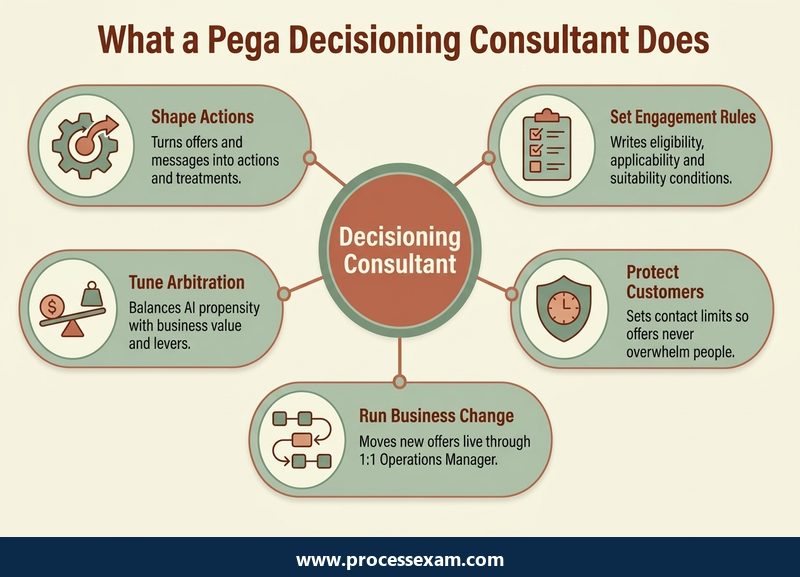
The job title varies from employer to employer, but the work described in Pega's exam topics falls into a recognisable set of responsibilities. On most Customer Decision Hub programmes the consultant owns the decision's behaviour from the first workshop to the weekly change cycle after go-live.
Designing the decision with the business
Early on, the consultant runs sessions with product owners and marketing leads to capture what they want to achieve and turn it into the business structure. That means agreeing which issues and groups exist, defining each action with its value and treatments, and writing the engagement policies. The consultant pushes back when a request would break the model, for instance when one product team asks for its offer to appear first for everyone.
Configuring Next-Best-Action Designer
Next-Best-Action Designer is where most of the configuration happens. The consultant sets up engagement policies, contact policies, arbitration settings and channel configuration through guided screens rather than code. They also build or adjust decision strategies, the visual flows that combine data, rules and model outputs, such as a strategy that uses a customer's credit score to decide which lending products belong in the running.
Working with data scientists and architects
The consultant does not build the predictive models, but they must understand them well enough to read their results and explain them to the business. They work with a data scientist, who owns model quality, and with a system architect, who connects Customer Decision Hub to channels and data sources. When the three disagree about why an action is under-performing, the consultant is usually the person who frames the question.
Running business change through 1:1 Operations Manager
After launch, the decision keeps changing. New offers arrive, prices move, messages need rewording. Pega's answer is 1:1 Operations Manager, where business users raise change requests that move through a defined life cycle before they reach production. The consultant helps set up the business operations team, the people who raise, build, test and approve those requests, and chooses the right change request type for each job, from launching a new web offer to updating many existing actions in bulk. Approved changes are deployed through Revision Manager, so the business can move quickly without editing the live system directly. The '26 exam topics also include managing brand voice with Pega GenAI and the enhanced email editor, both used to prepare content for those changes.
Who the role suits
People who do well as decisioning consultants tend to come from marketing technology, CRM, campaign management or business analysis. They are comfortable with data but more interested in business outcomes than algorithms, and they enjoy explaining why a system made a choice. Developers can move into the role too, but they usually find the business conversation, not the configuration, is the hard part.
What is on the CPDC '26 exam, and how are the topics weighted?
Pega lists the current exam on its Certified Pega Decisioning Consultant exam page on Pega Academy (checked September 2026). It applies to Pega Customer Decision Hub '26, carries the exam code PEGACPDC26V1 and shows no retirement date. If you studied for the earlier version, the change is mostly in the code: it moved from PEGACPDC25V1, while the question count, time limit, pass mark and topic weights stayed the same.
| Exam detail | CPDC |
|---|---|
| Full name | Certified Pega Decisioning Consultant |
| Exam code | PEGACPDC26V1 |
| Applies to | Pega Customer Decision Hub '26 |
| Vendor | Pega |
| Number of questions | 60 |
| Duration | 90 minutes |
| Passing score | 70% |
| Exam fee | USD 190 |
| Language | English |
| Delivery | Pearson VUE test centre or online proctored |
Pega publishes eight topic areas with their share of the exam:
| Topic area | Share of exam |
|---|---|
| Next-Best-Action concepts | 12% |
| Actions and treatments | 12% |
| Engagement policies | 15% |
| Contact policy and volume constraints | 13% |
| AI and Arbitration | 8% |
| Channels | 10% |
| Decision strategies | 15% |
| Business agility in 1:1 customer engagement | 15% |
How the topics map to the funnel
Read the list alongside the funnel above and a pattern appears. Next-Best-Action concepts cover the ideas behind one-to-one engagement, the customer engagement blueprint, value in the contact centre, the essentials of always-on outbound and defining the starting population. Actions and treatments cover building actions and presenting a single offer on the web or through outbound. Engagement policies include engagement strategies and customer journeys. Contact policy and volume constraints cover overexposure on inbound and outbound and limits on outbound volume.
AI and Arbitration is the smallest area but touches every scenario, because it covers arbitration itself, prioritisation with AI and business levers. Channels cover real-time containers, offer emails and third-party distribution. Decision strategies cover building and reading strategies, including one based on credit score. Business agility, tied for the largest share, is entirely about the post-launch world of change requests, operations teams and Revision Manager.
That last point surprises many candidates. Almost a sixth of the marks test how an organisation changes its decisions safely, not how it designs them. Anyone who has only worked on the build phase of a project should expect to spend real time on it. Once you know the funnel and the change process, a timed CPDC mock exam is a practical way to see whether you can apply them at the pace the 90-minute limit demands.
How the exam is delivered
Pearson VUE proctors the exam for Pega. You create a Pearson VUE account, register through it, and choose between a test centre and an online session taken at home or at work under webcam supervision. The online option needs a quiet room where you will not be interrupted for the whole session.
Who should take the CPDC exam, and what should you know first?
Pega lists the exam at beginner level and names the Decisioning Consultant mission as its preparation rather than a formal prerequisite certificate. You do not need to hold another Pega credential before booking it. The Decisioning Consultant mission for Customer Decision Hub '26 on Pega Academy groups the training into five parts: Customer Decision Hub Foundation, Cross-Sell on the Web, Cross-Sell on the Web Extended, Always-On Outbound Customer Engagement, and Business Agility in 1:1 Customer Engagement. Those five parts line up closely with the exam topics.
The credential is a good fit for four groups of people:
- Marketing technologists moving from campaign tools to real-time decisioning.
- Business analysts assigned to a Customer Decision Hub programme who need to speak the product's language.
- CRM and campaign specialists whose employer is replacing batch campaigns with next-best-action.
- Pega system architects who configure the channels and data around Customer Decision Hub and want to understand the decision layer they are integrating.
Helpful background, though not required, includes basic marketing concepts such as segments and response rates, a feel for how probabilities work, and some exposure to a customer-facing channel like a website or contact centre. Pega's Customer Decision Hub documentation is worth keeping open while you work through the mission, because it describes each feature in the product's own terms.
Which decisioning ideas trip up CPDC candidates?
Most wrong answers on a decisioning exam come from confusing two ideas that sound alike. These are the pairs that cause the most trouble, and each one is worth being able to explain in a sentence.
Applicability versus suitability
Both remove actions, but for different reasons. Applicability is about relevance at this moment: the customer already owns the product, or the offer only applies to a region they do not live in. Suitability is about whether the offer is good for the customer, even when it is relevant. If a scenario mentions the customer's welfare, affordability or fairness, think suitability; if it mentions holdings or circumstances, think applicability.
Contact policy versus volume constraints
Contact policies protect the individual customer from overexposure. Volume constraints protect the business's capacity or budget across all customers in an outbound run. A question about one customer seeing the same email every day points to contact policy; a question about a call centre that can only handle a fixed number of callbacks points to volume constraints.
Levers versus context weight
Both change the ranking, and both are easy to overuse. Context weight should reflect the customer's situation, such as a sudden service problem. Levers express business priorities, such as a quarterly push on a product. Using levers to fix a relevance problem hides the real issue and quietly damages the customer experience.
Inbound versus always-on outbound
Inbound decisions happen when the customer arrives, through a real-time container or an agent desktop. Always-on outbound applies the same decision logic to a starting population on a schedule and sends the winners through channels such as email. Candidates who picture outbound as a traditional campaign often choose answers that bypass the next-best-action logic entirely.
Design time versus change time
A final trap is answering a business agility question as if it were a design question. When a scenario describes a live system and a business user asking for a new offer, the right answer usually involves a change request and the operations process, not a developer editing rules directly.
Is the CPDC certification worth it for your career?
CPDC is worth it if your work touches, or is about to touch, Customer Decision Hub. It is a niche credential compared with Pega's System Architect track, and that is its strength: organisations that run Customer Decision Hub need people who understand both the business side and the decision engine, and they cannot hire them from the general Pega developer pool.
The credential helps in three concrete ways. It shows an employer or client that you know the product's vocabulary and design principles, which shortens the time before you are trusted with the business conversation. It supports a move from campaign management or CRM work into decisioning, a shift many organisations are making. And it is the first step towards Pega's most senior decisioning credential: according to the Pega Academy certifications page, becoming a Certified Pega Lead Decisioning Architect requires holding both the Decisioning Consultant and the Data Scientist certifications, completing a set of prerequisites and passing a two-phase interview.
Typical roles for certified consultants include decisioning consultant, decisioning analyst, customer engagement or marketing technology consultant, and, with experience, decisioning architect. Consultancies that implement Pega for banks, telecom providers and insurers often expect certified staff on client projects, because clients ask for evidence that the people configuring their decisions have been trained on the current product.
It is not the right starting point for everyone. If you build case management applications and never go near customer engagement, a credential from the System Architect or Business Architect track will do more for you; the full range is listed on our Pega certification exams page. And the credential will not replace experience. Employers value a consultant who can explain why the banking app should never have shown that card offer, and how they would fix the rule, far more than a certificate on its own. The best outcome is both: real project work on Customer Decision Hub, confirmed by the exam.
Pega ties each version of the exam to a product release, so the '26 credential reflects Customer Decision Hub '26. Keep an eye on Pega Academy after each major release, because the topic list and missions move with the product even when the exam format stays the same.
Frequently Asked Questions
What is the full form of CPDC in Pega?
In Pega, CPDC stands for Certified Pega Decisioning Consultant. It is the credential for professionals who help design and build solutions on Pega Customer Decision Hub, covering Next-Best-Action Designer, engagement policies, arbitration, decision strategies and business change through 1:1 Operations Manager. Other industries use the same letters for unrelated terms.
How many questions are on the CPDC exam, and what is the passing score?
The current CPDC exam, code PEGACPDC26V1, has 60 questions with a 90-minute time limit, and you need 70% to pass. Pega applies it to Customer Decision Hub '26. The earlier PEGACPDC25V1 exam used the same question count, duration, passing score and topic weights.
How much does the CPDC exam cost, and how do I book it?
The CPDC exam fee is USD 190. Pega delivers the exam through Pearson VUE, so you create a Pearson VUE account, register there, and choose either a test centre or an online proctored session taken at home or work with webcam supervision. Confirm the current fee when you register.
Are there prerequisites for the Pega CPDC certification?
Pega lists no earlier certification you must hold before taking the CPDC exam and rates it at beginner level. It points candidates to the Decisioning Consultant mission on Pega Academy, which covers Customer Decision Hub foundations, cross-sell on the web, always-on outbound and business agility in customer engagement.
What changed between the CPDC '25 and '26 exams?
The exam code moved from PEGACPDC25V1 to PEGACPDC26V1, and the exam now applies to Customer Decision Hub '26. As listed on Pega Academy in September 2026, both versions have 60 questions, 90 minutes, a 70% passing score and the same eight topic areas with identical weights.
- Pega Decisioning Consultant Test Questions |
- Pega Decisioning Consultant Book |
- Decisioning Consultant Certification Cost |
- Decisioning Consultant Certification Requirements |
- Pega Decisioning Consultant Sample Questions |
- Decisioning Consultant PDF |
- CPDC Question Bank |
- CPDC Exam Questions Download |
- CPDC Test Questions |
- PEGACPDC25V1 Mock Exam |
- PEGACPDC25V1 Simulator |
- Pega PEGACPDC25V1 Book |
- Pega PEGACPDC25V1 Question Bank |
- Pega PEGACPDC25V1 Study Guide |
- PEGACPDC25V1 Certification |
- PEGACPDC25V1 Certification Cost |
- PEGACPDC25V1 Certification Requirements |
- Pega PEGACPDC25V1 Exam Questions |
- Pega PEGACPDC25V1 Sample Questions |
- PEGACPDC25V1 |
- PEGACPDC25V1 PDF


