
CIS Service Provider Exam (CIS-SP): A Domain Separation Guide
Updated on 22 September 2026. What’s new: CIS-SP syllabus corrected: the exam's five domain separation areas and their weights replace an unrelated domain list.
Picture one ServiceNow instance serving forty client companies, and one client's incident data turning up in another client's monthly report. That single leak is the failure the CIS-SP exam is written around. The ServiceNow Certified Implementation Specialist - Service Provider credential tests whether you can run a domain-separated instance so every tenant sees only its own records and follows its own processes. It is a 45-question, 60-minute exam, costs USD $450 and is graded Pass / Fail.
Nobody hacked anything in that scenario. An analyst at the provider built a report while sitting high in the domain tree, where every client's records are visible by design, and scheduled it to a client contact. The platform did exactly what it was configured to do. The mistake was in the configuration, and configuration is what this exam examines.
This guide is written for the people who run that kind of instance: administrators at managed service providers, consultants who onboard new tenants, and architects deciding whether a new client belongs in a shared instance at all. It follows the exam the way the platform works, from the domain tree down to the applications that sit on it.
Why is one leaked record the whole point of the CIS-SP exam?
A managed service provider sells the same service desk, the same change process and the same catalog to many customers at once. Running a separate instance for each one is expensive and slow to maintain, so many providers put their clients on one instance and separate them logically. ServiceNow calls that capability domain separation, and it is the platform's answer to the general software idea of multitenancy: one running system, many tenants who must not see each other.
Separation has two halves, and the exam treats them as different skills. Data separation decides which records a user can read and write. Process separation decides which business logic, forms, choices and notifications apply to a record in a given domain. A provider can get the first half right and still send client A's approval emails with client B's wording, or apply one client's assignment logic to another client's tickets.
Clients sign contracts that assume their data is private. When a leak happens, the damage is commercial and sometimes regulatory, not merely technical. That is why providers ask for this credential when they staff an implementation: the person holding it is expected to design the domain tree, explain what each tenant can see, and predict what happens when a new client, a new application or a new data load arrives.
Who the exam is aimed at
ServiceNow opens the exam to customers, partners, employees and anyone else who wants to administer a domain-separated instance. In practice the candidates cluster into four jobs:
- Service provider administrators who keep a shared instance running day to day and field tenant requests.
- Implementation consultants who build new domains, load a client's foundation data and configure its process variations.
- Technical architects who choose between one shared instance and several dedicated ones, and design integrations accordingly.
- Enterprise platform owners in large groups that use domains to keep subsidiaries or regions apart without running separate instances.
That last group is worth noting. Domain separation is not only for outsourcers. A holding company with brands that must not share customer data faces the same design problem, and the exam's scenarios apply equally well to it.
What should you know about CIS-SP before you register?
The logistics are simple; the timing is the part to plan. Sixty minutes for forty-five questions is about eighty seconds each, and domain-separation questions often describe a tree of three or four domains before asking anything. Reading speed matters more here than on most implementation exams.
| Exam detail | CIS-SP |
|---|---|
| Full name | ServiceNow Certified Implementation Specialist - Service Provider |
| Exam code | CIS-SP |
| Vendor | ServiceNow |
| Category | Platform and AI |
| Scheduling | Pearson VUE |
| Number of questions | 45 |
| Duration | 60 minutes |
| Exam fee | USD $450 |
| Passing score | Pass / Fail |
ServiceNow maintains the details on its CIS-SP Mainline exam blueprint in ServiceNow University, which is the page to read before paying because it lists the current prerequisites and recommended courses. When we checked in September 2026 the blueprint was still published as the Mainline version, meaning it tracks the current platform release rather than a named family release. Seats are booked through Pearson VUE's ServiceNow page, either at a test centre or with online proctoring.
Two points are easy to miss. The result is a plain Pass or Fail with no public cut score, so readiness has to be judged from your own timed practice rather than from a target percentage. And a mainline credential is not permanent in the way a university degree is: ServiceNow expects holders to keep it current as the platform moves, and your ServiceNow University profile shows any maintenance exam that falls due.
Which parts of domain separation carry the most marks?
The current blueprint has five domains, and their weights are uneven enough to decide a study plan on their own. Process separation alone is more than a third of the exam; data visibility and data loading together take close to half. The complete topic breakdown, sub-topic by sub-topic, sits on our CIS-SP syllabus page. Older study notes that list six domains, including a separate platform governance area, describe an earlier version.
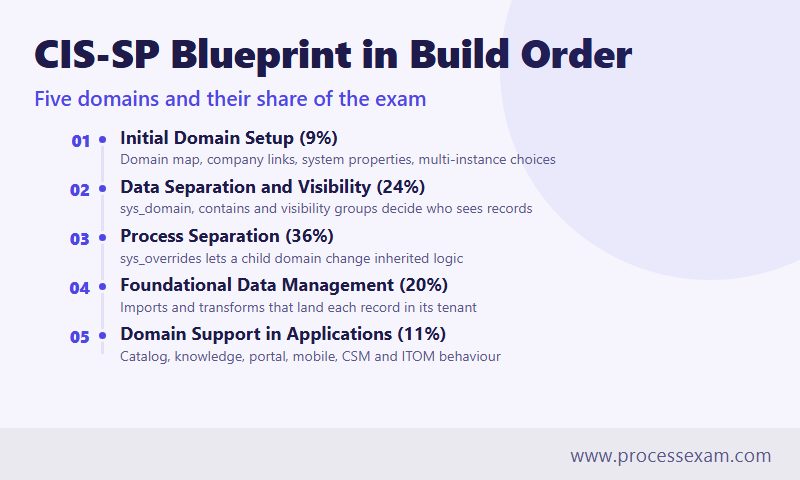
Initial domain setup and service provider architecture - 9%
The smallest domain covers the decisions made before the first tenant goes live. That means the system properties that switch domain behaviour on and shape it, the way companies relate to domains, and the domain map that records the tree. It also covers the architecture choice that comes before any of this: some clients belong on a dedicated instance, not in a shared one, and the exam expects you to recognise the scenarios where multi-instance is the better answer and what integrations then have to do.
A useful habit here is to state the reason for every level in a tree. A provider domain at the top, a level for each client, perhaps a level below for a client's regions: each level should exist because someone needs to see across it or because a process differs beneath it. Levels added for tidiness only create more places for visibility to go wrong.
Data separation and visibility - 24%
Nearly a quarter of the exam asks who can see what. It covers the sys_domain field on each record, the direction data flows through the tree, the contains relationship, visibility groups and a set of special cases. The next section walks through these in detail, because almost every scenario in the exam depends on them.
Process separation - 36%
The largest domain is about logic rather than data: the sys_overrides field, automation, UI configuration, choice lists and data-driven processes. It gets its own section below.
Foundational data management - 20%
One fifth of the marks sit on a single sub-topic, imports and transforms. That weight reflects reality. Onboarding a client means loading its users, groups, locations and configuration items, and a load that lands in the wrong domain undoes every visibility rule above it.
Domain support in applications - 11%
Not every application treats domains the same way. ServiceNow documents a level of domain support for each application, from separating data only to separating both data and process, and the exam asks what those levels mean in practice for the Service Catalog, Knowledge Management, mobile, Service Portal and newer applications such as Customer Service Management and IT Operations Management. Before promising a client that a module is fully separated, check its stated support level in ServiceNow's product documentation; the exam rewards candidates who know that the answer varies by application.
How does a domain hierarchy decide which tenant sees which record?
Every separated record carries a sys_domain value naming the domain it belongs to, and a domain path that encodes where that domain sits in the tree. Everything about visibility follows from those two values and a handful of rules. Learn the rules as a system and most data questions become a matter of tracing a path.
Data is visible upward, not sideways
A user sees records in their own domain and in the domains beneath it. A provider analyst in a domain above all the clients therefore sees every client's incidents, which is exactly what a service desk needs and exactly how the report in the opening scenario leaked. A user in client A's domain sees nothing in client B's domain, because B is a sibling rather than a descendant.
The global domain is shared by everyone
Records in global are visible from every domain. That is right for reference data every tenant needs and wrong for anything a client considers its own. ServiceNow's recommended pattern places a TOP domain beneath global as the root of the provider's own tree, so that provider data does not sit in global by accident. A domain marked as the default catches records that would otherwise have no home, and questions often ask where a record ends up when nothing assigns it explicitly.
Contains and visibility groups widen the view deliberately
Sometimes the tree is not enough. A regional support team may need to see two clients that sit under different branches. A contains relationship lets one domain treat another as if it were beneath it, so its users see that domain's data without the tree being redrawn. Visibility domains on a group, or on an individual user, grant extra read access to named domains for the people who need it. The exam likes to ask which of these tools is the narrowest fix for a given requirement, and the answer is usually the one that grants the least extra visibility.
Special considerations
The blueprint lists special considerations alongside the core rules, and they are where candidates who have only read about domains get caught. Examples worth rehearsing: what an administrator sees after switching session domain with the domain picker, why a record created by a provider analyst on behalf of a client can land in the provider's domain unless the process sets it, and how reports, scheduled jobs and integrations inherit the visibility of the account they run as. That last point is the opening scenario again, and it is the one to remember above all the others.
Why does process separation outweigh every other CIS-SP topic?
Visibility is a fixed set of rules. Process is where each client asks for something different, and that is where the work, and the marks, concentrate.
How inheritance and sys_overrides work
Process records such as business rules, client scripts, UI policies, notifications and assignment logic belong to a domain like any other record. Logic defined in a higher domain applies to every domain beneath it. When one client needs a variation, you do not edit the shared record; you switch to that client's domain and create a copy there. The copy's sys_overrides field points at the record it replaces, and from then on the client's domain runs its own version while every other tenant keeps the original.
That single mechanism answers a large share of process questions. If a change to a parent rule does not reach one client, look for an override in that client's domain. If a client's variation starts affecting its own child domains, remember that overrides are inherited downward too. If a variation was created in the wrong domain, it applies to the wrong set of tenants.
Automation and business logic
Business rules and flows decide what happens when a record changes. In a separated instance the question is always which domain's version runs for a given record. Rehearse cases where the record's domain and the acting user's domain differ, since the platform evaluates process against the record rather than the person.
UI configuration and choice lists
Forms, lists and views can differ by domain, so client A can capture a contract reference on its incident form while client B never sees the field. Choice lists can also be domain-specific, which lets each client keep its own categories and states. Expect questions that describe a client complaint about a missing field or an unexpected choice value and ask where the configuration lives.
Data-driven processes
The more mature approach is to drive variation from data rather than from copies of code: assignment lookups, approval rules and service level definitions stored per domain. One well-written rule that reads a per-client lookup scales to forty tenants far better than forty overrides do. The exam asks when each approach suits, and the provider-friendly answer is usually the data-driven one.
What goes wrong when client data is imported into the wrong domain?
Onboarding a new client almost always starts with a load: the company record, its users and groups, locations, and often its configuration items. Import sets and transform maps do the work exactly as they do on any instance, with one added question that decides whether the tenant is private. Which domain does each record land in?
If the transform sets sys_domain explicitly, or sets the company in a way that resolves to the right domain, the records arrive where they belong. If it does neither, records can inherit the domain of whoever or whatever runs the import. Run from a provider-level account, that means a new client's users appearing in the provider's own domain, visible to other tenants' analysts and absent from the client's own views. Nothing errors. The load looks successful until someone notices who can see whom.
Habits that keep loads clean
- Create the client's domain and company first, then load everything else against them.
- Map the domain in the transform rather than relying on the session domain of the person running it.
- Keep the coalesce fields tight, so a reload updates the right tenant's records instead of matching a similar record in another domain.
- After the load, sign in as a test user from the new client and a test user from a neighbouring client, and check what each one sees.
Foundational data management is worth one fifth of the exam, and questions in it tend to describe a symptom after the fact: users who cannot find their own group, or a location list showing another client's offices. Work backwards from the symptom to the transform that caused it.
How should a managed-service team prepare for CIS-SP in six weeks?
Six weeks at a few hours a week suits someone who already administers ServiceNow and has at least seen a domain-separated instance. Candidates new to domains should add two weeks at the start for the fundamentals. The plan below is built around one idea: build a small fictional provider and break it on purpose.
Weeks 1 and 2: build a practice tenant tree
Create a TOP domain, a provider operations domain and three imaginary clients beneath it, one of them with two regional child domains. Give each a company, a group and two users. If your employer has a separated sub-production instance, use it with permission. If not, check what ServiceNow currently allows on a personal developer instance and which domain separation labs come with its training, and plan around what is actually available rather than assuming.
Weeks 3 and 4: override something in every client
Give each client one process variation: a different assignment rule, an extra form field, a custom choice value, a notification with its own wording. Then change the parent version of each and predict, before you look, which clients pick up the change. This is the heart of the 36% domain, and predicting before checking is what turns reading into exam skill.
Week 5: load a new client badly, then properly
Import a fourth client's users and locations once with no domain mapping and see where they land. Then fix the transform and reload. Finish by testing a contains relationship and a visibility group, so you know the difference in what each grants.
Week 6: timed practice and leak drills
Sit a full timed set of 45 questions in 60 minutes early in the week, because pace on long scenario stems is a separate skill from knowledge. A CIS-SP practice exam run under those limits shows whether the eighty-second rhythm is comfortable, and the questions you miss sort neatly into the five domains. Spend the rest of the week on the domain that lost the most marks, back in your practice tenants, not on repeating the same questions.
Leak drills worth running before the exam
Each of these describes a symptom the exam might give you. Diagnose it in your practice tree until the answer is instant:
- A client sees another client's records. Check for a contains relationship or visibility group granted too broadly, and for records sitting in global.
- A report shows every tenant. Check the domain of the account the report runs as, not the domain of the recipient.
- A parent rule change does not reach one client. Look for an override in that client's domain.
- A client's variation leaks into its regions. Overrides flow downward; decide whether the regions should inherit it.
- New users are invisible to their own client. Trace the import: the transform probably never set the domain.
- A module ignores domain boundaries. Check that application's documented support level before blaming configuration.
On the day, the long stems are the risk. Identify the domain tree first, sketch it on the note board if the test format allows, then read what is being asked. Most wrong options describe something the platform can do but that would grant more visibility or copy more logic than the requirement needs.
What does CIS-SP prove to a managed service provider and its clients?
Domain separation is a specialist skill, and specialist skills are hard for an employer or a client to check in an interview. The credential gives them independent evidence that you understand the model, which matters most at the moments when a mistake is expensive: the design of a new shared instance, the onboarding of a large client, or the audit that follows a data incident.
For individuals the value depends on where they work. At a provider that runs shared instances, it is close to a baseline expectation for the administrators and consultants who touch the domain tree. At a partner that implements for providers, it lets a consultant lead the separation workstream rather than assist on it. In a large enterprise using domains for subsidiaries, it marks the person who can be trusted to add a new business unit without exposing an existing one.
It also sits well beside the rest of a ServiceNow career. Every application an administrator configures behaves slightly differently in a separated instance, so the knowledge carries into service management, customer service and operations work rather than standing alone. The typical titles that benefit are ServiceNow platform administrator at a managed service provider, implementation consultant, technical architect and platform owner for a multi-brand group. For any of them, being able to explain in one sentence why a record is visible to a given user is a skill clients notice.
Frequently Asked Questions
What is the ServiceNow CIS Service Provider certification?
It is ServiceNow's Certified Implementation Specialist - Service Provider credential, exam code CIS-SP. It confirms that you can administer a domain-separated instance where one ServiceNow environment serves many client companies, keeping each tenant's data private and letting each tenant run its own variations of shared processes.
How many questions are on the CIS-SP exam, and how long is it?
The CIS-SP exam has 45 questions and a 60 minute time limit, which works out at roughly eighty seconds per question. Many questions describe a domain tree before asking anything, so practise reading scenario stems quickly and sketching the hierarchy before choosing an answer.
What is the passing score for the CIS-SP exam?
ServiceNow grades CIS-SP as Pass or Fail and does not publish a numeric cut score. Judge readiness from your own timed practice across all five domains, and from whether you can explain why each wrong option would grant too much visibility or copy too much logic.
How much does the CIS-SP exam cost, and where is it booked?
The CIS-SP exam fee is USD $450. Seats are booked through Pearson VUE, at a test centre or with online proctoring. Partners and customers sometimes receive vouchers through ServiceNow learning programmes, so check your entitlement and the current blueprint in ServiceNow University before paying.
Which CIS-SP domain carries the most weight?
Process Separation is the largest domain at 36%. Data Separation and Visibility follows at 24%, Foundational Data Management at 20%, Domain Support in Applications at 11% and Initial Domain Setup and Service Provider Architecture at 9%. Overrides, inheritance and per-domain configuration therefore deserve the biggest share of study time.
- ServiceNow Service Provider Implementation Specialist Test Questions |
- CIS-SP Question Bank |
- ServiceNow Service Provider Implementation Specialist Book |
- Service Provider Implementation Specialist Certification Cost |
- Service Provider Implementation Specialist Certification Requirements |
- ServiceNow Service Provider Implementation Specialist Sample Questions |
- CIS-SP Exam Questions Download |
- CIS-SP Test Questions |
- Service Provider Implementation Specialist PDF |
- Platform and AI |
- CIS-Service Provider Mock Exam |
- CIS-Service Provider |
- CIS-Service Provider PDF |
- ServiceNow CIS-Service Provider Exam Questions |
- ServiceNow CIS-Service Provider Sample Questions |
- CIS-Service Provider Certification |
- CIS-Service Provider Certification Cost |
- CIS-Service Provider Certification Requirements |
- ServiceNow CIS-Service Provider Book |
- ServiceNow CIS-Service Provider Question Bank |
- ServiceNow CIS-Service Provider Study Guide


