
Chart Your Course: Navigating the OG0-041 Success Matrix

The OG0-041 certification, officially known as The Open Group Open FAIR Part 1, serves as a foundational credential for professionals aiming to master quantitative information risk management. This exam validates a candidate's understanding of the FAIR (Factor Analysis of Information Risk) methodology, a cornerstone framework for analyzing and measuring information risk in financial terms. Individuals seeking to apply a structured, objective approach to risk assessment and communicate risk effectively to business stakeholders will find this certification invaluable. This comprehensive guide outlines the exam's structure, delves into its core syllabus, highlights the benefits of certification, and provides a strategic roadmap for achieving OG0-041 success.
Unlocking Quantitative Risk Assessment Skills with OG0-041
Achieving the Open Group Open FAIR Part 1 certification signifies a professional's capability to understand and apply the principles of the FAIR methodology. This credential is vital for risk analysts, security managers, auditors, and business leaders who need to move beyond qualitative risk assessments to precise, data-driven analysis. It equips individuals with the necessary framework to quantify information risk, thereby enhancing decision-making and resource allocation within an organization. By focusing on the OG0-041 exam, candidates build a robust skill set applicable across various industries and regulatory environments.
Essential OG0-041 Examination Attributes
Understanding the fundamental characteristics of the OG0-041 exam is the first step in any successful preparation journey. This foundational knowledge helps candidates plan their study timeline and understand the assessment criteria. The Open Group designs this exam to rigorously test comprehension of the Open FAIR standard's core concepts.
The examination structure is as follows:
-
Exam Name: The Open Group Open FAIR Part 1
-
Exam Code: OG0-041
-
Exam Price: USD $375
-
Duration: 120 Minutes
-
Number of Questions: 80
-
Passing Score: 70%
These details underscore the exam’s rigor and the importance of thorough preparation. Candidates should allocate sufficient time to grasp each topic and practice effectively, ensuring they are well-prepared for both the time limit and question volume. For more detailed information on registration and scheduling, visit the Open Group Open FAIR Part 1 exam details page.
Navigating the Open FAIR Part 1 Syllabus
The OG0-041 exam syllabus is meticulously designed to cover all fundamental aspects of the Open FAIR methodology. A deep understanding of each topic is crucial for success, ensuring candidates can articulate and apply quantitative risk concepts effectively. The curriculum progresses from basic risk definitions to the intricacies of interpreting and communicating risk analysis results.
The core syllabus topics include:
-
Basic Risk Concepts: Establishing a common understanding of what constitutes risk, its components, and how it is perceived in various contexts. This includes defining assets, threats, vulnerabilities, and loss events within an information security context.
-
Taxonomy: Delving into the standardized language and classification system used within the FAIR framework. This ensures consistency and clarity in risk communication and analysis across different organizational units.
-
Terms: Learning the precise definitions of key terminology specific to the Open FAIR methodology, such as Loss Event Frequency (LEF), Threat Event Frequency (TEF), and Vulnerability (Vuln).
-
Interpreting Results: Developing the ability to accurately understand and explain the output of a FAIR analysis. This involves recognizing the significance of various data points and their implications for risk posture.
-
Communicating Results: Focusing on how to effectively convey complex quantitative risk analysis findings to diverse audiences, including executive leadership and technical teams, ensuring actionable insights are derived.
-
Business Case Development: Understanding how to construct a compelling business case for risk management initiatives based on FAIR analysis results, demonstrating the financial impact of risk.
-
Complementing Other Frameworks: Recognizing how Open FAIR integrates with and enhances existing qualitative risk management frameworks (e.g., ISO 27005, NIST RMF) rather than replacing them.
-
Assumptions: Identifying and documenting the assumptions made during a risk analysis, which is crucial for transparency and understanding the scope and limitations of the assessment.
-
Scoping/Definition: Learning how to properly define the scope of a risk analysis, including the assets, threats, and loss events relevant to a specific business problem.
-
Documenting Rationale: Emphasizing the importance of clearly documenting the logical reasoning and evidence supporting each step of a FAIR analysis, ensuring reproducibility and reviewability.
-
Choosing Abstraction Level: Deciding on the appropriate level of detail for a risk analysis, balancing precision with practicality and the availability of data.
-
Finding Data: Developing strategies and techniques for sourcing reliable data points required for quantitative risk assessment, including historical data, industry benchmarks, and expert opinions.
-
Troubleshooting Analyses: Acquiring the skills to identify and resolve common issues or inconsistencies that may arise during a FAIR analysis, ensuring the accuracy of results.
-
Calibration: Understanding how to refine expert estimates and input data to improve the accuracy and reliability of FAIR model outputs.
-
Distributions: Grasping the concept of probability distributions and how they are used in FAIR to represent uncertainty in various risk factors.
-
Most Likely Values: Determining the most probable values for uncertain variables within a risk scenario to inform the FAIR model.
-
Monte Carlo: Learning about Monte Carlo simulation, a critical technique used in FAIR to model the cumulative effect of uncertain variables and generate a range of potential outcomes.
-
Accounting for Uncertainty: Implementing methods to explicitly acknowledge and incorporate uncertainty into risk assessments, moving beyond single-point estimates.
-
Accuracy versus Precision: Distinguishing between the concepts of accuracy (closeness to the true value) and precision (reproducibility of results) in risk measurement.
-
Subjectivity versus Objectivity: Understanding the balance between subjective expert judgment and objective data in quantitative risk analysis and how to manage potential biases.
-
Deriving Vulnerability (Vuln): Learning the systematic approach to calculate or estimate vulnerability, a critical component in the FAIR model that quantifies the probability of a threat successfully overcoming controls.
-
Ordinal Scales: Recognizing the limitations and appropriate uses of ordinal scales (e.g., high, medium, low) compared to quantitative scales in risk measurement.
-
Diminishing Returns: Applying the concept of diminishing returns to risk mitigation strategies, understanding when the cost of further controls outweighs the reduction in risk.
-
The Open Group Certification for People: FAIR Certification Program: Familiarization with the broader Open FAIR certification ecosystem and career pathways.
This comprehensive syllabus ensures that certified professionals possess a holistic understanding of the FAIR framework, from its theoretical underpinnings to practical application.
Realizing the Value of Open FAIR Part 1 Credential
Obtaining the Open Group Open FAIR Part 1 certification offers significant advantages for professionals and their organizations. This credential is not merely a badge; it represents a commitment to best practices in risk management and provides tangible benefits that can influence career trajectories and business outcomes.
The key benefits include:
-
Enhanced Decision-Making: FAIR provides a quantifiable basis for risk decisions, enabling organizations to prioritize investments in security and risk mitigation based on actual financial impact rather than subjective judgment.
-
Improved Communication: Speaking the common language of financial risk allows professionals to communicate complex cyber risk scenarios clearly and persuasively to executive management and board members.
-
Career Advancement: The demand for professionals skilled in quantitative risk assessment is growing. The OG0-041 certification positions individuals as experts in a specialized and highly valued field, opening doors to leadership roles in risk management and cybersecurity.
-
Standardized Approach: Adopting the Open FAIR methodology introduces a consistent and repeatable process for assessing risk across an enterprise, reducing inconsistencies and improving the reliability of risk reporting.
-
Optimized Resource Allocation: By quantifying risk in financial terms, organizations can allocate their limited resources more effectively, investing in controls that yield the greatest reduction in financial exposure.
-
Demonstrated Expertise: The certification validates a professional’s ability to conduct thorough, objective risk analyses, building trust and credibility with stakeholders.
Professionals who earn this certification distinguish themselves as leaders capable of translating technical threats into clear business risks, a skill increasingly critical in today's digital landscape. Further insights on the program’s value can be found in the official exam documentation.
Crafting Your Strategic OG0-041 Preparation Pathway
A structured and comprehensive preparation strategy is paramount for success on the OG0-041 exam. Given the depth and breadth of the Open FAIR Part 1 syllabus, candidates must adopt a methodical approach that covers all topics thoroughly. This involves more than just memorization; it requires understanding the practical application of FAIR principles.
Structuring Your Study Plan
Begin by reviewing the entire syllabus to identify areas where you may need to focus more attention. Create a realistic study schedule that breaks down complex topics into manageable chunks. Consistency is key, so dedicating regular time slots to study will prove more effective than sporadic cramming sessions. Work from The Open Group's official study guides and the standards they are drawn from.
Consider these steps for effective preparation:
-
Deep Dive into Core Concepts: Start with the foundational risk concepts, taxonomy, and terminology. Ensure you can define and differentiate each term clearly. Build a solid understanding before moving to more advanced topics.
-
Master Analytical Techniques: Pay close attention to sections on interpreting and communicating results, business case development, and complementing other frameworks. These areas test your ability to apply FAIR in real-world scenarios.
-
Understand Data and Uncertainty: Spend significant time on topics such as finding data, troubleshooting analyses, calibration, distributions, and Monte Carlo simulations. These are critical for performing accurate quantitative risk assessments. Access Open FAIR methodology resources for detailed guides.
-
Practice with Scenarios: The exam often includes scenario-based questions that require applying the FAIR methodology. Work through various examples to solidify your understanding of how to scope, analyze, and communicate risk.
-
Regular Review and Self-Assessment: Regularly review previously studied material to reinforce learning. Use practice tests to identify knowledge gaps and areas requiring further study. This also helps in familiarizing yourself with the exam format and time constraints.
Leveraging Practice Exams for Readiness
Engaging with high-quality practice questions and full-length practice tests is crucial. These resources simulate the actual exam environment, helping you build confidence, manage time effectively, and pinpoint specific areas of weakness. Analyzing incorrect answers and understanding the underlying FAIR principles will significantly boost your readiness. Focus on applying the methodology to diverse scenarios presented in practice questions.
Integrating Open FAIR Principles for Business Advantage
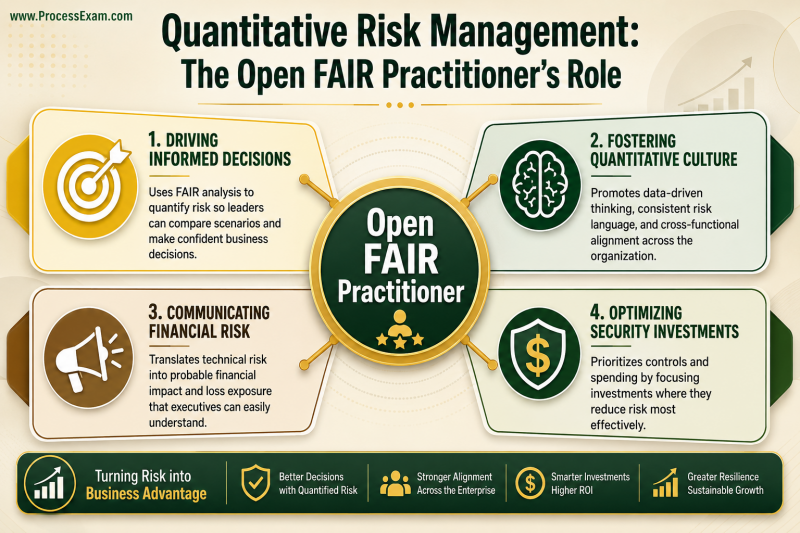
Beyond certification, the true power of the OG0-041 credential lies in its practical application within an organizational context. Professionals certified in Open FAIR Part 1 are equipped to integrate quantitative risk management into everyday business operations, fostering a more secure and resilient enterprise. This involves translating theoretical knowledge into tangible strategic and operational benefits.
Driving Informed Business Decisions
With the Open FAIR framework, certified individuals can move beyond subjective "high," "medium," and "low" risk ratings to provide leadership with clear, financially-driven insights into potential loss events. This enables more informed decision-making regarding cybersecurity investments, insurance strategies, and overall risk appetite. By presenting risk in monetary terms, organizations can clearly see the return on investment for various risk mitigation efforts. This objective approach minimizes emotional biases often associated with traditional risk assessments.
Fostering a Culture of Quantitative Risk Management
The presence of Open FAIR certified professionals within an organization helps to cultivate a culture where risk is understood, measured, and managed systematically. These individuals can champion the adoption of the FAIR methodology, train colleagues, and facilitate discussions that elevate the understanding of risk across different departments. This shift towards quantitative methods enhances accountability and improves the overall maturity of an organization's risk management program, making it more robust against evolving threats.
Overcoming Challenges and Building Success Habits
Preparing for the OG0-041 exam, like any specialized certification, can present certain challenges. However, by adopting effective study habits and understanding common pitfalls, candidates can significantly improve their chances of success. It is not just about learning the material but also about strategizing the learning process itself.
Addressing Common Preparation Hurdles
One significant challenge often faced by candidates is the shift from qualitative to quantitative thinking in risk management. Many professionals are accustomed to descriptive risk assessments, and the financial modeling required by FAIR demands a different mindset. Overcome this by dedicating extra time to the syllabus sections on distributions, Monte Carlo simulations, and calibration. Another hurdle can be sourcing relevant data for practice scenarios; focusing on understanding the methodology first, then applying it to hypothetical data, can be effective.
To build success habits:
-
Engage with the Community: Participate in Open FAIR forums or study groups. Discussing complex topics and diverse perspectives can deepen your understanding and provide clarity on challenging concepts.
-
Consistent Application: Regularly apply FAIR principles to various hypothetical scenarios, even outside formal study sessions. Think about how you would quantify risk in your daily professional context.
-
Seek Feedback: If possible, review your understanding or practice analyses with a mentor or a more experienced FAIR practitioner. Constructive feedback is invaluable for refining your approach.
-
Prioritize Understanding over Memorization: While knowing terms is important, the exam tests your ability to apply the FAIR methodology. Focus on why specific steps are taken and how different components interact.
This systematic approach will not only help in passing the OG0-041 exam but also in becoming a more proficient quantitative risk professional.
The Open Group Open FAIR Part 1 certification (OG0-041) is a strategic investment for professionals dedicated to advancing their expertise in quantitative information risk management. By meticulously preparing for the exam and fully embracing the FAIR methodology, candidates unlock the ability to deliver clear, data-driven insights that are critical for organizational resilience and success. This credential validates a specialized skill set essential in today's complex threat landscape.
Ready to solidify your expertise in quantitative information risk management? Start your structured preparation for the OG0-041 exam today and leverage the comprehensive resources available to guide your certification journey. Visit ProcessExam.com for high-quality practice materials that align with the official syllabus, helping you build confidence and ensure exam readiness.
Frequently Asked Questions
1. What is the primary purpose of the OG0-041 Open FAIR Part 1 certification?
The OG0-041 certification primarily validates an individual's understanding and ability to apply the Factor Analysis of Information Risk (FAIR) methodology. Its purpose is to equip professionals with skills to quantitatively measure and manage information risk, translating technical risks into financial terms for better business decision-making.
2. Who should consider taking the OG0-041 exam?
The OG0-041 exam is ideal for risk analysts, cybersecurity professionals, auditors, IT managers, and business leaders who need to move beyond qualitative risk assessments. It benefits anyone responsible for understanding, analyzing, and communicating information risk in a structured, quantitative manner within their organization.
3. How does the Open FAIR methodology differ from traditional risk assessment approaches?
Open FAIR distinguishes itself by providing a quantitative framework that measures information risk in financial terms, rather than using subjective qualitative ratings (e.g., high, medium, low). This allows for more objective comparisons, better resource allocation, and clearer communication of risk to business stakeholders.
4. Are there any prerequisites for taking the OG0-041 certification exam?
The Open Group typically does not impose formal prerequisites in terms of prior certifications or work experience for its Part 1 exams. However, candidates are expected to have a foundational understanding of general risk management concepts and information security principles to grasp the Open FAIR methodology effectively.
5. What career benefits can I expect from achieving the OG0-041 certification?
Achieving the OG0-041 certification can significantly enhance career prospects in risk management, cybersecurity, and IT governance roles. It demonstrates expertise in a highly sought-after skill set, leading to improved job opportunities, increased earning potential, and the ability to influence strategic security decisions within organizations by providing data-driven insights.
- Open Group Open FAIR Part 1 Test Questions |
- OG0-041 Question Bank |
- FAIR |
- Open FAIR Part 1 Simulator |
- Open FAIR Part 1 Mock Exam |
- Open Group Open FAIR Part 1 Book |
- Open FAIR Part 1 Certification Cost |
- Open FAIR Part 1 Certification Requirements |
- Open Group Open FAIR Part 1 Sample Questions |
- OG0-041 Exam Questions Download |
- OG0-041 Test Questions |
- Open FAIR Part 1 PDF


