
Benefits of PMI Agile Certified Practitioner (PMI-ACP) Certification
Updated on 22 September 2026. What’s new: updated for the rebuilt PMI-ACP exam launched in November 2024, with its current fees, domains and question format.
Picture a project manager whose team switched to two-week sprints while the certificate on their wall still described Gantt charts, phase gates and change control boards. The benefits of PMI-ACP certification start exactly there: it proves you can lead adaptive work, not just plan predictive work. It gives you a shared vocabulary across Scrum, Kanban and Lean, credibility during an agile transition, and a credential PMI rebuilt in 2024 around mindset, leadership, product and delivery.

That gap between how a team works and what its manager is certified in is more common than most people admit. Plenty of project managers learned their trade on plan-driven projects, earned a predictive credential, and then watched their organisation adopt sprints, backlogs and daily stand-ups around them. They still run the work, but the language in the room has changed, and their credentials no longer describe what they actually do.
The PMI Agile Certified Practitioner, known as PMI-ACP, is the Project Management Institute's answer to that gap. This article looks at what the credential is really good for, what the current exam measures, who gains the most from it, how to qualify, and how a manager with a predictive background can prepare without fighting their own habits.
What does the PMI-ACP prove that a predictive credential does not?
A predictive credential shows that you can define scope up front, build a baseline schedule, control change and close a project against a plan. Those skills still matter. What they do not show is whether you can lead a team that expects the plan to change every fortnight, and whether you know when that is the right way to work at all.
The PMI-ACP fills that space. It tests whether you can choose an approach that fits the problem, coach a team rather than direct it, keep a product backlog aligned with business value, and use flow and feedback to improve delivery. It is framework-neutral: rather than certifying you in one method, it expects you to understand Scrum, Kanban, Lean, extreme programming and hybrid models well enough to pick the right tool for a situation.
That neutrality is the first real benefit. Many agile certificates are tied to a single framework or a single training body. A manager who works across several teams, each doing agile slightly differently, gets more from a credential that treats those methods as a toolbox than from one that assumes everyone runs the same ceremonies.
The second benefit is the name behind it. PMI already runs the most widely recognised project management credentials, so hiring managers and procurement teams know how its certifications are built and maintained. When a PMI-ACP appears on a CV or a bid document, the reader knows it involved documented experience, formal training and a proctored exam, not a short online quiz.
Here are the exam facts, as published for the PMI-ACP today:
| Exam detail | PMI-ACP |
|---|---|
| Full name | PMI Agile Certified Practitioner |
| Exam code | PMI-ACP |
| Vendor | PMI |
| Exam fee | Member Price: USD $435 / Full Price: USD $495 |
| Duration | 180 minutes |
| Number of questions | 120 |
| Passing score | Above Target / Target / Below Target / Needs Improvement |
| Reference | Agile Practice Guide |
PMI keeps the current application steps, fees and policies on its PMI-ACP certification page. Check it before you apply, because PMI adjusts fees and requirements from time to time and the page is the final word.
Which benefits of PMI-ACP certification matter most in daily work?
The career benefits get most of the attention, but the everyday ones are what make the credential pay off on a Monday morning. These are the changes certified practitioners tend to notice first.
You stop translating between two languages
A manager with only predictive training often translates in their head: a sprint becomes a mini phase, a backlog becomes a requirements list, velocity becomes a progress percentage. Each translation loses something. Preparing for the PMI-ACP replaces that habit with a working understanding of why agile teams size work relatively, why they protect a sprint goal, and why a burn-up chart tells a sponsor more than a percentage complete. Conversations with the team get shorter because nobody is converting terms.
You can explain agile choices to sponsors
Sponsors and steering groups still ask predictive questions: when will it be done, what will it cost, what is in scope. A certified practitioner can answer those in adaptive terms without sounding evasive. You learn to talk about forecast ranges from throughput, value delivered per increment, and risk burned down through early releases. That skill is often what keeps an agile team trusted by leadership during its first year.
You lead without assigning every task
The exam spends a quarter of its weight on leadership, and most of that is about empowering teams: building trust, coaching and mentoring, recognising when to train versus when to coach, and handling conflict before it hardens. For a manager used to allocating work item by item, this is the hardest shift and the most valuable one, because self-organising teams stall quickly when the person in charge keeps pulling decisions back.
You recognise which approach a project needs
Not every project should be agile. The current outline asks candidates to classify situations with complexity models such as the Stacey Matrix and Cynefin, and to read the output of agile suitability tools. That gives you a defensible way to say "this one should be iterative, that one should stay predictive, and this one needs a hybrid", which is exactly the judgement organisations want from a senior project lead.
You measure value, not just activity
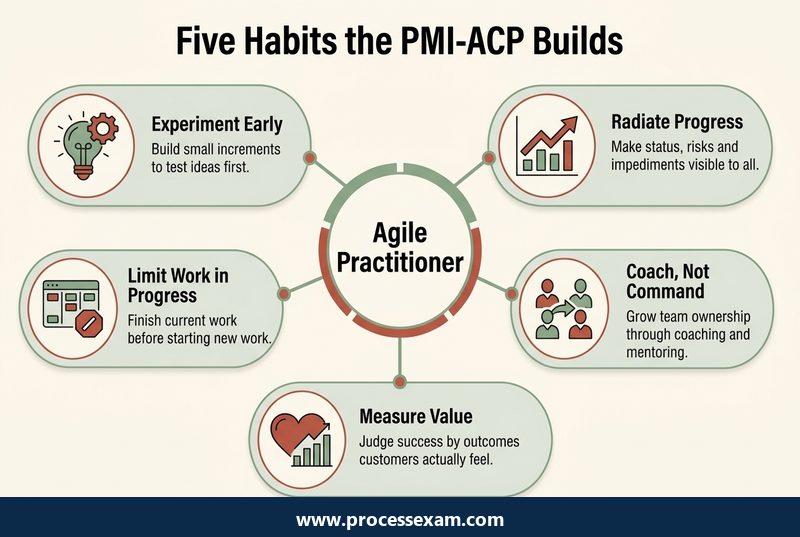
Agile metrics are easy to misuse. Velocity turned into a target, or a burndown shown to executives without context, can do more harm than good. The delivery domain expects you to choose metrics for a specific audience, radiate them openly, analyse trends and use them to decide what to change. Practitioners who absorb this stop reporting busyness and start reporting outcomes.
How does the 2024 exam content outline shape those benefits?
PMI launched a rebuilt PMI-ACP exam on 8 November 2024. The earlier outline spread the content across seven domains; the new one groups it into four, and PMI's March 2026 edition of the outline, checked in September 2026, keeps those four domains and weightings while describing the credential in terms of enterprise agility. You can read the full task list in PMI's PMI-ACP Examination Content Outline, and our PMI-ACP syllabus breakdown lays out the same tasks topic by topic for study.
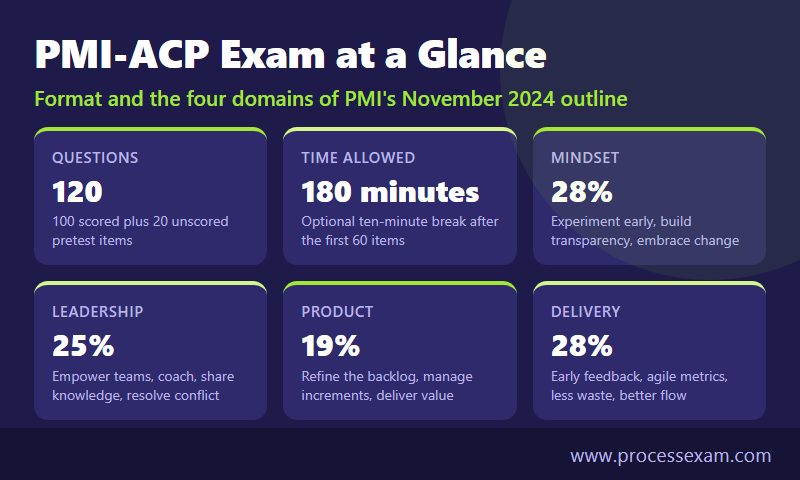
Mindset (28%)
This domain covers the thinking behind agile work. Its seven tasks are experimenting early, embracing the agile mindset, promoting a collaborative team environment, building transparency, fostering psychological safety, shortening feedback loops and embracing change. In practice that means building a small increment to test a market need, using information radiators so status and impediments are visible to everyone, encouraging dialogue over debate, and involving stakeholders from the first day rather than at the first demo.
Leadership (25%)
The six leadership tasks are empowering teams, facilitating problem resolution, promoting knowledge sharing, promoting agile principles and practices, promoting a shared vision and facilitating conflict management. Expect scenarios about emotional intelligence, reading non-verbal cues in a meeting, finding the root cause of a problem with tools such as an Ishikawa diagram, and building communities of practice so lessons do not stay inside one team.
Product (19%)
The smallest domain has four tasks: refining the product backlog, managing increments, visualising work and managing value delivery. You need to be comfortable clarifying and decomposing backlog items, prioritising them with stakeholders, sizing work together as a team, and defining what value means for a given product, including security, privacy and compliance concerns as well as customer satisfaction.
Delivery (28%)
Delivery has seven tasks: seeking early feedback, managing agile metrics, managing impediments and risk, recognising and eliminating waste, performing continuous improvement, actively engaging customers and optimising flow. This is where limiting work in progress, value stream mapping, risk-adjusted backlogs, spikes and cumulative flow diagrams appear, usually inside a scenario rather than as a definition to recall.
Read together, the four domains explain why the credential is useful beyond the exam. Mindset and leadership together make up more than half the test, so the certificate says as much about how you work with people as about which ceremonies you know. That is the part of the role a team notices first.
Who gains the most from the PMI-ACP, and who should look elsewhere?
PMI describes the audience as agile practitioners such as product owners, scrum masters and agile project managers. In practice the credential fits several profiles particularly well.
- Project managers moving into agile or hybrid delivery. The manager in the opening scenario is the classic candidate: experienced, credible, and in need of proof that their skills have kept pace with how the team works.
- Scrum masters and agile coaches. A framework-specific certificate shows you know one method well. The PMI-ACP adds breadth across Kanban, Lean and hybrid models, which helps when you support several teams.
- Product owners and product managers. The 2024 outline deliberately widened the audience to product roles, and the product and delivery domains speak directly to backlog, value and customer engagement work.
- PMO leads and delivery managers. People who set standards for many projects benefit from the suitability and tailoring content, since deciding which projects run adaptively is often their call.
- PMP holders. PMI counts an active PMP as meeting the agile experience requirement, so the PMI-ACP is a natural second credential for those who want their adaptive skills stated explicitly.
The PMI-ACP is a weaker fit in two situations. If you are new to project work and have little agile experience yet, you will struggle to meet the eligibility rules, and an entry-level credential makes more sense first. And if your organisation runs one framework strictly and only recognises that framework's own certificates, a framework-specific credential may be the one your employer actually asks for. Check job adverts in your market before deciding.
Do you qualify for the PMI-ACP, and what does the application involve?
The eligibility rules in the current outline have three parts: education, formal learning and agile experience. You need all three.
- Education: a secondary diploma, such as a high school diploma, GED or a global equivalent.
- Training: 21 hours of formal training in agile practices, frameworks and methodologies, completed before you apply, with proof of completion.
- Agile experience: one of four routes. Two years of agile experience within the past five years; or one year of agile experience plus a degree from a program accredited by PMI's Global Accreditation Center; or one year of agile experience plus an active third-party agile certification that you have held for more than a year; or an active PMP certification.
The third-party route is worth knowing about. If you already hold a Scrum or SAFe certificate earned over a year ago, PMI credits it as twelve months of the experience requirement, so you only need to document the remaining year. Existing PMI credential holders also have their recent agile and hybrid experience pulled into the application, rather than writing it out again.
The learning hours must come from courses that align with the outline, include practical exercises, and end with an assessment and a certificate. PMI names its own authorised exam prep, PMI Study Hall and the Agile Practice Guide as preparation resources, and PMI Authorized Training Partners teach from PMI's own course materials.
What the exam itself looks like
Of the 120 questions, 100 are scored and 20 are unscored pretest items scattered at random, so treat every question as if it counts. Question types include standard multiple choice, multiple response, drag-and-drop and exhibits. You have 180 minutes, with an optional ten-minute break at the halfway point, offered once you have finished and reviewed the first half of the items; after the break you cannot go back to them. The tutorial and closing survey sit outside the timed section.
You can sit the exam at a test centre or through online proctoring, both run by Pearson VUE on PMI's behalf. The online route needs a system check and a longer check-in, so leave margin before your start time. Once your application is approved, you have one year to pass and up to three attempts within that year.
How should a predictive project manager prepare for the PMI-ACP?
The biggest obstacle for experienced managers is not the content; it is instinct. Years of predictive work train you to escalate, re-plan and control, and many PMI-ACP scenarios reward the opposite: let the team decide, shorten the feedback loop, and adapt. The plan below is built around replacing those instincts rather than memorising more terms.
| Phase | Focus | What you should be able to do at the end |
|---|---|---|
| 1. Re-read the principles | Agile values, principles and the Agile Practice Guide | Explain in your own words why each principle exists and what it replaces |
| 2. Map the outline to your job | The four domains and their tasks | Name a real situation from your work for every task, or flag it as a gap |
| 3. Fill the gaps | Complexity models, flow, waste, metrics, coaching | Use the Stacey Matrix, WIP limits and cumulative flow diagrams on an example |
| 4. Practise judgement | Scenario questions across all four domains | Pick the most agile response and explain why the others fall short |
| 5. Rehearse the day | Full-length timed tests | Finish 120 questions inside 180 minutes with time left to review |
Most working professionals take somewhere between six and ten weeks to move through these phases, depending on how much agile work they already do. Your 21 training hours usually fall in the first two phases, which is why it helps to choose a course that follows the outline closely.
Test your instincts before exam day
Phase four is where predictive habits show up. A useful self-check: for every scenario you get wrong, write down whether your answer escalated, planned or controlled when the right answer coached, experimented or waited for team input. After a few sessions a pattern appears, and that pattern is what you need to change. Once your reasoning is steadier, a timed PMI-ACP mock exam shows whether you can hold that judgement across a full sitting and where your pacing slips.
Use your own projects as study material
You already have a library of examples: the release that slipped, the stakeholder who never came to reviews, the team that argued about estimates. Re-examine each one through the outline. Which task was missing? What would a retrospective, a spike or a WIP limit have changed? Tying abstract tasks to your own history makes them far easier to recall under time pressure.
What mistakes cost experienced managers the PMI-ACP exam?
Candidates with long project careers tend to fail for similar reasons, and almost none of them are about knowledge gaps.
- Answering as the manager in charge. Options that have the project manager decide, assign or escalate on the team's behalf are usually wrong unless the scenario clearly calls for it.
- Studying the old seven-domain material. Books and question sets written before November 2024 follow an outline that no longer exists. Check the publication date of anything you buy.
- Learning Scrum only. The exam is deliberately framework-neutral. Kanban flow, Lean waste and hybrid tailoring all appear, and Scrum-only preparation leaves visible holes.
- Skimming the leadership domain. Emotional intelligence, coaching and conflict resolution feel soft, but together with mindset they carry more than half the scored questions.
- Ignoring the break rule. Once you take the halfway break, the first section is locked. Review everything you flagged before you step away.
- Treating metrics as reporting. Questions about velocity, throughput and cycle time usually ask how the team should use them to improve, not how to present them upward.
Is the PMI-ACP worth it for your career, and how do you keep it active?
For the manager in the opening scenario, the answer is usually yes, because the credential closes a visible gap between their experience and their paperwork. The value shows up in a few concrete ways: job adverts for agile project, delivery and product roles that list it by name, contract and consultancy bids that ask for proof of agile capability, and internal moves into transformation or PMO roles where an organisation wants someone who can speak to both predictive and adaptive delivery.
It also sits well beside other credentials. Paired with a PMP, it shows a full range from predictive to adaptive work. Paired with a framework-specific certificate, it adds breadth and a globally recognised name. On its own, it is one of the few agile credentials that requires documented experience, which is part of why employers treat it as more than a training certificate.
Be realistic about what it will not do. A certificate does not replace a track record, and it will not turn a team that is agile in name only into one that delivers. Its value is highest for people who already practise agile and want that practice recognised, and lowest for people hoping the credential will create experience they do not have.
Keeping it active is straightforward. PMI requires 30 professional development units every three years under its Continuing Certification Requirements program, earned through agile-related learning and giving back to the profession. Most practitioners collect them naturally through courses, conferences, webinars and mentoring, as long as they log them as they go rather than rushing at the end of the cycle.
If your team already works in sprints and your credentials still describe phase gates, the PMI-ACP is the most direct way to bring the two back into line. Start with the outline, map it honestly against your own projects, and let the gaps you find set your study plan.
Frequently Asked Questions
What are the main benefits of PMI-ACP certification?
The PMI-ACP shows employers you can lead adaptive work across Scrum, Kanban, Lean and hybrid models, not only plan predictive projects. It gives you a shared vocabulary with agile teams, credibility during agile transitions, and a globally recognised PMI credential that requires documented experience, formal training and a proctored exam.
What does PMI-ACP stand for?
PMI-ACP stands for PMI Agile Certified Practitioner, a certification from the Project Management Institute. It is aimed at agile project managers, scrum masters, product owners and similar roles, and it tests agile knowledge across four domains: Mindset, Leadership, Product and Delivery, rather than any single framework.
How many questions are on the PMI-ACP exam?
The PMI-ACP exam has 120 questions and a time limit of 180 minutes. PMI's outline states that 100 questions are scored and 20 are unscored pretest items placed at random. An optional ten-minute break comes at the halfway point, and you cannot return to the first half afterwards.
How much does the PMI-ACP exam cost?
The PMI-ACP exam fee is USD $435 for PMI members and USD $495 at full price for non-members. Membership has its own annual cost, so compare the combined figure with the full price before deciding. Confirm current fees on PMI's certification page before you apply.
Is the PMI-ACP worth it for a project manager?
It is usually worth it for project managers whose teams already work in agile or hybrid ways, because it proves adaptive skills their predictive credentials do not cover. It adds most value alongside real agile experience and least for people hoping a certificate will replace hands-on practice.
- PMI Agile Practitioner Test Questions |
- PMI-ACP Question Bank |
- PMI Agile Practitioner Book |
- Agile Practitioner Certification Cost |
- Agile Practitioner Certification Requirements |
- PMI Agile Practitioner Sample Questions |
- PMI-ACP Exam Questions Download |
- PMI-ACP Test Questions |
- Agile Practitioner PDF |
- Agile Practitioner Simulator |
- Agile Practitioner Mock Exam |
- Specialized


