
APMP Certification Levels Explained: Foundation to Professional
APMP's main ladder has three rungs: Foundation (CF APMP), Practitioner (CP APMP) and Professional (CPP APMP). The first two are scored exams. The third has no exam at all, only an impact paper and an interview. Each rung opens at a different point in a bid career, so the useful question is not which certificate is best but which one is next for you, and what you must have behind you before you can book it.
What does each rung of the APMP ladder prove?
Each level answers a different question about you. Foundation asks whether you share the language and habits of the profession. Practitioner asks whether you can apply them to a live bid and lead others in doing so. Professional asks whether you have changed how your organisation, or the profession, works. APMP describes Practitioner certification as validating "real-world mastery of industry best practices and the ability to lead others in their use" in its Practitioner preparation guide, and it defines impact at the Professional level as "demonstrating advocacy of best practices achieved through leadership and communication" in its Professional candidate guidance.
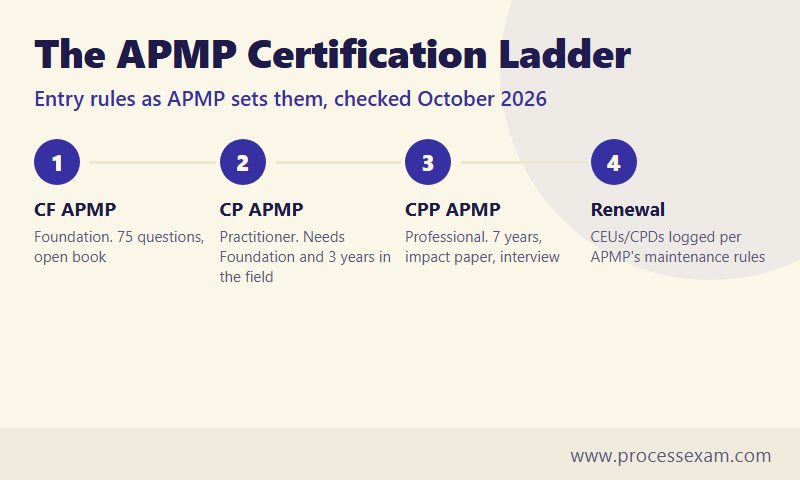
Read the ladder as three different kinds of evidence. A Foundation result is evidence of knowledge. A Practitioner result is evidence of judgement under a scenario. A Professional result is evidence of leadership that you document yourself and defend in front of two assessors. That is why the climb cannot be rushed by studying harder: the upper rungs ask for years in the work, not only hours with a book.
What the ladder does not tell an employer
A certificate is a summary, not a job description. Two people with the same Practitioner result can have run very different bids, and the ladder does not describe sectors, bid sizes or win rates. Treat it as a common yardstick that lets a hiring manager place you quickly, then use your CV and your stories for everything the yardstick leaves out. That is also why the upper levels demand years: they exist to match the credential to a track record.
The two exam rungs side by side
The table gives the exam figures for the two scored levels and for the Capture Practitioner route that runs alongside them.
| Detail | CF APMP | CP APMP | CAP APMP |
|---|---|---|---|
| Full name | APMP Foundation-Level Certification | APMP Practitioner-Level Certification | APMP Capture Practitioner-Level Certification |
| Version | Version 4.0 | v4.4 | v4.4 |
| Number of questions | 75 | 80 | 80 |
| Duration | 65 minutes | 150 minutes | 150 minutes |
| Passing score | Pass / Fail | 50 | 50 |
| Exam price | APMP Members: $425; Nonmembers: $780 | APMP Members: $425 | APMP Members: $425 |
APMP keeps the booking steps for the first rung on its Foundation certification page: create a free APMP ID, book, sit the paper online or in person, and use the sample exam and study guide in between. You have up to one year to take the exam after booking it.
What must you have in hand before you can sit each level?
The entry rules are where most plans go wrong, because they are measured in years and in membership status, not in study hours. The table is taken from APMP's Practitioner preparation guide and its Professional candidate guidance. APMP's Foundation page, as read in October 2026, states no experience requirement for the first rung.
| Level | What you need first |
|---|---|
| Foundation (CF APMP) | An APMP ID. Membership is optional, though APMP notes that membership plus the exam costs less than the exam alone. |
| Practitioner (CP APMP) | The Foundation certification, APMP membership in good standing, and at least three years' experience in the capture, sales, bid or proposal fields. |
| Capture Practitioner (CAP APMP) | APMP membership in good standing and the same three years of experience. Foundation is not on the list. |
| Professional (CPP APMP) | APMP membership, the Practitioner or Capture Practitioner certificate, at least seven years in a bid and proposals environment, and a reference who can rate you on managing and motivating others. |
What the gaps mean for timing
Two of those rules decide your calendar. The three-year rule means a newcomer can hold Foundation quickly but cannot book Practitioner until the experience is there. The seven-year rule means the Professional level is a mid-to-late-career step by design. Neither can be shortened by exam preparation, so the plan later in this guide starts from your years in the field, not from a study date.
The membership thread
APMP asks Practitioner candidates to be members in good standing and to maintain that membership. Treat membership as an ongoing line in your budget from the second rung onwards, not as a one-off purchase.
How does the assessment change as you climb?
The format changes at every step, and the biggest change is the last one.
Foundation: breadth, open book, short clock
The Foundation paper is 75 questions in 65 minutes and is open book. With under a minute a question, the reference material is for confirming an answer you already lean towards. Our guide to what CF APMP is covers its units and a four-week plan, so this guide does not repeat them.
Practitioner: scenarios and a much longer sitting
The Practitioner paper has 80 questions in 150 minutes, built on a supplied scenario. APMP's page for the level lists four competency areas that candidates must be able to apply and adapt to a given bid scenario: Information Research, Management and Sales Orientation; Planning and Management; Development; and Behaviour and Attitude. Each is tested twice over: can you apply the competency to the scenario, and can you tell an appropriate application from an inappropriate one. The CP APMP syllabus lays those areas out for study.
Professional: no exam, two stages
APMP states that there is no exam for the Professional certification. Stage one is the Proposal Professional Impact Paper (PPIP), which documents the impact you have made. It is assessed against criteria that include senior stakeholder engagement, a timeline, specific activities, quantitative or qualitative results, how the results were measured, how they were made sustainable, and a continuing professional development plan. The pass mark for the paper is 41 marks out of 48, about 85 percent, and the assessor aims to respond within four weeks.
Stage two is an interview run by two APMP-approved assessors and lasting at most an hour. You give a 20-minute presentation of your PPIP slides, then answer competency questions that you are told in advance, with at least five days to prepare. The presentation needs at least 31 out of 36, and the competency interview at least 17 out of 20. One deferral is allowed at each stage, and a candidate who fails after the second attempt can apply again when ready. APMP also states that its assessors may not act as mentors, so you must find your own reviewers for the paper.
What the Professional interview probes
The candidate guidance groups its example competency questions under headings: persuasiveness, communication, building relationships and teams, decision making and delegating responsibility, meeting leadership, and continuous professional development. Notice what is missing. There is no question about proposal theory, because the Practitioner level already covered it. The interview tests how you lead people, and a good answer is a short story from your own bids with a decision, a stakeholder and a result in it. If you cannot yet tell five such stories, that is your preparation list.
The guidance quoted here does not give the Professional assessment fee. Confirm it on the APMG-International booking portal before you budget.
Where do the Capture Practitioner route and the micro-certifications fit?
Capture Practitioner: a second door into the upper rung
If your work is winning the opportunity rather than writing the response, the Capture Practitioner level suits you better than the bid and proposal Practitioner. Its exam has the same size (80 questions in 150 minutes) and the same entry rules, minus Foundation. APMP's Capture Practitioner page is the place to confirm the current details. Because the Professional level accepts either Practitioner certificate, a capture specialist can reach it without ever sitting the bid and proposal Practitioner exam.
Micro-certifications: add-ons rather than rungs
APMP also offers short, topic-specific micro-certifications. None of them appears in the prerequisites for Practitioner or Professional, so they sit beside the ladder, not on it. They suit someone who wants dated proof of one skill without committing to a level. The four in the table are short papers, and all are priced the same.
| Micro-certification | Questions | Duration | Passing score | Price |
|---|---|---|---|---|
| AI-M APMP (AI) | 30 | 30 minutes | 73 | APMP Members: $165; Nonmembers: $300 |
| ES-M APMP (Executive Summaries) | 25 | 30 minutes | 68 | APMP Members: $165; Nonmembers: $300 |
| BW-M APMP (Bid & Proposal Writing) | 50 | 50 minutes | 67 | APMP Members: $165; Nonmembers: $300 |
| GR-M APMP (Graphics) | 30 | 30 minutes | 67 | APMP Members: $165; Nonmembers: $300 |
Each of these has its own guide on this site covering the paper in detail, so the point here is only where they fit. A sensible use is as a bridge year: if you are waiting for your third year of experience, a micro-certification in the skill you use daily gives you something current to show while the Practitioner clock runs.
Which bid-team role usually sits at which step?
APMP does not tie a certificate to a job title, and employers use the titles differently. The map below is a typical pattern in bid teams, not an APMP rule, and it is most useful as a way to ask where your own role sits.
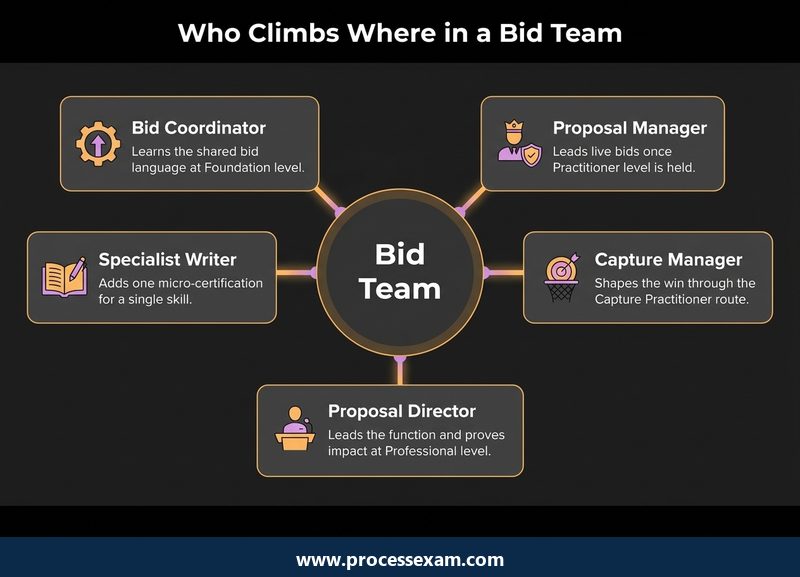
- Bid coordinator or proposal support. Schedules reviews, chases contributors and builds documents. Foundation fits, because the shared vocabulary is the daily tool.
- Proposal manager. Runs the bid from kick-off to submission. Practitioner fits, because it tests judgement on a scenario of exactly this kind.
- Capture manager. Shapes the opportunity before the request arrives. The Capture Practitioner route matches the work.
- Proposal director or head of the function. Sets the method for many bids and answers for results. Professional is where that leadership is documented.
- Specialist writer, editor or graphics lead. Often best served by a micro-certification in the one skill, with or without a level.
The pattern also works in reverse. If you are already a proposal manager with no certificate, the Foundation level is quick evidence for people who do not know your record, and Practitioner is the one that matches your actual job. Hiring managers who read a certificate beside a CV look for the level that corresponds to what you have done.
How long does the climb take, and what will it cost?
The fastest honest route is set by your experience, not your study speed. Here is how it plays out for four common starting points.
Early career, under three years in bids
Take Foundation first and log the work you do. Practitioner opens only when the third year is complete, so use the gap to build the habits the Practitioner paper tests: run a small bid review end to end and write down what you decided and why.
Three to six years in bids, no certificate yet
Sit Foundation, then book Practitioner once you have worked through the preparation guide's sample paper. Because Foundation is a prerequisite, the two exams are sequential, so leave enough time between them for the Foundation result to appear in your account.
A capture or sales background
Go straight to Capture Practitioner if you have three years in the field and a current APMP membership. You skip a rung, and the credential still counts as a prerequisite for the Professional level.
Seven or more years and real results to point to
Hold a Practitioner certificate, then start the PPIP. Begin collecting evidence a year ahead, because the criteria ask for measured results and how they were kept going, and you cannot reconstruct those from memory.
An illustrative timeline
The sketch below is an example, not an APMP schedule. Picture a coordinator who joins a bid team in year one. She sits Foundation in her first year and logs her work as she goes. In year three she completes the experience requirement, books Practitioner and passes. Between years three and six she runs bigger bids, logs CPD as she goes and keeps notes of measured results. In year seven the experience rule is met, she writes the PPIP using those notes, and the interview follows if the paper passes. At no point did she study harder than anyone else. She simply let the years accumulate evidence.
Planning slips worth avoiding
- Booking out of order. Foundation must be in place before the bid and proposal Practitioner exam, so do not book both at once and hope.
- Letting membership lapse. The upper levels depend on it, and renewing late is an avoidable interruption.
- Leaving evidence to the last year. The PPIP criteria ask how results were measured and sustained. Start the record while the work is happening.
- Using a micro-certification as a substitute. It proves one skill. It does not satisfy the experience or prerequisite rules of any level.
- Skipping the maintenance page. Renewal is the cost nobody quotes at booking time, so read the rules first.
Budgeting the fees you can see
Adding the listed member prices for the two scored exams gives $850 ($425 for Foundation plus $425 for Practitioner). For a non-member the Foundation exam alone is $780. APMP's Foundation study guide, Version 4, is listed at $75 for members and $125 for non-members. Membership dues and the Professional assessment fee are separate and are not quoted in the pages read, so add them yourself. A micro-certification adds $165 for a member.
What keeps each credential current once you have it?
APMP sets maintenance rules, and its Maintaining Your Certification page is the one to read before you book anything. For the Practitioner levels, APMP's preparation guide says the certification stays valid as long as you record continuing professional development in the CEU/CPD Tracker on your APMP profile. APMP's maintenance page sets the number of CEUs/CPDs and the renewal cycle, and the same page covers the Professional level.
Two practical habits follow. First, log CPD as you go, not at the deadline: a conference session, a mentoring hour or a published article is easier to record on the day. Second, keep membership active, because APMP ties the credential to it. The Foundation page points to the same maintenance page for renewal rules, so check it for the current Foundation terms rather than assuming the Practitioner figure applies.
Where should you start today?
Start from three facts: how many years you have in bids or capture, whether you are a member, and what your job is in a normal week. If you have under three years, you start at Foundation, and nothing else is open to you anyway. If you have three or more, choose between Practitioner and Capture Practitioner by the work you do. If you have seven or more and a Practitioner-level certificate, open the Professional guidance and read the PPIP criteria before anything else.
For the first step, the CF APMP practice exam lets you sit a timed 75-question run first, so you meet the pacing before you pay to sit the real one. After that, return to the table of entry rules above and set the date for your next step now, because the experience requirements make the ladder a multi-year plan.
Whatever your starting point, check the figures on APMP's own pages before booking. Prices, versions and rules change, and the details here were checked in October 2026.
Frequently Asked Questions
What are the APMP certification levels?
APMP's main ladder has three levels: Foundation (CF APMP), Practitioner (CP APMP) and Professional (CPP APMP). Foundation and Practitioner are scored exams. Professional has no exam, only an impact paper and an interview. A separate Capture Practitioner level and several micro-certifications sit alongside the ladder.
Do you need Foundation before Practitioner?
Yes for the bid and proposal Practitioner level: APMP lists the Foundation certification as a prerequisite, together with member standing and three years' experience. No for Capture Practitioner, whose listed requirements are membership and the same three years. Either Practitioner certificate then qualifies you for the Professional level.
What does CF APMP mean?
CF APMP is the code for the APMP Foundation-Level Certification, the first level of the Association of Proposal Management Professionals. CP APMP is Practitioner and CPP APMP is Professional. Foundation is a 75-question, open-book exam, and it is where most bid and proposal professionals begin.
How much experience does each APMP level need?
APMP's Foundation page lists no experience requirement. Practitioner and Capture Practitioner each ask for at least three years in the capture, sales, bid or proposal fields. Professional asks for at least seven years in a bid and proposals environment, plus a reference, so the upper rungs are measured in years, not study hours.
Is APMP certification worth it?
It gives an independent record that you meet a recognised standard, which matters most when a hiring manager does not know your history. The value depends on matching the level to your real experience. Foundation proves knowledge, Practitioner proves judgement on a scenario, and Professional proves documented leadership.
- APMP Foundation Test Questions |
- Bid/Proposal |
- Foundation Mock Exam |
- CF APMP Exam Questions Download |
- APMP Foundation Book |
- APMP CF APMP BOK PDF |
- Foundation Certification Cost |
- Foundation Certification Requirements |
- APMP Foundation Sample Questions |
- CF APMP Test Questions |
- Foundation PDF |
- CF APMP Question Bank |
- CF APMP Body of Knowledge (BOK) |
- Foundation Simulator


