
What Is CF APMP? Meaning, Cost, Exam Format and Study Plan
CF APMP is the exam code for the APMP Foundation-Level Certification, the entry credential of the Association of Proposal Management Professionals. The exam is 75 questions in 65 minutes, open book, graded Pass / Fail, and it costs USD $425 for APMP members or USD $780 for non-members. It tests the vocabulary and good practice of bid and proposal work, not deep specialist skill.

People find this page by typing "cf apmp", "what is cf apmp" or "cf apmp meaning", and they usually want four things: what the letters stand for, what the exam costs, what it feels like to sit, and whether it is worth doing. This guide answers those in that order, then gives a four-week plan and a method for using the open-book rule without losing time. It was checked against APMP's own Foundation page in September 2026, which describes Version 4 of the study guide.
What does CF APMP mean, and where does it sit in the APMP ladder?
APMP is the professional body for people who write, manage and win bids, proposals and tenders. "CF" marks the Foundation level. APMP's other levels are Practitioner (CP APMP) and Professional (CPP APMP), so CF APMP is the bottom rung: it shows you know the shared language of the profession, while the higher levels ask you to prove you can apply it to real bids.
That makes the certificate a good fit for several kinds of reader. Proposal coordinators and writers who learned the job on the job get a common framework for what they already do. Sales and business development staff who contribute to bids get to understand the process they feed. Subject matter experts who are regularly pulled into proposals see why the proposal team keeps asking for the same things. And people moving into bid work from another field get a structured way to learn the terms quickly.
The certificate is not a licence, and nobody needs it to write a bid. What it offers is a shared vocabulary. When a colleague says "discriminator", "gate decision" or "compliance matrix", a Foundation holder knows precisely what is meant, and that shortens a great many meetings.
Here are the exam facts in one table:
| Exam detail | CF APMP |
|---|---|
| Full name | APMP Foundation-Level Certification |
| Exam code | CF APMP |
| Vendor | APMP |
| Version | Version 4.0 |
| Number of questions | 75 |
| Duration | 65 minutes |
| Passing score | Pass / Fail |
| Exam price | APMP Members: $425; Nonmembers: $780 |
APMP keeps the current requirements and booking steps on its Foundation certification page, and it is the place to confirm anything that may have changed since this guide was written.
How much does CF APMP cost once you add the study materials?
The exam fee is only part of the spend, and APMP prices almost everything twice: once for members and once for everyone else. The figures below combine the exam fee with the study-material prices APMP lists on its study guides and reports page, as read in September 2026.
| Item | APMP member | Non-member |
|---|---|---|
| CF APMP exam | USD $425 | USD $780 |
| Foundation Study Guide, Version 4 (online) | USD $75 | USD $125 |
| Industry Glossary of Terms | USD $25 | USD $75 |
| Exam plus guide plus glossary | USD $525 | USD $980 |
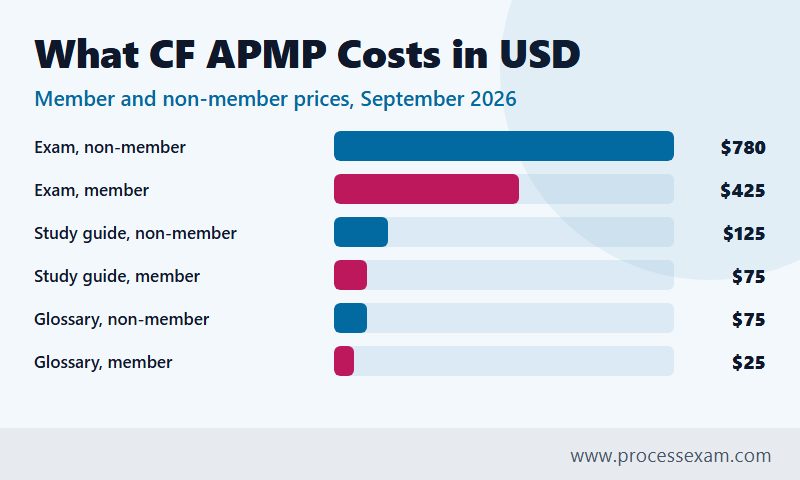
Two cautions about that table. First, the member column excludes the cost of APMP membership itself, which is a separate fee that APMP shows on its membership pages, so it is not listed here. APMP's own certification page says that membership plus the exam costs less than the non-member price, so it is worth adding the two together before you pay. Second, prices move, so treat the table as a budget guide and confirm at checkout.
Who usually pays, and how to ask
Many candidates do not pay personally. Bid teams often treat the Foundation exam as staff development, and the case for reimbursement is easy to make: certified team members share terminology, the fee is small next to the value of a single bid, and APMP's training partners can bundle course, guide and exam. If you plan to ask your manager, put the member-rate total from the table in the request, mention that the study guide is included in that total, and say when you intend to sit the exam.
What the study guide costs in time, not money
The guide is delivered online through a reader and, according to APMP, cannot be shared or downloaded. That matters for planning: you will read it on screen, and during the exam you will search it on screen. The later sections come back to that point, because it decides how you should take notes.
What is the exam actually like, with 75 open-book questions in 65 minutes?
Sixty-five minutes for 75 questions gives you about 52 seconds a question. The exam is multiple choice and graded Pass / Fail, so you receive no numeric mark to compare with anyone else's. APMP describes it as open book and offers online and in-person delivery, and candidates book it through APM Group's public exam booking site. APMP also says a booking stays valid for up to one year, which gives you room to plan, though not room to drift.
What open book really means
Open book sounds generous and is easy to misjudge. With 52 seconds per question, you cannot look up every answer. The materials help when you half remember a term and want to confirm which of two similar answers is the right one. They do not help when you have never met the idea, because you will not know what to search for. The candidates who do well treat the reference as a way to confirm an answer they already lean towards.
What the questions look like
Expect short scenario or definition questions in the language of bid work. A sample of the reasoning: a question describes a proposal team that needs to show the customer, requirement by requirement, exactly where each demand is answered. The idea being tested is the compliance matrix, and the trap options are usually neighbouring tools such as a schedule or a content plan. You are not asked to build a matrix; you are asked to know what it is for and when it belongs.
Because the exam is graded Pass / Fail, there is nothing to gain from perfectionism. Your job is to be clearly competent across all five syllabus units, not to be flawless in one.
Which five syllabus units does CF APMP cover?
The syllabus groups the material into five units. The names below are the unit titles used in our records of the syllabus, and each is described here in plain words. APMP updated its Foundation guide to Version 4 and rearranged some topics inside the units, so use the Version 4 study guide for the exact topic wording rather than any older list.
Understand business development
This unit places bids inside the sales lifecycle. It is the shortest unit to describe, but it colours everything else, because a proposal is one step in winning business, not a standalone document. Know the order of the lifecycle stages and which of them happen before the request for proposal arrives.
Focus on customer
This is the largest unit by topic count and the one where good candidates gain the most marks. It covers compliance and responsiveness, customer analysis and competitive intelligence, executive summaries, strategy and win themes, value propositions, features, benefits and discriminators, persuasion, price-to-win and teaming. The single idea joining them is that a proposal should be organised around what the customer needs to decide, not around what the company wants to say.
Learn the difference between a feature, a benefit and a discriminator, because it is the sort of distinction an exam question is built on. A feature is what something is or does. A benefit is what that gives the customer. A discriminator is a benefit the customer values that competitors cannot easily match.
Create deliverables
Here the exam moves from strategy to the documents themselves: the compliance matrix, proposal organisation, persuasive and clear writing, headings, graphics with action captions, page and document design, and cost and pricing data. Questions favour practical judgement, such as what a good action caption does that a plain caption does not, or why headings should mirror the customer's own structure.
Manage processes
This unit is the machinery of a bid: the end-to-end process, gate decisions, kickoff meetings, daily team management, review management, production management, virtual teams and lessons learned. If you have worked on a bid you already know most of it. What the exam adds is names and order, for example what a gate decision is deciding and which review happens at which point.
Use tools and systems
The last unit covers the supporting plans and systems: opportunity plans, content plans, knowledge management and scheduling. Candidates tend to underestimate it because it looks administrative. It is worth studying, since a handful of straightforward marks sit here and few candidates revise it.
Is CF APMP right for you, or should you start somewhere else?
Decide by looking at the work you do now and the work you want next, not by the name of the credential.
- Take it now if you write, coordinate or contribute to bids, and you want the shared language and a recognised line on your profile.
- Take it before Practitioner if you plan to go further. The bid and proposal Practitioner exam builds on the Foundation, and this site's CF APMP practice exam is meant as a first step in that sequence.
- Wait if you have never seen a bid, an RFP or a tender document. Read a few real documents first, or shadow a proposal team for a cycle; the exam will make far more sense afterwards.
APMP's page describes the route as six steps: create a free APMP ID, book the exam, take the sample exam, study alone or with an accredited training organisation, sit the exam, and earn the designation. It does not set out a long list of entry conditions in the material I could read, but requirements can change, so confirm eligibility on the official page before paying.
How would you prepare for CF APMP in four weeks?
Four weeks at four to five hours a week suits someone who already works on proposals. If you are new to bids, double the timeline. The plan below is built around the five units, and it puts the sample paper at the start and the end, so you can see the size of the gap you closed.
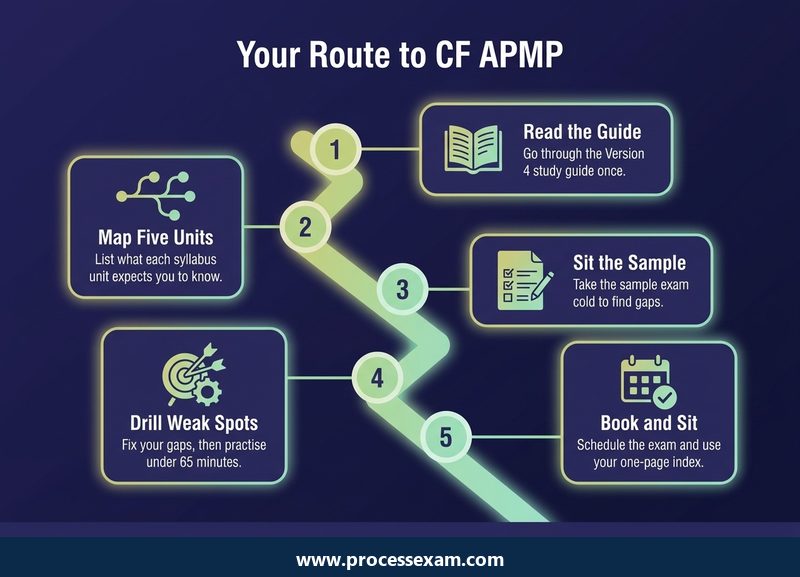
| Week | Focus | Finish the week with |
|---|---|---|
| 1 | Orientation and business development | Study guide read once end to end; business development lifecycle in your own words; a cold attempt at the APMP sample exam for a baseline |
| 2 | Customer focus in depth | Definitions of feature, benefit and discriminator; win themes and value propositions written for a bid you know |
| 3 | Deliverables and processes | Compliance matrix drawn once; review and gate decisions sketched on one page |
| 4 | Tools, timed practice and booking | Two timed papers of 75 questions in 65 minutes; your error list cleared; exam booked |
Start with the guide, then the sample exam
APMP names the Version 4 study guide, with the glossary as a second reference. Read the guide once straight through in week one so you know how much there is, before you start memorising. Then take the APMP sample exam cold. A poor first score is not a problem; it tells you which units to spend the next three weeks on. You can also work through this site's free CF APMP sample questions for a second view of the question style.
Turn your own bids into study material
The most efficient revision costs nothing. Take the last proposal you worked on and check it against the syllabus: where was the compliance matrix, what were the win themes, which sentence was the discriminator, what did the gate decision decide? Each answer you can find in a real bid is one you will not forget in the exam room. If you have no bid of your own, use a public tender document and a public award notice.
Use practice questions for timing as well as knowledge
Two full timed papers are enough. The first shows your pace; the second shows whether your approach to the open book has improved it. After each paper, sort every wrong or guessed answer into one of the five units. When one unit holds most of the misses, spend the next study session on that unit alone.
How do you use the open book without running out of time?
Since the guide is online, your open-book method is really a search method. Build it before exam day, not during the exam.
Make your own index before you sit
Write a one-page list of the terms you keep confusing, each with the section where the guide defines it. Include pairs that look alike: feature and benefit, win theme and value proposition, the different review types, and the different plans. A one-page index turns a two-minute hunt into a ten-second check.
Answer first, verify second
Read the question, choose the answer you believe, and only then decide whether it deserves a lookup. Reserve lookups for questions where you are torn between two options. A fair budget is to look something up in roughly one question in ten. If you find yourself searching more often, you are learning during the exam instead of confirming, and the clock will punish you.
Watch the small words
Questions on bid practice often turn on words such as "first", "best", "most" or "except". A candidate who knows the concept can still lose the mark by answering the wrong version of the question. Read the stem twice before the options.
Common mistakes that cost marks
- Treating open book as no revision. You cannot search for an idea you have never met.
- Reading the guide once and never testing yourself. Recognition is not recall.
- Ignoring the tools and systems unit. It is the easiest one to leave, and it holds marks that others miss.
- Using an old version of the guide. Study from Version 4, since APMP has reorganised some topics.
- Booking with no date discipline. A booking valid for a year is easy to postpone; pick a date in the next few weeks.
Will CF APMP raise your pay or change your role?
The honest answer is that CF APMP changes vocabulary before it changes pay. It makes you fluent in the terms your colleagues and competitors use, it signals that you have taken the profession seriously, and it is the base for the higher APMP levels. Employers who run bid teams often like a certified team because everyone works from the same definitions.
Searchers often ask about a "cf apmp salary". No number is quoted here, because no figure that could be verified separates certified from uncertified staff at the Foundation level. APMP does publish a compensation report for the industry, listed on its study guides and reports page, and that is the right source for pay in your region and role. Treat any online salary claim that names the Foundation certificate alone with caution.
Keeping the credential current
The certification does not stop at the exam. APMP sets maintenance rules for certified people, and they are described on its Maintaining Your Certification page. Read that page before booking so the cost of keeping the credential is part of your decision, not a surprise afterwards.
What to do next
If you decide to go ahead, the order is simple: create your APMP ID, get the Version 4 study guide, take the sample exam cold, follow the four-week plan, and book once your timed papers are consistently comfortable. Then check the official page one last time for any change to price or format. The certificate is a modest investment with a clear scope, and it gives you the shared language of a profession that rewards precision.
Frequently Asked Questions
What is CF APMP?
CF APMP is the exam code for the APMP Foundation-Level Certification, the entry level of the Association of Proposal Management Professionals. It confirms that you know the shared vocabulary and good practice of bid and proposal work, and it sits below the Practitioner and Professional levels.
How much does the CF APMP exam cost?
The exam costs USD $425 for APMP members and USD $780 for non-members. The study guide and glossary are priced separately, again with member and non-member rates, and membership itself is a separate fee, so add those together before you decide.
How many questions are on CF APMP and how long is the exam?
The exam has 75 questions and lasts 65 minutes, which is about 52 seconds a question. It is multiple choice and open book, so a quick, well organised search method matters as much as knowing the material.
What is the passing score for CF APMP?
The exam is graded Pass / Fail and no numeric passing score is listed in our exam records. Your own scores on timed practice papers are the best indicator: aim to be comfortably ahead in all five syllabus units, not perfect in one.
Is the CF APMP exam open book?
Yes. APMP describes the Foundation exam as open book and names the Version 4 study guide and the Industry Glossary of Terms as reference material. With under a minute per question, use the book to confirm answers you already lean towards, not to learn from scratch.
- APMP Foundation Test Questions |
- Bid/Proposal |
- Foundation Mock Exam |
- CF APMP Exam Questions Download |
- APMP Foundation Book |
- APMP CF APMP BOK PDF |
- Foundation Certification Cost |
- Foundation Certification Requirements |
- APMP Foundation Sample Questions |
- CF APMP Test Questions |
- Foundation PDF |
- CF APMP Question Bank |
- CF APMP Body of Knowledge (BOK) |
- Foundation Simulator


