
aPHRi Certification for HR Careers Outside the US
Updated on 23 September 2026. What’s new: the percentage pass mark is replaced with HRCI's actual standard, a scaled score of 500 set by a modified Angoff study.
The letter i at the end of aPHRi is the whole point of the credential. HRCI built the Associate Professional in Human Resources - International for people beginning HR work outside the United States, and it asks for no HR experience at all. The application costs $100, the exam itself another $300, and you answer 90 questions inside 105 minutes to reach the scaled score of 500 that HRCI sets as the standard.

That one design decision - a knowledge exam with no experience gate, written without United States employment law - explains who ends up sitting it. Office managers who inherited the people work. Payroll and admin staff who want the HR job title to match what they already do. Graduates in Dubai, Lagos, Manila or Warsaw whose local market recognises HRCI letters. And career changers who need something on a CV before anyone will interview them for an HR role.
This guide sets out who the aPHRi is built for, what the exam asks, what HRCI wants from an applicant, how the score is decided and where the credential leads afterwards. Every figure here comes either from HRCI's own published material, checked in September 2026, or from the exam content outline that the exam is written from.
What does the "i" in aPHRi change about the credential?
HRCI runs two parallel lines of credentials. One line - aPHR, PHR, SPHR - is written around United States practice and United States employment law. The other - aPHRi, PHRi, SPHRi - covers the same profession for people working elsewhere. The two are not a beginner version and an advanced version of each other; they are the same ladder built for two different legal environments.
The practical difference shows up in how the exam phrases its law questions. Where the domestic exams name specific American statutes, the international outline says "applicable laws and regulations" and leaves the jurisdiction open. You are expected to know how employment regulation works as a discipline - what an employer must document, where privacy obligations bite, what a lawful selection process looks like - and to apply that to the country you actually work in. HRCI states on its aPHRi certification page that the credential builds foundational knowledge for roles outside the United States, and the exam is also offered in Arabic, which tells you something about where candidates are sitting it.
One honest caveat belongs here. Seven of HRCI's credentials carry accreditation from the National Commission for Certifying Agencies; the aPHRi is the one that does not, and HRCI describes it instead as designed to meet those standards. HRCI also publishes pass rates for its certifications without listing a figure for the aPHRi, so nobody outside HRCI knows how many candidates clear it. Neither point makes the credential less useful for a first HR job, but both are worth knowing before you treat it as identical to the aPHR.
Here is the exam in one place.
| Detail | aPHRi |
|---|---|
| Certification | HRCI Associate Professional in Human Resources - International (aPHRi) |
| Exam code | aPHRi |
| Awarded by | HRCI |
| Category | Knowledge Certification |
| HR experience required | None |
| Application fee | $100 |
| Exam fee | $300 |
| Number of questions | 90 |
| Exam duration | 105 Minutes plus 30 minutes administration time |
| Passing score | 500 (on a scale of 100-700) |
| Delivery | Test centre with Pearson VUE, or online from home or work with OnVUE |
| Valid for | Three years, renewed with 45 recertification credits |
Do you need HR experience or a degree to apply for the aPHRi?
No. HRCI's wording could hardly be plainer. The aPHRi is knowledge-based, and nothing in the way of HR experience is asked of an applicant. There is no minimum number of years to document, no supervisor to sign a form and no HR-titled job to hold first. The exam measures what you know about the HR function, not how long you have been paid to do it.
That is genuinely unusual in this market. The PHRi and SPHRi both ask for professional-level HR experience, which HRCI defines as work involving independent judgement, some decision-making authority, data gathering and analysis, contact with people at several levels and personal accountability for results. If you have three or four years of that outside the United States, the aPHRi is beneath you and the PHRi is the right target. The aPHRi exists for everyone who has not reached that point yet.
Who HRCI expects to sit it
The HRCI certification policies handbook names three groups who should look at the associate-level exams. The first is anyone who manages people while their own role sits in a function other than HR. The second is the junior end of an HR team - clerks, assistants, administrators. The third is anyone moving into the profession from a different career. Read that list again if you have been talking yourself out of applying. A restaurant manager who hires, rosters, inducts and disciplines staff is in group one. A finance assistant who runs payroll changes and keeps personnel files is in group two. Anyone whose degree was in law, psychology, languages or business and who now wants an HR job is in group three.
What the application actually checks
Because there is no experience requirement, the application is mostly an identity and payment exercise - but international candidates hit two details that catch people out. The first is your name: HRCI wants your full legal name, middle name included, written in Latin characters exactly as it appears on a valid government-issued photo ID, because that is the name Pearson VUE will check at the door and the name that will appear in HRCI's directory. If your passport transliterates your name differently from your university certificates, follow the passport. The second is location: candidates resident in countries under United States trade sanctions cannot simply apply online and are told to contact HRCI directly. Check both before you pay anything, because the application fee is not refundable once an application has been approved.
HRCI also runs random audits on applications. An audited application, or one submitted with a special testing accommodation request, takes around ten business days to process rather than one, so build that into your timing if you have a date in mind.
Which five functional areas does the aPHRi exam test?
The exam is written from the aPHRi exam content outline, a document HRCI rebuilds periodically from a practice analysis of what early-career HR people actually do. The version in force when this guide was checked in September 2026 took effect in 2018 and splits the exam into five functional areas. The percentages below are the share of the scored questions each area carries, and they matter: a third of the paper sits in one area.
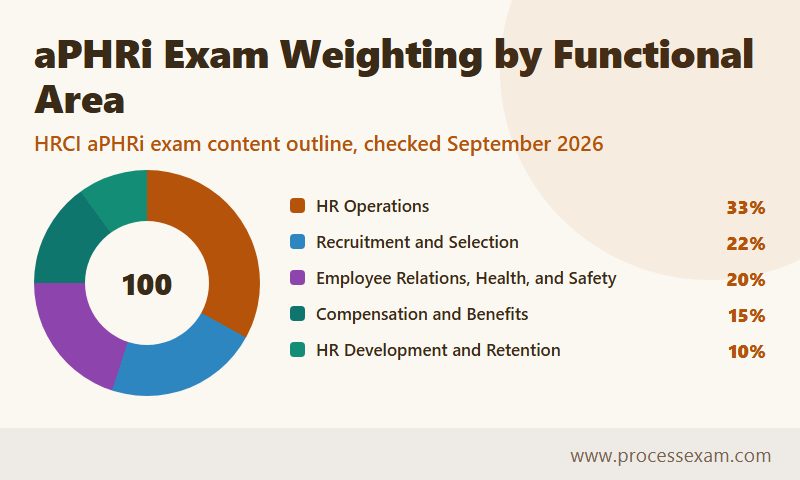
HR Operations - 33%
The biggest block by a wide margin, and the one people under-prepare because it sounds administrative. It covers how an organisation's strategy, mission and culture connect to the HR function; the legal and regulatory environment; confidentiality and privacy rules covering employee records and company data; HR policies and procedures including progressive discipline; and the everyday mechanics of records management, retention and disposal.
It also carries the numerate part of the exam. You need to recognise common HR metrics such as cost per hire, time to recruit and turnover rate, know how data gets collected through surveys, interviews and observation, and be able to say which chart suits which message. Add the purpose of a human resources information system, job classifications from hourly to contractor, job descriptions, reporting structures and the types of external provider an HR team buys from, and you have a third of the exam.
Recruitment and Selection - 22%
Everything from a vacancy being approved to a new joiner finishing induction. Laws and regulations around work authorisation, requisitions and job postings; applicant databases; where candidates come from, including referrals, social media and company career pages; and how they are reached, through advertising, job fairs and universities.
Then the selection half: alternative staffing arrangements such as outsourced recruitment, job sharing and remote workers; interviewing techniques including structured, behavioural, situational and panel formats; pre-offer and post-offer activity such as background and medical checks; and orientation and onboarding. Questions here reward anyone who has sat in on an interview, because the distinctions between interview types are easy to confuse from reading alone.
Employee Relations, Health, and Safety - 20%
The second-heaviest area, and the one that separates HR from administration. It covers employee and employer rights, how organisations collect feedback through attitude surveys, focus groups and exit interviews, and the workplace behaviour problems HR is called into: absenteeism, aggression, conflict between colleagues, harassment. You need to know how a complaint or grievance is investigated, how progressive discipline escalates from a verbal warning to termination, and what off-boarding involves, including handover, end-of-service benefits and non-compete terms.
The health and safety half covers the laws that require a safe workplace, risk management such as evacuation procedures and violence prevention, and security risks from equipment theft to weak password practice. Workforce reduction vocabulary - downsizing, mergers, relocation, transfers - sits here too.
Compensation and Benefits - 15%
Total rewards in the broad sense. Pay structures and programmes including variable pay, merit increases, bonuses, incentives, non-cash compensation and pay grades; benefit programmes from health cover to pension schemes; payroll vocabulary such as pay schedules, leave and paid time off; how salary and benefit survey data is collected; how insurance claims are filed and processed; and work-life balance arrangements such as flexible hours, remote working and sabbaticals.
Human Resource Development and Retention - 10%
The smallest area, and the one to study last. It covers training delivery formats - virtual, classroom, on-the-job - and how training is evaluated through participant surveys, pre- and post-testing and after-action plans. It also covers career development practices such as succession planning and dual career ladders, performance appraisal methods including ranking and rating scales, and performance management practices such as goal-setting, feedback and mentoring.
HRCI publishes the whole thing free as the aPHRi exam content outline, and it is the single most valuable study document you will use. Our own aPHRi exam syllabus page lays the same five areas out topic by topic if you prefer to work through them online rather than in a PDF.
What does the work behind the aPHRi look like day to day?
The outline ends with something most candidates skim past: a list of the tasks an early-career HR person is expected to perform. It is effectively a job description for the role the credential prepares you for, and it is the fastest way to work out whether you are closer to HR than you thought.
- Post job listings on the company website, social media and job boards, then manage the applicant database.
- Screen applicants for managers, answer candidate questions, arrange tests and coordinate interview logistics - and interview candidates yourself.
- Coordinate the employment offer, then handle post-offer work such as employment agreements, work authorisation, relocation and immigration.
- Run orientation and onboarding for new hires, rehires and transfers.
- Maintain employee data in the HRIS and keep HR forms filed and processed, from new-hire paperwork to termination documents.
- Coordinate payroll information, support benefit programmes, process employee claims and settle routine pay and benefits queries.
- Coordinate training sessions and deliver some of them, including safety and emergency-preparedness training.
- Answer or refer HR questions as the first line of support, and communicate policies, procedures and the organisation's values.
- Identify workplace risk and reduce it by auditing records.
- Track completion of performance reviews and development plans.
Count how many of those you already do under a different job title. Career changers routinely find they are doing six or seven of them - an office manager who posts vacancies, arranges interviews, inducts joiners, keeps the personnel files and chases performance reviews is doing HR work without the HR label. The exam will still test the areas you never touch, but you start with far more ground covered than a standing start.
How do you get from application to a booked exam appointment?
The route is short, but the clocks inside it trip people up. Nothing is booked until HRCI has approved you, and approval starts a window that expires.
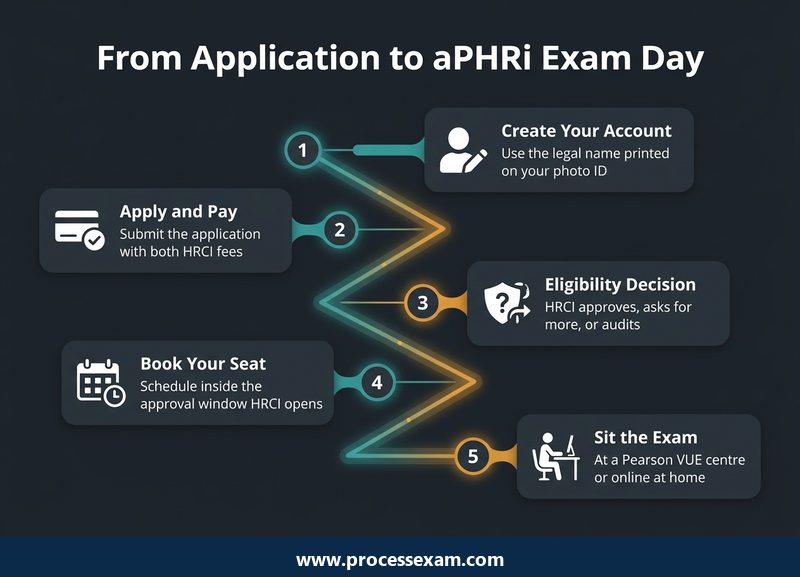
Create the HRCI account. Use the legal name from your photo ID, in Latin characters, and an email address you will still control in three years, because HRCI uses it as your primary identifier for everything including recertification.
Submit the application and pay. The $100 application fee and the $300 exam fee are both payable in United States dollars. Cash and personal cheques are not accepted, and HRCI does not begin reviewing an application until payment has cleared - relevant if you are paying by transfer from outside the United States, where bank charges are yours to cover.
Wait for the eligibility decision. A straightforward application is processed in about one business day. One selected for a random audit, or submitted with an accommodation request, takes around ten. You will get an email telling you that you are approved, that more information is needed, or that you have been audited.
Book within the eligibility period. Approval opens a window of 180 days, inside which the exam must be both booked and taken. That sounds generous and disappears quickly around a job. Pick the date first and build the study plan backwards from it, rather than studying until you feel ready and discovering the window has closed.
Choose how you sit it. The exam runs at Pearson VUE test centres and through OnVUE at home or in the office. Outside the United States the choice is often decided by where the nearest centre is and how reliable your connection is; OnVUE has its own room, identity and equipment requirements, so read them well before exam day rather than on the morning. The full set of rules lives in HRCI's certification handbook.
How does HRCI decide whether you passed?
This is where a lot of published advice about the aPHRi is simply wrong, so it is worth being precise. HRCI does not mark the exam as a percentage. It reports a scaled score between 100 and 700, and the pass standard is 500 for every HRCI exam type, whatever version of the paper you happen to sit.
Three mechanics sit behind that number. The cut score is set by a modified Angoff process, in which subject-matter experts rate every question for how likely a minimally qualified candidate is to answer it correctly. Multiple forms of each exam exist for security, so HRCI equates them statistically to make sure a slightly harder form is not a harder pass. And the scale itself exists so that a score means the same thing across forms and across years. A 500 is therefore not "500 out of 700", and it is not a percentage of the questions you answered correctly - it is a position relative to the standard HRCI set.
The question count works the same way. Of the 90 questions in front of you, 65 are scored and 25 are pretest items being trialled for future papers. They are not marked or separated in any way, they are scattered through the exam, and they do not count towards your result. You will not be able to tell which is which, so answer all 90 with the same care.
You get your result at the end of the session. HRCI explains the document in its guide to understanding your results report: a pass or fail decision, your scaled score, and an indication of how you performed in each content area. That per-area feedback is a study guide, not an official domain score, and HRCI says so explicitly - useful for deciding where to focus if you need to sit again, useless as a boast.
If you do not pass, there is a 90-day cooling-off period before you can schedule a retake, and you re-apply and pay the fees again. A retake approval starts its own 180-day window. Plan for one attempt rather than budgeting for two: three months is a long gap when a job application depends on the letters.
What does a six-week aPHRi study plan look like?
Six weeks at roughly an hour a day suits most candidates who work full time and have some exposure to the workplace side of HR. Give yourself eight to ten weeks if the whole field is new. The plan below follows the weighting rather than the running order of the outline, so the heaviest areas get the most time and the lightest one is not left to the last night.
| Week | Focus | What to finish |
|---|---|---|
| 1 | HR Operations, part one | Strategy, culture, the legal and regulatory environment, confidentiality and records management |
| 2 | HR Operations, part two | HR metrics, data collection and reporting, HRIS, job classifications, job descriptions, external providers |
| 3 | Recruitment and Selection | Sourcing, recruitment methods, interview types, pre- and post-offer activity, onboarding |
| 4 | Employee Relations, Health, and Safety | Feedback methods, workplace behaviour, grievances, progressive discipline, off-boarding, risk and security |
| 5 | Compensation and Benefits, then Development and Retention | Pay structures, benefits, payroll vocabulary, claims; training delivery and evaluation, appraisal and performance management |
| 6 | Timed practice and revision | Two full-length timed attempts, every wrong answer reviewed by area, a one-page summary sheet |
Two habits make the difference in those six weeks. The first is reading the outline as a checklist rather than a contents page: tick each numbered knowledge statement only when you could explain it to a colleague, and the gaps become obvious. The second is anchoring the generic material to your own country. The exam will not ask about a named national statute, but the concepts behind the questions - lawful selection, records retention, safe working, how a grievance is handled - all exist in your local law, and learning them through examples you recognise makes them stick.
Week six is where timing gets tested rather than knowledge. Sitting a full aPHRi practice exam under the clock shows you whether 90 questions in 105 minutes leaves you comfortable or rushed, and the areas where your answers wobble are the ones to revisit before the real thing.
One last warning about study material. Because the outline has been stable for years, there is a lot of old aPHRi content circulating, some of it repeating a percentage pass mark that HRCI has never used. Treat any source that quotes a percentage to pass with suspicion, and check anything it says about fees or format against HRCI's own page before you rely on it.
Where does the aPHRi lead once you have passed it?
The credential is valid for three years. Keeping it means earning 45 recertification credits within that cycle or sitting the exam again - roughly fifteen credits a year, which webinars, courses, conferences and on-the-job HR projects all count towards. Start logging activity in your first year rather than discovering the requirement in month thirty.

In the meantime the letters do a specific job. They tell a recruiter that someone independent has tested your knowledge of the five areas above, which is exactly the gap a CV without HR employment history leaves open. That maps to the roles the outline describes: HR assistant, HR coordinator, HR administrator, recruitment or talent coordinator, payroll and benefits administrator, HR officer in a small company where one person does all of it. It also helps internal candidates - the office manager or finance assistant already doing HR tasks who needs an argument for the job title.
The natural next step is the PHRi, and the aPHRi buys you time to qualify for it. Spend two or three years doing professional-level HR work - exercising judgement, owning decisions, analysing data, being accountable for outcomes - and you meet the experience requirement that the aPHRi deliberately skips. From there the ladder runs to the SPHRi for senior and strategic HR outside the United States, or to the GPHR if your work starts crossing borders into mobility, international assignments and multi-country policy.
A word on pay, since it is the first thing people ask: a credential on its own does not set a salary, and what an HR coordinator earns in Nairobi, Riyadh and Kuala Lumpur has far more to do with the local market than with letters after a name. Treat the aPHRi as the thing that gets your CV read for roles that would otherwise filter you out, and let the experience you gain in those roles do the rest.
If you are still deciding, the test is simple. If you work outside the United States, have no HR employment history to point to, and want something credible to show for the HR work you already do or intend to do, the aPHRi is built precisely for you. Start with the exam content outline, map the five areas against what you already know, and book the date once you can see the gap.
Frequently Asked Questions
What does aPHRi stand for?
aPHRi stands for Associate Professional in Human Resources - International. It is HRCI's entry-level, knowledge-based credential for HR work outside the United States. The lower-case a marks the associate level and the i marks the international line, which is written without United States employment law.
How much does the aPHRi certification cost?
HRCI charges a $100 application fee and a $300 exam fee, both payable in United States dollars. The application fee is not refunded once an application has been approved. Budget separately for study material, and again for a retake, since failing means paying both fees a second time.
Do you need HR experience to take the aPHRi exam?
No. The aPHRi is knowledge-based, and HRCI asks for no HR experience at all, so there is nothing to document and no minimum period to serve. Candidates with several years of professional-level HR work behind them should look at the PHRi instead, which does test experience.
How many questions are on the aPHRi exam and how long does it take?
The exam has 90 questions and a testing time of 105 Minutes plus 30 minutes administration time. Only 65 of those questions are scored; the other 25 are pretest items being trialled, scattered through the paper and not identified, so answer every question with equal care.
What is the passing score for the aPHRi exam?
You need a scaled score of 500 on a scale of 100-700. It is not a percentage, and it is not 500 questions out of 700. HRCI sets the standard with a modified Angoff study and equates versions of the exam so that 500 means the same on every form.
- Knowledge Certification |
- HRCI HR Associate Professional in Human Resources - International Test Questions |
- aPHRi Question Bank |
- HRCI HR Associate Professional in Human Resources - International Book |
- HR Associate Professional in Human Resources - International Certification Cost |
- HR Associate Professional in Human Resources - International Certification Requirements |
- HRCI HR Associate Professional in Human Resources - International Sample Questions |
- aPHRi Exam Questions Download |
- aPHRi Test Questions |
- HR Associate Professional in Human Resources - International PDF


