
aPHR Exam Prep: How HRCI Questions Work and How to Practise
Updated on 14 November 2026. What’s new: the exam now covers five HRCI functional areas, from Talent Acquisition to Compliance and Risk Management at 25%

Two things on a practice result matter more than the percentage: how many wrong answers you can explain, and how long each question took you. HRCI's aPHR is 90 questions, of which 65 count towards the score, graded on a scaled range of 100 to 700 where 500 passes, so a percentage from any practice set is only a rough guide. This guide covers how the questions are built and how to practise with them.
What does the aPHR exam look like from the inside?
It is a computer-based exam, taken at a Pearson VUE testing centre or at home or in an office through online proctoring, and HRCI describes the aPHR as a knowledge-based credential with no HR experience required. You sit one continuous block of 90 questions. HRCI's aPHR page splits them into 65 scored questions and 25 pretest questions, which means more than one in four items on your screen adds nothing to your result. The page was checked in November 2026.
| Fact | aPHR |
|---|---|
| Certification | HRCI Associate Professional in Human Resources (aPHR) |
| Questions | 90 in all, of which HRCI counts 65 and uses 25 as trial items |
| Exam fee | $300 |
| Application fee | $100 |
| Exam time | 105 minutes, with administration time added on top |
| Passing score | 500 on a scale of 100 to 700 |
| Delivery | Pearson VUE testing centre or online proctoring |
Divide the 105 minutes by 90 questions and you get about 70 seconds per question, which is our own arithmetic, not an HRCI target. The average hides a spread. A fill-in-the-blank item that asks for one number can take twenty seconds, and a scenario with three linked questions can take several minutes in total. What the average does tell you is the pace to rehearse: practice sittings run at roughly that speed teach you what the clock feels like long before exam day.
The five functional areas in HRCI's aPHR exam content outline are Talent Acquisition at 19%, Learning and Development at 15%, Compensation and Benefits at 17%, Employee Relations at 24%, and Compliance and Risk Management at 25%. How to divide your study hours across them is a planning question that has its own guide; here the focus is the questions themselves, because the same HR fact can be asked in several different ways and each way needs its own kind of practice.
Which question styles will HRCI put in front of you?
HRCI's page on how the exams are structured sorts its items into traditional multiple choice and a group it calls alternative item types. Its certification handbook lists the same five formats. Each one rewards a slightly different habit, so it is worth meeting all five before you sit the exam.
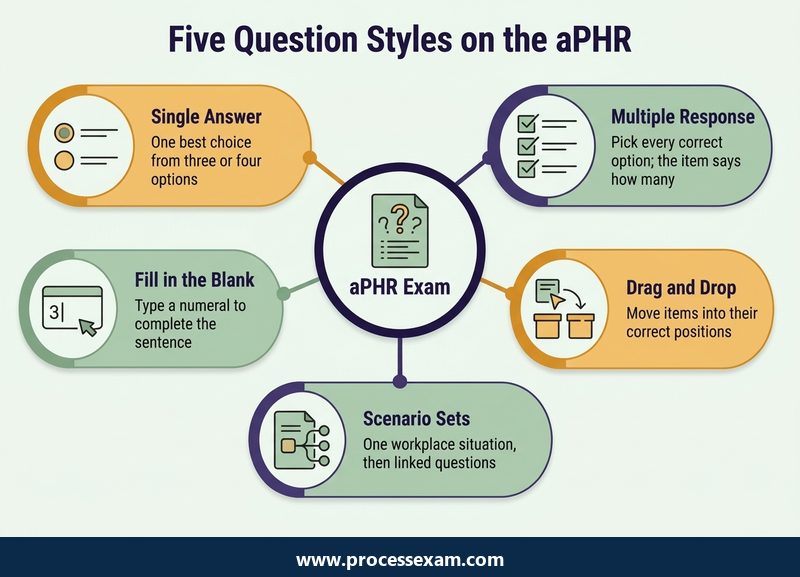
The five examples below were written for this guide. They are not HRCI items, they do not appear in any HRCI material, and they only show the shape of each format. Reading a few of the free aPHR sample questions alongside them gives you a second look at the same formats.
Traditional multiple choice
HRCI says each of these has a stem and either four or, in some cases, three answer choices, with exactly one correct. An illustration: A hiring manager wants a vacancy advertised, but the duties of the role have changed since it was last filled. Which document should be updated first? (A) The organisation chart. (B) The job description. (C) The payroll register. (D) The offer letter template.
The answer is B. The tempting wrong choice is D, because an offer letter feels close to hiring, but it is downstream: the job description defines the work, and the advert, the offer and the pay band all follow from it. Single-answer items like this reward knowing the order in which HR work happens.
Multiple choice, multiple response
These look like ordinary multiple choice, but two or more options are correct. HRCI states that the item tells you how many to pick. An illustration: Which TWO measures best show that a safety-training session changed behaviour? (A) The attendance sheet. (B) A supervisor's observation of the task a month later. (C) A fall in related incidents. (D) The number of slides used. (E) The room booking.
The answers are B and C, because both measure what people do after the session rather than whether the session happened. The common failure is picking one right option and one that merely sounds related. Handle it by judging each option against the stem on its own, then counting your ticks against the number the item asks for.
Fill in the blank
HRCI describes these as an item where you enter a numeral to complete the sentence. An illustration: An employer made 40 job offers and 30 were accepted. Enter the offer acceptance rate as a whole-number percentage. The answer is 75. The format punishes sloppy arithmetic and unit slips, such as typing 0.75 or 75% when the box wants a plain number, and there is nothing to eliminate and no option to guess from. Practise the small set of HR calculations an entry-level role meets: rates, ratios, percentages of a total, and simple pay or benefit sums.
Drag and drop
Here you click on pieces of information and drag them into the right positions. An illustration: Arrange these steps of a basic hiring process in order: make the offer; screen and interview candidates; identify the vacancy; post the role and source candidates; write the job description. The order is: identify the vacancy, write the job description, post the role and source candidates, screen and interview, make the offer. The trap is a close pair, such as posting the role before the job description is settled. Read all the pieces before moving any, because placing one early often exposes where the others must go.
Scenarios
HRCI describes scenario questions as typical HR situations followed by a series of items that depend on the scenario, which means you must pull facts from different subject areas. An illustration: An employee tells her supervisor that a colleague's repeated remarks about her accent make her uncomfortable. The supervisor replies that she should ignore it and takes no further step. A first linked item could ask what the supervisor should have done, with the best answer being to pass the concern to HR through the proper channel. A second could ask what HR should do first, with the best answer being to record the complaint and begin a prompt, impartial look into it.
The scenario spans Employee Relations and Compliance and Risk Management at once, so two content areas can both be tested by one story. Read the story once for the facts and once for who you are in it, then answer each linked item without letting an earlier answer pull you off the evidence in the text.
What separates the keyed answer from a close second on the aPHR?
HRCI's wording is precise here. Its structure page says you should select the best correct response and that best means a panel of HR subject matter experts would agree with the judgement. It also says some answer choices are distractors written to look correct. That description is enough to build a routine, and the routine below is our own method, not HRCI guidance.
- Read the last line of the stem first. It tells you whether you are being asked for the first step, the best step, or the exception, and the rest of the stem then reads as evidence for that question.
- Decide who you are. On the aPHR you are usually an HR assistant or a new HR practitioner, not the owner of the business, so an option that hands the decision to a manager or escalates to the right function often beats one that acts alone.
- Sort the options into right, premature and wrong. A distractor is often true in general but wrong for now, like drafting a disciplinary letter before the facts have been gathered. Sequence questions are where premature options do their damage.
- Be suspicious of absolutes. Words such as always, never and only make an option easy to knock down, though they do not make it wrong every time. Test them, do not ban them.
- Prefer the answer that records, informs or follows a process. HR practice is built on documentation and consistency, so the option that leaves a trail usually beats the one that relies on memory or goodwill.
One more point shapes how you practise. HRCI's structure page says that application and synthesis level items, the two higher cognitive levels, are found only on its practice-based certifications, and the aPHR is a knowledge-based one. That leaves most of your questions at the lowest level, knowledge and comprehension, which HRCI defines as recalling factual material such as definitions. Expect the weight to fall on knowing terms, rules, processes and the right order of steps, with scenario items as the main place where judgement shows up. The handbook adds that candidates are responsible for knowing the laws and regulations in force at the time of their exam, so a study source dated several years ago is a risk in the Compliance and Risk Management area.
Which of the 90 questions count, and what does 500 actually mean?
HRCI's handbook says every exam includes scored questions and pretest questions scattered at random, and that pretest items are not counted in the final result. It adds that pretest questions are not marked out from the others and that you should answer them with the same care as scored ones. HRCI uses them to collect data on new items before they join future exams, and its structure page says items that do not meet its standards are revised and retested or dropped.
Two habits follow from that. First, never decide that a strange question is a pretest and wave it through, because you cannot tell which ones they are and you may be wrong about the item. Second, a question that baffles you does not mean you are failing; with 25 items unscored and nothing to identify them, odd-looking questions are expected, and one bad item is a small share of 65.
The structure page also says there is no partial credit: you must respond to all parts of an item correctly. That matters most for multiple response and drag and drop, where getting three of four placements right still earns nothing. In practice sets, mark such items wrong when any part is wrong, or you will overstate your score.
Why 500 is not a percentage
The passing score is 500 on a scaled range of 100 to 700. According to HRCI's handbook, a panel of HR experts sets the cut score by rating every question for a borderline candidate, a standard-setting approach called the modified Angoff method, and the exam versions are then equated so that 500 stays the pass standard whichever one you receive. In effect, a slightly harder form asks for fewer correct answers than an easier one.
That has a direct consequence for practice. Read as a fraction, 500 out of 700 tempts you to treat a practice percentage in the low seventies as the line. It is not a valid conversion, because the handbook gives no raw-to-scaled table and the number of correct answers behind 500 moves with the form. Treat any practice percentage as a trend line against your own earlier results, not as a forecast of the scaled score. HRCI also publishes pass rates; its pass rates page lists the aPHR at 71% as of December 31, 2025, a figure that describes candidates as a group and says nothing about your own preparation.
How should you run a full-length practice sitting?
A full sitting is the only way to learn how stamina and pacing behave across 90 questions, so give it the same conditions as the real exam. HRCI's handbook says there are no scheduled breaks, that an unscheduled break counts against your exam time, and that study materials cannot be reviewed during the exam or during a break. Mirror that: one seat, one run, no phone, no notes, no pausing the timer.
Rehearse the pace, not just the content
Set a clock for 105 minutes and check it at checkpoints rather than question by question: after about a third of the questions you should have used about a third of the time, and the same at two thirds. If you are far behind at the first checkpoint, you are over-reading, not under-knowing, and that is a fixable problem. A simple pass structure works for most candidates:
- First pass. Answer everything you can settle at once. Fill-in-the-blank and clean single-answer items go quickly and buy time for the harder ones.
- Mark and move. When an item is stuck between two options, choose the better one, mark it and keep going, rather than letting one question eat the time of three.
- Final pass. Return to your marked items with whatever time is left, and recheck any multiple-response answers against the number of options the stem asks for.
Before the real exam starts, HRCI says candidates have access to a short tutorial on the testing software and that it is worth using to learn the special features. Use that time to find out what the exam software lets you mark and revisit, instead of assuming it behaves like your practice tool. For your own rehearsals, pick a practice tool that lets you mark an answer and come back.
Match the sitting to the stage
| Stage | Sitting | What it is for |
|---|---|---|
| Early | Short sets on one functional area, a dozen or two questions each | Learning the content and the style of that area, with the book open after each question |
| Middle | Mixed sets across all five areas, lightly timed | Learning to switch topic without warning, as the exam does |
| Late | Full 90-question sittings in one go | Pacing, stamina and an honest read on where you stand |
| Last days | One light mixed set, then the error log only | Keeping recall warm without opening new problems |
Practice with fresh questions is worth more than rereading questions you already know, because a repeated item tests memory of the item and not memory of the subject. Ration your pool: use sets you have not seen for the late full sittings, and keep older sets for retesting weak areas. A mock paper such as the aPHR practice exam from ProcessExam gives you full-length sittings and area-by-area sets to run this routine on, and the result of each sitting feeds the review cycle in the next section.
What should you do with each wrong answer?
Most candidates read the right answer, nod and move on. That feels like learning and mostly is not, because the mistake that produced the wrong answer is still there for next time. A review that works asks why you missed the question before it asks what the answer was.
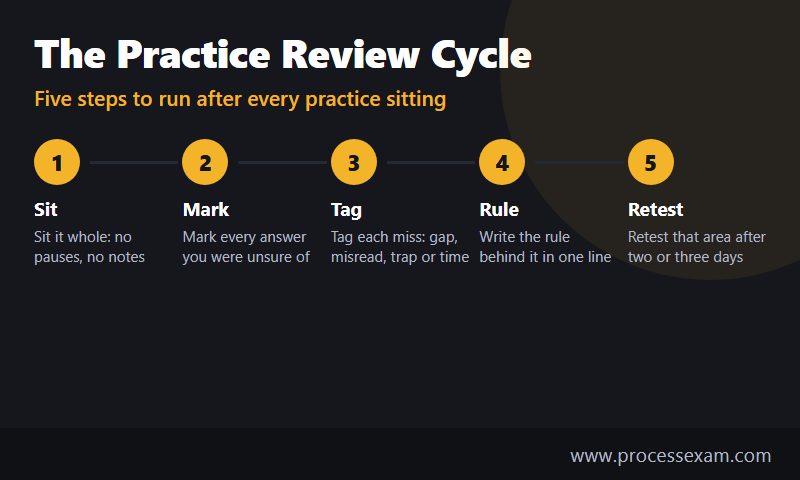
The five steps in the picture are a routine we recommend, built from the exam's own structure. Sit the test whole, mark every answer you were unsure of (including right ones you guessed), tag each miss with a cause, write the rule behind it in a line, and retest that area after a gap. The tagging step is where most of the value sits.
Tag every miss with one cause
| Cause | What it looks like | What to do next |
|---|---|---|
| Knowledge gap | You could not recall the term, rule or step | Go back to HRCI's content outline for that area, restudy it and write one flashcard |
| Misread | You answered a different question from the one asked, often the exception or the first step | Underline the last line of the stem on the next ten items |
| Distractor | You knew the topic but chose an option that was true yet premature or beside the point | Write why the right answer beats it, not just that it does |
| Time | You rushed the last stretch or spent far too long on one item | Fix the pass structure, not the content |
| Format slip | You lost an item to a missed instruction, such as picking one option when two were needed | Re-read the instruction line before locking in any answer |
After two or three sittings, the counts tell you what to change. A column full of knowledge gaps means you need more study before more practice. A column full of misreads and distractors means your knowledge is fine and the exam technique is what to fix, which no amount of rereading the textbook will cure. Time errors that cluster at the end of the sitting point at pacing and stamina, which only full sittings can improve.
Write the rule, then test it later
For each miss, write one line that begins with the situation and ends with the principle, for example: when a concern about conduct reaches a supervisor, it goes to HR and is recorded. A page of such lines is a better last-week revision tool than a stack of reread chapters, because every line comes from a mistake you actually made. Then retest that functional area two or three days later with questions you have not seen. If the same cause appears again, the rule is too vague and needs rewriting.
Count guesses as well as errors. An answer you got right by luck is the same risk as a wrong one, so give your marked-but-correct items the same tagging treatment. In a first sitting it is worth checking how many of your correct answers you could not defend.
Which signs show your practice is paying off?
A single high score is weak evidence, especially if you had seen the questions before. Look instead for patterns across several sittings.
- Stability. Your results on fresh full sittings sit close together rather than swinging by large amounts. A big swing means luck or topic selection is still doing some of the work.
- No lagging area. The weakest of the five functional areas is not far behind the strongest, because the exam mixes them and a hole in one area cannot be hidden.
- A shrinking error column. The count of knowledge gaps falls from sitting to sitting. If misreads and distractors dominate, you are probably close on content and should concentrate on technique.
- Time left over. You finish the first pass with room to revisit your marked items, instead of finishing as the clock runs out.
- Rules that hold. The one-line rules from your log answer new questions correctly when you retest, not just the ones they were written for.
Remember what a practice score is. It is measured on someone else's question set, under conditions you control, and on a percentage scale that does not convert to HRCI's. It is a good tool for tracking your own progress and a poor tool for predicting a scaled score. If your practice results look right and you still feel unsure, check the weakest area one more time before booking instead of waiting for a perfect score that no practice tool can promise.
If the real attempt does not go your way, HRCI's handbook says the results report shows the scaled score gap to the passing score and a performance level per topic area, which it describes as a guide for further study and not an official domain score. A candidate who does not pass faces a 90-day wait before scheduling another attempt, so a failed attempt costs time as well as the fee, which is one more argument for finding your weak habits in practice, where a miss costs nothing.
Frequently Asked Questions
How many aPHR questions actually count towards the score?
HRCI lists 90 questions, made up of 65 scored questions and 25 pretest questions. Pretest items are not marked out from the rest and are not counted in the final result, so you should answer every question with the same care. The split was checked on HRCI's aPHR page in November 2026.
What is the aPHR exam pass rate?
HRCI publishes it. Its pass rates page gives the aPHR at 71% as of December 31, 2025, and HRCI says it reports these figures annually under accreditation standards. The figure describes all candidates, so it predicts nothing about one person's result.
What score do you need to pass the aPHR?
You need a scaled score of at least 500 on a range of 100 to 700. The score is scaled, not a percentage of correct answers, and HRCI equates different exam versions so that 500 is the pass standard on whichever version you take. A practice percentage cannot be converted exactly.
Does the aPHR give partial credit on multiple response questions?
No. HRCI says candidates must respond to all parts of an item correctly to receive credit, and no partial credit is awarded. For multiple response and drag and drop items, getting some selections or placements right and others wrong scores nothing for that question.
How hard is the aPHR exam?
HRCI classes the aPHR as a knowledge-based credential with no experience requirement, and keeps its higher-level item types for its practice-based exams, so most aPHR items test recall and comprehension. A 71% group pass rate suggests that candidates who prepare do pass, though it says nothing about any one reader.
- HRCI HR Associate Professional Exam Questions |
- HRCI HR Associate Professional Question Bank |
- HRCI HR Associate Professional Questions |
- HRCI HR Associate Professional Study Guide |
- HRCI aPHR Quiz |
- aPHR Certification |
- aPHR Questions |
- aPHR Practice Test |
- aPHR Study Guide Material |
- aPHR Sample Exam |
- HR Associate Professional Certification |
- HRCI HR Associate Professional Book |
- HR Associate Professional Certification Cost |
- HR Associate Professional Certification Requirements |
- HRCI HR Associate Professional Sample Questions |
- aPHR Exam Questions Download |
- aPHR Test Questions |
- HR Associate Professional PDF |
- HRCI Associate Professional in Human Resources


