
AI and IASSC ICBB: What Black Belts Need to Know
The IASSC Certified Lean Six Sigma Black Belt (IASSC ICBB) credential signifies mastery of advanced Lean Six Sigma principles and methodologies, validating an individual's ability to lead complex improvement projects. Professionals holding this esteemed certification are crucial in driving operational excellence, reducing waste, and improving process performance within organizations. However, the landscape of process improvement is rapidly transforming, largely due to the pervasive and disruptive influence of Artificial Intelligence (AI). This article delves into the critical implications of AI for IASSC ICBB holders, outlining how this technological shift impacts existing skills, demands new competencies, and reshapes the future of process excellence.
AI's Disruptive Influence on Process Excellence
Artificial Intelligence is no longer a futuristic concept but a present-day reality profoundly reshaping industries globally. For Lean Six Sigma Black Belts, AI represents both a formidable challenge and an unparalleled opportunity. Its disruptive nature stems from its capacity to automate cognitive tasks, analyze vast datasets at unprecedented speeds, and identify patterns that human analysts might miss. This significantly impacts traditional data analysis, problem identification, and solution implementation phases of Six Sigma projects, pushing IASSC ICBB professionals to adapt their skill sets and methodologies.
The integration of AI tools necessitates a fundamental shift in how Black Belts approach their projects. Instead of manual data collection and statistical software, AI algorithms can pre-process, clean, and even interpret data, providing ready insights. This acceleration of the Analyze phase means Black Belts must become more adept at leveraging these tools, understanding their outputs, and validating their applicability, rather than solely focusing on the mechanics of statistical computation. The core value shifts from data crunching to strategic interpretation and ethical application of AI-derived intelligence.
Automating Data Analysis and Pattern Recognition
One of AI's most immediate impacts is its ability to revolutionize the data analysis phase of any Lean Six Sigma project. Traditional Black Belts spend considerable time collecting, cleaning, and statistically analyzing data using tools like Minitab or JMP. AI-powered platforms, however, can automate many of these laborious steps, from anomaly detection to root cause identification.
-
Predictive Analytics: AI algorithms can forecast process performance, identify potential failures before they occur, and predict bottlenecks, enabling proactive problem-solving.
-
Anomaly Detection: Machine learning models excel at identifying unusual patterns or outliers in large datasets, which could signify defects or inefficiencies.
-
Natural Language Processing (NLP): For qualitative data, such as customer feedback or incident reports, NLP can extract themes, sentiment, and critical insights far more quickly than manual review.
-
Root Cause Analysis: Advanced AI can analyze correlations across numerous variables to pinpoint root causes with higher precision and speed, reducing the iterative nature of traditional RCA.
Realigning the Black Belt's Strategic Focus
With AI handling the heavy lifting of data analysis, the IASSC ICBB professional's role pivots towards higher-level strategic contributions. Their unique understanding of process dynamics, customer needs, and organizational objectives becomes even more critical. They must guide the AI, frame the right questions, and translate AI-generated insights into actionable improvements that align with business goals.
The strategic Black Belt, augmented by AI, can now focus on:
-
Defining the right problems for AI to solve.
-
Interpreting complex AI outputs and explaining them to stakeholders.
-
Designing experiments for AI-driven insights.
-
Ensuring the ethical and responsible use of AI in process improvement.
-
Developing implementation strategies for AI-recommended changes.
-
Measuring the ROI of AI-assisted improvements.
Integrating AI into Lean Six Sigma Methodologies
The synergy between Artificial Intelligence and Lean Six Sigma offers a powerful new paradigm for continuous improvement. While Lean Six Sigma provides the structured framework for problem-solving, AI infuses it with enhanced analytical power, predictive capabilities, and automation. IASSC ICBB professionals must understand how to strategically weave AI tools into each phase of the DMAIC (Define, Measure, Analyze, Improve, Control) roadmap to maximize efficiency and effectiveness. This integration elevates traditional methodologies, making them more robust and adaptive to dynamic business environments.
AI in the Define Phase: Sharpening Project Scope
In the Define phase, AI can refine problem statements and project scope by providing deeper insights into customer needs and operational pain points. Historically, this relied on voice of customer (VOC) surveys, interviews, and anecdotal evidence. AI transforms this by enabling comprehensive analysis of vast textual and behavioral data.
-
Sentiment Analysis: AI-powered NLP tools can process massive volumes of customer feedback from reviews, social media, and call center transcripts to accurately gauge sentiment and identify critical dissatisfaction points.
-
Process Mining: AI algorithms can analyze event logs from IT systems to automatically discover, visualize, and analyze actual business processes, revealing hidden bottlenecks and deviations that traditional process mapping might miss.
-
Requirements Elicitation: AI can cross-reference multiple data sources to identify conflicting requirements or unmet customer expectations, ensuring projects address the most impactful areas.
By leveraging these AI capabilities, Black Belts can ensure their project definitions are grounded in comprehensive, data-driven understanding, leading to more impactful projects. For more insights on leveraging data for process improvement, visit our resources on process improvement insights.
AI in the Measure Phase: Precision Data Collection and Validation
The Measure phase, foundational for data integrity, benefits immensely from AI's automation and precision. AI tools can streamline data collection, ensure its quality, and provide initial baseline assessments with greater accuracy and less manual effort.
-
Automated Data Collection: IoT sensors and AI-powered vision systems can collect real-time data from physical processes, eliminating manual input errors and providing continuous streams of information.
-
Data Cleaning and Pre-processing: Machine learning models can identify and correct anomalies, missing values, and inconsistencies in datasets, ensuring high data quality for subsequent analysis.
-
Baseline Performance Calculation: AI can rapidly process historical data to establish precise baseline metrics, enabling accurate measurement system analysis and process capability assessments.
AI in the Analyze Phase: Deepening Root Cause Understanding
The Analyze phase is where AI truly shines, transforming hypothesis testing and root cause identification. Instead of traditional statistical methods applied to limited variables, AI can explore complex relationships across a multitude of factors.
-
Advanced Statistical Modeling: AI and machine learning algorithms (e.g., regression, decision trees, neural networks) can model complex process behaviors and predict outcomes with higher accuracy, revealing underlying drivers.
-
Correlation and Causation Discovery: AI can identify intricate correlations between process inputs and outputs, helping Black Belts prioritize potential root causes for deeper investigation.
-
Simulation and What-If Analysis: AI-powered simulations can model various scenarios and predict the impact of potential changes, allowing Black Belts to test hypotheses virtually before physical implementation.
AI in the Improve and Control Phases: Intelligent Solutions and Monitoring
AI extends its utility to the Improve and Control phases by facilitating the design of intelligent solutions and enabling proactive monitoring, ensuring sustained gains.
Improve Phase:
-
Generative Design: AI can suggest optimal process configurations or design parameters based on defined constraints and objectives, accelerating solution development.
-
Robotic Process Automation (RPA): For repetitive, rule-based tasks identified for improvement, RPA bots can automate execution, freeing human resources for more strategic work.
-
Prescriptive Analytics: Beyond predicting what will happen, AI can recommend specific actions to achieve desired outcomes, providing precise guidance for improvement initiatives.
Control Phase:
-
Predictive Maintenance: AI monitors equipment and process parameters to predict potential failures, allowing for maintenance before defects occur, ensuring process stability.
-
Adaptive Control Systems: AI-driven control systems can automatically adjust process parameters in real-time to maintain desired performance levels, preventing deviations.
-
Automated Reporting and Dashboards: AI can generate real-time performance reports and dashboards, alerting Black Belts to deviations and enabling prompt corrective action.
Evolving Your Black Belt Competencies for the AI Era
The advent of AI demands a proactive evolution of the Black Belt's skill set, moving beyond traditional statistical proficiency to encompass a broader understanding of data science, technology, and strategic thinking. To remain indispensable, IASSC ICBB holders must cultivate new competencies that allow them to effectively harness AI's power while retaining the human-centric problem-solving ethos of Lean Six Sigma. This shift is not about replacing existing knowledge but augmenting it to navigate a more data-intensive and automated operational landscape.
Developing AI Literacy and Data Science Fundamentals
A foundational understanding of AI concepts and data science is now essential. Black Belts don't need to become data scientists or machine learning engineers, but they must speak the language, understand capabilities, and interpret outputs. This includes:
-
Understanding AI Methodologies: Grasping the basics of supervised vs. unsupervised learning, neural networks, decision trees, and regression models.
-
Data Governance and Ethics: Knowledge of data privacy regulations (e.g., GDPR, CCPA) and the ethical implications of using AI, particularly concerning bias in algorithms.
-
Data Visualization: Advanced skills in presenting complex AI-derived insights clearly and compellingly to diverse audiences.
-
Statistical Programming (Optional but Beneficial): Familiarity with languages like Python or R for interacting with AI tools or performing advanced statistical analyses.
Enhancing Strategic Thinking and Problem Framing
As AI automates analytical tasks, the Black Belt's role shifts towards higher-order thinking. Strategic thinking becomes paramount, focusing on:
-
Business Acumen: A deeper understanding of organizational strategy, market dynamics, and financial implications to identify where AI can deliver the most significant value.
-
Critical Thinking for AI Outputs: The ability to critically evaluate AI-generated recommendations, identify potential flaws or biases, and ensure they align with real-world constraints and ethical considerations.
-
Complex Problem Framing: Articulating ambiguous problems into structured challenges that AI tools can address, defining clear objectives and success metrics for AI-powered projects.
Leveraging AI for Enhanced Problem-Solving and Control
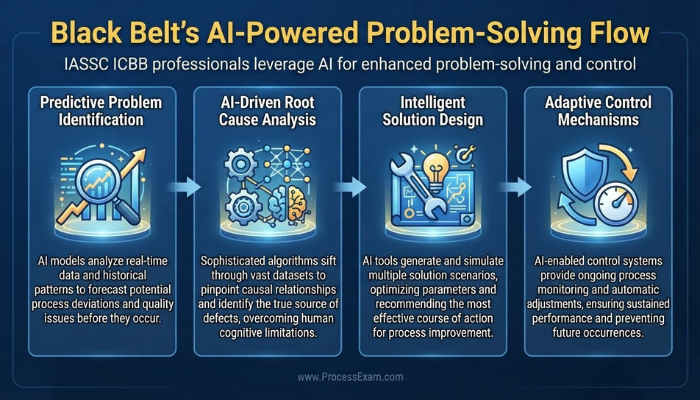
The true power of AI for IASSC ICBB professionals lies in its capacity to elevate problem-solving from reactive fire-fighting to proactive foresight and to implement control mechanisms that are dynamic and self-optimizing. This paradigm shift enables Black Belts to move beyond merely fixing existing issues to designing resilient, intelligent processes that continuously learn and adapt. Embracing AI allows for a more comprehensive and sustainable approach to maintaining high-quality operations and ensuring long-term gains.
Predictive Problem Identification
Instead of relying on control charts to signal out-of-control conditions after they occur, AI can predict deviations before they impact performance. Machine learning models analyze trends and subtle patterns in real-time data streams, alerting Black Belts to potential issues early.
This allows for:
-
Proactive Intervention: Addressing root causes before defects are produced or customer satisfaction is compromised.
-
Optimized Resource Allocation: Directing improvement efforts to areas with the highest predicted risk, maximizing impact and efficiency.
-
Reduced Downtime: Predicting equipment failures or system malfunctions and scheduling preventive maintenance, ensuring continuous operation.
Intelligent Process Control Mechanisms
AI goes beyond traditional Statistical Process Control (SPC) by enabling adaptive and intelligent control systems. While SPC flags out-of-control points, AI can initiate corrective actions automatically or suggest precise adjustments.
-
Dynamic Control Limits: AI can adapt control limits in real-time based on changing process conditions or environmental factors, making control charts more sensitive and relevant.
-
Automated Feedback Loops: Integrated AI systems can automatically adjust machine settings, production parameters, or resource allocation in response to real-time process data, maintaining optimal performance.
-
Anomaly-Based Alerts: Instead of simple threshold breaches, AI can identify complex patterns of anomalies that indicate emerging issues, providing more nuanced and timely warnings.
For discussions and insights from the community on these evolving control methods, engaging with platforms like Six Sigma community discussions can be highly beneficial.
Charting a Future-Ready Path for IASSC ICBB Professionals
As the integration of AI into business operations accelerates, IASSC ICBB holders must actively chart a future-ready professional path. This involves not only adapting to new technologies but also championing a culture of data-driven innovation and continuous learning. Their role will evolve from solely being process improvers to becoming strategic enablers who leverage advanced analytics to drive digital transformation and sustain competitive advantage. This forward-looking perspective requires embracing new tools, expanding networks, and advocating for ethical AI practices.
Continuous Learning and Skill Upgradation
The pace of AI development necessitates a commitment to lifelong learning. Black Belts must continuously update their knowledge and skills to stay relevant.
-
Specialized AI Courses: Enrolling in courses on machine learning fundamentals, data visualization, or specific AI applications relevant to their industry.
-
AI Tools Proficiency: Gaining hands-on experience with AI/ML platforms, RPA tools, or process mining software.
-
Industry Conferences and Workshops: Actively participating in events that explore the intersection of AI, Lean Six Sigma, and operational excellence.
Cultivating Cross-Functional Collaboration
AI-driven projects inherently require collaboration across diverse disciplines. Black Belts will need to work closely with data scientists, IT professionals, software engineers, and business leaders. This demands enhanced communication, leadership, and change management skills.
-
Translating Business Needs: Effectively communicating operational challenges to technical AI teams and interpreting AI outputs for business stakeholders.
-
Leading Hybrid Teams: Managing projects that involve both traditional Lean Six Sigma experts and AI/data specialists.
-
Championing Change: Guiding organizations through the adoption of AI-driven process improvements, addressing resistance, and building enthusiasm.
Core IASSC ICBB Knowledge Domains and AI Convergence
The rigorous syllabus for the IASSC Certified Lean Six Sigma Black Belt exam, code ICBB, provides a robust foundation in statistical analysis, process management, and improvement methodologies. While AI introduces new tools and techniques, it does not render this core knowledge obsolete; rather, it amplifies its application and demands a deeper conceptual understanding. Black Belts must understand how their existing expertise aligns with and is enhanced by AI capabilities, particularly in areas such as process definition, statistical control, and inferential analysis. The convergence of these domains creates a powerful synergy, equipping professionals to tackle increasingly complex operational challenges.
Foundational Six Sigma Concepts and AI
The basics and fundamentals of Six Sigma, which emphasize variation reduction and process stability, remain critical. AI tools help achieve these goals more effectively.
-
The Basics of Six Sigma: AI reinforces the understanding of process variation by providing granular data analysis and predictive models that highlight areas of instability.
-
The Fundamentals of Six Sigma: The principles of customer focus, data-driven decision making, and continuous improvement are intensified as AI provides richer customer insights and more accurate data for decisions.
-
Selecting Lean Six Sigma Projects: AI can analyze vast internal and external data to identify high-impact projects with greater precision, aligning with strategic objectives.
Process Analysis and Measurement in an AI Context
Understanding processes, defining them, and accurately measuring their performance are core Black Belt competencies that AI enhances dramatically. The IASSC ICBB Body of Knowledge is detailed on the comprehensive Body of Knowledge page.
-
Process Definition: AI-powered process mining tools can automatically map and optimize complex process flows, complementing traditional value stream mapping.
-
Six Sigma Statistics: While AI automates calculations, Black Belts still need to understand the underlying statistical concepts to interpret AI model outputs and validate their accuracy.
-
Measurement System Analysis: AI can assist in validating measurement systems by analyzing sensor data and instrument calibration performance more rigorously.
-
Process Capability: AI's predictive capabilities enable more accurate forecasting of process capability, allowing proactive adjustments rather than reactive corrections.
-
Patterns of Variation: Machine learning algorithms excel at identifying subtle, complex patterns of variation that might be missed by traditional control charts, providing deeper insights into process behavior.
Inferential Statistics and Hypothesis Testing with AI
The IASSC ICBB syllabus places significant emphasis on inferential statistics and hypothesis testing, which AI tools can augment, but not replace. Black Belts need to guide the AI and interpret its statistical findings.
-
Inferential Statistics: AI can perform complex inferential analyses on massive datasets, identifying statistically significant relationships that inform decision-making.
-
Hypothesis Testing: While AI can generate hypotheses and test them rapidly, Black Belts must understand the assumptions, limitations, and practical implications of the statistical tests performed by AI models. This applies to:
-
Hypothesis Testing with Normal Data
-
Hypothesis Testing with Non-Normal Data
-
-
Regression Analysis: AI algorithms can perform advanced linear and multiple regression analyses with numerous variables, offering more comprehensive insights into cause-and-effect relationships. This includes:
-
Simple Linear Regression
-
Multiple Regression Analysis
-
Designed Experiments and Advanced Controls with AI
Designed Experiments (DOE) and advanced control methods are crucial Black Belt skills. AI can optimize DOE execution and establish more sophisticated control systems.
-
Designed Experiments: AI can help design optimal experimental matrices, analyze results more efficiently, and even simulate DOE outcomes, reducing the need for costly physical experiments. This covers:
-
Full Factorial Experiments
-
Fractional Factorial Experiments
-
-
Lean Controls: AI-powered systems can enforce lean principles by monitoring flow, identifying waste, and optimizing resource utilization in real-time.
-
Statistical Process Control (SPC): AI enhances SPC by providing predictive alerts and automating adjustments, moving from reactive monitoring to proactive control.
-
Six Sigma Control Plans: AI can build dynamic control plans that adapt to changing process conditions, ensuring sustained performance and continuous improvement.
Understanding the IASSC ICBB Credential Details
The IASSC Certified Lean Six Sigma Black Belt (IASSC ICBB) certification validates a professional's comprehensive understanding and application of the entire Lean Six Sigma methodology, from project selection to advanced statistical analysis and control. This globally recognized credential confirms a high level of proficiency in managing and leading complex process improvement initiatives. Aspiring Black Belts must be familiar with the specifics of the examination to ensure thorough preparation.
-
Exam Name: IASSC Certified Lean Six Sigma Black Belt
-
Exam Code: ICBB
-
Exam Price: USD $450
-
Duration: 240 Minutes
-
Number of Questions: 150
-
Passing Score: 70%
This structure underscores the comprehensive nature of the exam, demanding not just theoretical knowledge but also the ability to apply complex analytical tools and strategic thinking across a wide range of Lean Six Sigma principles. Successful candidates demonstrate a deep understanding of the IASSC ICBB Body of Knowledge, preparing them for real-world process optimization challenges.
Strategic Preparation for the AI-Augmented ICBB Exam
Preparing for the IASSC Certified Lean Six Sigma Black Belt (IASSC ICBB) exam in the age of AI requires a strategic approach that acknowledges both the enduring relevance of foundational Lean Six Sigma principles and the growing importance of AI literacy. While the core syllabus focuses on traditional methodologies, a forward-thinking candidate will approach their studies with an eye towards how these principles can be augmented and applied in an AI-driven environment. Effective preparation goes beyond memorization, emphasizing conceptual understanding and practical application, particularly in data-intensive areas.
Mastering the Core Syllabus with an AI Lens
Candidates must meticulously review each topic area of the IASSC ICBB syllabus, but with a critical perspective on how AI impacts or enhances each concept. For instance, when studying "Measurement System Analysis," consider how AI-powered sensors or advanced analytics could improve gauge R&R studies. When reviewing "Hypothesis Testing," think about how AI could automate the selection of tests or rapidly process large datasets for testing.
Focus on:
-
Conceptual Depth: Understand the 'why' behind each tool and technique, not just the 'how,' as AI may change the 'how' but not the underlying statistical purpose.
-
Data Interpretation: Practice interpreting statistical outputs, whether generated manually or by AI tools, to ensure you can derive meaningful conclusions.
-
Problem-Solving Scenarios: Engage with case studies that incorporate complex, real-world data, considering how AI might be used to accelerate analysis or identify deeper insights.
Developing Foundational AI Awareness
While the exam itself may not directly test AI proficiency, an awareness of AI's role in data analysis and process improvement will enhance a candidate's overall understanding and prepare them for future professional challenges. This includes:
-
Understanding AI Terminology: Familiarize yourself with common AI and machine learning terms relevant to data processing and analytics.
-
Exploring AI Applications: Research how AI is being applied in various industries for quality control, predictive maintenance, and operational efficiency.
-
Ethical Considerations: Reflect on the ethical implications of AI, particularly concerning data bias and decision-making transparency in process improvement.
Utilizing Diverse Study Materials and Practice
A comprehensive preparation strategy involves a blend of study materials, practice questions, and peer interaction. This helps solidify understanding and build confidence for the exam.
-
Official IASSC Resources: Leverage the official IASSC Body of Knowledge and any recommended study guides to ensure alignment with exam objectives.
-
Online Training Courses: Enroll in reputable online IASSC Lean Six Sigma Black Belt training courses that offer structured lessons, practice exams, and expert instruction.
-
Practice Questions: Regularly engage with IASSC ICBB practice questions and IASSC ICBB sample questions to become familiar with the exam format and question styles.
-
Study Groups: Collaborate with other aspiring Black Belts to discuss complex topics, share insights, and challenge each other's understanding.
Conclusion
For IASSC Certified Lean Six Sigma Black Belt (IASSC ICBB) holders, AI is not merely a tool but a fundamental force reshaping the essence of process excellence. While the foundational principles of Lean Six Sigma remain immutable, the methods and speed with which improvements are identified and implemented are profoundly augmented by AI. To remain at the forefront of their profession, Black Belts must embrace continuous learning, develop AI literacy, and pivot towards strategic leadership in AI-driven projects. This proactive evolution will ensure that their expertise continues to drive significant value in an increasingly automated and data-rich operational landscape.
The journey to becoming an AI-augmented Black Belt is an investment in future relevance and impact. By integrating AI knowledge into their existing Lean Six Sigma competencies, IASSC ICBB professionals can transform challenges into opportunities, leading their organizations through the next wave of operational innovation. Equip yourself with the knowledge and skills needed to thrive in this evolving environment, and ensure your certification continues to be a beacon of excellence in process improvement. For comprehensive certification preparation resources, explore the options available to strengthen your understanding and readiness.
FAQs
1. How does AI specifically impact the Black Belt's role in root cause analysis?
AI significantly enhances root cause analysis by automating data collection, performing complex correlations across vast datasets, and identifying subtle patterns that human analysts might miss. This allows Black Belts to pinpoint root causes faster and with greater precision, shifting their focus from manual data crunching to strategic interpretation of AI-generated insights and validation of findings.
2. Do IASSC ICBB holders need to become AI experts to remain relevant?
Not necessarily. While a deep understanding of AI is beneficial, IASSC ICBB holders primarily need to develop AI literacy—understanding AI capabilities, limitations, and ethical considerations. Their role will be to effectively leverage AI tools, interpret their outputs, and guide AI-driven projects, rather than becoming full-fledged AI developers or data scientists. The emphasis is on augmentation, not replacement, of their existing skills.
3. How can Black Belts ensure the ethical use of AI in process improvement projects?
Ensuring ethical AI use involves several steps: understanding data governance and privacy regulations, actively checking AI models for inherent biases in training data or algorithms, promoting transparency in AI decision-making, and validating AI recommendations against real-world context and human judgment. Black Belts should champion responsible AI practices and engage stakeholders in discussions about fairness and accountability.
4. Will AI replace traditional statistical tools and methods covered in the IASSC ICBB syllabus?
AI is more likely to augment and enhance traditional statistical tools rather than completely replace them. The fundamental statistical concepts (e.g., hypothesis testing, regression, SPC) remain crucial for interpreting AI outputs and validating model accuracy. AI can automate the application of these methods to larger datasets or suggest optimal statistical approaches, allowing Black Belts to focus on strategic insights rather than manual calculations.
5. What are the key new skills IASSC ICBB professionals should prioritize for the AI era?
Key new skills include AI literacy (understanding core AI concepts and terminology), enhanced data interpretation and visualization, strategic problem framing for AI applications, critical thinking to evaluate AI outputs, and improved cross-functional collaboration with data scientists and IT professionals. A commitment to continuous learning in both Lean Six Sigma and emerging AI technologies is also vital.
- Lean Six Sigma |
- IASSC Lean Six Sigma Black Belt Sample Questions |
- ICBB Exam Questions Download |
- ICBB Test Questions |
- Lean Six Sigma Black Belt PDF |
- Lean Six Sigma Black Belt Certification Requirements |
- IASSC Lean Six Sigma Black Belt Book |
- IASSC ICBB BOK PDF |
- Lean Six Sigma Black Belt Certification Cost |
- IASSC Lean Six Sigma Black Belt Test Questions |
- ICBB Question Bank |
- ICBB Body of Knowledge (BOK)


