
AgileBA Foundation Exam: Cost, Syllabus and Study Plan
Updated on 12 October 2026. What’s new: exam fee corrected to USD $386 for the APMG International AgileBA Foundation exam
USD $386 buys one sitting of a 50-question, 40-minute paper that needs 25 correct answers. It does not buy the Handbook, a course, or proof that you can analyse work inside a sprint. This guide separates what the AgileBA Foundation fee covers from what you still pay for, then explains the version to study, the syllabus areas, and a three-week plan for a working analyst.
What does the AgileBA Foundation fee cover, and what do you still pay for?
The figure on record for the APMG International Agile Business Analysis Foundation exam is USD $386. That pays for the paper and its marking and, if you reach the pass mark, for the Foundation certificate. APMG's own AgileBA page does not print a price. It says that prices come from accredited training organisations, or from APMG's public exam portal if you book the exam alone. So treat $386 as a reference point and ask a provider for a written quote before you budget.
What the exam fee buys
- One attempt at the Foundation paper: 50 multiple-choice questions, closed book, 40 minutes.
- A result against a pass mark of 25 out of 50, which is 50%.
- A Foundation certificate that, according to APMG, does not expire and has no defined validity period.
What it leaves out
- The guidance. You cannot pass from a summary. APMG says self-study candidates need to buy the guidance, the Handbook for version 2, as well as the exam. APMG's study materials store lists the Agile Business Analysis Handbook, published by the Agile Business Consortium, at GBP 42 in paperback, and APMG also lists an eBook edition.
- A course. The usual route is a course from an accredited provider. Course length, price and format vary by country and provider, and many include the exam voucher, so an exam-only quote and a course quote are not comparable until you read what each contains. APMG says most accredited providers include the guidance in the course fee.
- A second attempt. APMG's page states no retake fee or waiting rule, so ask the provider before you pay. Assume a retake costs money.
- Your own time. The plan further down uses about 24 hours. For an employee, that is the larger cost.
Price three routes side by side before you commit to one. The questions in the right-hand column are the ones that change the total.
| Route | What it usually includes | What to ask before paying |
|---|---|---|
| Accredited course | Classroom or online teaching, the guidance and often the exam | Is the exam voucher included, and does the course teach version 2? |
| Self-study and exam-only booking | The Handbook plus the exam fee, nothing else | Where do you book, and what is the retake rule? |
| Employer-funded | Whatever the training budget allows | Is a Practitioner attempt in the same budget? |
For a working analyst with agile experience, self-study is realistic. For someone changing careers, a course gives the vocabulary quickly and is easier to justify to an employer. Whichever you choose, the exam itself is the smallest line in the budget and the most predictable one.
Which AgileBA version should you study for?
This question decides which book you buy. APMG's AgileBA page lists two versions of the guidance, version 2 and version 3, both published by the Agile Business Consortium, and asks candidates to buy the version that matches the qualification they are taking. This guide is written for version 2, which is based on the Agile Business Analysis Handbook and is the version our syllabus and practice pages follow. Version 3 has its own Reference Book and is a separate qualification.
APMG's page also gives 31 March 2027 as the date on which version 2 is due to be withdrawn. A candidate booking now is therefore preparing for version 2, and should read APMG's page again before paying, since dates and availability can change. Confirm with your training provider or APMG which version your booking covers, and buy the matching book.
For the Foundation paper itself, APMG describes the same format for both versions: 50 multiple-choice questions, 25 marks to pass, closed book, 40 minutes. For version 2, APMG says the Foundation exam is available in English and Polish. Check every practice resource, too: the edition named on the cover or the product page should say Handbook and version 2 before you spend hours on it.
The Foundation paper at a glance
APMG sets the Foundation paper out like this, and the format is the same for version 2.
| Exam detail | AgileBA Foundation |
|---|---|
| Exam name | APMG International Agile Business Analysis Foundation |
| Exam code | AgileBA Foundation |
| Vendor | APMG International |
| Certification | APMG International Certified Agile Business Analysis Foundation (AgileBA Foundation) |
| Number of questions | 50, multiple choice |
| Duration | 40 minutes |
| Passing score | 50% (25 of 50) |
| Exam fee | USD $386 |
| Open or closed book | Closed book |
| Validity | No expiry for Foundation |
Forty minutes for fifty questions is 48 seconds each. The pass mark counts correct answers, and APMG's page mentions no deduction for wrong ones, so a blank is the only certain way to lose a point. Never leave a question empty.
What does the Foundation syllabus ask a business analyst to know?
APMG's public page does not publish domain weightings for the Foundation paper, so be wary of any guide that quotes a precise percentage per topic. Our AgileBA Foundation syllabus page lists four topic areas: Business Analysis Fundamentals, Strategy and Organisation, Practices, and Requirements. The Handbook's own contents page, shown in APMG's store, runs from the role of the business analyst in an agile world through the agile business case, stakeholders, requirements and user stories, prioritisation, workshops, modelling, timeboxing, requirements planning and the requirements lifecycle, to making the transition to agile business analysis. Treat the sections below as a study map that links those four areas to those chapters, not as an official breakdown of marks.
Business analysis fundamentals
Start with the role itself. The Handbook opens with the business analyst's role in an agile world and with agile fundamentals, so expect questions that check whether you understand why an agile analyst works differently from a traditional one. The traditional analyst writes a complete specification and hands it over. The agile analyst stays alongside the team, keeps requirements current and answers questions as the work proceeds.
The Handbook presents its guidance within the DSDM framework, according to APMG's store page, while including many generic agile techniques that are useful to an analyst. So learn the vocabulary of roles, timeboxes and iterative delivery, and learn why each exists. A question that asks what an analyst should do when a requirement changes mid-project is usually testing whether you treat change as normal and manage it, instead of resisting it.
Strategy and organisation
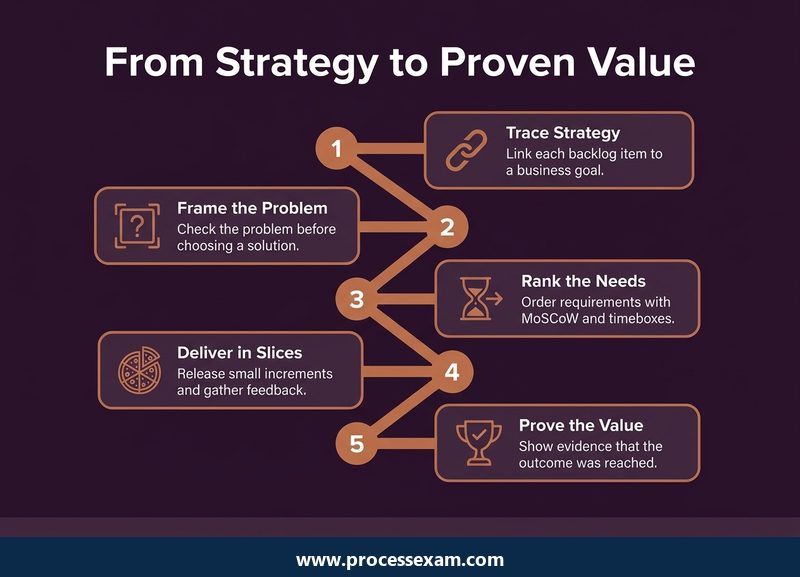
The Handbook says it aims to give context to the analyst role beyond the individual project, in relation to organisational mission and strategy. The agile business case is its own chapter. Expect scenario questions that start with a project and ask how the work links to a business objective. The skill is tracing a requirement up to the objective, and down again to the evidence that the objective was met. A typical case: a team has delivered every story in a release, yet sales did not move. The better answer revisits what the business expected, instead of adding more stories.
Learn the difference between an output and an outcome. An output is something the team produces, such as a report screen or a release. An outcome is a change in what people do or what the business earns because of it. A business case in an agile setting is not a one-off document; it is reviewed as evidence arrives.
Practices
This area covers how the analyst works day to day: stakeholders, workshops, modelling, and timeboxing with iterative development. These are skills in their own right. Scenario questions usually describe a stakeholder who disagrees or goes quiet, and the answer that works brings people into a shared model, not one that escalates or waits.
- Stakeholder engagement means knowing who has an interest, who decides and how often to involve them.
- Workshops need a clear purpose, a timebox, the right people in the room and a record of decisions before people leave. A workshop that ends without agreed priorities has produced conversation, not analysis.
- Modelling gives a team a picture that people can correct, which is faster than correcting a long document.
- Timeboxing fixes the end date and flexes the content, which protects quality and forces choices about what matters most.
Requirements
Here you need to know how a requirement moves from a vague need to an ordered, testable item. The Handbook has chapters on requirements and user stories, prioritisation, requirements planning and estimating, and the requirements lifecycle.
- User stories state who needs something, what they need and why. Acceptance criteria say how the team will know it is done.
- Functional and non-functional requirements are different kinds of statement. Response time is not a feature, but it still has to be tested.
- MoSCoW sorts items into Must, Should, Could and Won't have this time. The test is what happens if the item is missing at the deadline. Prioritisation should rest on value, not on the loudest sponsor.
- Planning and estimating continue through the lifecycle, so a requirement is revisited as the team learns more.
How does a Foundation question read, and how do you take it apart?
Foundation checks recall and understanding, so most questions are shorter than a Practitioner scenario. Still, the options are written to tempt you with a half-true statement. A routine that helps: find the actual ask in the final sentence, then go back to the stem for context, and cross off any option that answers a different question before you weigh the rest. APMG offers a free, automatically marked sample exam, and its sample papers page is the place to try it once you have read the Handbook.
Three practice stems and how to approach them
A requirement that is vague. A sponsor says the system must be easy to use. The test is whether you spot a non-functional requirement that is too vague to verify, and look for a measurable form such as how quickly a new user completes a task. Options that simply add the requirement to the backlog as written are traps.
A priority dispute. Two departments both call their feature a Must have. Look for the option that asks what happens if the item is not delivered by the end of the timebox. The one that gets the answer from the stakeholders in a workshop beats the one where the analyst decides alone.
A skipped analysis step. The team started building before anyone checked whether the problem was real. The better answer goes back to the business case and the need behind the request, not on to a better estimate.
When two options seem equally right, prefer the one that involves the business, delivers something small and gets feedback. That bias is not a trick; it reflects the philosophy of the whole approach.
What should three weeks of evenings look like?
The plan below totals 24 hours: about eight a week, in four or five sessions. It is shorter than the four-week plans many guides offer, because the Foundation paper is a recall exam. Add a week if agile vocabulary is new to you, and take away a few hours if you already work as a product owner or business analyst in sprints.
| Block | Hours | What you do |
|---|---|---|
| Business analysis fundamentals | 4 | Read the opening chapters of the Handbook, then write one paragraph on how your own role would change in an agile team. |
| Strategy and organisation | 4 | Study the agile business case. Trace one real backlog item to a business objective and name the evidence that would show it worked. |
| Practices | 5 | Cover stakeholders, workshops, modelling and timeboxing. List who you would invite to a prioritisation workshop on a project you know. |
| Requirements | 4 | Work through user stories, MoSCoW and planning. Rewrite five vague needs as stories with acceptance criteria. |
| Timed papers | 5 | Sit the APMG sample paper, then a full 50-question set in 40 minutes with no notes. |
| Review of misses | 2 | Group every wrong answer by the Handbook chapter it came from and reread only those pages. |
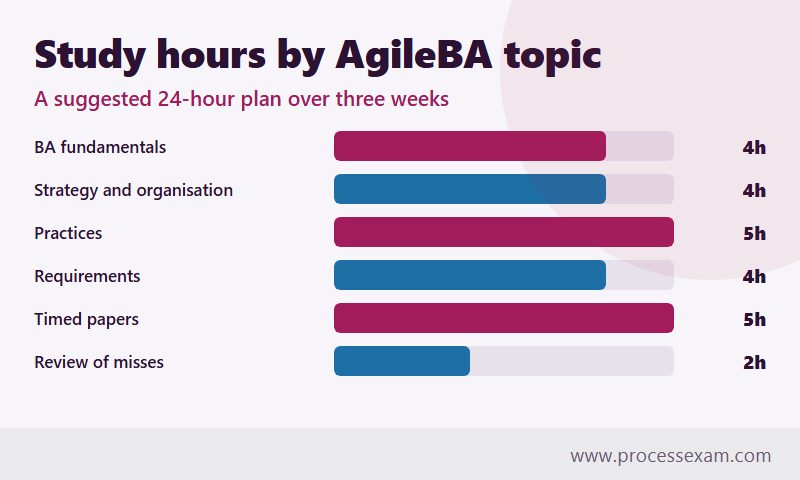
Run the timed papers in the final week, not the first. Before then, you do not yet have the vocabulary to make your errors useful. For full-length rehearsal beyond APMG's single sample paper, the AgileBA Foundation practice exam adds further papers in the same 50-question format, so no single paper has to be reused. Whichever bank you use, repeating questions until you remember the answers measures memory, not understanding. Rotate to new questions as soon as your scores stop moving.
A rule for the guidance itself
Read for the reason behind each practice, not the list of steps. The exam rewards candidates who can say why a timebox protects quality or why a Must is a Must. Keep a single page where you write each technique and the problem it solves. By the final week, that page is the only revision you need.
How do you manage 50 questions without a book?
The paper is closed book, so nothing can be looked up. Pacing matters more than most candidates expect, because 48 seconds a question leaves little room for rereading.
- First pass, about 25 minutes. Answer anything you are sure of at once. Mark the rest and move on.
- Second pass, about 12 minutes. Return to marked questions and eliminate options that fail on the question's own words.
- Last three minutes. Answer everything still empty, since a guess has a chance and a blank has none.
Watch absolute words. Options that say always or never are rarely right in a framework built on judgement. Watch for options that sound correct for a traditional business analyst, such as signing off a complete specification before development begins, because the agile answer almost always works in smaller steps with feedback in between.
Delivery is online or at a test centre, depending on the provider and country. APMG's page does not state which applies to you, so confirm it when you book, along with identification rules and system checks if the exam is taken at home.
Where does Foundation end, and what do Practitioner and AgilePM add?
Foundation tests whether you know and understand the approach. Practitioner tests whether you can apply it to a scenario. For version 2, APMG describes the Practitioner paper as a complex multiple-choice exam of 4 questions worth 20 marks each, 80 marks in total, with a pass mark of 40 marks (50%). It runs for two and a half hours and is open book, with the AgileBA Handbook as the only book allowed.
APMG says candidates who pass Practitioner are recognised as AgileBA Registered Practitioners, and stay registered for five years. To keep that status they must pass a re-registration exam 3 to 5 years after their previous certification. After the five years the certification stays valid but the Registered status is lost, and regaining it needs the full Practitioner exam again. A version 2 re-registration exam appears on APMG's page as a separate product, marked version 2 only.
APMG's page lists Agile Project Management (AgilePM) among related products, which is a natural companion for analysts who work in agile projects. APMG's pages do not state a prerequisite for AgileBA Foundation, so confirm any requirement for Practitioner with your provider before you book both.
Who gets a return on the fee, and who should wait?
A fee is justified by what changes after you pay it. These are the situations where Foundation tends to earn its cost:
- You are moving from waterfall analysis into sprints. The vocabulary and the habits of working in increments are the gap, and Foundation fills it quickly.
- Your employer already uses AgilePM or DSDM. The alignment is close, so the certificate maps to practices the team already follows.
- You want the ladder to Practitioner. Foundation is the first step, and the plan above keeps the effort in proportion.
It earns less where an analyst already works in agile teams and mainly wants a credential for a CV, or where an employer asks specifically for another body's certificate. A Foundation pass shows that you know the vocabulary and the reasoning. It does not show that you have run a prioritisation workshop, and an interviewer will test that separately. If the budget allows only one attempt, sit the exam when your timed papers are stable rather than when a course ends, because a fee spent early is the most common waste.
Finally, keep the version question in mind. If you are studying the Handbook today, you are preparing for version 2, which APMG says is due to be withdrawn on 31 March 2027, so check APMG's page before you book. The Foundation certificate itself does not expire, according to APMG.
Frequently Asked Questions
How much does the AgileBA Foundation exam cost?
The fee on record is USD $386 for the Foundation exam. APMG's own page prints no price: it says prices come from accredited training organisations, or from its public exam portal for exam-only bookings. Course prices vary by provider and often include the exam, so compare written quotes before you decide.
How many questions are on the AgileBA Foundation exam, and what is the pass mark?
The Foundation paper has 50 multiple-choice questions, is closed book and lasts 40 minutes. The pass mark is 25 out of 50, which is 50%. That works out at roughly 48 seconds per question, so pace yourself and answer every question instead of leaving gaps.
Should I study AgileBA version 2 or version 3?
This guide is written for version 2, which uses the AgileBA Handbook and is the version our syllabus and practice pages follow. APMG also lists a version 3 and gives 31 March 2027 as the date version 2 is due to be withdrawn, so check APMG's AgileBA page and confirm the version with your provider before you book.
Does the AgileBA Foundation certificate expire?
No. APMG says the Foundation certificate does not expire and has no defined validity period. The Practitioner level is different: its Registered Practitioner status lasts five years, and reinstating it after that requires sitting the full Practitioner exam again.
Can I take AgileBA Foundation without a course?
Yes. APMG says you can self-study by buying the guidance, the Handbook for version 2, and booking the exam directly. Many candidates still choose an accredited course for the structure. Ask any provider whether the exam is included in the course price so you can compare costs fairly.
- Business Analysts |
- APMG International Agile Business Analysis Foundation Test Questions |
- AgileBA Foundation Question Bank |
- AgileBA Foundation Body of Knowledge (BOK) |
- Agile Business Analysis Foundation Simulator |
- Agile Business Analysis Foundation Mock Exam |
- APMG International Agile Business Analysis Foundation Book |
- APMG International AgileBA Foundation BOK PDF |
- Agile Business Analysis Foundation Certification Cost |
- Agile Business Analysis Foundation Certification Requirements |
- APMG International Agile Business Analysis Foundation Sample Questions |
- AgileBA Foundation Exam Questions Download |
- AgileBA Foundation Test Questions |
- Agile Business Analysis Foundation PDF


